
Hard disk Market - Industry Structure Evaluation, Demand Drivers Analysis, Growth Analysis and Identification, Competitive Positioning Review & Market Size Forecast to 2032
Overview
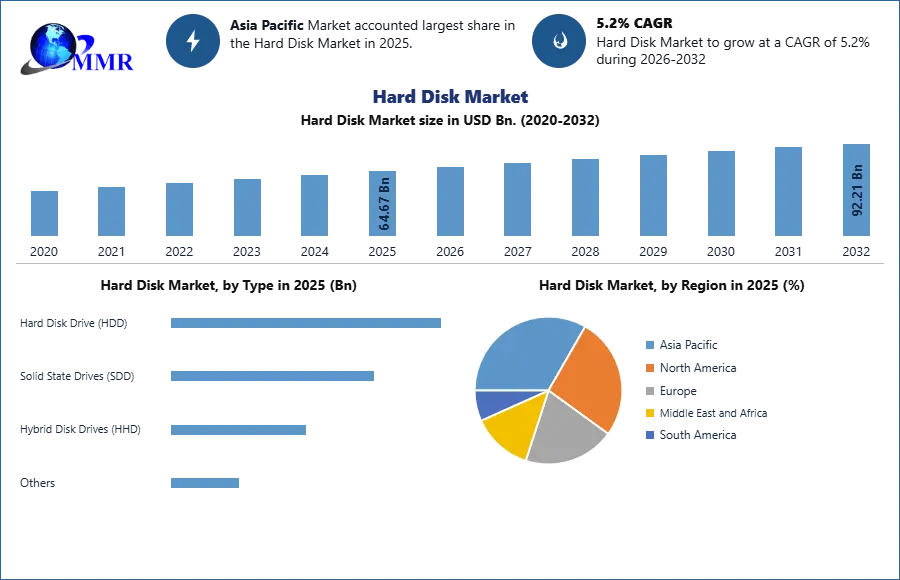
The Hard disk Market size was valued at USD 64.67 Billion in 2025 and the total Hard disk revenue is expected to grow at a CAGR of 5.2% from 2026 to 2032, reaching nearly USD 92.21 Billion.
Hard disk Market Overview:
Hard discs are non-volatile computer storage systems that consist of rotating magnetic discs or platters. It is a permanent data storage device that is utilized as a secondary storage device. Data may be accessible directly since the disc rotates at a faster pace. During the forecast period, the worldwide hard disc market is expected to develop significantly. Manufacturers of hard disc drives (HDDs) are aggressively investing in modern technologies in order to provide the most effective data storage facilities to businesses and individuals. Consider the usage of sophisticated aluminum substrates, which has grown in importance and popularity among HDD makers in recent years.
The report analyzes the Middle East conflict's impact on market leaders, followers, and disruptors. As geopolitical instability and supply chain disruptions vary across trade corridors, impacts differ by segment notably in aluminum substrate sourcing and helium-filled drive production. The report covers short-term and long-term effects, specifically regarding surging raw material costs and systemic capacity shortages, helping decision-makers prepare strategic regional outlines to navigate this evolving landscape.
To know about the Research Methodology :- Request Free Sample Report
Hard disk Market Dynamics:
The hard disk is an electromechanical data storage device that uses magnetic storage to store and retrieve digital data using one or more rigid rapidly rotating platters coated with magnetic material. Hard disk manufacturers are significantly investing in advanced technologies to offer the most efficient data storage facilities to enterprises as well as individuals. Presently, the hard disk market is focused on Seagate, Western Digital Corporation, and Toshiba are estimated to more than 37% of the market share in 2025. The global hard disk market is driven by the increasing need for data storage facilities among enterprises as well as the introduction of advanced and reliable SSDs.
However, the high cost of the hard disk is restraining the market growth at the global level. Widespread adoption of cloud computing and significant development and expansion of IoT in various applications are expected to create beneficial opportunities for the key player in the market during the forecast period.
Hard disk Market segment analysis:
The Global Hard disk Market is segmented into Type, and Application.
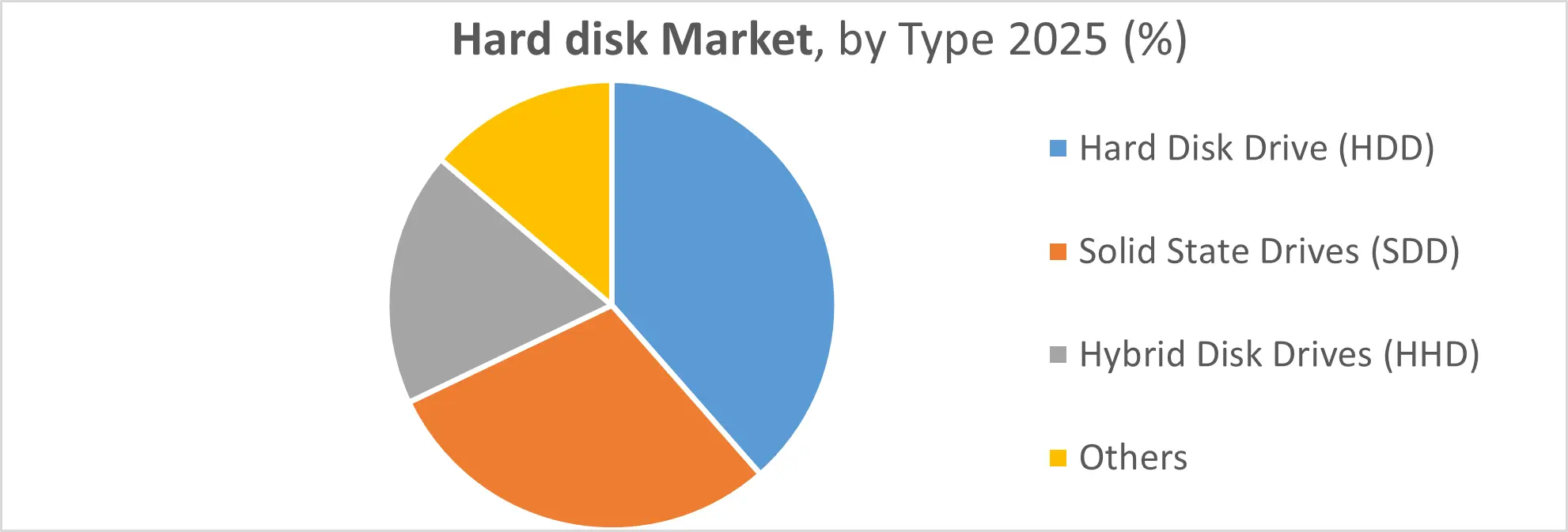
Based on type, the hard disk drive (HDD) segment has led the hard disk market in 2025. The higher demand for HDDs and its extensively used in personal computers and data centres due to HDDs are inexpensive as compared to SSDs, their demand is higher. e.g., Microsoft Corporation announced to terminate the service of the Windows 7 operating system by 2025.
Based on application, in 2032, the notebook category is expected to lead the global hard disc market, with a market value of $25.81 billion. Depending on the application, several sorts of storage configurations are used by notebooks with various use cases. The market is seeing an increase in demand for notebook PCs having both an HDD and an SSD.
Hard disk Market Regional Insight:
Asia Pacific held the dominant market share in 2025 and is expected to maintain a leading position in the market during the forecast period. China and Japan are major contributors to regional market growth. Among these, china accounted for the prominent market share in 2025 and is expected to reach US$ Mn by the end of 2032, with a CAGR of 7.0%. Owing to the presence of a large number of manufacturing firms and the availability of low-cost raw materials as well as inexpensive labor.
But, Japan is expected to grow during the forecast period thanks to the Japanese market is likely to offer lucrative opportunities for vendors operating in the hard disk market. Key players in the market are highly investing in research and development activities for the introduction of the advanced had disk is predicted to accelerate the growth of this region in the near future.
Recent Industry Developments (2025–2026)
| Exact Date | Company | Development | Impact |
|---|---|---|---|
| 17 February 2026 | Western Digital | The company confirmed that its total manufacturing capacity for 2026 is effectively sold out due to massive AI-driven data center demand. | Secures long-term revenue stability and signals a significant supply crunch for non-hyperscale customers. |
| 23 January 2026 | Seagate Technology | Seagate announced its nearline HDD capacity is fully allocated through the end of 2026 to support Amazon and Microsoft AI infrastructure. | Strengthens market leadership in high-capacity enterprise storage while pivoting growth toward drive density over unit volume. |
| 12 November 2025 | Toshiba | Toshiba successfully verified a 12-platter stacking technology for 3.5-inch drives, paving the way for 40 TB capacities. | Maintains technological parity with rivals by significantly increasing areal density without changing the standard form factor. |
| 14 August 2025 | Micron Technology | The company unveiled the 6600 ION PCIe Gen 5 high-capacity drive specifically designed to replace traditional hard disks in data centers. | Increases competitive pressure on the HDD market as flash-based alternatives begin to close the capacity gap. |
| 15 January 2025 | Seagate Technology | Seagate completed the USD 119 million acquisition of Intevac's imaging business to accelerate the commercialization of HAMR technology. | Accelerates the R&D roadmap for next-generation hard drives exceeding 30 TB capacity. |
The objective of the report is to present a comprehensive analysis of the global Hard disk market to the stakeholders in the industry. The past and current status of the industry with the forecasted market size and trends are presented in the report with the analysis of complicated data in simple language. The report covers all the aspects of the industry with a dedicated study of key players that include market leaders, followers, and new entrants.
PORTER, PESTEL analysis with the potential impact of micro-economic factors of the market have been presented in the report. External as well as internal factors that are supposed to affect the business positively or negatively have been analyzed, which will give a clear futuristic view of the industry to the decision-makers.
The report also helps in understanding the global market dynamics, structure by analyzing the market segments and projects the global market size. Clear representation of competitive analysis of key players by product, price, financial position, product portfolio, growth strategies, and regional presence in the global market make the report investor’s guide.
Global Hard disk Market Scope: Inquire before buying
| Hard Disk Market | |||
|---|---|---|---|
| Report Coverage | Details | ||
| Base Year: | 2025 | Forecast Period: | 2026-2032 |
| Historical Data: | 2020 to 2025 | Market Size in 2025: | 64.67 USD Bn. |
| Forecast Period 2026-2032 CAGR: | 5.2% | Market Size in 2032: | 92.21 USD Bn. |
| Segments Covered: | by Type | Hard Disk Drive (HDD) Solid State Drives (SDD) Hybrid Disk Drives (HHD) Others |
|
| by Storage Capacity | Less than 500 GB 500 GB-1TB Above 1TB |
||
| by End User | Personal Business/Commercial Government |
||
Global Hard disk Market, by Region:
North America (United States, Canada and Mexico)
Europe (UK, France, Germany, Italy, Spain, Sweden, Austria, Turkey, Russia and Rest of Europe)
Asia Pacific (China, India, Japan, South Korea, Australia, ASEAN and Rest of APAC)
Middle East and Africa (South Africa, GCC, Egypt, Nigeria and Rest of ME&A)
South America (Brazil, Argentina, Columbia and Rest of South America)
Key Players / Competitors Profiles Covered in Brief in Global Hard disk Market Report in Strategic Perspective:
- Western Digital Co.
- Seagate Technology
- Toshiba Co.
- Sony Co.
- Transcend Information
- Samsung Electronics
- ADATA Technology Co.
- Hewlett Packard Enterprise
- Apple Inc.
- Quantum Corp.
- SK Hynix Inc.
- Intel Corporation
- Mushkin Enhanced
- Micron Technology Inc.
- SanDisk
- Hitachi
- G-Technology
- Kingston Technology
- Dell Technologies Inc.
- ioSafe
- Buffalo Inc.
- Nidec Corporation
- Hoya Corporation
- Synology Inc.
- QNAP Systems Inc.
Frequently Asked Questions
1] What is the projected Hard Disk Market size and forecast growth?
Ans. The Hard Disk Market valuation was USD 64.67 Billion in 2025, projected to reach USD 92.21 Billion by 2032, exhibiting a 5.2% CAGR forecast period.
2] Which region leads the Hard Disk Market Share Analysis for 2026?
Ans. Asia Pacific dominates due to China’s manufacturing infrastructure and low-cost raw materials. Japan also offers lucrative opportunities through intensive R&D and advanced data storage innovations.
3] Which region is the primary global Hard Disk Manufacturing Hub?
Ans. Asia Pacific leads production, with China and Thailand serving as central hubs. This dominance is driven by established supply chains, inexpensive labor, and massive electronic-component-firm presence.
4] How is AI impacting the Hard Disk Market Trends 2026?
Ans. Massive AI-driven data center demand has effectively sold out manufacturing capacity for major players like Western Digital, signaling a significant supply crunch for non-hyperscale enterprise customers.
5] Are HDDs or SSDs better for Hard disk Market cost-effectiveness?
Ans. HDDs remain the cost-effective choice for bulk storage in personal computers and data centers, though Micron’s PCIe Gen 5 drives are increasing competitive market pressure.
6] How is technology increasing Hard disk Market capacity for enterprises?
Ans. Next-generation HAMR technology and 12-platter stacking are enabling capacities exceeding 40 TB, allowing manufacturers like Seagate and Toshiba to maintain density leadership over flash-based alternatives.