Global Gold Mining Market By Mining Method, By Ore Grade, By Production Scale, By End-Use Application, by Region and Forecast 2034

5.2%
CAGR (2026-2034)
406.2 USD Bn.
Forecast Market Size
305
Report Pages
142
Market Tables

Overview

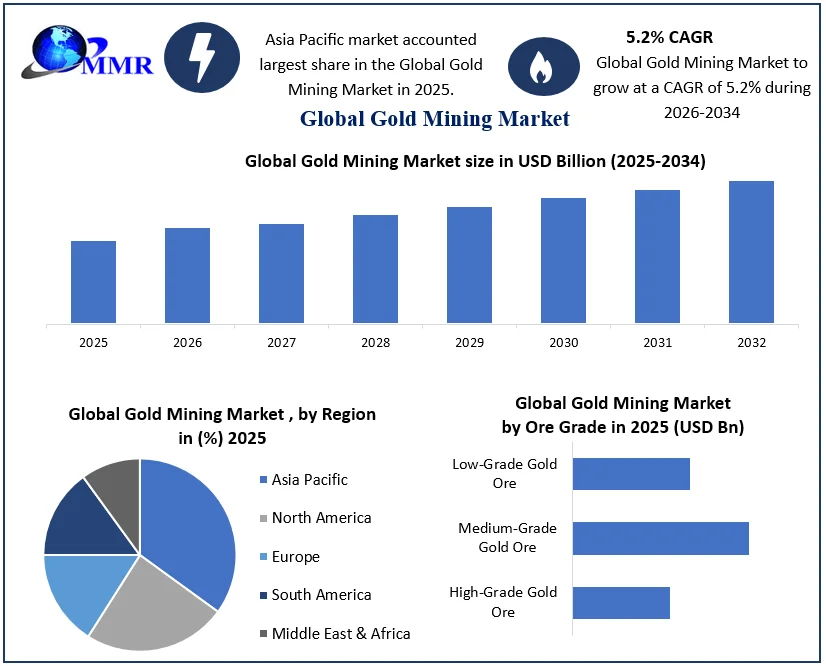
The Global Gold Mining Market was valued at USD 406.2 Billion in 2025 and is projected to reach USD 649.1 Billion by 2034, growing at a CAGR of 5.2% during the forecast period 2026–2034.

Parameter

Value

Market Size (2025)

USD 406.2 Billion

Market Size (2034)

USD 649.1 Billion

CAGR

5.2%

Historical Period

2020 to 2025

Forecast Period

2026 to 2034

Global Gold Mining Market Overview

The Global Gold Mining Market focuses on the exploration, extraction, processing, and production of gold from naturally occurring mineral deposits through surface mining, underground mining, and placer mining operations. Gold mining involves identifying economically viable gold reserves, developing mining infrastructure, extracting gold-bearing ores, and processing them through crushing, grinding, gravity separation, flotation, cyanidation, and other recovery techniques to obtain refined gold. The Gold Mining Market plays an important role in the global precious metals industry by supplying gold for jewellery manufacturing, investment products, central bank reserves, electronics, medical equipment, and other industrial applications. The global gold mining industry generated an estimated market value of approximately USD 406.2 billion in 2025, based on the working market-size estimate used in this report. Market valuation is influenced by mined gold production volumes, realized gold prices, ore grades, extraction costs, and the commercial value of recovered gold. Increasing demand for gold as a financial asset, growing investment in precious metals, and the strategic importance of gold reserves support the economic significance of the global gold mining industry.

The Global Gold Mining Market Growth is influenced by rising gold prices, geopolitical uncertainties, central bank gold purchases, expanding exploration activities, and investments in mine development and production capacity. Mining companies are increasingly adopting automated mining equipment, artificial intelligence-based geological analysis, remote monitoring systems, advanced mineral processing technologies, and sustainable extraction practices to improve operational efficiency and gold recovery rates. North America remains an important region in the gold mining industry, supported by established mining infrastructure, major gold-producing operations in the United States and Canada, and the presence of leading companies such as Newmont Corporation, Agnico Eagle Mines Limited, and Barrick Mining Corporation. Meanwhile, Asia-Pacific contributes significantly to global gold production, particularly through China's mining industry and Australia's established gold-producing operations. Companies such as Zijin Mining Group, Northern Star Resources, and Gold Fields Limited continue to strengthen their positions through mine expansions, exploration investments, operational improvements, and international mining activities. However, declining ore grades, rising extraction costs, environmental regulations, water consumption concerns, and difficulties in discovering economically viable reserves remain important challenges for gold mining companies..

The Maximize Market Research (MMR) Global Gold Mining Market Report provides a comprehensive analysis of market size, production trends, mining methods, applications, regional performance and competitive landscape. The report examines key growth drivers, challenges, emerging opportunities, technological advancements, gold production dynamics and investment trends. It also evaluates leading gold mining companies, their expansion strategies, mergers and acquisitions, exploration activities and operational developments. The Global Gold Mining Market Research Report helps investors, mining companies and industry stakeholders identify growth opportunities, assess market risks and make informed business decisions through 2034
Gold Mining Market Growth

To know about the Research Methodology :- Request Free Sample Report

Global Gold Mining Market Key Highlights

• Strong Market Growth: The Global Gold Mining Market was valued at USD 406.2 Billion in 2025 and is projected to reach USD 649.1 Billion by 2034, growing at a CAGR of 5.2% during 2026–2034.
• Rising Gold Prices and Investment Demand: Increasing gold prices, geopolitical uncertainties, central bank purchases, and growing demand for gold bullion and investment products support global gold mining industry expansion.
• Asia-Pacific Strengthens Gold Production: China and Australia remain major gold-producing countries, supported by established mining infrastructure, ongoing exploration activities, mine expansions, and investments in advanced extraction technologies.
• Advanced Mining Technologies Transform Production: Increasing adoption of AI-based geological exploration, automated drilling equipment, remote-controlled mining systems, and advanced mineral processing technologies creates opportunities to improve gold recovery and operational efficiency.

Global Gold Mining Market Dynamics

Drivers: Rising gold prices and increasing investment demand are driving the growth of the Global Gold Mining Market.

Increasing gold prices, geopolitical uncertainties and central bank reserve diversification are strengthening global demand for gold. The average annual gold price increased by approximately 44% to USD 3,431.5 per ounce in 2025, creating favourable revenue opportunities for mining companies. Additionally, central banks purchased approximately 863.3 tonnes of gold, encouraging companies such as Newmont Corporation, Agnico Eagle Mines and Barrick Mining Corporation to expand production and exploration activities.

Restraints: High operational costs and declining ore grades are restraining the expansion of the Global Gold Mining Market.

Gold mining companies face rising expenses related to labour, energy, equipment, transportation and mineral processing. Industry average all-in sustaining costs (AISC) increased by approximately 9% year-on-year to USD 1,605 per ounce in Q3 2025. Additionally, declining ore grades and limited production growth increase extraction costs, reduce profit margins and make new mining projects more capital-intensive.

Opportunities: Growing exploration investments and technological advancements are creating new opportunities in the Global Gold Mining Market.

Global gold exploration budgets increased by approximately 11% to USD 6.15 billion in 2025, supporting new discoveries and mine development. The adoption of artificial intelligence, automated drilling, remote-controlled equipment and advanced mineral processing is improving operational efficiency and gold recovery. Brownfield exploration, underground mining and low-grade ore processing also offer opportunities for future market expansion.

Challenges: Environmental regulations, resource depletion and exploration uncertainties are creating challenges for the Global Gold Mining Market.

Gold mining companies face challenges related to water consumption, tailings management, land rehabilitation, biodiversity protection and environmental compliance. Declining ore quality and difficulties in discovering new deposits can affect long-term production. Additionally, permitting delays, community opposition, geopolitical uncertainties and high project development costs create investment risks, requiring companies to balance production growth with sustainable mining practices.

Global Gold Mining Market Trends

Key Market Trends

Gold Mining Market Trends and Industry Insights

Adoption of AI and Digital Mining Technologies

Gold mining companies are
increasingly using artificial intelligence, geological modelling, predictive
analytics and real-time monitoring to improve exploration accuracy and
operational efficiency.

Increasing Automation in Mining Operations

Automated drilling, autonomous haulage vehicles and
remote-controlled equipment are improving worker safety, productivity and
cost efficiency across mining sites

Expansion of Underground Mining Activities

Companies are investing in advanced
underground mining infrastructure to access deeper gold deposits as easily
accessible surface reserves become increasingly limited.

Growing Focus on Sustainable Gold Mining

Mining operators are adopting water recycling,
renewable energy, efficient waste management and responsible tailings
practices to reduce environmental impact.

Rising Investment in Brownfield Exploration

Gold producers are prioritizing
exploration near existing mines to identify additional reserves, extend mine
life and utilize established infrastructure.

Global Gold Mining Market Segment Analysis

Global Gold Mining Market, by Mining Method

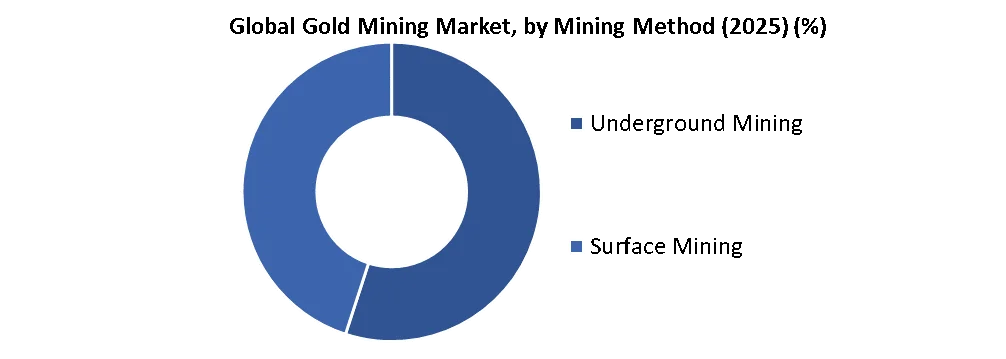
Underground mining involves extracting gold deposits located deep beneath the earth's surface using advanced drilling equipment, automated machinery and specialized mining technologies. Surface mining focuses on extracting near-surface gold deposits through open-pit operations, heavy equipment and efficient mineral processing systems. Increasing gold exploration, technological advancements and investments in mining infrastructure are supporting the development of both underground and surface mining operations in the Global Gold Mining Market.
Gold Mining Market by mining method (1)

Global Gold Mining Market, by Application

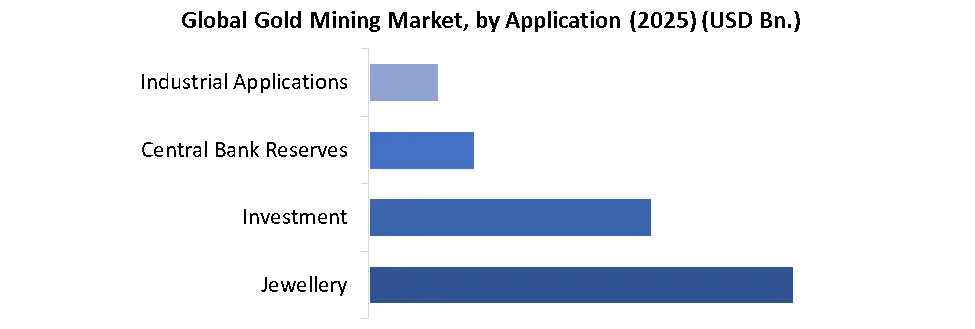
Jewellery and investment are major application segments of the Global Gold Mining Market, driven by increasing demand for gold ornaments, luxury accessories, physical bullion, coins and gold-backed financial assets. Jewllery consumption is supported by cultural preferences, wedding purchases and expanding luxury retail, while investment demand is influenced by inflation concerns, geopolitical uncertainties, currency fluctuations and portfolio diversification strategies. Gold mining companies supply raw gold to jewllery manufacturers, refiners, institutional investors and global bullion markets, supporting the growth of the international gold industry.
Gold Mining Market by application

Global Gold Mining Market Regional Insights

Asia-Pacific holds the leading position in the Global Gold Mining Market, accounting for the largest regional market share of 35%. The region's dominance is supported by substantial gold production, established mining operations, expanding exploration activities, and increasing investments in mineral extraction technologies. China, Australia, Indonesia, and India represent important regional markets, with China and Australia contributing significantly to gold production. The presence of major gold mining companies, extensive mineral reserves, and ongoing investments in underground and open-pit mining operations strengthens the region's position in the global gold mining industry.

North America's Gold Mining Market accounts for XX% of the global market share, supported by established mining infrastructure, advanced mineral exploration technologies, and significant gold reserves. The United States and Canada represent major regional contributors, with important gold-producing regions in Nevada, Alaska, Ontario, and Quebec. Increasing investments in exploration, mine development, automation, and sustainable extraction technologies support regional mining activities. The presence of established companies, including Newmont, Barrick Mining, and Agnico Eagle Mines, strengthens North America's position in global gold production.

Europe accounts for XX% of the Global Gold Mining Market, supported by established mining operations, advanced extraction technologies, and growing investments in mineral resource development. Countries such as Russia, Sweden, Finland, and Türkiye contribute to regional gold production through established mining projects and exploration activities. Increasing adoption of automated mining equipment, efficient ore processing technologies, and environmentally responsible extraction practices supports industry development. The region's focus on improving mining productivity, resource recovery, and operational efficiency strengthens its participation in the global gold mining industry.

South America's Gold Mining Market represents XX% of the global market share, driven by substantial mineral reserves, established gold-producing countries, and ongoing mining exploration activities. Brazil, Peru, Chile, Colombia, and Argentina represent important regional markets, supported by extensive gold deposits and established mining operations. The availability of mineral-rich geological formations, increasing foreign investments, and expansion of large-scale mining projects support regional production. Growing adoption of modern extraction technologies, mineral processing improvements, and exploration of previously underdeveloped gold deposits create further opportunities for the regional gold mining industry.

The Middle East & Africa Gold Mining Market accounts for XX% of the global market share, supported by significant untapped mineral resources, expanding exploration activities, and increasing investments in mining infrastructure. South Africa, Ghana, Mali, Burkina Faso, and Tanzania represent important gold-producing countries, with the African region contributing significantly to global gold production. In the Middle East, Saudi Arabia is expanding its mining sector through investments in mineral exploration and resource development. Increasing international mining investments, new project development, and improvements in mineral processing capabilities support the region's long-term gold mining opportunities.

Global Gold Mining Market Recent Developments

Published Date Recent Developments
November 2026 Barrick Mining Corporation reports strong third-quarter operational performance, with
increased gold production compared with the previous quarter, continued mine
expansion activities and progress across major gold mining projects,
strengthening its global gold production capabilities.
October 2026 ON Gold Resources Ltd. regains full ownership and operatorship of the October Gold Project in
Ontario, Canada, following Evolution Mining's withdrawal from the joint
venture, creating new opportunities for gold exploration and mineral resource
development
October 2026 Burkina Faso introduces new gold refining requirements, directing industrial
mining companies to deliver gold doré production to approved domestic
refineries, supporting local mineral processing and the development of the country's
gold value chain.
September 2026 Orogen Royalties Inc.
acquires the Toro de Oro and El Gigante gold projects in southwest Utah, USA,
expanding its gold exploration portfolio and strengthening opportunities for
future mineral resource development.
August 2026 Newmont Corporation and Barrick Mining Corporation reach an agreement to contribute additional properties to their
Nevada Gold Mines joint venture, resolving outstanding disputes and
supporting the development of a major gold mining complex in Nevada.

Global Gold Mining Market Competitive Landscape

The Global Gold Mining Market is highly competitive, with leading mining companies focusing on gold production expansion, mineral exploration, strategic acquisitions, joint ventures and advanced mining technologies to strengthen their market positions. Major players compete through access to high-grade gold reserves, operational efficiency, production capacity, cost optimization and sustainable mining practices. Companies are also investing in underground mining, open-pit extraction, automated mining equipment and advanced mineral processing technologies to improve gold recovery and reduce operating costs. Strategic mergers, acquisitions and partnerships are helping market participants expand their geographical presence, secure additional mineral resources and strengthen their global gold mining portfolios.

In Gold Mining Market Recent industry developments highlight increasing market consolidation and strategic expansion. In July 2026, Equinox Gold and Orla Mining completed their business combination, strengthening their North American gold mining presence. In April 2026, Agnico Eagle pursued strategic acquisitions to expand its gold exploration portfolio in Finland. Additionally, Newmont and Barrick agreed to expand their Nevada Gold Mines joint venture in August 2026. These developments demonstrate how mergers, acquisitions, joint ventures and exploration investments are shaping competition in the global gold mining industry.

Global Gold Mining Market Scope: Inquire before buying

Global Gold Mining Market
Report Coverage Details
Base Year: 2025 Forecast Period: 2026-2034
Historical Data: 2020 to 2025 Market Size in 2025: USD 406.2 Billion
Forecast Period 2026 to 2034 CAGR: 5.2% Market Size in 2034: USD 649.1 Billion
Segments Covered: By Mining Method Surface Mining (Open-Pit Mining)
Underground Mining
Placer Mining (Alluvial Mining)
Other Mining Methods
By Ore Grade High-Grade Gold Ore
Medium-Grade Gold Ore
Low-Grade Gold Ore
By Production Scale Large-Scale Industrial Mining
Mid-Tier Gold Mining
Small-Scale and Artisanal Gold Mining
By End-Use Application Jewellery and Ornament Manufacturing
Investment and Bullion
Central Bank Gold Reserves
Industrial and Technological Applications
Other Applications

Global Gold Mining Market by Region

North America (United States, Canada and Mexico)
Europe (UK, France, Germany, Italy, Spain, Sweden, Austria and Rest of Europe)
Asia Pacific (China, South Korea, Japan, India, Australia, Indonesia, Malaysia, Vietnam, Taiwan, Bangladesh, Pakistan and Rest of APAC)
Middle East and Africa (South Africa, GCC, Egypt, Nigeria and Rest of ME&A)
South America (Brazil, Argentina, Rest of South America)

Global Gold Mining Market Key players

1. Newmont Corporation
2. Agnico Eagle Mines Limited
3. Barrick Mining Corporation
4. Kinross Gold Corporation
5. B2Gold Corp.
6. Equinox Gold Corp.
7. IAMGOLD Corporation
8. Alamos Gold Inc.
9. Eldorado Gold Corporation
10. Orla Mining Ltd.
11. SSR Mining Inc.
12. Coeur Mining, Inc.
13. Lundin Gold Inc.
14. Dundee Precious Metals Inc.
15. Pan American Silver Corp.
16. Freeport-McMoRan Inc.
17. Polyus PJSC
18. Endeavour Mining plc
19. AngloGold Ashanti plc
20. Gold Fields Limited
21. Harmony Gold Mining Company Limited
22. Perseus Mining Limited
23. Resolute Mining Limited
24. West African Resources Limited
25. Zijin Mining Group Co., Ltd.
26. Shandong Gold Mining Co., Ltd.
27. Zhaojin Mining Industry Company Limited
28. Chifeng Jilong Gold Mining Co., Ltd.
29. China Gold International Resources Corp. Ltd.
30. Hunan Gold Corporation Limited
31. Lingbao Gold Group Company Ltd.
32. Northern Star Resources Limited
33. Evolution Mining Limited
34. Regis Resources Limited
35. Westgold Resources Limited
36. Ramelius Resources Limited
37. Capricorn Metals Ltd.
38. Vault Minerals Limited
39. Navoi Mining and Metallurgical Company
40. G Mining Ventures Corp.

Frequently Asked Questions:

1. What is the Global Gold Mining Market size and forecast?
The Global Gold Mining Market is driven by increasing gold production, investment demand, central bank purchases and expanding mineral exploration activities. The market forecast depends on gold prices, mining output, exploration investments and new mine development..

2. What are the major factors driving Global Gold Mining Market growth?
Rising gold prices, increasing demand for gold jewellery and investment products, geopolitical uncertainties, central bank gold purchases, mineral exploration and technological advancements in gold extraction are driving Global Gold Mining Market growth.

3. Which region leads the Global Gold Mining Market?
Asia Pacific holds a significant position in the Global Gold Mining Market, supported by gold production in China, Australia, Indonesia and other regional economies. North America also represents a major market due to established mining infrastructure in the United States and Canada.

4. What are the major types of mining methods used in the Global Gold Mining Market?
The Global Gold Mining Market primarily includes underground mining and surface mining. Underground mining extracts deep-seated gold deposits, while surface mining focuses on near-surface deposits through open-pit mining operations.

5. What are the major applications of gold in the Global Gold Mining Market?
Major gold applications include jewellery manufacturing, investment products, central bank reserves and industrial applications. Gold is widely used in ornaments, bullion, coins, financial assets, electronics and specialized industrial components.

Table of Contents

1. Executive Market Landscape and Industry Overview 1.1. Global Gold Mining Market Size (Value USD Billion and Production Volume in Million Ounces), 2025–2034 1.2. Historical Gold Production Trends and Market Revenue Performance Across Major Producing Countries 1.3. Major Gold Mining Companies, Operating Mines and Global Production Contribution 1.4. Role of Gold Mining in Global Jewellery, Investment and Central Bank Reserve Demand 1.5. Integration of Exploration, Mine Development, Extraction and Gold Processing Operations 1.6. CAGR Analysis of Global Gold Mining Market During 2025–2034 2. Global Gold Mining Market Dynamics 2.1. Global Gold Mining Market Trends 2.2. Global Gold Mining Market Dynamics 2.2.1. Drivers 2.2.2. Restraints 2.2.3. Opportunities 2.2.4. Challenges 2.3. PORTER’s Five Forces Analysis 2.4. PESTLE Analysis 3. Global Gold Mining Market Macroeconomic Factors 3.1. Global GDP Growth and Economic Conditions Influencing Gold Mining Investment 3.2. International Gold Price Fluctuations Affecting Mine Development and Production Economics 3.3. Inflation, Interest Rates and Currency Movements Influencing Gold Investment Demand 3.4. Central Bank Gold Purchasing Trends and International Reserve Diversification Patterns 3.5. Mining Capital Expenditure, Project Financing and Foreign Direct Investment Trends 3.6. Energy Prices, Labour Costs and Equipment Expenses Influencing Mining Profitability 3.7. Geopolitical Uncertainty, Trade Policies and Government Mining Investment Frameworks 4. Gold Mining Industry Trends & Emerging Operational Requirements 4.1. Increasing Gold Exploration Activities and Development of New Mineral Deposits 4.2. Expansion of Large-Scale Open-Pit and Underground Gold Mining Operations 4.3. Declining Gold Ore Grades and Increasing Demand for Advanced Processing Technologies 4.4. Adoption of Automation, Artificial Intelligence and Digital Mining Technologies 4.5. Increasing Focus on Sustainable Gold Extraction and Environmentally Responsible Mining 4.6. Rising Consolidation Through Mergers, Acquisitions and Strategic Mining Partnerships 5. Gold Mining Categories & Production Landscape 5.1. Surface Mining, Underground Mining and Placer Gold Extraction Operations 5.2. High-Grade, Medium-Grade and Low-Grade Gold Ore Production Landscape 5.3. Large-Scale Industrial, Mid-Tier and Small-Scale Artisanal Gold Mining Operations 5.4. Gold Exploration, Resource Development and Commercial Production Activities 5.5. Gold Ore Extraction, Processing, Refining and Bullion Production Landscape 5.6. Gold Mining Production Distribution Across Major Countries and Geographic Regions 6. Gold Exploration & Geological Resource Assessment 6.1. Gold Exploration Planning, Geological Mapping and Mineral Prospect Identification 6.2. Exploration Drilling, Core Sampling and Subsurface Geological Investigation 6.3. Geochemical Analysis, Geophysical Surveys and Gold Mineralization Characterization 6.4. Gold Resource Estimation, Geological Modelling and Deposit Evaluation 6.5. Remote Sensing, Drone Surveying and Geospatial Exploration Technologies 6.6. Gold Discovery Trends, Exploration Success Rates and Resource Development Assessment 7. Gold Reserves, Ore Grade & Mineral Resource Quality Assessment 7.1. Global Gold Reserves and Resources by Country and Geological Deposit Type 7.2. High-Grade Gold Ore Deposits and Production Economics Assessment 7.3. Medium-Grade Gold Ore Deposits and Processing Requirements Evaluation 7.4. Low-Grade Gold Ore Deposits and Large-Scale Extraction Viability Analysis 7.5. Average Gold Ore Grade Trends and Mineral Reserve Replacement Assessment 7.6. Impact of Ore Grade Decline on Gold Recovery Rates and Mining Costs 8. Mine Planning, Engineering & Feasibility Assessment 8.1. Gold Mine Design, Production Planning and Operational Scheduling 8.2. Geological Modelling, Reserve Estimation and Mine Optimization Assessment 8.3. Pre-Feasibility and Feasibility Studies for Gold Mining Project Development 8.4. Mine Infrastructure Engineering, Layout Design and Technical Assessments 8.5. Capital Expenditure Estimation, Operating Cost Modelling and Project Evaluation 8.6. Independent Technical Due Diligence and Gold Mining Investment Assessment 9. Gold Mine Development & Construction Landscape 9.1. Gold Mine Access Development, Excavation and Site Preparation Activities 9.2. Open-Pit Mine Development, Underground Access and Shaft Sinking Operations 9.3. Gold Mine Infrastructure Construction and Supporting Facility Development 9.4. Underground Tunnelling, Ground Support and Rock Reinforcement Requirements 9.5. Mine Ventilation, Dewatering and Underground Utility Installation 9.6. Mine Construction, Project Commissioning and Commercial Production Readiness 10. Gold Mining Method & Extraction Operations 10.1. Surface Gold Mining Operations and Open-Pit Extraction Processes 10.2. Underground Gold Mining Operations and Deep Deposit Extraction Techniques 10.3. Placer and Alluvial Gold Mining Operations and Mineral Recovery Processes 10.4. Heap Leaching and Alternative Gold Extraction Methods 10.5. Comparative Analysis of Mining Methods by Production Cost, Recovery Rate and Capital Intensity 10.6. Mining Method Selection Criteria Based on Ore Grade, Deposit Depth and Geological Conditions 11. Gold Mining Drilling, Blasting & Material Extraction Operations 11.1. Production Drilling and Controlled Blasting Operations in Surface Gold Mines 11.2. Underground Drilling, Long-Hole Drilling and Development Drilling Activities 11.3. Explosives Management, Blast Design and Rock Fragmentation Optimization 11.4. Controlled Blasting for Mine Wall Stability and Ground Vibration Management 11.5. Rock Breaking, Secondary Blasting and Oversized Ore Reduction Operations 11.6. Blast Performance Monitoring, Safety Compliance and Drilling Productivity Optimization 12. Gold Ore Handling, Haulage & Internal Mine Logistics 12.1. Gold Ore, Waste Rock and Overburden Transportation Operations 12.2. Mining Truck Utilization and Material Haulage Productivity Assessment 12.3. Conveyor Systems, Material Transfer and Bulk Handling Infrastructure 12.4. Ore Stockpile Management, Grade Blending and Internal Mine Logistics 12.5. Mine-to-Processing Plant Transportation and Material Flow Management 12.6. Haulage Productivity, Fuel Efficiency and Transportation Cost Optimization 13. Gold Extraction & Specialized Mining Operations 13.1. Underground Gold Mine Development, Tunnelling and Excavation Operations 13.2. Ground Control, Rock Bolting and Underground Strata Reinforcement 13.3. Underground Ventilation, Cooling and Mine Dewatering Systems 13.4. Underground Production Drilling, Loading and Ore Transportation Operations 13.5. Shaft Development, Mine Access Inspection and Underground Infrastructure Management 13.6. Specialized Extraction Techniques for Deep, Narrow-Vein and Geologically Complex Gold Deposits 14. Gold Ore Processing, Beneficiation & Recovery Technologies 14.1. Gold Ore Crushing, Grinding, Screening and Size Reduction Processes 14.2. Gravity Separation and Gold Concentration Technologies 14.3. Cyanide Leaching, Carbon-in-Leach (CIL) and Carbon-in-Pulp (CIP) Processing 14.4. Flotation, Heap Leaching and Alternative Gold Recovery Processes 14.5. Pressure Oxidation, Bio-Oxidation and Refractory Gold Ore Processing 14.6. Ore Sorting, Grade Control and Mineral Recovery Optimization Technologies 14.7. Metallurgical Testing, Gold Recovery Rates and Processing Plant Efficiency Assessment 15. Gold Mining Equipment, Machinery & Asset Lifecycle Assessment 15.1. Surface and Underground Gold Mining Equipment Utilization 15.2. Drilling Rigs, Excavators, Loaders and Mining Truck Deployment 15.3. Crushing, Grinding and Mineral Processing Equipment Requirements 15.4. Preventive, Corrective and Predictive Maintenance of Gold Mining Equipment 15.5. Spare Parts Management, Equipment Refurbishment and Machinery Replacement 15.6. Equipment Productivity, Reliability and Asset Lifecycle Management 16. Gold Mine Infrastructure, Utilities & Operational Support 16.1. Mine-Site Power Infrastructure Installation and Electrical Maintenance Requirements 16.2. Water Supply, Pumping, Dewatering and Distribution System Management 16.3. Mine Ventilation, Compressed Air and Industrial Utility Infrastructure 16.4. Fuel Storage, Distribution and Mine-Site Energy Management 16.5. Mine Access Roads, Workshops, Warehouses and Supporting Infrastructure 16.6. Mining Camp Management, Workforce Accommodation and Site Facilities 17. Environmental, Water Management & Sustainability Assessment 17.1. Environmental Impact Assessment and Regulatory Permitting Requirements for Gold Mines 17.2. Mine Water Treatment, Wastewater Management and Water Recycling Technologies 17.3. Dust Suppression, Air Quality Monitoring and Mining Emissions Management 17.4. Tailings Management, Waste Rock Disposal and Environmental Risk Assessment 17.5. Biodiversity Management, Land Restoration and Environmental Compliance 17.6. Greenhouse Gas Accounting, Sustainability Reporting and Mining Decarbonization Strategies 18. Gold Mine Closure, Rehabilitation & Land Restoration 18.1. Gold Mine Closure Planning and End-of-Life Operational Assessments 18.2. Land Rehabilitation, Revegetation and Disturbed Land Restoration Activities 18.3. Tailings Facility Closure, Waste Containment and Site Stabilization 18.4. Contaminated Soil Remediation and Post-Closure Mine Water Management 18.5. Mining Infrastructure Dismantling, Equipment Removal and Site Decommissioning 18.6. Closure Cost Estimation, Financial Assurance and Post-Closure Monitoring 19. Gold Mining Safety, Risk Management & Regulatory Compliance 19.1. Occupational Health and Safety Requirements Across Gold Mining Operations 19.2. Workplace Hazard Identification, Risk Assessment and Mine Safety Audits 19.3. Emergency Response Planning, Mine Rescue Services and Incident Investigation 19.4. Geotechnical Monitoring, Slope Stability and Underground Ground Movement Assessment 19.5. Mining Regulatory Compliance Audits, Operational Inspections and Technical Certifications 19.6. Safety Training, Workforce Competency Development and Mining Risk Management 20. Gold Mining Technology, Automation & Digital Transformation 20.1. Artificial Intelligence and Machine Learning Applications in Gold Exploration and Mining 20.2. Autonomous Mining Equipment Deployment and Remote Mining Operations 20.3. Digital Mine Planning, Fleet Management and Production Monitoring Systems 20.4. Remote Operating Centres, Equipment Diagnostics and Digital Mine Management 20.5. AI-Enabled Predictive Maintenance and Data Analytics in Gold Mining Operations 20.6. Blockchain-Based Gold Traceability and Digital Supply Chain Integration 20.7. Cybersecurity and Operational Technology Integration Across Mining Infrastructure 21. Gold Mining Workforce, Technical Training & Specialist Labor Requirements 21.1. Skilled Workforce Requirements Across Gold Exploration and Mining Operations 21.2. Recruitment of Mining Engineers, Geologists and Metallurgical Specialists 21.3. Mining Equipment Operator Training and Technical Competency Development 21.4. Workforce Mobilization, Shift Management and Remote Mine-Site Staffing 21.5. Specialist Engineering, Maintenance and Mineral Processing Workforce Requirements 21.6. Labour Productivity, Workforce Safety and Employee Retention Assessment 22. Gold Mining Pricing, Cost Economics & Profitability Assessment 22.1. Global Gold Mining Cost Trends Across Major Producing Countries 22.2. Cash Cost and All-In Sustaining Cost (AISC) Analysis by Mining Method 22.3. Capital Expenditure and Operating Expenditure Structure of Gold Mining Projects 22.4. Energy, Labour, Consumables, Explosives and Equipment Cost Structures 22.5. Royalty Payments, Government Taxation and Production-Linked Financial Obligations 22.6. Break-Even Gold Price, Profit Margins and Mine-Level Economic Assessment 22.7. Return on Investment, Project Payback Period and Mining Asset Valuation 23. Gold Mining Production, Project Execution & Operational Performance 23.1. Gold Mine Development Timelines, Site Preparation and Production Commissioning 23.2. Gold Production Capacity, Ore Throughput and Equipment Availability Assessment 23.3. Gold Recovery Rates, Production Targets and Operational Performance Measurement 23.4. Mine Productivity, Capacity Utilization and Production Efficiency Benchmarking 23.5. Coordination Between Exploration, Extraction and Mineral Processing Operations 23.6. Production Cost Control, Operational Risk Mitigation and Continuous Improvement 24. Gold Mining Demand by End-Use Application & Gold Consumption Category 24.1. Jewellery and Ornament Manufacturing Demand Across Major Gold-Consuming Countries 24.2. Investment and Bullion Demand Including Gold Bars, Coins and Gold-Backed ETFs 24.3. Central Bank Gold Reserve Purchasing Patterns and Reserve Diversification Requirements 24.4. Industrial Gold Applications Across Electronics, Dentistry and Aerospace Industries 24.5. Gold Demand from Emerging Industrial and Specialized Applications 24.6. Regional Gold Consumption Patterns and End-Use Demand Contribution 24.7. Gold Price Sensitivity and Demand Elasticity Across End-Use Applications 25. Gold Mining Market Demand by Operator Type & Project Development Stage 25.1. Large Diversified Gold Mining Companies and Enterprise-Level Production Operations 25.2. Mid-Tier Gold Mining Operators and Production Expansion Requirements 25.3. Junior Gold Mining Companies and Exploration-Stage Development Activities 25.4. Small-Scale and Artisanal Gold Miners and Informal Production Activities 25.5. Greenfield Gold Mining Projects and New Mine Development Requirements 25.6. Brownfield Expansion, Mine Modernization and Existing-Site Production Development 25.7. Joint Ventures, Mining Partnerships and Royalty-Based Gold Production Models 26. Global Gold Mining Regional & Country-Level Market Landscape 26.1. North American Gold Production, Mining Infrastructure and Investment Opportunities 26.2. European Gold Mining Operations, Resource Development and Regulatory Environment 26.3. Asia-Pacific Gold Mining Expansion Across Major Gold-Producing Economies 26.4. Latin American Gold Exploration, Production and Mining Investment Landscape 26.5. African Gold Mining Production, Exploration Opportunities and Operational Challenges 26.6. United States, Canada, China, Australia, Russia, Ghana, South Africa, Peru and Other Major Gold-Producing Countries 26.7. Regional Gold Reserves, Labour Costs, Mining Policies and Investment Frameworks 27. Global Gold Mining Market: Market Size and Forecast by Segmentation (Value USD Billion and Production Volume in Million Ounces) (2025–2034) 27.1. Global Gold Mining Market Size and Forecast, By Mining Method 27.1.1. Surface Mining 27.1.2. Underground Mining 27.1.3. Placer (Alluvial) Mining 27.1.4. Other Mining Methods 27.2. Global Gold Mining Market Size and Forecast, By Ore Grade 27.2.1. High-Grade Gold Ore 27.2.2. Medium-Grade Gold Ore 27.2.3. Low-Grade Gold Ore 27.3. Global Gold Mining Market Size and Forecast, By Production Scale 27.3.1. Large-Scale Industrial Mining 27.3.2. Mid-Tier Gold Mining 27.3.3. Small-Scale and Artisanal Mining 27.4. Global Gold Mining Market Size and Forecast, By End-Use Application 27.4.1. Jewellery and Ornaments 27.4.2. Investment and Bullion 27.4.3. Central Bank Reserves 27.4.4. Industrial and Technological Applications 27.4.5. Other Applications 27.5. Global Gold Mining Market Size and Forecast, By Region 27.5.1. North America 27.5.1.1. United States 27.5.1.2. Canada 27.5.1.3. Mexico 27.5.1.4. Rest of North America 27.5.2. Europe 27.5.2.1. Russia 27.5.2.2. Türkiye 27.5.2.3. Sweden 27.5.2.4. Finland 27.5.2.5. United Kingdom 27.5.2.6. Rest of Europe 27.5.3. Asia Pacific 27.5.3.1. China 27.5.3.2. Australia 27.5.3.3. India 27.5.3.4. Indonesia 27.5.3.5. Papua New Guinea 27.5.3.6. Japan 27.5.3.7. Rest of Asia Pacific 27.5.4. Middle East and Africa 27.5.4.1. Ghana 27.5.4.2. South Africa 27.5.4.3. Mali 27.5.4.4. Burkina Faso 27.5.4.5. Tanzania 27.5.4.6. Côte d'Ivoire 27.5.4.7. Saudi Arabia 27.5.4.8. Rest of Middle East and Africa 27.5.5. South America 27.5.5.1. Peru 27.5.5.2. Brazil 27.5.5.3. Chile 27.5.5.4. Argentina 27.5.5.5. Colombia 27.5.5.6. Guyana 27.5.5.7. Rest of South America 28. Competitive Landscape 28.1. MMR Competition Matrix 28.2. Competitive Positioning of Leading Gold Mining Companies [Revenue and Market Share (%)] 28.3. Key Players Benchmarking 28.3.1. Company Name 28.3.2. Headquarters 28.3.3. Gold Mining Asset Portfolio 28.3.4. Annual Gold Production Volume 28.3.5. Gold Reserves and Mineral Resources 28.3.6. Average Ore Grade and Gold Recovery Rate 28.3.7. Total Company Revenue (2025) 28.3.8. Gold Mining Revenue Contribution (2025) 28.3.9. Operating Mines and Project Pipeline 28.3.10. Geographic Presence 28.4. Market Structure 28.4.1. Market Leaders 28.4.2. Market Followers 28.4.3. Emerging Players 28.5. Gold Production Growth Rate / Y-o-Y (%) of Companies 28.6. Operating Profit Margin and AISC Benchmarking of Companies 28.7. Exploration and Development Investments of Companies 28.8. Revenue Vs Net Earnings – Financial Health Benchmarking (2025) 28.9. Gold Production Performance and Financial Analysis (2025) 28.10. Mergers and Acquisitions Details 28.11. Recent Key Developments 29. Gold Exploration, Mine Development & Project Portfolio Landscape 29.1. Leading Gold Exploration and Geological Assessment Companies 29.2. Major Gold Deposit Discovery and Mineral Resource Development Activities 29.3. Greenfield Gold Mining Project Development and Feasibility Assessment 29.4. Brownfield Mine Expansion and Existing Asset Development Strategies 29.5. Exploration Budgets, Reserve Replacement and Project Pipeline Benchmarking 29.6. Geographic Exploration Presence and Development-Stage Comparison 30. Gold Mining Operations, Processing & Technology Landscape 30.1. Surface and Underground Gold Mining Operational Capabilities of Leading Producers 30.2. Gold Extraction, Leaching and Mineral Recovery Technology Adoption 30.3. Gold Processing Plant Capacity, Throughput and Recovery Performance 30.4. Mining Equipment, Automation and Digital Operational Capabilities 30.5. Environmental Management, Tailings Handling and Sustainable Mining Practices 30.6. Mine Productivity, Operating Cost and Technical Performance Benchmarking 31. Gold Mining Company Strategies & Expansion Plans 31.1. Gold Production Capacity Expansion and Mine Development Strategies 31.2. Geographic Expansion Across Emerging and Established Gold-Producing Countries 31.3. Acquisition of Gold Mining Assets and Exploration-Stage Projects 31.4. Investment in Processing Facilities, Equipment and Mining Infrastructure 31.5. Strategic Partnerships, Joint Ventures and International Mining Collaborations 31.6. Portfolio Diversification, Asset Optimization and Mine Life Extension Strategies 32. Gold Mining Industry SWOT, Investments & Strategic Developments 32.1. Competitive Strengths and Operational Advantages of Established Gold Mining Companies 32.2. Production Constraints, Declining Ore Grades and Rising Operating Cost Challenges 32.3. Emerging Opportunities in Untapped Deposits and Advanced Gold Recovery Technologies 32.4. Competitive Threats from Regulatory Uncertainty, Environmental Liabilities and Geopolitical Risks 32.5. Major Acquisitions, Mining Partnerships and Gold Project Development Activities 32.6. Investments in Automation, Sustainability, Exploration and Production Capacity Expansion 33. Gold Mining Competitive Outlook & Market Positioning 33.1. Competitive Dynamics Across Major Gold-Producing Companies and Geographic Markets 33.2. Market Concentration, Production Fragmentation and Ownership Structure Assessment 33.3. Growth of Integrated Gold Mining Companies and Diversified Asset Portfolios 33.4. Technology-Enabled Production Differentiation and Cost Optimization Strategies 33.5. Emerging Competitive Opportunities Across Exploration and Mine Development Activities 33.6. Future Positioning of Leading Global Gold Mining Companies 34. Company Profile: 50+ Key Players 34.1. Detailed Profile Considering the Parameters 34.1.1. Company Overview 34.1.2. Business Portfolio 34.1.3. Financial Overview 34.1.4. Gold Production and Operational Performance 34.1.5. Gold Reserves and Mineral Resources 34.1.6. SWOT Analysis 34.1.7. Strategic Analysis 34.1.8. Recent Developments 34.2. Regional Key Players 34.2.1. North America 34.2.2. Europe 34.2.3. Asia Pacific 34.2.4. Middle East and Africa 34.2.5. South America 35. Key Findings 36. Strategic Moves & Industry Outlook 37. Research Methodology

Custom Market Research Services

We Will Customise The Research For You, In Case The Report Listed Above Does Not Meet With Your Requirements