Underground Mining Vehicles Market by Product Type, Propulsion and Region - Global Market Size Estimation, Industry-Wide Analysis, Competitive Landscape Assessment & Long-Term Forecast to 2034

6.01%
CAGR (2026-2034)
7288.76 USD Mn.
Forecast Market Size
323
Report Pages
130
Market Tables

Overview

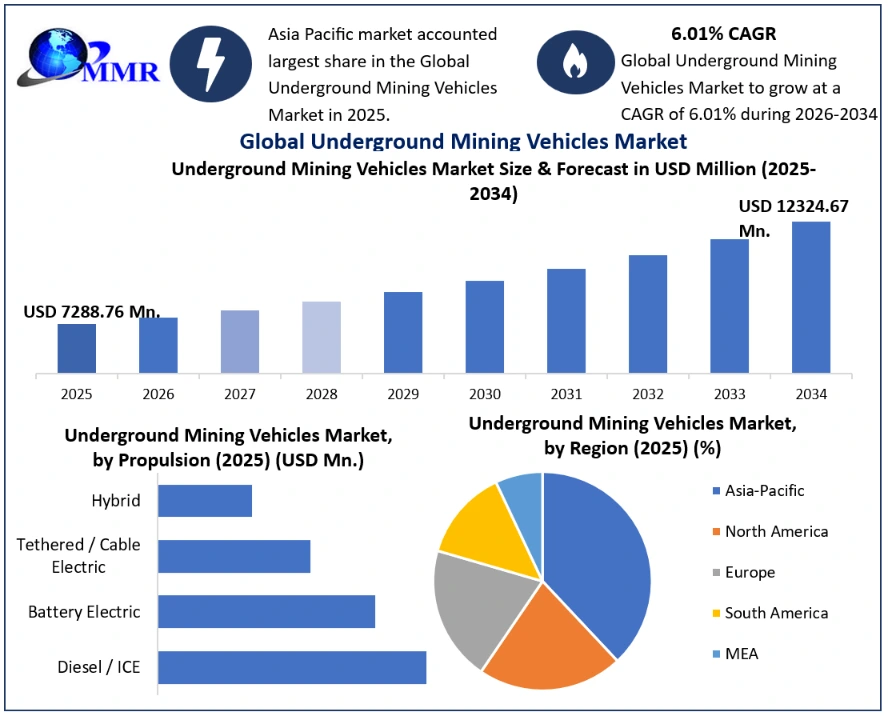
The Underground Mining Vehicles Market size was valued at USD 7288.76 Million in 2025 and the total Underground Mining Vehicles revenue is expected to grow at a CAGR of 6.01% from 2026 to 2034, reaching nearly USD 12324.67 Million by 2034.

Underground Mining Vehicles are essential machinery used in underground mining operation to facilitate tasks such as transportation of personnel and materials, maintenance, and support activities in confined mining environment. These vehicles, which include loaders, trucks, and service vehicles, are specially designed to operate in challenging conditions of underground mines, often featuring robust construction and safety features to handle harsh environment. Global demand for minerals and metals especially those critical to renewable energy technologies has led to expanded mining activities. This in turn drives need for advanced Underground Mining Vehicles Market to support these operations efficiently. Innovations in mining technology such as automation and electrification are enhancing capabilities of Underground Mining Vehicles Market.

For instance, advancements like battery electric vehicles and hydrogen fuel cell technology are becoming increasingly prominent. Caterpillars introduction of its first battery electric underground truck and GM and Komatsus collaboration on hydrogen fuel cell powered mining trucks are prime examples of this trend. There is growing emphasis on reducing carbon footprint of mining operations. The development and deployment of battery electric and hydrogen powered Underground Mining Vehicles is part of industry shift towards more sustainable practices. The recent milestone achieved by Epiroc, and ABB with deployment of first fully battery electric trolley truck system highlights this trend.

Modern Underground Mining Vehicles Market are designed with enhanced safety features and improved operational efficiency. For example, integration of automation systems such as Sandviks AutoMine Fleet enhances productivity and reduces operational costs by optimizing management of mining equipment. Sandvik has secured significant orders from major mining companies like Hindustan Zinc and Almina Minas do Alentejo S.A., emphasizing their commitment to providing advanced mining equipment and aftermarket services. Caterpillar has showcased its first battery-electric underground truck, complementing its existing electric loader and furthering its goal of creating a complete electric underground haul solution. Epirocs acquisition of AARD Mining Equipment and its collaborative efforts with Boliden and ABB on battery-electric trolley truck systems reflect strategic moves to enhance Underground Mining Vehicles Market presence and technological capabilities. The Underground Mining Vehicles Market is evolving with a clear trend towards sustainability, technological innovation, and increased efficiency, positioning itself for robust growth in forecast period.

Underground Mining Vehicles Market Growth Outlook
Underground Mining Vehicles Market Growth

To know about the Research Methodology :- Request Free Sample Report

Underground Mining Vehicles Market Dynamics:

Adoption of an all-electric fleet in underground mines is one of the key opportunities for manufacturers.
In the current Underground Mining Vehicles Market scenario, an all-electric fleet in underground mines is still challenging but that will soon become a reality as the industry understands the benefit of electric technology. Normet is highly cognizant of the significant infrastructural investment required by the transition to electric equipment. The company conducts studies to estimate the potential costs and requirements of key infrastructure such as charging station locations, and ensures that electric vehicles can operate according to the available supply and mine profile.

The company has been highly active in the Underground Mining Vehicles Market in recent years, and is launching a new line of electric equipment Normet SmartDrive. The usage of electric equipment has significant safety benefits for workers, as it reduces carbon dioxide emissions in mines, which is mainly important in underground operations that have limited ventilation. There is a remarkable shift towards electrification in the mining industry. The metals and mining sector contributes 4% to 7% of worldwide greenhouse gas emissions. OEMs are innovating and bringing new machines to the Underground Mining Vehicles Market to meet the unique needs of the modern mining world.
Technological advancements in the productivity and sustainability are expected to offer key opportunity for business growth.

The mining industry is investing in automation, digitalization and electrification technologies. Mining companies are expected to focus on the process of converting their existing fleet into an electrification fleet. If the Underground Mining Vehicles Market intends to become more innovative, it must be able to evaluate technology on a different scale for establishment of a standard supply chain. It became true as the mining industry’s significant critical minerals exploration begins to develop into new projects, with a healthy number of greenfield projects in development. And, in the long-term, changing requirements will impact OEM makers. In the future, some currently open pit mines will transition to underground, providing an opportunity for OEMs to fulfill their needs.

Mining companies are thus embracing technological advancements in their quest for productivity and sustainability. Underground Mining Vehicle manufacturers are keeping pace by developing equipment utilizing alternative energy sources, automation systems and digitalization technologies. Lowering the carbon footprint of a mine is as much a priority as improving the safety metrics, and OEMs are offering a variety of ways to reduce emissions. One effective option is to increase the efficiency. Advanced technologies are central for greener mining industry, and electrification is at the core of that push. For Epiroc, electrification, digitalization and automation are key to increasing sustainability, productivity and safety. Currently Brazil has open-pit mining, which accounts for about 90 to 95% of the country mines. There is potential for Underground Mining Vehicles Market to grow in the future. In Brazil some of open pit mines will be transitioning to underground. Underground Mining Vehicles Market manufacturers are optimistic about their future growth. One of the main advantages of underground mining is the widespread perception that it is a more sustainable way of mining, as it has less impact on the environment.

Underground Mining Vehicles Market Segment Analysis:

Based on Propulsion, The Underground Mining Vehicles Market was predominantly diesel-operated, with a substantial 79.17% market share in 2025, compared to 20.83% for electrically operated vehicles. Diesel-powered vehicles are favored for their robust performance and higher torque making them suitable for demanding underground mining conditions where durability and power are crucial. They offer extensive range and refueling convenience which is essential in large mining operations with limited infrastructure. The shift towards electric vehicles is gaining momentum due to increasing environmental regulations and the need for reduced emissions. Electric vehicles though currently smaller segment are emerging as sustainable alternative with advancements in battery technology and charging infrastructure. They offer benefits such as lower operational costs and minimal environmental impact aligning with the industry move towards greener practices. The adoption of electric vehicles is expected to grow as technological advancements make them more viable for underground applications.

Underground Mining Vehicles Market Regional Insights:

In the Underground Mining Vehicles Market Asia Pacific leads with the largest share of 34.45% in 2025, driven by its extensive mining activities and rapid industrialization. This regions dominance is attributed to major mining operations in countries like China and Australia, which are investing heavily in advanced mining equipment to enhance productivity and safety. For instance, Chinas significant coal mining industry and Australia vast mineral resources drive demand for high-performance underground vehicles.

North America holds notable 27.31% market share, with the US and Canada contributing substantially to the Underground Mining Vehicles Market. The growth in North America is propelled by technological advancements and strong focus on mining safety and efficiency. The U.S. mining sectors emphasis on upgrading its fleet with modern efficient underground vehicles exemplifies this trend. Notable investments in equipment innovation and sustainability such as adoption of electric utility vehicles, are shaping Underground Mining Vehicles Market dynamics in this region.

Europe with 22.01% market share is experiencing steady growth driven by stringent environmental regulations and shift towards more sustainable mining practices. European countries like Sweden and Finland are leading in the adoption of cleaner technologies and electric utility vehicles. For example, Volvo CEs commitment to developing electric mining equipment highlights Europes focus on reducing emissions and improving operational efficiency.

Underground Mining Vehicles Market Competitive Landscape

Recent advancements in Underground Mining Vehicles significantly boost Underground Mining Vehicles Market growth. Sandviks SEK 345 million order for advanced mining equipment from Hindustan Zinc enhances productivity and safety, driving demand for sophisticated solutions. Caterpillar introduction of its first battery electric underground truck, developed with Newmont, advances sustainability and automation in mining, setting new industry standards. GM and Komatsus hydrogen fuel cell powered mining truck promises zero emission operations, offering cleaner alternative to diesel engines. MacLean Engineerings new battery electric vehicles reduce energy costs and improve safety. Collectively, these innovations address critical industry needs and foster rapid Underground Mining Vehicles Market growth.

The global Underground Mining Vehicles Market is characterized by competition among established mining equipment manufacturers offering underground loaders, haul trucks, utility vehicles, and specialized transportation equipment. Key competitive factors include equipment reliability, payload capacity, operational safety, automation, electrification, maintenance support, and total cost of ownership. Manufacturers are focusing on technological innovation, battery-electric equipment, autonomous operations, and integrated fleet management solutions to improve productivity and reduce underground emissions.

The competitive landscape is shaped by global OEMs with broad underground mining equipment portfolios and specialized manufacturers focused on utility vehicles, personnel carriers, and mine-support applications. Sandvik AB, Epiroc AB, Caterpillar Inc., and Komatsu Ltd. compete through equipment performance, automation, electrification, and aftermarket services, while Normet Group, MacLean Engineering, Getman Corporation, Aramine, and Kovatera Inc. strengthen competition in specialized underground vehicles and application-specific equipment.
The growing demand for battery-electric vehicles and automated fleet operations is increasing competition in advanced underground mobility solutions. Manufacturers are investing in low-emission equipment, remote operation, digital fleet monitoring, and productivity-enhancing technologies. In addition, equipment durability, operator safety, service availability, spare-parts supply, and lifecycle costs remain important factors in purchasing decisions.
Key companies operating in the Underground Mining Vehicles Market include Sandvik AB, Epiroc AB, Caterpillar Inc., Komatsu Ltd., Normet Group Oy, MacLean Engineering, Getman Corporation, Aramine, Hermann Paus Maschinenfabrik, Fermel, BEML Limited, Eimco Elecon, J.H. Fletcher & Co., Kovatera Inc., SMT Scharf GmbH, and XCMG Group.

Underground Mining Vehicles Market Recent Developments:

Date Company Development Impact
07 January 2026 Caterpillar Inc. Caterpillar unveiled its next-generation autonomous underground mining haul truck technology platform alongside integrated Cat MineStar site optimization systems at CES 2026. The system enables Level 4 autonomous navigation in harsh underground environments to improve site safety and continuous haulage productivity.
15 January 2026 Sandvik AB Sandvik secured a major SEK 420 million equipment order from The Redpath Group to supply underground trucks, loaders, and drill rigs for Evolution Mining's Cowal operations. The contract accelerates deployment of tele-remote equipment and digital fleet management solutions across deep underground gold mining sites.
18 August 2026 Komatsu Ltd. Komatsu commercialized the HM460-6 articulated dump truck featuring a 42-tonne maximum payload capacity and low-emissions engine platform. The vehicle delivers a 5% increase in payload capacity while lowering haul-cycle fuel consumption and operating costs in demanding mining terrains.
01 September 2026 Epiroc AB Epiroc secured a $64 million equipment supply contract from MMG to deliver face drilling rigs, loaders, and mine trucks for the Khoemacau copper mine expansion in Botswana. The fleet expansion enhances high-efficiency underground extraction capabilities while improving operational safety in large-scale copper mining.
30 September 2026 Normet Group Normet completed the integration of its fully electric hammering unit portfolio into its Smart365 global underground equipment platform. The initiative expands zero-emissions utility and rock-breaking machine options to help underground mining operations satisfy zero-carbon targets.

Underground Mining Vehicles Market Scope: Inquire before buying

Underground Mining Vehicles Market
Report Coverage Details
Base Year: 2025 Forecast Period: 2026-2034
Historical Data: 2020 to 2025 Market Size in 2025: USD 7288.76 Million.
Forecast Period 2026 to 2034 CAGR: 6.01% Market Size in 2034: USD 12324.67 Million..
Segments Covered: by Product Type Product Types
Concrete Transportation
  Agitator
  Transmixer
  Others
Lifting and Installations
Scissor Lifts
  Multi-Lift
  Boom Lift
Underground Logistics
Crane Machine
  Fuel Lube Truck
  Flat Deck
  Others
Mechanical Scaling Bolting
Bolter
  Scalers
  Shotcrete Machines
  Others
Explosive Charging
Utility Vehicles and Multipurpose Vehicles
Grader
  Bottom Truck
  Cassette Truck
  Others
by Propulsion Diesel Operated
Electrically Operated
by Automation Level Operator-Driven
Remote-Controlled
Semi-Autonomous
Fully Autonomous
by Application Coal Mining
Metal Mining
Precious Metals
  Base Metals
  Ferrous Metals
Non-Metallic Mineral Mining
by Mining Method Room & Pillar Mining
Cut & Fill Mining
Sublevel Stoping
Block Caving
Sublevel Caving
Longwall Mining
Others
by End User Mining Companies / Mine Operators
Contract Mining Companies
Equipment Rental & Leasing Companies

Underground Mining Vehicles Market, by Region

North America (United States, Canada and Mexico)
Europe (UK, France, Germany, Italy, Spain, Sweden, Austria and Rest of Europe)
Asia Pacific (China, South Korea, Japan, India, Australia, Indonesia, Malaysia, Vietnam, Taiwan, Bangladesh, Pakistan and Rest of APAC)
Middle East and Africa (South Africa, GCC, Egypt, Nigeria and Rest of ME&A)
South America (Brazil, Argentina Rest of South America)

Underground Mining Vehicles Market Key Players:

North America:
1. Caterpillar Inc.
2. Getman Corporation
3. MacLean Engineering
4. Kovatera Inc.
5. DUX Machinery Corporation
6. J.H. Fletcher & Co.
7. Damascus Corporation
8. Marcotte Underground Mining Vehicles Services Inc.
9. Total Equipment Services Inc. (TES Inc.)
10. Timberland Equipment Limited
11. Miller Technology Incorporated
12. Johnson Industries
Others

Europe:
13. Sandvik AB
14. Epiroc AB
15. Normet Group
16. Aramine
17. Hermann Paus Maschinenfabrik GmbH
18. KGHM ZANAM S.A.
19. SMT Scharf GmbH
20. Mine Master Ltd.
16. Titan Makina
17. Dieci S.r.l.
Others

Asia Pacific:
23. Komatsu Ltd.
24. SANY Group
25. XCMG Group
26. Qingdao Fambition Heavy Machinery Co., Ltd.
27. Beijing Anchises Technology Co., Ltd.
28. Beijing Anbang Boda Technology Co., Ltd.
29. Fucheng Underground Mining Equipment
30. Nanchang Kamach Mining Co., Ltd.
31. EIMCO ELECON (India) Limited
32. BEML Limited
33. Jacon Equipment
34. Elphinstone Pty Ltd.
Others

Rest of World:
35. Fermel (Pty) Ltd.
36. AARD Mining Equipment
37. Bell Equipment
38. Bird Machines
39. Resemin S.A.
40. Tumi Raise Boring
Others

Frequently Asked Questions:
1. What are the growth drivers for the Underground Mining Vehicles Market?
Ans. Adoption of an all-electric fleet in underground mines is one of the key drivers for manufacturers driving the Underground Mining Vehicles Market.

2. What is the major Opportunity for the Underground Mining Vehicles Market growth?
Ans. Technological advancements in productivity and sustainability are expected to offer key opportunities for business growth in the Underground Mining Vehicles market.

3. Which country is expected to lead the global Underground Mining Vehicles Market during the forecast period?
Ans. Asia Pacific is expected to lead the Underground Mining Vehicles Market during the forecast period.

4. What is the projected market size and growth rate of the Underground Mining Vehicles Market?
Ans. The Underground Mining Vehicles Market size was valued at USD 7288.76 Million in 2025 and the total Underground Mining Vehicles revenue is expected to grow at a CAGR of 6.01% from 2026 to 2034, reaching nearly USD 12324.67 Million by 2034.

5. What segments are covered in the Underground Mining Vehicles Market report?
Ans. The segments covered in the Underground Mining Vehicles Market report are by Product Types, Propulsion, and Region.

Table of Contents

1. SECTION A – GLOBAL UNDERGROUND MINING VEHICLE MARKET INTRODUCTION 1.1. Executive Market Landscape and Industry Overview 1.1.1. Underground Mining Vehicle Market size (Value USD Mn. and Volume 000'Units) estimation and growth outlook (2025–2034) 1.1.2. Market Definition, Scope & Product Classification Framework 1.1.3. Global Underground Mining Vehicle Value Chain & Industry Ecosystem Assessment 1.1.4. Market Attractiveness Analysis by Region & End-Use Industry 1.2. Underground Mining Vehicle Market Dynamics 1.2.1. Underground Mining Vehicle Market Trends 1.2.2. Underground Mining Vehicle Market Dynamics 1.2.3. Drivers 1.2.4. Restraints 1.2.5. Opportunities 1.2.6. Challenges 1.2.7. PORTER’s Five Forces Analysis 1.2.7.1. Supplier Power 1.2.7.2. Buyer Power 1.2.7.3. Threat of Substitutes 1.2.7.4. Threat of New Entrants 1.2.7.5. Competitive Rivalry 1.2.8. PESTLE Analysis 1.3. Global Underground Mining Vehicle Installed Base Analysis 1.3.1. Installed Base by Vehicle Type and Equipment Category 1.3.2. Region-wise Underground Mining Vehicle Installed Fleet Distribution 1.3.3. OEM-wise Installed Base and Fleet Share Analysis 1.3.4. Fleet Age Profile and Average Vehicle Operating Life 1.3.5. Active vs. Idle Fleet and Vehicle Utilization Rate Analysis 1.3.6. Diesel, Battery-Electric, Hybrid and Tethered-Electric Fleet Penetration 1.3.7. Conventional, Remote-Controlled and Autonomous Installed Fleet Analysis 1.3.8. Fleet Replacement Cycle, Retirement and 2026–2034 Replacement Opportunity 1.4. Regulatory Framework and Compliance Requirements Overview 1.4.1. Region-wise Underground Mining Vehicle Regulations 1.4.2. Underground Mining Vehicle Safety Standards & Certification Requirements 1.4.3. Diesel Engine Emission & Underground Air Quality Regulations 1.4.4. Battery-Electric Vehicle Safety & Electrical Compliance Requirements 1.4.5. Battery Fire, Thermal Runaway & Explosion Protection Standards 1.4.6. Battery Charging & Underground Charging Infrastructure Compliance 1.4.7. Vehicle Inspection, Maintenance & Periodic Certification Requirements 1.5. LHD and Underground Haul Truck Fleet Analysis 1.5.1. LHD vs. Underground Haul Truck Installed Base 1.5.2. Region-wise LHD and Haul Truck Fleet Distribution 1.5.3. OEM-wise Installed Fleet and Competitive Positioning 1.5.4. Fleet Distribution by Payload and Capacity Class 1.5.5. Diesel vs. Battery-Electric Fleet Penetration 1.5.6. Fleet Age and Average Operating Life 1.5.7. Utilization, Availability and Productivity Benchmarking 1.5.8. Fleet Replacement and Expansion Requirements through 2034 1.6. Pricing Analysis and Cost Structure Evaluation (2025) 1.6.1. Vehicle Type-wise Average Selling Price (ASP) Benchmarking 1.6.2. LHD, Underground Haul Truck & Utility Vehicle Pricing Analysis 1.6.3. Diesel vs. Battery-Electric vs. Hybrid Vehicle Price Comparison 1.6.4. Vehicle Payload, Capacity & Specification-wise Pricing Benchmarking 1.6.5. Charging & Battery-Swapping Infrastructure Cost Assessment 1.6.6. OEM Manufacturing, Component & Assembly Cost Breakdown 1.6.7. Maintenance, Spare Parts & Rebuild Cost Benchmarking 1.6.8. Energy Cost – Diesel vs. Electricity Comparison 1.7. Fleet Age & Underground Vehicle Replacement Cycle Analysis 1.7.1. Underground Vehicle Fleet Age Distribution 1.7.2. Average Fleet Age by Vehicle Type 1.7.3. Region-wise Fleet Age Profile 1.7.4. OEM-wise Fleet Age and Installed Base Assessment 1.7.5. Average Operating Life by Vehicle Category 1.8. Battery-Electric Underground Mining Vehicle Adoption Analysis 1.8.1. Battery-Electric Vehicle Installed Fleet and Penetration Rate 1.8.2. Region-wise BEV Adoption across Global 1.8.3. BEV Adoption by Vehicle Type – LHDs, Haul Trucks and Utility Vehicles 1.8.4. OEM-wise Battery-Electric Vehicle Deployment 1.8.5. Battery Chemistry, Capacity and Vehicle Range Benchmarking 1.8.6. Diesel-to-Battery-Electric Fleet Conversion Trends 1.8.7. Operating Cost, Ventilation and Emission Reduction Benefits 1.9. Autonomous & Remote-Controlled Underground Vehicle Adoption 1.9.1. Autonomous and Remote-Controlled Vehicle Installed Base 1.9.2. Region-wise Automation Adoption and Deployment 1.9.3. Adoption by LHDs, Haul Trucks, Drilling and Support Vehicles 1.9.4. Remote-Controlled vs. Semi-Autonomous vs. Fully Autonomous Penetration 1.9.5. OEM-wise Autonomous Technology Deployment 1.9.6. Productivity, Safety and Utilization Impact Assessment 1.9.7. Mine Connectivity and Digital Infrastructure Requirements 1.10. Import–Export Trade Flow Analysis (2025) 1.10.1. Global Underground Mining Vehicle Import–Export Overview 1.10.2. Region-wise Import Value and Volume Analysis 1.10.3. Region-wise Export Value and Volume Analysis 1.10.4. Major Origin Markets for Underground Mining Vehicle Imports 1.10.5. Vehicle Type-wise Trade Flow Analysis 1.10.6. Import Dependency and Local Equipment Availability 1.10.7. Trade Regulations, Tariffs and Logistics Cost Assessment 1.11. Commodity-wise Underground Vehicle Demand – Copper, Gold, Silver & Others 1.11.1. Underground Vehicle Demand by Mineral/Commodity 1.11.2. Copper Mining Vehicle Demand and Fleet Requirements 1.11.3. Gold Mining Vehicle Demand and Fleet Requirements 1.11.4. Silver Mining Vehicle Demand and Fleet Requirements 1.11.5. Zinc, Lead and Other Base Metal Vehicle Demand 1.11.6. Commodity Production and Mine Depth Impact on Vehicle Demand 1.12. Mine Expansion & New Project-linked Vehicle Demand Analysis 1.12.1. Underground Mine Expansion Pipeline across Global 1.12.2. Greenfield Underground Mining Project Assessment 1.12.3. Brownfield Mine Expansion and Fleet Addition Requirements 1.12.4. Region-wise Upcoming Underground Mining Projects 1.12.5. Project-wise Vehicle Type and Fleet Requirements 1.12.6. Mining CAPEX and Vehicle Procurement Pipeline 1.12.7. Project Commissioning Timeline and Equipment Purchase Cycles 1.13. Charging Infrastructure & Battery-Swapping Requirements Analysis 1.13.1. Underground BEV Charging Infrastructure Requirements 1.13.2. Fixed Charging vs. Opportunity Charging Assessment 1.13.3. Battery-Swapping Infrastructure Requirements 1.13.4. Charging Power and Electrical Capacity Requirements 1.13.5. Charging Infrastructure by Vehicle and Battery Capacity 1.13.6. Mine Grid Capacity and Power Distribution Requirements 1.13.7. Charging Downtime and Fleet Productivity Assessment 1.13.8. Infrastructure Investment Requirements for BEV Fleet Expansion 1.14. Propulsion Type Demand in Underground Mining Vehicle: Market Share and YoY Growth (2025–2034) 1.14.1. Battery Electric Underground Mining Vehicle in Global Underground Mining Vehicle Market Share (%) by Region 2025 1.14.1.1. North America 1.14.1.2. Europe 1.14.1.3. Asia Pacific 1.14.1.4. Middle East & Africa 1.14.1.5. South America 1.14.2. Diesel / ICE Underground Mining Vehicle in Global Underground Mining Vehicle Market YoY Growth Rate (%) 2025–2034 1.14.3. Region-wise Consumption of Underground Mining Vehicle by Propulsion Type 1.15. Growth of Underground Mining Vehicle by End User (2025–2034) 1.15.1. Growth Outlook for Mining Companies / Mine Operators 1.15.2. Growth Outlook for Contract Mining Companies 1.15.3. Growth Outlook for Equipment Rental & Leasing Companies 1.15.4. End User-wise Vehicle Procurement Volume Analysis 1.15.5. End User-wise LHD and Haul Truck Demand Growth 1.15.6. Electric and Autonomous Vehicle Adoption by End User 1.15.7. Fleet Expansion and Replacement Demand by End User 1.16. Adoption & Deployment Trends 1.16.1. Underground Vehicle Adoption by Vehicle Type 1.16.2. Region-wise Deployment Trends across Global 1.16.3. Surface-to-Underground Fleet Transition Patterns 1.16.4. Battery-Electric Vehicle Deployment Trends 1.16.5. Remote-Controlled and Autonomous Vehicle Adoption 1.16.6. New Mine vs. Existing Mine Fleet Deployment 1.16.7. Fleet Modernization and Digital Integration Trends 1.16.8. 2026–2034 Vehicle Deployment and Technology Transition Outlook 1.17. Mining Company Fleet Procurement & Buying Behavior Analysis 1.17.1. Key Underground Vehicle Purchase Decision Criteria 1.17.2. OEM and Brand Selection Factors 1.17.3. New Vehicle vs. Used/Rebuilt Vehicle Preference 1.17.4. Purchase vs. Rental vs. Leasing Preference 1.17.5. Payload, Productivity and Reliability Requirements 1.17.6. Total Cost of Ownership Influence on Procurement 1.17.7. Preference for Electric and Low-Emission Vehicles 1.17.8. Procurement Cycle, Tendering and Fleet Standardization Trends 1.18. Aftermarket, Spare Parts, Rebuild & Lifecycle Services Analysis 1.18.1. Aftermarket Revenue Opportunity by Vehicle Type 1.18.2. Spare and Replacement Parts Demand 1.18.3. Preventive and Predictive Maintenance Services 1.18.4. Vehicle Rebuild and Remanufacturing Demand 1.18.5. Major Component Replacement Cycles 1.18.6. OEM vs. Independent Aftermarket Service Providers 1.18.7. Long-Term Maintenance and Service Contract Adoption 1.19. Investment and Funding Analysis in Underground Mining Vehicle Sector 1.19.1. OEM Investment in Underground Vehicle Capacity Expansion 1.19.2. Investment in Battery-Electric Vehicle Development 1.19.3. Autonomous and Remote-Controlled Vehicle R&D Investment 1.19.4. Charging and Battery-Swapping Infrastructure Investment 1.19.5. Mining Company Fleet Modernization CAPEX 1.19.6. Strategic Partnerships and Technology Investments 1.19.7. Mergers, Acquisitions and Joint Venture Activity 1.20. Innovation Shaping Future Underground Mining Vehicle Development 1.20.1. Battery-Electric and Zero-Emission Vehicle Innovation 1.20.2. Autonomous Haulage and Loading Technologies 1.20.3. Remote-Controlled Vehicle System Development 1.20.4. Advanced Battery and Energy Management Technologies 1.20.5. AI, Telematics and Connected Fleet Integration 1.20.6. Predictive Maintenance and Digital Twin Applications 1.21. Underground Mining Vehicle Supply Chain & Distribution Network Assessment 1.21.1. Underground Vehicle Value Chain and Supplier Ecosystem 1.21.2. Critical Component and Raw Material Sourcing 1.21.3. Engines, Batteries, Drivetrains and Hydraulic System Suppliers 1.21.4. OEM Manufacturing and Assembly Footprint 1.21.5. Dealer and Distributor Network across Global 1.21.6. Spare Parts Warehousing and Service Infrastructure 1.22. Comparative Analysis: Automation Level in Global Underground Mining Vehicle Market 1.22.1. Operator-Driven vs. Remote-Controlled vs. Semi-Autonomous vs. Fully Autonomous Vehicle Comparison 1.22.2. Automation Level-wise Market Penetration & Installed Fleet Analysis 1.22.3. Vehicle Type-wise Automation Adoption – LHDs, Haul Trucks, Drill Rigs & Utility Vehicles 1.22.4. Productivity, Cycle Time & Equipment Utilization Benchmarking by Automation Level 1.22.5. Operator Requirement & Labor Cost Reduction Comparison 1.22.6. Safety Performance & Personnel Exposure Reduction Assessment 1.22.7. CAPEX, Automation Technology Premium & Total Cost of Ownership Comparison 1.23. Diesel vs. Battery-Electric vs. Hybrid Vehicle Penetration 1.23.1. Diesel vs. Battery-Electric vs. Hybrid Installed Fleet Share 1.23.2. Region-wise Powertrain Penetration across Global 1.23.3. Powertrain Penetration by Vehicle Type – LHDs, Haul Trucks and Utility Vehicles 1.23.4. New Vehicle Sales Mix by Powertrain Technology 1.23.5. Diesel-to-Battery-Electric Fleet Transition and Replacement Trends 1.23.6. Hybrid Vehicle Adoption and Retrofit Potential 1.23.7. Operating Cost, Ventilation and Emission Performance Comparison 1.23.8. 2026–2034 Powertrain Penetration and Electrification Outlook 1.24. Long-Term Market Evolution and Structural Shifts 1.24.1. Transition from Diesel to Battery-Electric and Hybrid Vehicles 1.24.2. Shift from Operator-Driven to Remote and Autonomous Operations 1.24.3. Underground Fleet Modernization and Replacement Trends 1.24.4. Evolution of LHD and Underground Haul Truck Demand 1.24.5. Increasing Integration of AI, Telematics and Connected Fleet Systems 1.24.6. Shift toward Low-Emission, Safer and More Productive Underground Operations 1.25. Design of Underground Mining Machines: Engineering & Design Assessment 1.25.1. Underground Mining Machine Design Principles and Engineering Requirements 1.25.2. Machine Architecture, Structural Configuration and Component Layout 1.25.3. Chassis, Frame, Load-Bearing Structure and Mechanical Design Assessment 1.25.4. Machine Dimensions, Low-Profile Configurations and Underground Clearance Requirements 1.25.5. Payload Distribution, Stability, Weight Balance and Maneuverability in Machine Design 1.25.6. Hydraulic, Mechanical, Electrical and Drivetrain System Integration in Machine Architecture 1.25.7. Design Adaptation to Underground Mining Methods, Geological Conditions and Space Constraints 1.25.8. Engineering Design Trade-Offs across LHDs, Underground Haul Trucks and Utility Vehicles 1.25.9. Future Directions in Underground Mining Machine Engineering Design 1.26. Global Underground Mining Vehicle Market: Market Size and Forecast by Segmentation (by Value USD Million and Volume 000'Units) (2025–2034) 1.26.1. Underground Mining Vehicle Market Size and Forecast, By Vehicle Type 1.26.1.1. Loading Vehicles 1.26.1.2. Load Haul Dump (LHD) Vehicles 1.26.1.3. Underground Loaders 1.26.1.4. Haulage Vehicles 1.26.1.5. Low-Profile Dump Trucks (LPDT) 1.26.1.6. Underground Haul Trucks 1.26.1.7. Shuttle Cars 1.26.1.8. Drilling Vehicles 1.26.1.9. Underground Production Drill Rigs 1.26.1.10. Development Drill Jumbos 1.26.1.11. Long-Hole Drill Rigs 1.26.1.12. Ground Support Vehicles 1.26.1.13. Roof Bolters 1.26.1.14. Scalers 1.26.1.15. Shotcrete Sprayers 1.26.1.16. Concrete Transportation Vehicles 1.26.1.17. Concrete Agitators 1.26.1.18. Concrete Transmixers 1.26.1.19. Lifting & Installation Vehicles 1.26.1.20. Scissor Lifts 1.26.1.21. Boom Lifts 1.26.1.22. Multi-Lifts 1.26.1.23. Utility & Service Vehicles 1.26.1.24. Personnel Carriers 1.26.1.25. Fuel & Lube Trucks 1.26.1.26. Flat Deck Vehicles 1.26.1.27. Cassette Carriers 1.26.1.28. Crane Vehicles 1.26.1.29. Explosive Charging Vehicles 1.26.1.30. Multipurpose Utility Vehicles 1.26.1.31. Other Specialized Underground Vehicles 1.26.2. Underground Mining Vehicle Market Size and Forecast, By Propulsion Type 1.26.2.1. Diesel / ICE 1.26.2.2. Battery Electric 1.26.2.3. Tethered / Cable Electric 1.26.2.4. Hybrid 1.26.3. Underground Mining Vehicle Market Size and Forecast, By Automation Level 1.26.3.1. Operator-Driven 1.26.3.2. Remote-Controlled 1.26.3.3. Semi-Autonomous 1.26.3.4. Fully Autonomous 1.26.4. Underground Mining Vehicle Market Size and Forecast, By Application 1.26.4.1. Coal Mining 1.26.4.2. Metal Mining 1.26.4.3. Precious Metals 1.26.4.4. Base Metals 1.26.4.5. Ferrous Metals 1.26.4.6. Non-Metallic Mineral Mining 1.26.5. Underground Mining Vehicle Market Size and Forecast, By Mining Method 1.26.5.1. Room & Pillar Mining 1.26.5.2. Cut & Fill Mining 1.26.5.3. Sublevel Stoping 1.26.5.4. Block Caving 1.26.5.5. Sublevel Caving 1.26.5.6. Longwall Mining 1.26.5.7. Others 1.26.6. Underground Mining Vehicle Market Size and Forecast, By End User 1.26.6.1. Mining Companies / Mine Operators 1.26.6.2. Contract Mining Companies 1.26.6.3. Equipment Rental & Leasing Companies 1.26.7. Global Underground Mining Vehicle Market Size and Forecast, By Region 1.26.7.1. North America 1.26.7.1.1. United States 1.26.7.1.2. Canada 1.26.7.1.3. Mexico 1.26.7.2. Europe 1.26.7.2.1. United Kingdom 1.26.7.2.2. France 1.26.7.2.3. Germany 1.26.7.2.4. Italy 1.26.7.2.5. Spain 1.26.7.2.6. Sweden 1.26.7.2.7. Russia 1.26.7.2.8. Rest of Europe 1.26.7.3. Asia Pacific 1.26.7.3.1. China 1.26.7.3.2. S. Korea 1.26.7.3.3. India 1.26.7.3.4. Japan 1.26.7.3.5. Australia 1.26.7.3.6. Indonesia 1.26.7.3.7. Philippines 1.26.7.3.8. Malaysia 1.26.7.3.9. Vietnam 1.26.7.3.10. Thailand 1.26.7.3.11. Rest of Asia Pacific 1.26.7.4. Middle East and Africa 1.26.7.4.1. South Africa 1.26.7.4.2. Bahrain 1.26.7.4.3. Kuwait 1.26.7.4.4. Oman 1.26.7.4.5. Qatar 1.26.7.4.6. Saudi Arabia 1.26.7.4.7. United Arab Emirates (UAE) 1.26.7.4.8. Rest of MEA 1.26.7.5. South America 1.26.7.5.1. Brazil 1.26.7.5.2. Argentina 1.26.7.5.3. Chile 1.26.7.5.4. Colombia 1.26.7.5.5. Rest of South America 2. SECTION B – COMPETITIVE INTELLIGENCE & INDUSTRIAL ECOSYSTEM 2.1. Company Profiles: Key Players 2.1.1. Overview 2.1.2. Business Portfolio 2.1.3. Financial Overview 2.1.4. SWOT Analysis 2.1.5. Strategic Analysis 2.1.6. Recent Developments 2.1.7. North America 2.1.7.1. Caterpillar Inc. 2.1.7.2. Getman Corporation 2.1.7.3. MacLean Engineering 2.1.7.4. Kovatera Inc. 2.1.7.5. DUX Machinery Corporation 2.1.7.6. J.H. Fletcher & Co. 2.1.7.7. Damascus Corporation 2.1.7.8. Marcotte Underground Mining Vehicles Services Inc. 2.1.7.9. Total Equipment Services Inc. (TES Inc.) 2.1.7.10. Timberland Equipment Limited 2.1.7.11. Miller Technology Incorporated 2.1.7.12. Johnson Industries 2.1.7.13. Others 2.1.8. Europe 2.1.8.1. Sandvik AB 2.1.8.2. Epiroc AB 2.1.8.3. Normet Group 2.1.8.4. Aramine 2.1.8.5. Hermann Paus Maschinenfabrik GmbH 2.1.8.6. KGHM ZANAM S.A. 2.1.8.7. SMT Scharf GmbH 2.1.8.8. Mine Master Ltd. 2.1.8.9. Titan Makina 2.1.8.10. Dieci S.r.l. 2.1.8.11. Others 2.1.9. Asia Pacific 2.1.9.1. Komatsu Ltd. 2.1.9.2. SANY Group 2.1.9.3. XCMG Group 2.1.9.4. Qingdao Fambition Heavy Machinery Co., Ltd. 2.1.9.5. Beijing Anchises Technology Co., Ltd. 2.1.9.6. Beijing Anbang Boda Technology Co., Ltd. 2.1.9.7. Fucheng Underground Mining Equipment 2.1.9.8. Nanchang Kamach Mining Co., Ltd. 2.1.9.9. EIMCO ELECON (India) Limited 2.1.9.10. BEML Limited 2.1.9.11. Jacon Equipment 2.1.9.12. Elphinstone Pty Ltd. 2.1.9.13. Others 2.1.10. Rest of World 2.1.10.1. Fermel (Pty) Ltd. 2.1.10.2. AARD Mining Equipment 2.1.10.3. Bell Equipment 2.1.10.4. Bird Machines 2.1.10.5. Resemin S.A. 2.1.10.6. Tumi Raise Boring 2.1.10.7. Others 2.2. Competitive Landscape Overview of Key Market Participants 2.2.1. Market Positioning of Leading Underground Mining Vehicle OEMs 2.2.2. Competitive Market Share by Vehicle Type 2.2.3. Region-wise Competitive Presence across Global 2.2.4. LHD and Underground Haul Truck Competitive Positioning 2.2.5. Battery-Electric and Hybrid Vehicle Portfolio Strength 2.2.6. Autonomous and Remote-Controlled Technology Capabilities 2.3. Company Business Strategy and Expansion Approaches 2.3.1. Global Market Expansion and Localization Strategies 2.3.2. Underground Vehicle Portfolio Expansion and New Product Launches 2.3.3. Battery-Electric Vehicle Development and Commercialization Strategy 2.3.4. Autonomous and Remote-Controlled Vehicle Development Strategy 2.3.5. Strategic Partnerships with Mine Operators and Mining Contractors 2.3.6. Dealer, Distributor and Regional Service Network Expansion 2.4. Product Portfolio Analysis of Leading Market Players 2.4.1. Underground Vehicle Portfolio Breadth by Vehicle Category 2.4.2. LHD and Underground Loader Portfolio Comparison 2.4.3. Underground Haul Truck and LPDT Portfolio Comparison 2.4.4. Drilling and Ground Support Vehicle Portfolio 2.4.5. Utility, Service and Personnel Vehicle Portfolio 2.4.6. Battery-Electric and Hybrid Vehicle Offerings 2.5. Revenue Performance and Financial Analysis Overview 2.5.1. Company-level Revenue Performance and Growth Trends 2.5.2. Mining/Underground Equipment Business Revenue Contribution 2.5.3. Order Intake and Equipment Backlog Assessment 2.5.4. Operating Profitability and Margin Performance 2.5.5. Global Revenue and Geographic Exposure, Where Disclosed 2.5.6. Capital Expenditure and Manufacturing Investment 2.5.7. R&D Spending and Technology Investment 2.6. Future Strategic Outlook of Leading Market Players 2.6.1. 2026–2034 Global Growth and Expansion Priorities 2.6.2. Battery-Electric Underground Vehicle Roadmaps 2.6.3. Autonomous and Remote-Controlled Vehicle Development Plans 2.6.4. Next-Generation LHD and Underground Haul Truck Strategy 2.6.5. Digital, Connected and AI-Enabled Fleet Development 2.6.6. Regional Manufacturing, Dealer and Service Expansion Outlook 2.6.7. Aftermarket, Rebuild and Lifecycle Service Growth Strategy 2.6.8. Long-Term Competitive Positioning and Technology Transformation 3. SECTION C – STRATEGIC RECOMMENDATION 3.1. Key Findings 3.2. Analyst Recommendation 3.3. Research Methodology

Custom Market Research Services

We Will Customise The Research For You, In Case The Report Listed Above Does Not Meet With Your Requirements