
GaAs Photodiodes Market Size by Active Area, Industry, Region – Revenue Pool Analysis, Margin Structure Assessment, Capital Flow Trends, Competitive Benchmarking & Forecast to 2034
Overview
Global GaAs Photodiodes Market Size is USD 80 Mn. and is expected to reach USD 118.89 Mn. by 2034, at a CAGR of 4.5% during the forecast period.
Global GaAs Photodiodes Market Overview
GaAs photodiodes are semiconductor optoelectronic devices made from gallium arsenide that convert incident light into electrical signals. Known for their fast response, high sensitivity, and suitability for near-infrared light detection, GaAs photodiodes support optical communication, fiber-optic systems, industrial sensing, medical instrumentation, scientific equipment, and high-speed measurement applications. Their ability to deliver reliable optical detection makes them important components in advanced photonics, precision electronics, and next-generation sensing technologies.
The GaAs Photodiodes Market is growing as demand increases for high-speed optical detection, efficient signal conversion, advanced telecommunications, and compact electronic sensing components. Growing investment in fiber-optic communication, industrial automation, scientific research, and precision measurement is creating opportunities for specialized photodiode manufacturers. Asia Pacific remains an important regional market, supported by its electronics manufacturing ecosystem and telecommunications infrastructure, while companies such as Hamamatsu Photonics participate in the broader photodetector industry. Publicly available research from agencies such as the National Institute of Standards and Technology also provides relevant context on semiconductor technologies, optical measurement, and photonics innovation. Buyers include optical component manufacturers, telecommunications equipment suppliers, industrial sensor developers, research laboratories, and medical instrument producers seeking reliable light-detection solutions.
The MMR GaAs Photodiodes Market Report examines market trends, industry competition, product developments, regional demand, and emerging growth opportunities. It helps clients evaluate opportunities in high-speed optical sensing, advanced communication systems, customized photodetectors, and next-generation semiconductor applications while understanding changing customer requirements and competitive positioning. The research also assesses market drivers, restraints, challenges, and investment prospects to support informed business planning and long-term growth strategies.
GaAs Photodiodes Market Growth Outlook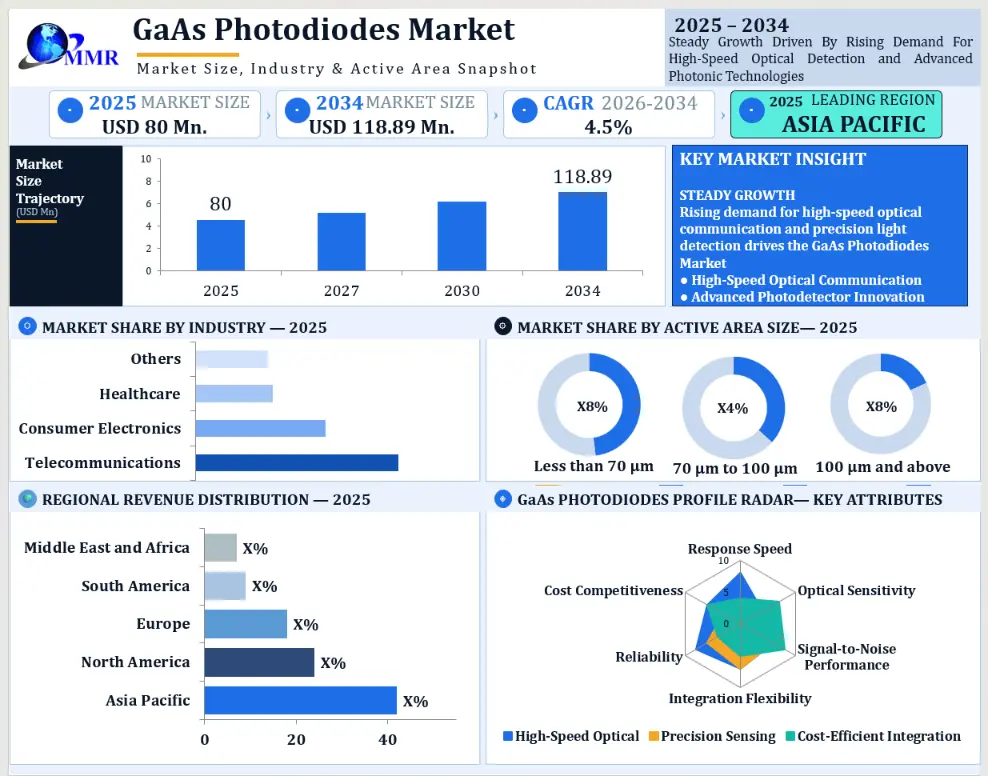
To know about the Research Methodology :- Request Free Sample Report
Global GaAs Photodiodes Market - Key Highlights
Market Growth Outlook: The GaAs Photodiodes Market is valued at USD 80 million in 2025 and is projected to reach USD 118.89 million by 2034, growing at a CAGR of 4.5% during 2026 to 2034.
Leading Regional Market: Asia Pacific leads the market due to its semiconductor manufacturing ecosystem, electronics production capabilities, and demand for optical communication components.
Active Area Size Opportunity: The less than 70 µm segment is positioned for growth because smaller active areas can offer lower junction capacitance and faster response for high speed optical detection.
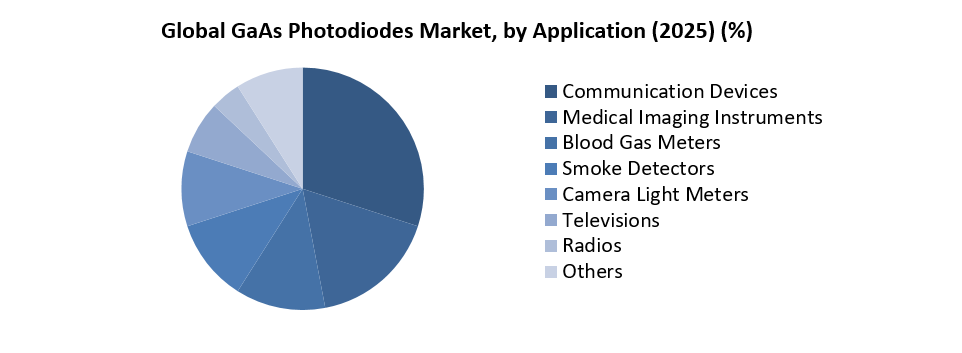
Application Growth Potential: Communication devices represent an important application opportunity as demand increases for optical signal detection, fiber optic components, and short wavelength communication systems.
Technology and Competitive Landscape: Manufacturers are focusing on high sensitivity, low noise, faster response, and application specific packaging. Competition from silicon and indium gallium arsenide photodiodes makes wavelength suitability and cost efficiency important differentiators.
Global GaAs Photodiodes Market Dynamics
Rising Demand for High-Speed Optical Detection Drive the GaAs Photodiodes Market
The GaAs Photodiodes Market benefits from increasing demand for high-speed light detection, optical signal conversion, and precision sensing across telecommunications, industrial automation, scientific instrumentation, and electronic systems. Gallium arsenide photodiodes offer useful sensitivity in the near-infrared spectrum, with typical spectral response extending toward approximately 870 nanometres, making them suitable for applications involving infrared emitters and optical measurement equipment. Growing adoption of fiber-optic components, automated inspection systems, and compact photonic devices encourages manufacturers to develop photodiodes with faster response times, stable performance, and improved signal accuracy. These requirements create opportunities for GaAs photodiode manufacturers serving high-speed optical communication, semiconductor testing, and advanced sensor applications.
Limited Spectral Response and High Manufacturing Costs Restrict GaAs Photodiodes Market Adoption
The GaAs Photodiodes Market faces constraints associated with material selection, specialized semiconductor fabrication, manufacturing consistency, and competition from alternative photodetector technologies. Conventional GaAs photodiodes have a cutoff wavelength of 870 nanometres, which limits their suitability for applications requiring longer near-infrared wavelengths, including many optical communication systems operating around 1,310 or 1,550 nanometres. Indium gallium arsenide photodiodes can provide better sensitivity across these longer wavelengths, creating a competitive disadvantage for conventional GaAs devices in specific applications. In addition, precise wafer processing, defect control, packaging requirements, and performance testing can increase production costs. These factors may discourage price-sensitive buyers and require manufacturers to demonstrate clear advantages in response speed, application suitability, reliability, and total system cost.
Integrated Photonics and Advanced Semiconductor Sensors Create New GaAs Photodiodes Market Opportunities
Emerging opportunities in integrated photonics, high-frequency optical detection, advanced scientific instrumentation, and specialized semiconductor sensing can support the development of the GaAs Photodiodes Market. Research from the National Institute of Standards and Technology highlights the use of compound semiconductor materials and wafer-bonding techniques in integrated photonic devices, demonstrating the potential for compact optical technologies and improved integration with silicon-based platforms. Manufacturers can pursue opportunities by developing application-specific photodiodes, improving device integration, and supplying customized components for precision measurement, research equipment, and high-speed detection systems. Demand from semiconductor research laboratories, industrial sensor manufacturers, and photonics developers may also create opportunities for specialized packaging, low-noise designs, and detector configurations tailored to particular wavelength ranges and operating conditions.
Intense Competition and Device Integration Complexity Challenge GaAs Photodiodes Market Growth
The GaAs Photodiodes Market must address competition from silicon, indium gallium arsenide, and other semiconductor photodetectors, each offering different wavelength ranges, sensitivity levels, costs, and operating characteristics. Selecting the appropriate detector requires manufacturers and equipment developers to balance spectral response, response speed, noise, temperature stability, device dimensions, and integration requirements. For example, silicon photodiodes can serve many visible-light applications, while indium gallium arsenide devices are often preferred for longer near-infrared wavelengths. Manufacturers must therefore maintain consistent device quality, improve compatibility with optical systems, and meet application-specific performance requirements without significantly increasing production costs. Managing specialized fabrication processes, maintaining dependable component supply, and differentiating products in a technically competitive market remain important challenges for sustained commercial adoption.
Global GaAs Photodiodes Market - Key Trends
- High-Speed Optical Detection for Data Centers: GaAs photodiodes designed for short-wavelength optical links are attracting attention as data centers require reliable, high-speed signal detection. Demand for optical transceivers, active optical cables, and short-reach communication systems creates opportunities for compact photodetectors operating around the 850-nanometre wavelength.
- Integration of GaAs Photodiodes with Silicon Photonics: Semiconductor developers are investigating ways to combine compound semiconductor light-detection capabilities with silicon-based photonic platforms. This approach can help address component size, signal transmission, and integration requirements in advanced optical systems, although manufacturing compatibility remains a technical consideration.
- Development of Low-Noise and High-Sensitivity Photodiodes: Manufacturers are focusing on reducing dark current, controlling electrical capacitance, and improving optical responsivity to achieve accurate detection of weak light signals. These improvements are relevant to laboratory instrumentation, optical testing, laser monitoring, and precision measurement equipment.
- Advanced Photodetector Designs for Specialized Sensing: Device developers are exploring new semiconductor structures to improve detection speed and spectral performance. Research published in 2025 demonstrated ultra-high-speed photodetector designs using dilute nitride materials on gallium arsenide substrates for operation at 1,310 nanometres, indicating potential development pathways beyond conventional GaAs photodiode structures.
- Demand for Application-Specific Photodiode Packaging: Optical component manufacturers increasingly offer different package configurations to meet requirements for space, electrical connectivity, optical coupling, and thermal management. Compact packages and fiber-coupled configurations are relevant to telecommunications equipment, industrial optical sensors, and precision instruments, where detector integration can influence overall system performance.
- Greater Emphasis on Semiconductor Material and Supply Chain Reliability: Manufacturers are paying attention to gallium availability, wafer quality, fabrication consistency, and supplier diversification when planning compound semiconductor production. Reliable access to suitable materials and stable manufacturing processes is important for maintaining product quality, managing procurement risks, and meeting the requirements of specialized photodetector customers.
Global GaAs Photodiodes Market Segment Analysis
Based on Active Area Size, The less than 70 µm segment is expected to remain the leading category in the GaAs Photodiodes Market because smaller active areas support faster response times and lower junction capacitance, making them suitable for high-speed optical communication and short-wavelength signal detection. Commercial products demonstrate this trend, with manufacturers offering 70 µm photodiodes for 10 gigabits-per-second applications and smaller 40 µm designs for higher-speed detection. The 70 µm–100 µm segment serves applications that require a balance between detection performance and light collection, while the 100 µm and above segment remains relevant where greater light-capturing area is preferred over maximum response speed.
Based on Application, Communication devices are an important growth area for the GaAs Photodiodes Market, driven by the need for fast optical signal detection in communication equipment and short-wavelength optical links. Photodiodes convert incoming light into electrical signals, supporting optical receivers and other light-based systems. Smoke detectors and camera light meters continue to use photo detection for light-level measurement, while medical imaging instruments and blood gas meters rely on optical detection techniques for specific diagnostic functions. Televisions and radios represent established consumer-electronics applications, although the type of detector used varies by device design. For GaAs photodiodes specifically, communication devices are a reasonable candidate for the leading segment, but the ranking should be validated against application-level sales data before being presented as a confirmed market result.
Global GaAs Photodiodes Market Regional Analysis
Asia Pacific is the leading region in GaAs Photodiodes Market due to its established semiconductor manufacturing ecosystem, electronics production capabilities, and demand for optical communication components. China, Japan, South Korea, and Taiwan contribute through semiconductor fabrication, optoelectronic component development, and telecommunications equipment manufacturing. The region also benefits from demand for compact photodetectors used in optical sensing, industrial electronics, and consumer devices. Continued investment in photonics research and advanced electronic components creates opportunities for GaAs photodiode manufacturers to serve equipment producers and specialized sensor suppliers.
North America remains an important region in the GaAs Photodiodes Market, driven by demand for advanced optical sensing, telecommunications infrastructure, aerospace electronics, defense systems, and scientific instrumentation. The United States plays a significant role through semiconductor research, photonics innovation, and the development of high-performance detection technologies. Canada also contributes through research institutions and specialized technology applications. Opportunities arise from precision optical measurement, advanced communication equipment, and industrial sensing systems that require reliable light detection and consistent device performance.
Europe maintains a significant presence in the GaAs Photodiodes Market through its optical engineering capabilities, industrial automation sector, medical technology industry, and research-driven semiconductor ecosystem. Germany contributes through industrial sensing and automotive electronics, while France and the United Kingdom support photonics research, aerospace technologies, and specialized instrumentation. Demand for accurate optical measurement, compact sensor components, and advanced diagnostic equipment creates opportunities for GaAs photodiode suppliers serving industrial, scientific, and healthcare applications.
South America represents an emerging opportunity in the GaAs Photodiodes Market as telecommunications modernization, industrial automation, and electronic equipment adoption create demand for optical detection components. Brazil and Mexico offer potential through their telecommunications infrastructure, manufacturing activities, and integration of electronic systems. Market opportunities are associated with optical communication equipment, industrial monitoring, and imported photonic components used by local equipment manufacturers and system integrators. Wider adoption depends on technology investment, component availability, and the development of specialized technical capabilities.
The Middle East and Africa region presents opportunities for the GaAs Photodiodes Market through investments in telecommunications infrastructure, industrial monitoring, security systems, and advanced electronic equipment. Countries such as Saudi Arabia, the United Arab Emirates, Israel, and South Africa contribute through different combinations of technology development, communications projects, defense electronics, and research activities. Demand for reliable optical sensors in specialized detection and monitoring systems can create opportunities for suppliers, particularly as regional technology projects increase their use of advanced photonic components.
Global GaAs Photodiodes Market Competitive Landscape
The competitive landscape of the GaAs Photodiodes Market is shaped by established optoelectronic manufacturers and specialized semiconductor companies competing through high-speed photodetection, device reliability, product customization, and optical communication applications. Key players include Albis Optoelectronics AG, OSI Optoelectronics, Hamamatsu Photonics K.K., Kyosemi Corporation, Global Communication Semiconductors, LLC, Lasermate Group, Inc., Dexerials Corporation, and Coherent Corp.. These companies compete by developing gallium arsenide PIN photodiodes, high-speed photodetector chips, compact sensor components, and customized solutions for fiber-optic communication, data transmission, industrial sensing, and electronic equipment. Product performance, spectral sensitivity, response speed, active area, packaging flexibility, and integration with optical receiver systems remain important factors influencing purchasing decisions. As demand for reliable optical signal detection grows, manufacturers that combine application-specific engineering with consistent component quality and efficient supply capabilities are positioned to strengthen their presence in the GaAs Photodiodes Market.
Product Benchmarking by Actual GaAs Photodiodes Specifications
- Coherent 850 nm GaAs PIN Photodiode: Wavelength - 840 to 860 nm. Active area / aperture - 40 µm. Published performance - 25 gigabits per second.
- Albis Optoelectronics PD10Yx: Wavelength - 830 to 860 nm. Active area / aperture - 60 µm. Published performance - Up to 14 gigabits per second per channel.
- Albis Optoelectronics PD05Kx: Wavelength - 830 to 860 nm. Active area / aperture - Large optical aperture. Published performance - Up to 5 gigabits per second per channel.
- Lasermate PDC-85A2G: Wavelength - 850 nm. Active area / aperture - Verify product datasheet. Published performance - 1.9 GHz bandwidth.
Global GaAs Photodiodes Market Recent Developments:
| Date | Company | Development | Impact |
|---|---|---|---|
| 06 January 2026 | Marktech Optoelectronics | Marktech Optoelectronics and manufacturing partner Optrans Corporation introduced new transfer-molded photodiode and LED packaging capabilities scheduled for Q2 2026 commercial availability. | The precision encapsulation improves optical beam control, environmental robustness, and manufacturing scalability for industrial, medical, and aerospace detectors. |
| 04 August 2026 | ams OSRAM | ams OSRAM announced the development of addressable micro-photodiode arrays paired with 850 nm GaAs VCSEL emitters for AI datacenter optical interconnects. | The matched emitter-detector architecture supports ultra-low-power, high-bandwidth optical links tailored for next-generation AI scale-up clusters. |
| 21 September 2026 | Coherent Corp. | Coherent showcased its 200G-per-lane photodetectors and 6-inch GaAs/InP wafer manufacturing milestones at ECOC 2026, surpassing 1 billion cumulative photodetectors shipped. | The expanded compound semiconductor capacity accelerates high-speed optical transceiver deployment and 400G photodetector development for AI data centers. |
| 19 October 2026 | Optrans Corporation | Optrans and Marktech expanded their portfolio of four-channel InGaAs PIN quadrant photodiodes covering 1.7 µm to 2.6 µm cut-off wavelengths. | The multi-segment III-V detector lineup enhances laser beam tracking, optical alignment, and analytical instrumentation precision. |
| 04 November 2026 | Excelitas Technologies | Excelitas launched the XPD-100-1 and XPDA-200 Series chip-scale photodiodes delivering 90% quantum efficiency at 850 nm and 70 ns response times. | The compact 1.75 × 1.75 mm surface-mount packages streamline high-volume automated assembly for miniaturized near-infrared optical sensing. |
The Scope of Global GaAs Photodiodes Market: Inquire before buying
| Global GaAs Photodiodes Market | |||
|---|---|---|---|
| Report Coverage | Details | ||
| Base Year: | 2025 | Forecast Period: | 2026-2034 |
| Historical Data: | 2020 to 2025 | Market Size in 2025: | USD 80 Mn. |
| Forecast Period 2026 to 2034 CAGR: | 4.5% | Market Size in 2034: | USD 118.89 Mn. |
| Segments Covered: | by Active Area Size | Less than 70 µm 70 µm – 100 µm 100 µm & above |
|
| by Industry | Consumer Electronics Healthcare Telecommunications Others |
||
| by Application | Smoke Detectors Camera Light Meters Televisions Radios Medical Imaging Instruments Blood Gas Meters Communication Devices Others |
||
Global GaAs Photodiodes Market, by Region
North America (United States, Canada and Mexico)
Europe (UK, France, Germany, Italy, Spain, Sweden, Austria, Turkey, Russia and Rest of Europe)
Asia Pacific (China, India, Japan, South Korea, Australia, ASEAN and Rest of APAC)
Middle East and Africa (South Africa, GCC, Egypt, Nigeria and Rest of ME&A)
South America (Brazil, Argentina, Columbia and Rest of South America)
Global GaAs Photodiodes Market, Key Players
- OSI Optoelectronics
- Kyoto Semiconductor Co., Ltd.
- Albis Optoelectronics AG
- Broadcom Inc.
- Global Communication Semiconductors, LLC
- Hamamatsu Photonics K.K.
- AMS Technologies AG
- Kyosemi Corporation
- COMSOL AB
- Lasermate Group, Inc.
- Electro-Optics Technology, Inc.
- Enablence Switzerland AG
- Coherent Corp.
- MACOM Technology Solutions
- Excelitas Technologies Corp.
- Thorlabs, Inc.
- Vishay Intertechnology, Inc.
- Teledyne Judson Technologies
- Opto Diode Corporation
- Marktech Optoelectronics
- Moxtek, Inc.
- Optilab, LLC
- AC Photonics, Inc.
- IQE plc
- Qorvo, Inc.
- TRUMPF Photonic Components
- Dexerials Corporation
- PREMA Semiconductor GmbH
- VIGO Photonics S.A.
- JENOPTIK AG
- Lite-On Technology Corporation
- GenUV
- Bentham Instruments Limited
- EVERLIGHT Electronics Co., Ltd.
- Centronic Limited
- Laser Components GmbH
- GPD Optoelectronics Corp.
- Fermionics Opto-Technology
- First Sensor AG
- EMCORE Corporation
- Applied Optoelectronics, Inc.
- Nisshinbo Micro Devices Inc.
- KODENSHI Corporation
- OptoSigma Corporation
- Newport Corporation
- Fujitsu Optical Components Limited
- Hamamatsu Photonics
- OSI Laser Diode, Inc.
- Photonics Industries International, Inc.
- Santec Holdings Corporation
Global GaAs Photodiodes Market - Frequently Asked Questions
1.Which region has the largest share in the GaAs Photodiodes Market?
Ans: Asia Pacific held the leading share of the GaAs Photodiodes Market in 2025.
2.What is the growth rate of the GaAs Photodiodes Market?
Ans: The GaAs Photodiodes Market is projected to grow at a CAGR of 4.5 during the forecast period from 2026 to 2034.
3.What is the scope of the GaAs Photodiodes Market report?
Ans: The report covers market trends, growth drivers, restraints, competitive landscape, regional analysis, and market forecasts.
4.Who are the key players in the GaAs Photodiodes Market?
Ans: Key players include OSI Optoelectronics, Albis Optoelectronics AG, Kyoto Semiconductor Co., Ltd., Hamamatsu Photonics, and Global Communication Semiconductors, LLC.
5.What is the study period of the GaAs Photodiodes Market?
Ans: The GaAs Photodiodes Market is studied from 2020 to 2034.