
Flash Memory Market- Industry Structure Evaluation, Demand Drivers Analysis, Regional Growth Analysis and Identification, Competitive Positioning Review & Global Market Size Forecast to 2032
Overview
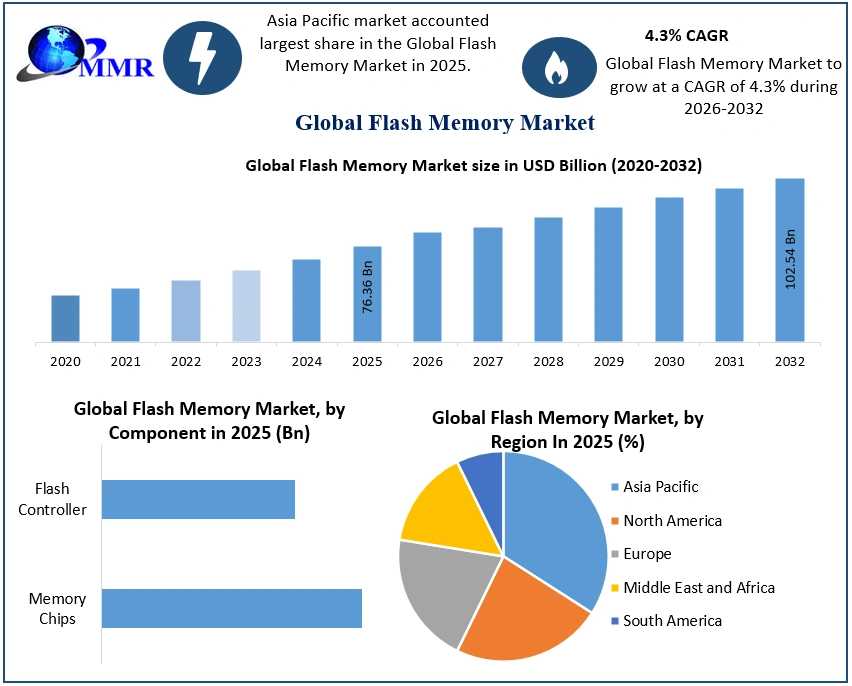
The Flash Memory Market size was valued at USD 76.36 Billion in 2025 and the total Flash Memory revenue is expected to grow at a CAGR of 4.3% from 2026 to 2032, reaching nearly USD 102.54 Billion by 2032.
Flash Memory Market Overview:
The Flash Memory Market is growing rapidly, thanks to the growing demand for high-capacity storage in smartphones, PCs, and industrial devices. As mobile devices integrate more features, such as fingerprint scanners and advanced GPS, the need for high-density storage solutions rises, with 3D NAND flash gaining popularity. Key industry players such as Samsung and SK Hynix are advancing memory technology, with Samsung set to release its 300-layer NAND flash and SK Hynix expanding production of its 238-layer NAND for diverse applications, including SSDs.
China, remains a significant market due to strong demand and government programs such as “Made in China 2025” aimed at increasing local semiconductor production. Despite COVID-19’s supply chain challenges, automated production facilities in China sustained operations, ensuring minimal disruption. The flash memory market continues to benefit from rising data processing needs for AI and machine learning, which demand reliable and high-capacity storage solutions. This trend positions flash memory as essential across consumer electronics and industrial sectors alike. This factor significantly boosts the market.
To know about the Research Methodology :- Request Free Sample Report
Emerging Technologies Drive Flash Memory Market Growth
The growing demand for consumer electronics, including smartphones, tablets, laptops, and gaming consoles, has significantly boosted the flash memory market. The proliferation of smartphones featuring high-resolution cameras and complex app ecosystems, the need for high-capacity storage solutions has accelerated.
• For instance, Samsung Electronics has recently started mass-producing advanced 286-layer NAND flash memory chips to address the increasing storage demands in smartphones and data centers. Flagship smartphone models, such as those by Apple and Samsung, now offer over 1TB of internal storage, enabling users to store large media files and applications seamlessly.
In the gaming industry, the latest consoles rely on SSDs powered by NAND flash memory to reduce load times and elevate gaming experiences. This has urged manufacturers to develop higher-density flash memory solutions to meet evolving consumer expectations. As the demand for faster and more efficient storage solutions continues to grow, innovations such as 3D NAND technology are expected to push the boundaries of flash memory capacity and performance. These advancements lead to even smaller and more powerful storage devices, enabling the continuous integration of AI and augmented reality applications.
• Also, the ongoing research into next-generation technologies, such as MRAM and ReRAM, promises to revolutionize data storage by offering increased speed, durability, and energy efficiency.
The automotive sector has seen rising adoption of flash memory in advanced driver-assistance systems (ADAS) and infotainment systems, creating demand for reliable, high-performance storage solutions. The flash memory industry is evolving rapidly to meet these diverse application requirements, with key players innovating to address the growing needs across sectors, further boosting the flash memory market's growth.

High Production Costs Limits the Flash Memory Market Growth
High production costs are a significant barrier to the growth of the Flash Memory Market, as a result, these high production costs are passed down to consumers, leading to elevated prices for flash memory products. This factor limits the accessibility and affordability of such technology for the average consumer. Consequently, high prices slow down the adoption rate of new devices that rely on flash memory. The manufacturing process for advanced flash memory types, such as 3D NAND, is complex and requires substantial investment in both technology and infrastructure.
• For example, building a state-of-the-art semiconductor fabrication plant cost around $2.5 billion, a substantial investment that limits market entry for many companies.
Also, the production process demands high-quality materials and strict quality control, both of which increase manufacturing expenses. Variations in the prices of raw materials further add to these challenges, making production costs unpredictable and negatively impacting profit margins. These financial hurdles discourage smaller manufacturers from entering the market, which in turn reduces competition and innovation. Thus, high production costs create a significant obstacle to expanding flash memory capacity, making it difficult to keep pace with the growing consumer demand for storage solutions. These challenges slow the overall development of the flash memory market.
Emerging Technologies creates lucrative growth opportunities to Flash Memory Market Growth
Emerging technologies in the flash memory market are unlocking lucrative growth opportunities by advancing storage capabilities and expanding application potential. 3D NAND technology leads the way by vertically stacking memory cells, allowing for greater storage density and enhanced performance. With heavy investments from industry giants such as Samsung and Western Digital, this technology is meeting rising demands for high-capacity solutions across consumer electronics and data centers.
The integration of AI and machine learning with flash memory is accelerating data processing, supporting real-time analytics in sectors like automotive and healthcare. Also, Non-Volatile Memory Express (NVMe) technology is boosting data transfer speeds, making flash memory ideal for high-performance applications in gaming, cloud computing, and enterprise data centers.
Flash memory adoption in automotive applications is also on the rise, particularly for advanced driver-assistance systems (ADAS) and infotainment. In healthcare, medical devices increasingly rely on flash memory for rapid, reliable data access. Together, these innovations are driving technological advancement boosting the new revenue streams and flash memory Growth opportunities for the flash memory industry.
Flash Memory Market Segmentation
Based on the Type, the global Flash Memory market is sub-segmented into NAND Flash Memory and NOR Flash Memory. The NAND Flash Memory segment dominated the type segment of the Flash Memory market share in the year 2025. Due to its unique combination of high storage density, cost-effectiveness, and fast read-write capabilities. Unlike traditional memory types, NAND flash store large amounts of data at a lower price per gigabyte, making it highly suitable for consumer electronics, data centers, and mobile devices. The popularity of 3D NAND technology has amplified this dominance, enabling manufacturers to stack cells vertically, thereby increasing storage capacity while reducing overall costs.
NAND’s scalability and flexibility in adapting to evolving storage needs further drive its dominance. The rising demand in various applications, including solid-state drives (SSDs), smartphones, and cloud storage services, where high-capacity, reliable, and quick-access memory is essential. As industries such as automotive and healthcare adopt flash memory for advanced applications, NAND flash’s cost-efficiency and versatility continue to reinforce its position as the leading type in the Flash Memory Market.
Flash Memory Market Regional Analysis:
Asia-Pacific holds a major share of the flash memory market. The strong demand across diverse end-user applications. This demand is especially high in developing nations such as China, India, and Indonesia, where smartphone usage is rapidly growing. The region also benefits from extensive semiconductor fabrication activity in countries such as China, South Korea, and Singapore, attracting significant capital investments from multinational memory manufacturers. China, in particular, is seeing substantial investment due to government initiatives like the "Made in China 2025" program, aimed at achieving USD 305 billion in semiconductor output by 2032 and meeting 80% of domestic demand.
Emerging companies in China, such as Yangtze River Storage Technology, Fujian Jin Hua, Hua Li, and Hefei Chang Xin Memory, are expanding rapidly and plan to double their equipment investments. These developments are expected to boost competition in the Asia-Pacific region, as local companies and foreign players intensify their expansion efforts to meet the growing demand for flash memory. The strategic focus on local production and increased investment makes Asia-Pacific a significant growth region for the global Flash Memory Market.
Flash Memory Market Scope: Inquiry Before Buying
| Flash Memory Market | |||
|---|---|---|---|
| Report Coverage | Details | ||
| Base Year: | 2025 | Forecast Period: | 2026-2032 |
| Historical Data: | 2020 to 2025 | Market Size in 2025: | USD 76.36 Bn. |
| Forecast Period 2026 to 2032 CAGR: | 4.3% | Market Size in 2032: | USD 102.54 Bn. |
| Segments Covered: | by Type | NAND Flash Memory NOR Flash Memory |
|
| by Component | Memory Chips Flash Controller |
||
| by Application | Smartphone Digital Camera USB Flash Drives Solid-States Drives Tablets & Laptops Gaming Consoles Media Player |
||
| by End-User | Enterprise Industrial Individual/Personal |
||
Flash Memory Market, by Region
North America (United States, Canada and Mexico)
Europe (UK, France, Germany, Italy, Spain, Sweden, Austria and Rest of Europe)
Asia Pacific (China, South Korea, Japan, India, Australia, Indonesia, Malaysia, Vietnam, Taiwan, Bangladesh, Pakistan and Rest of APAC)
Middle East and Africa (South Africa, GCC, Egypt, Nigeria and Rest of ME&A)
South America (Brazil, Argentina Rest of South America)
Flash Memory Market, Key Players are:
1. Samsung Electronics
2. Kioxia Corporation
3. Western Digital
4. Micron Technology
5. Intel Corporation
6. SanDisk
7. Yangtze Memory Technologies Co. (YMTC)
8. Macronix International
9. STMicroelectronics
10. Infineon Technologies
11. Renesas Electronics
12. Kingston Technology
13. Biwin Storage Technology
14. Tekmos
15. AMIC Technology
16. Winbond Electronics
17. Silicon Storage Technology (SST)
18. ISSI (Integrated Silicon Solution Inc.)
19. ESMT (Elite Semiconductor Memory Technology)
20. Phison Electronics
21. Toshiba Corporation
22. Adata Technology
23. Team Group
24. Transcend Information
25. PNY Technologies
26. Seagate Technology
27. Netlist
28. Others
FAQs:
1. What are the growth drivers for the Flash Memory Market?
Ans. Digital Transformation Across Industries are expected to be the major driver for the Flash Memory Market.
2. What are the major opportunities for the Flash Memory Market growth?
Ans. Growing Demand for Data-Intensive Applications are expected to be the major opportunities in the Flash Memory Market.
3. Which region is expected to lead the global Flash Memory Market during the forecast period?
Ans. Asia-Pacific is expected to lead the Flash Memory Market during the forecast period.
4. What was the Global Flash Memory Market size in 2025?
Ans: The Global Flash Memory Market size was USD 76.36 Billion in 2025.
5. What segments are covered in the Flash Memory Market report?
Ans. The segments covered in the Flash Memory Market report are by Type, Component, Application and End-User and Region.