
Fire Protection Systems Market - Industry Structure Evaluation, Demand Drivers Analysis, Regional Growth Analysis and Identification, Competitive Positioning / Landscape Review & Global Market Size Forecast to 2032
Overview
Global Fire Protection Systems Market was valued at USD 79.72 Bn in 2025 and is expected to reach USD 124.62 Bn by 2032, growing at a CAGR of 6.59% during the forecast period.
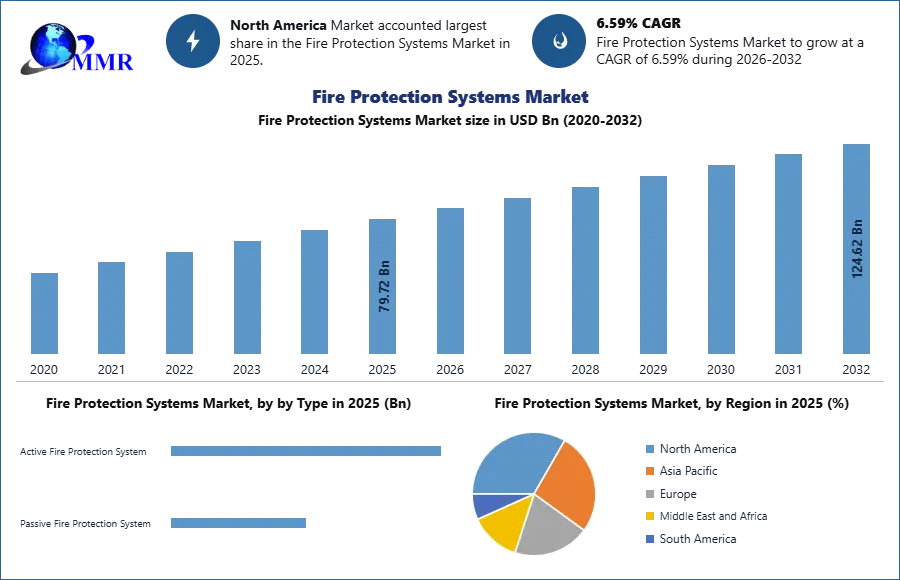
The Global Fire Protection Systems Market is currently witnessing a robust and evolving landscape, driven by several key factors that emphasize the significance of fire safety in various industries. The market is characterized by rising demand for advanced fire protection solutions due to increased awareness of the devastating consequences of fire incidents, stricter government regulations, and the growing adoption of smart building technologies. These factors have fueled the expansion of the fire protection systems market, encompassing fire detection, suppression, and control systems. Increasing urbanization, infrastructure development, and investments in commercial and residential construction projects worldwide have further accelerated market growth.
The market is benefiting from advancements in fire protection technologies, including the integration of IoT and AI-based systems for real-time monitoring and rapid response. This technology-driven approach aids in the early detection and mitigation of fire hazards, which is critical to preventing disasters and protecting lives and assets. The global emphasis on environmental sustainability and the use of eco-friendly fire suppression agents is influencing market dynamics, as companies strive to align with eco-conscious consumers and meet stringent environmental regulations.
Recent developments by key market players are indicative of the industry's dynamism. Leading companies like Honeywell International, Johnson Controls, Siemens AG, and Tyco Fire Products are consistently innovating to strengthen their market presence. For instance, Honeywell launched the "Xtralis VESDA-E VEA" series, an advanced aspirating smoke detection solution, which enhances early warning capabilities. Siemens introduced "Cerberus FIT," a cost-effective and versatile fire protection system suitable for diverse applications. Such innovations underscore fierce competition and the focus on providing more efficient, reliable, and tailored fire protection solutions.
The market is also witnessing increased partnerships and collaborations among industry players to expand their global reach and offer comprehensive fire safety solutions. Mergers and acquisitions are shaping the competitive landscape, with larger companies acquiring specialized firms to broaden their product portfolios and improve their market position. These trends indicate that the Global Fire Protection Systems Market is on a growth trajectory, offering immense opportunities for both established players and new entrants to contribute to the global fire safety landscape, ensuring safer environments for people and assets while fostering sustainability and technological advancement.To know about the Research Methodology :- Request Free Sample Report
Fire Protection Systems Market Scope and Research Methodology:
The Fire Protection Systems Market encompasses a wide scope and utilizes a robust research methodology to gather insights and analyze the various facets of the industry. Gathering data from diverse sources, including market reports, industry publications, government sources, company financial reports, and market surveys. Carefully examining the collected data to identify market trends, growth drivers, challenges, and opportunities. Evaluating the competitive landscape by assessing the market shares, strategies, and developments of key industry players. Utilizing statistical models and historical data to forecast future market trends, growth projections, and market size.
Conducting interviews, surveys, and discussions with industry experts, stakeholders, and consumers to gain valuable insights into market dynamics. Reviewing existing literature, industry reports, and academic studies to gather additional information and context. Cross-referencing and validating research findings to ensure the accuracy and reliability of the collected data and analysis. This combination of comprehensive elements provides a holistic understanding of the Fire Protection Systems Market, enabling businesses and stakeholders to make well-informed decisions and investments in this
Fire Protection Systems Market Dynamics:
Urbanization and High-Rise Construction Fuel Fire Safety Market:
Government regulations for the installation of fire protection systems in commercial and residential buildings are a key driver. For example, in 2019, New York City passed Local Law 194, which requires the installation of sprinkler systems in all residential buildings with three or more units, boosting demand for fire protection systems. Increasing urbanization and infrastructure development globally are driving demand for fire protection systems. The growth of smart cities and the construction of high-rise buildings necessitate advanced fire protection systems to ensure safety. Innovations in fire detection and suppression technologies, like advanced smoke detectors, automated fire suppression systems, and AI-based analytics, are spurring market growth. For instance, the use of aspirating smoke detection (ASD) systems, like Xtralis VESDA, offers early warning capabilities. Growing environmental concerns are promoting the use of eco-friendly fire suppression agents. The adoption of clean agents like 3M™ Novec™ 1230 Fire Protection Fluid in data centers and critical facilities is an example of this trend.
The growth of industries such as oil and gas, manufacturing, and energy necessitates fire protection systems. For instance, the expansion of oil refineries in the Middle East is driving the demand for advanced fire suppression systems. Heightened awareness of fire safety in the wake of high-profile fire incidents is encouraging businesses and individuals to invest in fire protection. The Notre Dame Cathedral fire in Paris in 2019 raised awareness about the importance of fire protection. Insurance companies incentivize the installation of fire protection systems by offering reduced premiums. This encourages property owners to invest in fire safety measures, as seen in the adoption of fire sprinklers in commercial buildings to reduce insurance costs.
The expansion of multinational corporations and businesses into new regions and markets creates a need for standardized fire protection systems. These companies require consistent fire safety measures across their global facilities, fostering market growth. Ongoing R&D efforts by key market players to develop more efficient and cost-effective fire protection solutions are driving market growth. For example, Siemens' Cerberus FIT is the product of such R&D efforts. Strategic collaborations and acquisitions among industry players enhance product offerings and market reach. Johnson Controls' acquisition of Tyco Fire Products is a notable example of how partnerships influence the market's competitive landscape.
Weak Enforcement of Safety Regulations Hampers Market Growth:
The significant upfront investment required for the installation of advanced fire protection systems deters cost-sensitive customers. For example, retrofitting a building with a comprehensive fire sprinkler system is expensive and discourages some property owners from adopting these safety measures. In many developing regions, weak enforcement of building codes and fire safety regulations hampers market growth. The tragic Grenfell Tower fire in London in 2017 highlighted the consequences of lax enforcement of fire safety standards. Fire protection systems require regular maintenance to ensure their effectiveness.
Complex maintenance procedures and costs pose a challenge for businesses, such as hotels and hospitals, which must maintain fire safety around the clock. The installation and maintenance of advanced fire protection systems require specialized technical skills. The shortage of qualified technicians and engineers hinders system deployment. This challenge is particularly prevalent in remote or rural areas. Integration challenges may arise when older buildings need to incorporate advanced fire protection technology. Retrofitting outdated infrastructure is complicated and costly, as seen in the case of historical landmarks, like the Louvre Museum in Paris, which face challenges in modernizing fire safety without compromising their architectural integrity.
Frequent false alarms strain resources, as emergency responders and building staff may become complacent or fail to respond promptly. False alarms result from outdated or poorly maintained fire detection systems, impacting public safety and resources. While eco-friendly fire suppression agents are gaining traction, some face environmental scrutiny. For example, the phase-out of Halon fire extinguishing agents due to their ozone-depleting properties led to the need for alternative solutions that are not always as effective. The market's fragmentation with numerous players and products leads to confusion among consumers.
The abundance of options makes it challenging for decision-makers to choose the most suitable fire protection systems for their specific needs, resulting in market uncertainty. Economic downturns and fluctuations in construction and industrial activities impact investments in fire protection. During economic crises, companies may postpone or scale back fire safety investments, affecting market growth. Evolving fire safety regulations and standards pose challenges for manufacturers and end-users in maintaining compliance. Frequent changes may require continuous updates and adjustments to fire protection systems, leading to added costs and complexity for businesses.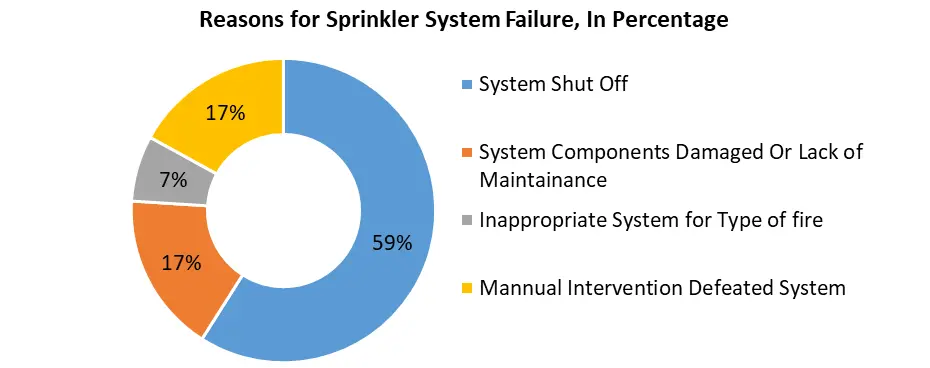 Historic Building Renovations Create Opportunities for Fire Safety Upgrades:
The growing adoption of smart building technologies presents an opportunity for fire protection system manufacturers to integrate advanced sensors, IoT, and AI for real-time monitoring and response. For instance, the integration of fire detection with building automation systems in modern skyscrapers like The Shard in London enhances safety and efficiency. The expansion of renewable energy projects, such as solar and wind farms, requires specialized fire protection systems.
Companies offer solutions like early detection and fire suppression in remote renewable energy facilities, ensuring their protection and compliance with environmental standards. With the increasing reliance on data centers, there is a significant opportunity for advanced fire suppression and detection systems. Companies like Amazon Web Services invest in cutting-edge fire protection to safeguard data centers from potential threats, driving demand for innovative solutions. Hospitals and healthcare facilities demand robust fire protection due to the sensitive nature of their operations. The implementation of advanced fire suppression systems, like water mist systems, ensures patient and staff safety, as seen in hospitals adopting these technologies worldwide.
The aviation sector requires specialized fire protection systems for aircraft hangars and maintenance facilities. Developments like foam-based fire suppression systems used in military aircraft hangars create opportunities for industry players to cater to this unique market. The emphasis on green building certifications, such as LEED (Leadership in Energy and Environmental Design), provides opportunities for manufacturers of eco-friendly fire suppression agents. Green buildings often require sustainable fire protection solutions to meet environmental standards. As developing regions invest in infrastructure development, including airports, railways, and commercial complexes, there is a growing demand for fire protection systems.
The e-commerce boom drives the need for fire protection in large distribution centers. Companies like Alibaba invest in state-of-the-art fire detection and suppression systems to protect their vast warehouses, creating opportunities for suppliers of these technologies. Many older buildings require fire safety upgrades to comply with modern standards. The renovation and retrofitting of historic structures, like the Palace of Westminster in the UK, offers opportunities for companies specializing in preserving architectural integrity while enhancing fire protection. The growth of energy storage facilities, such as lithium-ion battery farms, requires specialized fire protection solutions to mitigate the risk of thermal runaway events. Innovations in fire detection and suppression for energy storage systems create opportunities in this emerging sector. These growth opportunities highlight the diverse applications and evolving needs within the Global Fire Protection Systems Market, demonstrating the potential for innovation, specialization, and market expansion.
| Exact Date | Company | Development | Impact |
|---|---|---|---|
| 16 February 2026 | Siemens Smart Infrastructure | Siemens introduced its Building X Fire Apps, a cloud-based suite designed to modernize legacy fire systems with remote monitoring and ISOtechnology™. | This advancement enhances digital connectivity and maintenance efficiency, reducing the physical labor required for large-scale commercial fire safety management. |
| 01 January 2026 | International Maritime Organization (IMO) | New SOLAS Chapter II-2 amendments entered into force, mandating individually identifiable fire detection and alarm systems on passenger ship Ro-Ro decks. | The mandate drives a surge in maritime fire safety technology upgrades, prioritizing rapid identification of fire locations in complex cargo environments. |
| 29 September 2025 | Johnson Controls | Johnson Controls launched the IQ Panel 5 at GSX 2025, featuring PowerG+ wireless connectivity for integrated fire and security management. | The system provides scalable, wire-free solutions that reduce installation complexity for retrofitting aging infrastructure in the commercial sector. |
| 01 July 2025 | Honeywell International Inc. | Honeywell finalized the acquisition of the Li-ion Tamer business from Nexceris to integrate off-gas detection into its fire life safety portfolio. | This acquisition addresses battery safety risks in energy storage systems and data centers, providing critical early-stage fire prevention for green energy infrastructure. |
| 18 March 2025 | Resideo Technologies Inc. | The company partnered with Google Home to launch the First Alert Smart Smoke & Carbon Monoxide Alarm, compatible with Nest Protect devices. | This collaboration expands interconnected home safety ecosystems, allowing users to manage fire protection via the Google Home app for seamless coverage. |
| 12 February 2025 | Teledyne Technologies Inc. | Teledyne introduced the Spyglass Xtend triple-infrared flame detector, capable of detecting both hydrogen and hydrocarbon fires simultaneously. | The innovation enhances safety in high-risk industrial environments where hydrogen flames may trigger invisible fuel fires, improving incident response accuracy. |
Fire Protection Systems Market Segment Analysis:
Based on Type, The Global Fire Protection Systems Market is effectively segmented based on the type of systems, distinguishing between Active Fire Protection Systems and Passive Fire Protection Systems. Active Fire Protection Systems, which include fire detection and suppression systems, are extensively adopted in critical applications like data centers and industrial facilities due to their real-time response capabilities. They are particularly relevant in environments where early fire detection and rapid suppression are essential to safeguard lives and assets.
Passive fire protection systems, which encompass fire-resistant materials, structural components, and compartmentalization, are widely applied in the building and construction sectors, including residential, commercial, and public infrastructure projects.
The adoption of passive fire protection systems is driven by regulatory compliance, building codes, and a growing awareness of fire safety in the construction industry. These two segments complement each other, with Active systems addressing immediate threats and Passive systems providing structural integrity, making the Global Fire Protection Systems Market highly adaptable to diverse applications and adoption scenarios.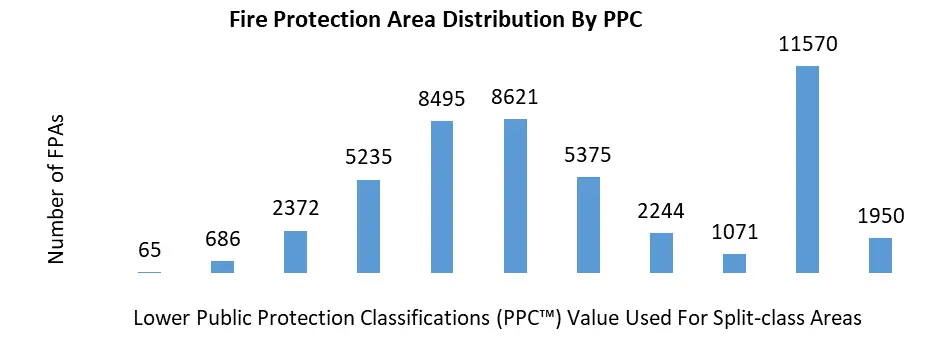
Fire Protection Systems Market Regional Insights:
The Global Fire Protection Systems Market exhibits distinct regional insights based on manufacturing hubs, major consumption areas, and trade dynamics. Large manufacturing regions, such as Asia-Pacific, particularly China, have emerged as the epicenter of fire protection system production. The robust manufacturing infrastructure, skilled labor force, and the presence of key market players have propelled this region into a global manufacturing powerhouse. North America, with the United States at its core, stands out as a major consuming region. The stringent enforcement of safety regulations and a heightened awareness of fire protection measures drive significant demand for advanced fire protection systems in sectors ranging from commercial to industrial.
This demand is further catalyzed by the region's inclination toward smart building technologies. On the import-export front, Europe plays a pivotal role. With well-established trade networks and partnerships, European countries import and export a substantial volume of fire protection equipment and technologies. This region acts as a critical trading junction, facilitating the flow of fire protection systems to various parts of the world. Additionally, the Middle East and Africa, with their rapid urbanization and increasing infrastructure development, are showing an upward trajectory in both consumption and production of fire protection systems, making them significant players in the global market. These regional dynamics emphasize the interplay of manufacturing, consumption, and trade in the Global Fire Protection Systems Market, where different regions contribute uniquely to the industry's growth and development.
| Detector type | Operational criteria | Application |
| Optical detectors | Smoke development, no / low heat development, no visible flames | for early detection of smoldering fires with large and bright smoke particles |
| Thermal detectors | strong heat radiation, heat development | Detection of open fires in small monitoring areas |
| Optical-thermal multi-sensor detectors | Incipient fire with slow progression, CO gas development | Surveillance areas with high requirements for personal protection |
| Ionization smoke detector | particularly sensitive, even to the smallest smoke particles | often prohibited in Germany due to radioactive radiation (replacement by optical-thermal detectors) |
| Flame detector | high emission (IR, UV), e.g. with flammable liquids and gases | Surveillance areas with increased fire hazard |
| Special detectors I – linear heat detectors | Places where point detectors cannot be used | Use in difficult environmental conditions (e.g. dirt, heat, cold, humidity) |
Competitive Landscape
Key Players of the Fire Protection Systems Market profiled in the report are Consilium AB, DESAUTEL SAS, Eaton, Encore Fire Protection, Fike Corporation, Fire Suppression Ltd, Gentex Corporation, Gunnebo AB, Halma plc, Hochiki Corporation, Honeywell International Inc, Johnson Controls International Plc, Minimax Viking GmbH, NAFFCO FZCO, Napco Security Technologies, Inc. This provides huge opportunities to serve many End-users and customers and expand the Fire Protection Systems Market.
In July 2023 - SparxTM Smart Sprinkler System Prototype: Sparx Holdings Group completed the SparxTM Smart Sprinkler System prototype, aiming to revolutionize fire suppression. It enhances the efficiency of conventional sprinkler systems, improving response times, and making them effective in complex fire scenarios.
In July 2023 - QTEC Fire Suppression Solutions: Integrated Fire Technology expanded its product offering with QTEC fire suppression solutions, gaining exclusive distribution rights in South Africa. QTEC's low-pressure foam spray system is adaptable to various applications, including mining, and industrial facilities.
In June 2023 - Fike Fire Monitors: Fike Corp. introduced autonomous water cannons, the Fike Fire Monitors, capable of quickly extinguishing fires in hard-to-reach areas. These water-based cannons utilize advanced technology, including flame detectors and high-definition cameras, for effective fire suppression.
In October 2022 - Johnson Controls and Rescue Air Systems: Johnson Controls acquired Rescue Air Systems, specializing in firefighter air replenishment systems (FARS). FARS allows firefighters to refill breathing air bottles within buildings during emergencies, expanding Johnson Controls' fire suppression product line.
In August 2022 - Honeywell's Fire-Lite Detection: Honeywell introduced Fire-Lite Detection, offering contemporary fire prevention systems for small to medium-sized buildings in Australia. This announcement aligns with the robust growth of Australia's construction sector, driving demand for modern fire protection systems.
Fire Protection Systems Market Scope: Inquiry Before Buying
| Fire Protection Systems Market | |||
|---|---|---|---|
| Report Coverage | Details | ||
| Base Year: | 2025 | Forecast Period: | 2026-2032 |
| Historical Data: | 2020 to 2025 | Market Size in 2025: | 79.72 USD Bn |
| Forecast Period 2026-2032 CAGR: | 6.59% | Market Size in 2032: | 124.62 USD Bn |
| Segments Covered: | by Service | Managed Services Installation and Design Services Maintenance Services Other |
|
| by Type | Active Fire Protection System Passive Fire Protection System |
||
| by Product | Fire Detection Fire Response Fire Suppression Fire Analysis |
||
| by End-User | Commercial Industrial Governmental Institutional Others |
||
Fire Protection Systems Market, by region
North America (United States, Canada and Mexico)
Europe (UK, France, Germany, Italy, Spain, Sweden, Austria, Turkey, Russia and Rest of Europe)
Asia Pacific (China, India, Japan, South Korea, Australia, ASEAN and Rest of APAC)
Middle East and Africa (South Africa, GCC, Egypt, Nigeria and Rest of ME&A)
South America (Brazil, Argentina, Columbia and Rest of South America)
Fire Protection Systems Market Key Players:
1. Consilium AB
2. DESAUTEL SAS
3. Eaton
4. Encore Fire Protection
5. Fike Corporation,
6. Fire Suppression Ltd
7. Gentex Corporation
8. Gunnebo AB
9. Halma plc
10. Hochiki Corporation
11. Honeywell International Inc
12. Johnson Controls International Plc
13. Minimax Viking GmbH
14. NAFFCO FZCO
15. Napco Security Technologies, Inc.
16. Robert Bosch GmbH
17. Schneider Electric,
18. SCHRACK SECONET AG,
19. Securiton AG
20. Siemens AG
21. Solas Fire Safety Equipment (P) Ltd.
22. Swastik Synergy Engineering Private Limited
23. Victaulic Co.,
24. Viking Automatic Sprinkler Company
25. Yamato Protec Corporation