
Extended Reality Market Size by Technology, Offering, Device Type, Application, Region – Revenue Pool Analysis, Margin Structure Assessment, Capital Flow Trends, Competitive Benchmarking & Forecast to 2032
Overview
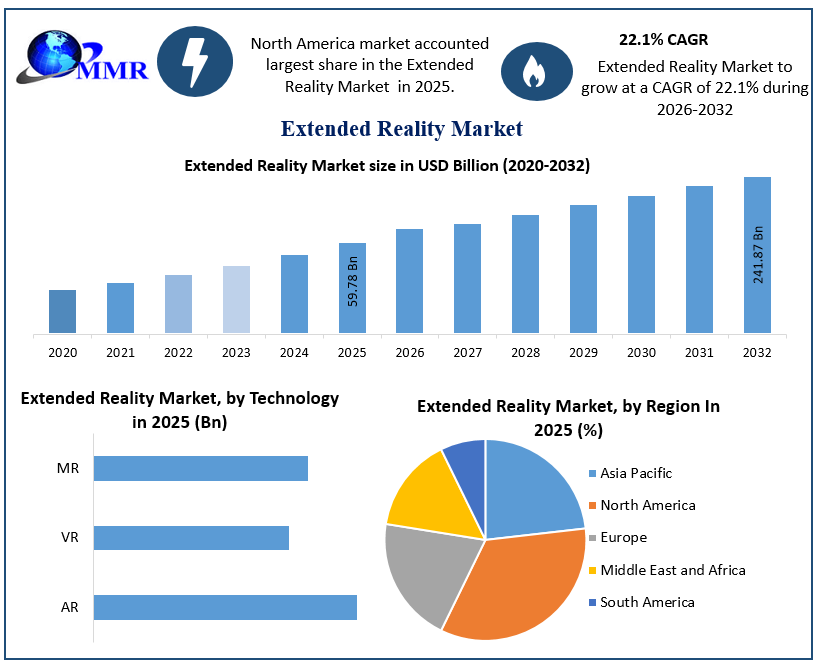
The Extended Reality Market size was valued at US 59.78 Bn in 2025 and market revenue is growing at a CAGR of 22.1 % from 2026 to 2032, reaching nearly USD 241.87 Bn by 2032.
Extended Reality Market Overview:
The Global Extended Reality (XR) Market comprises Augmented Reality (AR), Virtual Reality (VR), and Mixed Reality (MR) technologies that blend digital content with physical or fully immersive environments. XR adoption is increasing across gaming and entertainment, healthcare, education, manufacturing, automotive, retail, aerospace, and enterprise training. The market is increasingly shifting from traditional VR applications toward spatial computing, AR smart glasses, AI-enabled immersive experiences, digital twins, remote assistance, and industrial training. The development of lighter wearable devices, improved displays, AI-powered interfaces, and faster wireless connectivity is expanding the potential use cases for XR beyond entertainment.
Recent device-level data highlights a mixed but evolving market landscape. Global VR headset shipments declined 12% year-on-year in 2024, with Meta accounting for 77% of global VR headset shipments. The market is witnessing stronger momentum in AR smart glasses, during the first half of 2025, global AR smart-glasses shipments increased 50% year-on-year, while VR headset shipments declined 14%. This divergence indicates a gradual shift in industry attention toward lightweight AR devices and the emerging "AR + AI" ecosystem. Meta maintained around 80% of the global VR headset market in the first half of 2025, demonstrating the concentration of the VR hardware landscape.
The market's future growth is increasingly linked to the convergence of XR with artificial intelligence, spatial computing, 5G, edge computing, and digital twins. Enterprise applications are becoming particularly important as businesses use XR for workforce training, remote collaboration, product design, healthcare simulation, and industrial maintenance. North America being he flagbearer of innovation and adoption holds an important position in the market due to its strong technology investment and the presence of major ecosystem players, while Asia Pacific presents significant growth potential supported by consumer electronics manufacturing, gaming, industrial digitalization, and emerging AR smart-glass adoption. Though high hardware costs, limited content ecosystems, privacy concerns, cybersecurity risks, and user comfort remain key barriers to widespread adoption, the latest shipment data suggests that AR smart glasses and AI-integrated wearable experiences may represent the next major growth opportunity within the broader XR ecosystem.
 To know about the Research Methodology :- Request Free Sample Report
Extended Reality Market Dynamics:
XR Application Landscape: Gaming Leads Adoption While Enterprise Applications Gain Momentum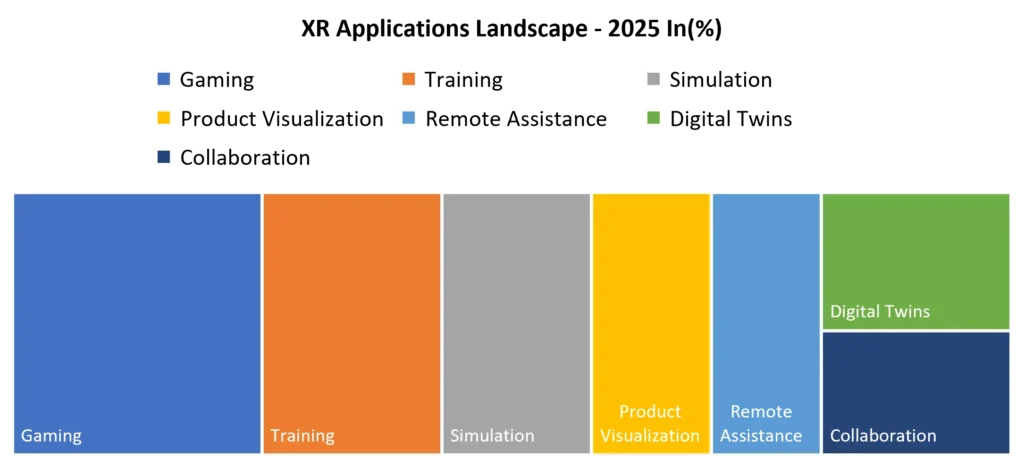
Gaming represents the largest application area in this illustrative distribution, reflecting XR's established consumer and entertainment base. However, training, simulation, remote assistance, and digital twins collectively account for a substantial share, highlighting the growing shift toward enterprise and industrial applications. Product visualization and collaboration further demonstrate the expanding role of XR in design, engineering, sales, and distributed work environments
Extended Reality Market Segment Analysis:

Extended Reality Market Recent Developments:
| Date | Recent Development |
| January 2025 | Meta continued expanding its AI-powered Ray-Ban Meta smart-glasses ecosystem, strengthening the integration of Meta AI, cameras, audio, and multimodal capabilities and positioning smart glasses as a mainstream wearable computing platform. |
| March 2025 | Google and Samsung continued advancing the Android XR ecosystem, focusing on a common platform for headsets and smart glasses and strengthening competition around the next generation of AI-powered spatial computing devices. |
| May 2025 | Google announced Android XR developer advancements and partnerships, supporting the development of immersive applications and experiences across XR headsets and future smart glasses. |
| 2025 | Meta, XREAL, RayNeo, Xiaomi, and other manufacturers expanded their smart-glasses portfolios, contributing to a shift in XR competition from conventional VR headsets toward lightweight AR and AI-enabled wearable devices. |
| 2025 | AI became increasingly integrated into XR devices, with vendors focusing on voice interaction, computer vision, contextual assistance, real-time translation, and multimodal AI to make immersive technology more practical for everyday use. |
| 2025 | Enterprise XR adoption continued expanding, particularly in manufacturing, healthcare, training, remote assistance, engineering, and digital-twin applications, encouraging vendors to develop specialized solutions beyond consumer gaming and entertainment. |
| March 25, 2026 | IDC reported that the global XR device market grew 44.4% in 2025, with smart glasses driving the rebound while traditional VR and MR headsets continued to decline, highlighting the industry's transition toward lighter and more wearable XR formats. |
| 2025–2026 | Competition increasingly shifted toward AI-first smart glasses and spatial computing ecosystems, with vendors competing on AI capabilities, device ergonomics, optical technologies, content ecosystems, and integration with smartphones and cloud platforms. ( |
Competitive Landscape – Extended Reality (XR) Market
The Extended Reality (XR) Market is moderately consolidated at the platform and hardware level but remains fragmented across devices, software, content, and enterprise applications. Competition is increasingly centered around ability to combine hardware, operating systems, AI, spatial computing, content ecosystems, developer platforms, and cloud infrastructure. Leading global players include Meta Platforms, Inc., Apple Inc., Microsoft Corporation, Google LLC, Samsung Electronics Co., Ltd., Sony Group Corporation, HTC Corporation, NVIDIA Corporation, Qualcomm Technologies, Inc., ByteDance (PICO), XREAL, Magic Leap, Varjo Technologies, Lenovo Group, and Unity Software. Meta is particularly influential in consumer VR, while Apple competes through premium spatial computing with Vision Pro. Sony leverages the PlayStation ecosystem, Microsoft focuses strongly on enterprise and industrial applications, and companies such as XREAL, Vuzix, Magic Leap, and Varjo compete in AR and specialized enterprise markets.
The competitive landscape is increasingly shifting from traditional VR headsets toward AI-enabled smart glasses and lightweight AR devices.The global XR device market grew 44.4% in 2025, driven primarily by smart glasses, while traditional VR and MR headset shipments declined. This is changing competitive strategies, with companies increasingly focusing on AI assistants, multimodal interaction, real-time translation, computer vision, lightweight designs, and everyday wearable applications. The market is also seeing greater ecosystem competition, with hardware manufacturers partnering with AI and technology companies to combine optics, chips, operating systems, and AI capabilities.
Scope of Global Extended Reality Market: Inquire before buying
| Global Extended Reality Market | |||
|---|---|---|---|
| Report Coverage | Details | ||
| Base Year: | 2025 | Forecast Period: | 2026-2032 |
| Historical Data: | 2020 to 2025 | Market Size in 2025: | US $ 59.78 Bn. |
| Forecast Period 2026 to 2032 CAGR: | 22.1% | Market Size in 2032: | US $ 241.87 Bn. |
| Segments Covered: | By Technology | AR VR MR |
|
| By Offering | Hardware Software |
||
| By Device Type | AR Device VR Device MR Device |
||
| By Application | Consumer Commercial Automotive Enterprises Other |
||
Extended Reality Market, by Region
North America (United States, Canada and Mexico)
Europe (UK, France, Germany, Italy, Spain, Sweden, Austria and Rest of Europe)
Asia Pacific (China, South Korea, Japan, India, Australia, Indonesia, Malaysia, Vietnam, Taiwan, Bangladesh, Pakistan and Rest of APAC)
Middle East and Africa (South Africa, GCC, Egypt, Nigeria and Rest of ME&A)
South America (Brazil, Argentina Rest of South America)
Extended Reality Market by Key players:
North America
- Microsoft Corporation (USA)
- Google LLC (Alphabet Inc.) (USA)
- Magic Leap, Inc. (USA)
- Qualcomm Technologies, Inc. (USA)
- Apple Inc. (USA)
- Unity Technologies (USA)
- Epic Games, Inc. (USA)
- Meta Platforms, Inc. (USA)
- Niantic Spatial, Inc. (USA)
- NVIDIA Corporation (USA)
- Snap Inc. (USA)
- Sony Interactive Entertainment LLC (USA)
- Vuzix Corporation (USA)
- Varjo Technologies Oy (USA operations)
- RealWear, Inc. (USA)
- PTC Inc. (USA)
- Roblox Corporation (USA)
Europe
- Ubisoft Entertainment SA (France)
- Varjo Technologies Oy (Finland)
- TeamViewer SE (Germany)
- Hexagon AB (Sweden)
- Siemens AG (Germany)
- Dassault Systèmes SE (France)
- Improbable Worlds Limited (UK)
- Ultraleap Ltd. (UK)
- Zappar Ltd. (UK)
- XR Games (UK)
Asia Pacific
- HTC Corporation (Taiwan)
- Sony Group Corporation (Japan)
- Samsung Electronics Co., Ltd. (South Korea)
- Lenovo Group Limited (China)
- PICO Technology Co., Ltd. (China)
- XREAL Technology Co., Ltd. (China)
- Rokid Corporation Ltd. (China)
- TCL Technology Group Corporation (China)
- Xiaomi Corporation (China)
- NTT Corporation (Japan)
- Panasonic Holdings Corporation (Japan)
- Canon Inc. (Japan)
- DPVR (China)
Latin America
- Minsait (Spain/Latin America operations)
- Globant S.A. (Argentina)
- Mercado Libre, Inc. (Argentina/Latin America)
Middle East & Africa
- G42 (UAE)
- Presight AI Holding PLC (UAE)
- stc Group (Saudi Arabia)
- Injazat (UAE)
- Alpha Data (UAE)
Others
Frequently Asked Questions:
1] What segments are covered in the Global Extended Reality Market report?
Ans. The segments covered in the Extended Reality Market report are based on, Technology, Offering, Device Type, Application and Regions.
2] Which region is expected to hold the highest share of the Global Extended Reality Market?
Ans. The North America region is expected to hold the highest share of the Extended Reality Market.
3] What is the market size of the Global Extended Reality Market by 2032?
Ans. The market size of the Extended Reality Market by 2032 is expected to reach US$ 241.87 Bn.
4] What was the market size of the Global Extended Reality Market in 2025?
Ans. The market size of the Extended Reality Market in 2025 was valued at US$ 59.78 Bn.
5] Key players in the Extended Reality Market.
Ans. Microsoft Corporation (USA), Google (Alphabet Inc.) (USA), Magic Leap, Inc. (USA), Qualcomm Incorporated (USA), and Apple Inc. (USA))