Ethylene Vinyl Acetate Market Size by Type, Processing Technology, Application, End-Use Industry, Region, Industry-Wide Analysis, Competitive Landscape Assessment & Long-Term Forecast to 2032

6.5%
CAGR (2026-2032)
9.43 USD Bn.
Market Size
316
Report Pages
140
Market Tables

Overview

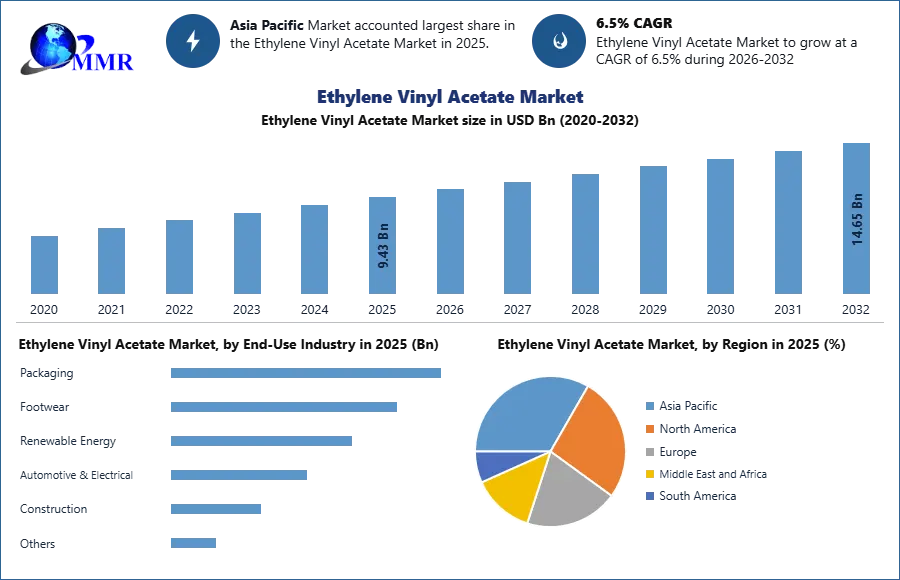
Ethylene Vinyl Acetate Market was valued at US$ 9.43 Bn. in 2025 and the total Ethylene Vinyl Acetate revenue is expected to grow at 6.5% from 2026 to 2032, reaching nearly US$ 14.65 Bn.

Ethylene Vinyl Acetate Market Overview:

The Ethylene Vinyl Acetate (EVA) market is poised for substantial growth, driven by the increasing demand for multipurpose solutions in various industries, particularly adhesives, sealants, and coatings. EVA's versatility makes it an ideal material for a wide range of applications, including flexible hoses, footwear components, automobile bumpers, moulded automotive parts, toys, athletic goods, and flexible packaging. The ability of EVA to provide excellent adhesion, flexibility, and impact resistance is a key factor fueling its adoption across diverse sectors. Additionally, the rising demand for sustainable and eco-friendly products is further bolstering the market, as EVA is considered a more environmentally friendly alternative to other synthetic materials. The automotive industry, in particular, has been a significant contributor to the growing demand for EVA due to its usage in parts that require high durability, such as bumpers and interior components. Similarly, the packaging industry is increasingly adopting EVA for its lightweight, durable, and moisture-resistant properties, making it a preferred choice for flexible packaging solutions. The expanding footwear market, which relies on EVA for its lightweight and cushioning properties, is also driving market growth. Furthermore, the continued advancements in manufacturing technologies, improving EVA's quality and cost-effectiveness, are likely to support its further penetration into new markets and applications. As these industries continue to grow and diversify, the global EVA market is set to expand significantly, with increasing demand for high-performance materials offering multifunctional properties across a range of sectors.

Ethylene Vinyl Acetate Market Report Scope:

The ethylene vinyl acetate market is segmented based on type, end-use industry and region. The growth of various segments helps report users in acquiring knowledge of the many growth factors expected to be prevalent throughout the market and develop different strategies to help identify core application areas and the gap in the ethylene vinyl acetate market. The report provides an in-depth analysis of the market and contains meaningful insights, facts, historical data, and statistically supported and industry-validated market statistics. It also includes estimates based on an appropriate set of assumptions and methodologies.

A bottom-up approach has been used to estimate the market size. Key Players in the ethylene vinyl acetate market are identified through secondary research and their market revenues are determined through primary and secondary research. Secondary research included a review of annual and financial reports of leading manufacturers, while primary research included interviews with important opinion leaders and industry experts such as skilled front-line personnel, entrepreneurs, and marketing professionals. Some of the leading key players in the global Ethylene Vinyl Acetate market include BASF SE, Exxon Mobil Corporation, The Dow Chemical Company, Formosa Plastic Corporation, and Celanese Corporation. The report is not only a representation of global players but also covers the market holding of local players in each country. Market structure by country with market holding by market leaders, market followers, and local players make this report a comprehensive and insightful industry outlook. The report has covered the mergers and acquisitions, strategic alliances, joint ventures, and partnerships happening in the market by region, by investment, and their strategic intent.
To know about the Research Methodology:-Request Free Sample Report

Ethylene Vinyl Acetate Market Dynamics:

Driver: Versatility in Applications

One of the major drivers of the Ethylene Vinyl Acetate (EVA) market is its exceptional versatility in numerous applications across a variety of industries. EVA is widely recognized for its excellent properties such as flexibility, impact resistance, and strong adhesion. These characteristics make it an ideal material in sectors like automotive, footwear, packaging, and consumer goods. In the automotive industry, EVA is commonly used in bumpers, molded parts, and interior components due to its durability and resistance to environmental stressors.

The growing demand for lightweight and cushioned footwear has boosted the use of EVA in shoes, particularly in midsoles, insoles, and soles, providing superior comfort and performance. EVA's role in packaging has also expanded significantly, especially in flexible packaging, due to its moisture resistance and barrier properties that help preserve product freshness. In addition to these key sectors, EVA’s usage is growing in the production of toys, athletic goods, and even medical applications, demonstrating its adaptability across diverse markets. The widespread adoption of EVA due to its multi-functional benefits across various applications, coupled with increasing demand for lightweight, durable, and cost-effective materials, is driving growth in the EVA market globally.

Opportunity: Sustainability and Eco-friendly Demand

An emerging opportunity in the Ethylene Vinyl Acetate (EVA) market lies in the growing demand for sustainable and eco-friendly materials across various industries. With increasing global awareness regarding environmental concerns and climate change, industries are increasingly seeking materials that minimize environmental impact. EVA is gaining traction due to its potential for being produced in more environmentally friendly ways compared to other synthetic polymers.

For instance, bio-based EVA, derived from renewable sources such as sugarcane, is a growing trend. This bio-based variant offers a sustainable alternative to conventional EVA produced from fossil fuels, making it attractive for industries aiming to reduce their carbon footprint. Furthermore, the recycling of EVA products, particularly in packaging applications, is becoming more common, as it is easier to recycle compared to other plastics, contributing to circular economy practices. As consumers and industries place greater emphasis on sustainability, there is significant growth potential for EVA manufacturers to innovate and provide eco-friendly solutions.

Restraint: Volatility in Raw Material Prices

One significant restraint in the growth of the Ethylene Vinyl Acetate (EVA) market is the volatility in the prices of its primary raw materials, particularly ethylene and vinyl acetate. Ethylene is derived from fossil fuels, and its price is highly sensitive to fluctuations in global crude oil prices, which are influenced by geopolitical factors, supply-demand imbalances, and other economic events. Vinyl acetate, another crucial component, is also subject to price variations based on market dynamics. These fluctuations in raw material prices can have a direct impact on the production costs of EVA, making it more expensive for manufacturers.

As a result, such price instability can reduce profit margins and pose challenges for manufacturers to maintain stable production costs, leading to an unpredictable market environment. This volatility may also hinder the market's ability to scale in emerging economies, where price sensitivity is a critical factor in purchasing decisions. Additionally, the reliance on petrochemicals and the oil and gas industry for these raw materials adds another layer of uncertainty to the market, as potential disruptions in the supply of crude oil or changes in government policies related to petroleum products could further escalate costs. As a result, market growth can be stunted by these uncertainties in the pricing of key raw materials.

Ethylene Vinyl Acetate Market Segment Analysis

Based on Type, Low-Density Ethylene Vinyl Acetate (LEVA) is the dominant type in the global Ethylene Vinyl Acetate (EVA) market. LEVA is known for its superior flexibility, softness, and low-density characteristics, making it highly desirable for applications requiring elasticity and impact resistance. Its low-density properties allow it to be processed into flexible, lightweight products, contributing to its widespread use in industries such as footwear, automotive, and packaging. In footwear, LEVA is commonly used in the production of shoe soles, midsoles, and insoles, where cushioning, comfort, and flexibility are essential. The material is also popular in the automotive industry for parts such as bumpers, molded components, and interior parts, where its ability to absorb shocks and resist stress is highly valued. Additionally, LEVA is used extensively in flexible packaging, providing durability, moisture resistance, and excellent barrier properties for food and consumer goods.

Based on Processing Technology, Extrusion is the dominant processing technology in the production of Ethylene Vinyl Acetate (EVA), primarily due to its efficiency and ability to produce a wide variety of shapes and sizes. The extrusion process involves forcing EVA resin through a die to create continuous profiles, sheets, films, and other shapes, making it ideal for large-scale manufacturing and mass production. This method is particularly well-suited for applications requiring thin, uniform films, such as in packaging materials, as well as for creating flexible products like hoses, pipes, and wire coatings. The extrusion process also allows for the integration of additives into the EVA resin, such as colorants, fillers, and stabilizers, providing additional customization for specific applications. In the footwear industry, extrusion is widely used to produce EVA sheets for midsoles, soles, and insoles, which require a high level of consistency and performance.

Ethylene Vinyl Acetate Market Regional Insights

The market for Low-Density Ethylene Vinyl Acetate (LEVA) in the Asia Pacific region is experiencing significant growth, driven by increased demand from various industries such as footwear, packaging, automotive, and consumer goods. LEVA's unique properties, including flexibility, impact resistance, and low density, make it highly suitable for applications that require lightweight, durable, and flexible materials. In the footwear sector, LEVA is extensively used in the production of shoe soles, insoles, and midsoles, especially in countries like China, India, and Vietnam, where the footwear industry is booming due to large-scale production and export. The automotive industry in the region is another key driver for LEVA, as manufacturers seek lightweight materials to improve fuel efficiency and performance in vehicles. LEVA's application in automotive bumpers, molded parts, and interior components is gaining momentum, particularly in countries with robust automotive production, such as Japan, South Korea, and China. Additionally, LEVA’s use in flexible packaging is expanding rapidly due to its moisture resistance, durability, and excellent barrier properties, making it a popular choice in packaging for food, consumer goods, and electronics. The Asia Pacific region's strong manufacturing base, coupled with increasing consumer demand for sustainable and cost-effective products, is accelerating LEVA adoption. Furthermore, growing environmental awareness is pushing the region towards more eco-friendly materials, with LEVA offering a lower environmental footprint compared to other polymers.

Recent Developments

On March 2026: ExxonMobil reported its full‑year 2025 earnings, delivering strong results with $28.8 billion in total earnings and significant cash flow, supporting its chemical and refining segments amidst a challenging industry backdrop. In addition to strong financials, the company’s Board recommended redomiciling its legal headquarters from New Jersey to Texas, aligning corporate structure with its operational base. ExxonMobil also agreed this year to restructure its chemical recycling partnership, shifting ownership stakes of Cyclyx International with partners such as LyondellBasell to optimize recycling assets. However, the company plans to close its long‑running Fife ethylene plant in Scotland in early 2026, citing high operating costs and weak markets — a move indicative of strategic rationalization amid broader petrochemical headwinds.

On January 2026: Dow Inc. launched its “Transform to Outperform” strategic initiative aimed at boosting productivity and profitability, targeting at least $2 billion in near‑term EBITDA improvements via streamlined operations and enhanced use of AI and automation. As part of this plan, Dow announced a significant workforce restructuring, cutting approximately 4,500 jobs (13 % of employees) to reduce costs and reposition the company amid ongoing sector headwinds. Despite these challenges, the company continues to participate in industry events (such as the J.P. Morgan Industrials Conference) and reported about $40 billion in sales for 2025. However, broader market pressures have also affected its stock performance, reflecting pressures in the chemicals sector tied to feedstock costs and demand variability.

Ethylene Vinyl Acetate Market Scope: Inquire before buying

Ethylene Vinyl Acetate Market
Report Coverage Details
Base Year: 2025 Forecast Period: 2026-2032
Historical Data: 2020 to 2025 Market Size in 2025: 9.43 USD Bn
Forecast Period 2026-2032 CAGR: 6.5% Market Size in 2032: 14.65 USD Bn
Segments Covered: by Type Low Density Ethylene Vinyl Acetate (LEVA)
Medium Density Ethylene Vinyl Acetate (MEVA)
High Density Ethylene Vinyl Acetate (HEVA)
by Processing Technology On-Premise
Cloud
by Application Film
Foam
Adhesives & Sealants
Solar Cell Encapsulation
Others
by End-Use Industry Packaging
Footwear
Renewable Energy
Automotive & Electrical
Construction
Others

Ethylene Vinyl Acetate Market, by Region

North America (United States, Canada, Mexico)
Europe (United Kingdom, France, Germany, Italy, Spain, Sweden, Russia, Poland, Belgium, Netherlands, Rest of Europe)
Asia Pacific (China, South Korea, India, Japan, Australia, Indonesia, Malaysia, Philippines, Thailand, Vietnam, Rest of Asia Pacific)
Middle East & Africa (South Africa, GCC, Egypt, Nigeria, Rest of MEA)
South America (Brazil, Argentina, Colombia, Chile, Rest of South America)

Key players/Competitors profiles covered in the Ethylene Vinyl Acetate Market report in strategic perspective

  1. ExxonMobil Corporation
  2. Dow Inc.
  3. Celanese Corporation
  4. BASF SE
  5. Arkema Group
  6. LG Chem
  7. LyondellBasell Industries
  8. Formosa Plastics Corporation
  9. Hanwha Total Petrochemical
  10. SIPCHEM
  11. Innospec
  12. Clariant AG
  13. Infineum International Limited
  14. United Plastic Components Inc.
  15. Porex Corporation
  16. USI Corporation
  17. Albis Plastics
  18. Armacell
  19. Bamberger Polymers
  20. Beologic
  21. Borealis
  22. Bostik
  23. Braskem
  24. BYK
  25. Cabot Corporation
  26. National Analytical Corporation
  27. Patel Export Industries
  28. Chempha Industries
  29. Yash Polyplast
  30. Mk Resources

Table of Contents

1. Ethylene Vinyl Acetate Market Introduction
1.1. Study Assumption and Market Definition
1.2. Scope of the Study
1.3. Executive Summary
2. Global Ethylene Vinyl Acetate Market: Competitive Landscape
2.1. MMR Competition Matrix
2.2. Competitive Landscape
2.3. Key Players Benchmarking
2.3.1. Company Name
2.3.2. Business Segment
2.3.3. End-user Segment
2.3.4. Revenue (2025)
2.3.5. Company Locations
2.4. Leading Ethylene Vinyl Acetate Market Companies, by market capitalization
2.5. Market Structure
2.5.1. Market Leaders
2.5.2. Market Followers
2.5.3. Emerging Players
2.6. Mergers and Acquisitions Details
3. Ethylene Vinyl Acetate Market: Dynamics
3.1. Ethylene Vinyl Acetate Market Trends by Region
3.1.1. North America Ethylene Vinyl Acetate Market Trends
3.1.2. Europe Ethylene Vinyl Acetate Market Trends
3.1.3. Asia Pacific Ethylene Vinyl Acetate Market Trends
3.1.4. Middle East and Africa Ethylene Vinyl Acetate Market Trends
3.1.5. South America Ethylene Vinyl Acetate Market Trends
3.2. Ethylene Vinyl Acetate Market Dynamics by Region
3.2.1. North America
3.2.1.1. North America Ethylene Vinyl Acetate Market Drivers
3.2.1.2. North America Ethylene Vinyl Acetate Market Restraints
3.2.1.3. North America Ethylene Vinyl Acetate Market Opportunities
3.2.1.4. North America Ethylene Vinyl Acetate Market Challenges
3.2.2. Europe
3.2.2.1. Europe Ethylene Vinyl Acetate Market Drivers
3.2.2.2. Europe Ethylene Vinyl Acetate Market Restraints
3.2.2.3. Europe Ethylene Vinyl Acetate Market Opportunities
3.2.2.4. Europe Ethylene Vinyl Acetate Market Challenges
3.2.3. Asia Pacific
3.2.3.1. Asia Pacific Ethylene Vinyl Acetate Market Drivers
3.2.3.2. Asia Pacific Ethylene Vinyl Acetate Market Restraints
3.2.3.3. Asia Pacific Ethylene Vinyl Acetate Market Opportunities
3.2.3.4. Asia Pacific Ethylene Vinyl Acetate Market Challenges
3.2.4. Middle East and Africa
3.2.4.1. Middle East and Africa Ethylene Vinyl Acetate Market Drivers
3.2.4.2. Middle East and Africa Ethylene Vinyl Acetate Market Restraints
3.2.4.3. Middle East and Africa Ethylene Vinyl Acetate Market Opportunities
3.2.4.4. Middle East and Africa Ethylene Vinyl Acetate Market Challenges
3.2.5. South America
3.2.5.1. South America Ethylene Vinyl Acetate Market Drivers
3.2.5.2. South America Ethylene Vinyl Acetate Market Restraints
3.2.5.3. South America Ethylene Vinyl Acetate Market Opportunities
3.2.5.4. South America Ethylene Vinyl Acetate Market Challenges
3.3. PORTER's Five Forces Analysis
3.4. PESTLE Analysis
3.5. Technology Roadmap
3.6. Regulatory Landscape by Region
3.6.1. North America
3.6.2. Europe
3.6.3. Asia Pacific
3.6.4. Middle East and Africa
3.6.5. South America
3.7. Key Opinion Leader Analysis For Ethylene Vinyl Acetate Industry
3.8. Analysis of Government Schemes and Initiatives For Ethylene Vinyl Acetate Industry
3.9. Ethylene Vinyl Acetate Market Trade Analysis
3.10. The Global Pandemic Impact on Ethylene Vinyl Acetate Market
4. Ethylene Vinyl Acetate Market: Global Market Size and Forecast by Segmentation (in USD Bn) 2025-2032
4.1. Ethylene Vinyl Acetate Market Size and Forecast, by Type (2025-2032)
4.1.1. Low Density Ethylene Vinyl Acetate (LEVA)
4.1.2. Medium Density Ethylene Vinyl Acetate (MEVA)
4.1.3. High Density Ethylene Vinyl Acetate (HEVA)
4.2. Ethylene Vinyl Acetate Market Size and Forecast, by Processing Technology (2025-2032)
4.2.1. On-Premise
4.2.2. Cloud
4.3. Ethylene Vinyl Acetate Market Size and Forecast, by Application (2025-2032)
4.3.1. Film
4.3.2. Foam
4.3.3. Adhesives & Sealants
4.3.4. Solar Cell Encapsulation
4.3.5. Others
4.4. Ethylene Vinyl Acetate Market Size and Forecast, by End-Use Industry (2025-2032)
4.4.1. Packaging
4.4.2. Footwear
4.4.3. Renewable Energy
4.4.4. Automotive & Electrical
4.4.5. Construction
4.4.6. Others
4.5. Ethylene Vinyl Acetate Market Size and Forecast, by Region (2025-2032)
4.5.1. North America
4.5.2. Europe
4.5.3. Asia Pacific
4.5.4. Middle East and Africa
4.5.5. South America
5. North America Ethylene Vinyl Acetate Market Size and Forecast by Segmentation (in USD Bn) 2025-2032
5.1. North America Ethylene Vinyl Acetate Market Size and Forecast, by Type (2025-2032)
5.1.1. Low Density Ethylene Vinyl Acetate (LEVA)
5.1.2. Medium Density Ethylene Vinyl Acetate (MEVA)
5.1.3. High Density Ethylene Vinyl Acetate (HEVA)
5.2. North America Ethylene Vinyl Acetate Market Size and Forecast, by Processing Technology (2025-2032)
5.2.1. On-Premise
5.2.2. Cloud
5.3. North America Ethylene Vinyl Acetate Market Size and Forecast, by Application (2025-2032)
5.3.1. Film
5.3.2. Foam
5.3.3. Adhesives & Sealants
5.3.4. Solar Cell Encapsulation
5.3.5. Others
5.4. North America Ethylene Vinyl Acetate Market Size and Forecast, by End-Use Industry (2025-2032)
5.4.1. Packaging
5.4.2. Footwear
5.4.3. Renewable Energy
5.4.4. Automotive & Electrical
5.4.5. Construction
5.4.6. Others
5.5. North America Ethylene Vinyl Acetate Market Size and Forecast, by Country (2025-2032)
5.5.1. United States
5.5.1.1. United States Ethylene Vinyl Acetate Market Size and Forecast, by Type (2025-2032)
5.5.1.1.1. Low Density Ethylene Vinyl Acetate (LEVA)
5.5.1.1.2. Medium Density Ethylene Vinyl Acetate (MEVA)
5.5.1.1.3. High Density Ethylene Vinyl Acetate (HEVA)
5.5.1.2. United States Ethylene Vinyl Acetate Market Size and Forecast, by Processing Technology (2025-2032)
5.5.1.2.1. On-Premise
5.5.1.2.2. Cloud
5.5.1.3. United States Ethylene Vinyl Acetate Market Size and Forecast, by Application (2025-2032)
5.5.1.3.1. Film
5.5.1.3.2. Foam
5.5.1.3.3. Adhesives & Sealants
5.5.1.3.4. Solar Cell Encapsulation
5.5.1.3.5. Others
5.5.1.4. United States Ethylene Vinyl Acetate Market Size and Forecast, by End-Use Industry (2025-2032)
5.5.1.4.1. Packaging
5.5.1.4.2. Footwear
5.5.1.4.3. Renewable Energy
5.5.1.4.4. Automotive & Electrical
5.5.1.4.5. Construction
5.5.1.4.6. Others
5.5.2. Canada
5.5.2.1. Canada Ethylene Vinyl Acetate Market Size and Forecast, by Type (2025-2032)
5.5.2.1.1. Low Density Ethylene Vinyl Acetate (LEVA)
5.5.2.1.2. Medium Density Ethylene Vinyl Acetate (MEVA)
5.5.2.1.3. High Density Ethylene Vinyl Acetate (HEVA)
5.5.2.2. Canada Ethylene Vinyl Acetate Market Size and Forecast, by Processing Technology (2025-2032)
5.5.2.2.1. On-Premise
5.5.2.2.2. Cloud
5.5.2.3. Canada Ethylene Vinyl Acetate Market Size and Forecast, by Application (2025-2032)
5.5.2.3.1. Film
5.5.2.3.2. Foam
5.5.2.3.3. Adhesives & Sealants
5.5.2.3.4. Solar Cell Encapsulation
5.5.2.3.5. Others
5.5.2.4. Canada Ethylene Vinyl Acetate Market Size and Forecast, by End-Use Industry (2025-2032)
5.5.2.4.1. Packaging
5.5.2.4.2. Footwear
5.5.2.4.3. Renewable Energy
5.5.2.4.4. Automotive & Electrical
5.5.2.4.5. Construction
5.5.2.4.6. Others
5.5.3. Mexico
5.5.3.1. Mexico Ethylene Vinyl Acetate Market Size and Forecast, by Type (2025-2032)
5.5.3.1.1. Low Density Ethylene Vinyl Acetate (LEVA)
5.5.3.1.2. Medium Density Ethylene Vinyl Acetate (MEVA)
5.5.3.1.3. High Density Ethylene Vinyl Acetate (HEVA)
5.5.3.2. Mexico Ethylene Vinyl Acetate Market Size and Forecast, by Processing Technology (2025-2032)
5.5.3.2.1. On-Premise
5.5.3.2.2. Cloud
5.5.3.3. Mexico Ethylene Vinyl Acetate Market Size and Forecast, by Application (2025-2032)
5.5.3.3.1. Film
5.5.3.3.2. Foam
5.5.3.3.3. Adhesives & Sealants
5.5.3.3.4. Solar Cell Encapsulation
5.5.3.3.5. Others
5.5.3.4. Mexico Ethylene Vinyl Acetate Market Size and Forecast, by End-Use Industry (2025-2032)
5.5.3.4.1. Packaging
5.5.3.4.2. Footwear
5.5.3.4.3. Renewable Energy
5.5.3.4.4. Automotive & Electrical
5.5.3.4.5. Construction
5.5.3.4.6. Others
6. Europe Ethylene Vinyl Acetate Market Size and Forecast by Segmentation (in USD Bn) 2025-2032
6.1. Europe Ethylene Vinyl Acetate Market Size and Forecast, by Type (2025-2032)
6.2. Europe Ethylene Vinyl Acetate Market Size and Forecast, by Processing Technology (2025-2032)
6.3. Europe Ethylene Vinyl Acetate Market Size and Forecast, by Application (2025-2032)
6.4. Europe Ethylene Vinyl Acetate Market Size and Forecast, by End-Use Industry (2025-2032)
6.5. Europe Ethylene Vinyl Acetate Market Size and Forecast, by Country (2025-2032)
6.5.1. United Kingdom
6.5.1.1. United Kingdom Ethylene Vinyl Acetate Market Size and Forecast, by Type (2025-2032)
6.5.1.2. United Kingdom Ethylene Vinyl Acetate Market Size and Forecast, by Processing Technology (2025-2032)
6.5.1.3. United Kingdom Ethylene Vinyl Acetate Market Size and Forecast, by Application (2025-2032)
6.5.1.4. United Kingdom Ethylene Vinyl Acetate Market Size and Forecast, by End-Use Industry (2025-2032)
6.5.2. France
6.5.2.1. France Ethylene Vinyl Acetate Market Size and Forecast, by Type (2025-2032)
6.5.2.2. France Ethylene Vinyl Acetate Market Size and Forecast, by Processing Technology (2025-2032)
6.5.2.3. France Ethylene Vinyl Acetate Market Size and Forecast, by Application (2025-2032)
6.5.2.4. France Ethylene Vinyl Acetate Market Size and Forecast, by End-Use Industry (2025-2032)
6.5.3. Germany
6.5.3.1. Germany Ethylene Vinyl Acetate Market Size and Forecast, by Type (2025-2032)
6.5.3.2. Germany Ethylene Vinyl Acetate Market Size and Forecast, by Processing Technology (2025-2032)
6.5.3.3. Germany Ethylene Vinyl Acetate Market Size and Forecast, by Application (2025-2032)
6.5.3.4. Germany Ethylene Vinyl Acetate Market Size and Forecast, by End-Use Industry (2025-2032)
6.5.4. Italy
6.5.4.1. Italy Ethylene Vinyl Acetate Market Size and Forecast, by Type (2025-2032)
6.5.4.2. Italy Ethylene Vinyl Acetate Market Size and Forecast, by Processing Technology (2025-2032)
6.5.4.3. Italy Ethylene Vinyl Acetate Market Size and Forecast, by Application (2025-2032)
6.5.4.4. Italy Ethylene Vinyl Acetate Market Size and Forecast, by End-Use Industry (2025-2032)
6.5.5. Spain
6.5.5.1. Spain Ethylene Vinyl Acetate Market Size and Forecast, by Type (2025-2032)
6.5.5.2. Spain Ethylene Vinyl Acetate Market Size and Forecast, by Processing Technology (2025-2032)
6.5.5.3. Spain Ethylene Vinyl Acetate Market Size and Forecast, by Application (2025-2032)
6.5.5.4. Spain Ethylene Vinyl Acetate Market Size and Forecast, by End-Use Industry (2025-2032)
6.5.6. Sweden
6.5.6.1. Sweden Ethylene Vinyl Acetate Market Size and Forecast, by Type (2025-2032)
6.5.6.2. Sweden Ethylene Vinyl Acetate Market Size and Forecast, by Processing Technology (2025-2032)
6.5.6.3. Sweden Ethylene Vinyl Acetate Market Size and Forecast, by Application (2025-2032)
6.5.6.4. Sweden Ethylene Vinyl Acetate Market Size and Forecast, by End-Use Industry (2025-2032)
6.5.7. Austria
6.5.7.1. Austria Ethylene Vinyl Acetate Market Size and Forecast, by Type (2025-2032)
6.5.7.2. Austria Ethylene Vinyl Acetate Market Size and Forecast, by Processing Technology (2025-2032)
6.5.7.3. Austria Ethylene Vinyl Acetate Market Size and Forecast, by Application (2025-2032)
6.5.7.4. Austria Ethylene Vinyl Acetate Market Size and Forecast, by End-Use Industry (2025-2032)
6.5.8. Rest of Europe
6.5.8.1. Rest of Europe Ethylene Vinyl Acetate Market Size and Forecast, by Type (2025-2032)
6.5.8.2. Rest of Europe Ethylene Vinyl Acetate Market Size and Forecast, by Processing Technology (2025-2032)
6.5.8.3. Rest of Europe Ethylene Vinyl Acetate Market Size and Forecast, by Application (2025-2032)
6.5.8.4. Rest of Europe Ethylene Vinyl Acetate Market Size and Forecast, by End-Use Industry (2025-2032)
7. Asia Pacific Ethylene Vinyl Acetate Market Size and Forecast by Segmentation (in USD Bn) 2025-2032
7.1. Asia Pacific Ethylene Vinyl Acetate Market Size and Forecast, by Type (2025-2032)
7.2. Asia Pacific Ethylene Vinyl Acetate Market Size and Forecast, by Processing Technology (2025-2032)
7.3. Asia Pacific Ethylene Vinyl Acetate Market Size and Forecast, by Application (2025-2032)
7.4. Asia Pacific Ethylene Vinyl Acetate Market Size and Forecast, by End-Use Industry (2025-2032)
7.5. Asia Pacific Ethylene Vinyl Acetate Market Size and Forecast, by Country (2025-2032)
7.5.1. China
7.5.1.1. China Ethylene Vinyl Acetate Market Size and Forecast, by Type (2025-2032)
7.5.1.2. China Ethylene Vinyl Acetate Market Size and Forecast, by Processing Technology (2025-2032)
7.5.1.3. China Ethylene Vinyl Acetate Market Size and Forecast, by Application (2025-2032)
7.5.1.4. China Ethylene Vinyl Acetate Market Size and Forecast, by End-Use Industry (2025-2032)
7.5.2. S Korea
7.5.2.1. S Korea Ethylene Vinyl Acetate Market Size and Forecast, by Type (2025-2032)
7.5.2.2. S Korea Ethylene Vinyl Acetate Market Size and Forecast, by Processing Technology (2025-2032)
7.5.2.3. S Korea Ethylene Vinyl Acetate Market Size and Forecast, by Application (2025-2032)
7.5.2.4. S Korea Ethylene Vinyl Acetate Market Size and Forecast, by End-Use Industry (2025-2032)
7.5.3. Japan
7.5.3.1. Japan Ethylene Vinyl Acetate Market Size and Forecast, by Type (2025-2032)
7.5.3.2. Japan Ethylene Vinyl Acetate Market Size and Forecast, by Processing Technology (2025-2032)
7.5.3.3. Japan Ethylene Vinyl Acetate Market Size and Forecast, by Application (2025-2032)
7.5.3.4. Japan Ethylene Vinyl Acetate Market Size and Forecast, by End-Use Industry (2025-2032)
7.5.4. India
7.5.4.1. India Ethylene Vinyl Acetate Market Size and Forecast, by Type (2025-2032)
7.5.4.2. India Ethylene Vinyl Acetate Market Size and Forecast, by Processing Technology (2025-2032)
7.5.4.3. India Ethylene Vinyl Acetate Market Size and Forecast, by Application (2025-2032)
7.5.4.4. India Ethylene Vinyl Acetate Market Size and Forecast, by End-Use Industry (2025-2032)
7.5.5. Australia
7.5.5.1. Australia Ethylene Vinyl Acetate Market Size and Forecast, by Type (2025-2032)
7.5.5.2. Australia Ethylene Vinyl Acetate Market Size and Forecast, by Processing Technology (2025-2032)
7.5.5.3. Australia Ethylene Vinyl Acetate Market Size and Forecast, by Application (2025-2032)
7.5.5.4. Australia Ethylene Vinyl Acetate Market Size and Forecast, by End-Use Industry (2025-2032)
7.5.6. Indonesia
7.5.6.1. Indonesia Ethylene Vinyl Acetate Market Size and Forecast, by Type (2025-2032)
7.5.6.2. Indonesia Ethylene Vinyl Acetate Market Size and Forecast, by Processing Technology (2025-2032)
7.5.6.3. Indonesia Ethylene Vinyl Acetate Market Size and Forecast, by Application (2025-2032)
7.5.6.4. Indonesia Ethylene Vinyl Acetate Market Size and Forecast, by End-Use Industry (2025-2032)
7.5.7. Malaysia
7.5.7.1. Malaysia Ethylene Vinyl Acetate Market Size and Forecast, by Type (2025-2032)
7.5.7.2. Malaysia Ethylene Vinyl Acetate Market Size and Forecast, by Processing Technology (2025-2032)
7.5.7.3. Malaysia Ethylene Vinyl Acetate Market Size and Forecast, by Application (2025-2032)
7.5.7.4. Malaysia Ethylene Vinyl Acetate Market Size and Forecast, by End-Use Industry (2025-2032)
7.5.8. Vietnam
7.5.8.1. Vietnam Ethylene Vinyl Acetate Market Size and Forecast, by Type (2025-2032)
7.5.8.2. Vietnam Ethylene Vinyl Acetate Market Size and Forecast, by Processing Technology (2025-2032)
7.5.8.3. Vietnam Ethylene Vinyl Acetate Market Size and Forecast, by Application (2025-2032)
7.5.8.4. Vietnam Ethylene Vinyl Acetate Market Size and Forecast, by End-Use Industry (2025-2032)
7.5.9. Taiwan
7.5.9.1. Taiwan Ethylene Vinyl Acetate Market Size and Forecast, by Type (2025-2032)
7.5.9.2. Taiwan Ethylene Vinyl Acetate Market Size and Forecast, by Processing Technology (2025-2032)
7.5.9.3. Taiwan Ethylene Vinyl Acetate Market Size and Forecast, by Application (2025-2032)
7.5.9.4. Taiwan Ethylene Vinyl Acetate Market Size and Forecast, by End-Use Industry (2025-2032)
7.5.10. Rest of Asia Pacific
7.5.10.1. Rest of Asia Pacific Ethylene Vinyl Acetate Market Size and Forecast, by Type (2025-2032)
7.5.10.2. Rest of Asia Pacific Ethylene Vinyl Acetate Market Size and Forecast, by Processing Technology (2025-2032)
7.5.10.3. Rest of Asia Pacific Ethylene Vinyl Acetate Market Size and Forecast, by Application (2025-2032)
7.5.10.4. Rest of Asia Pacific Ethylene Vinyl Acetate Market Size and Forecast, by End-Use Industry (2025-2032)
8. Middle East and Africa Ethylene Vinyl Acetate Market Size and Forecast by Segmentation (in USD Bn) 2025-2032
8.1. Middle East and Africa Ethylene Vinyl Acetate Market Size and Forecast, by Type (2025-2032)
8.2. Middle East and Africa Ethylene Vinyl Acetate Market Size and Forecast, by Processing Technology (2025-2032)
8.3. Middle East and Africa Ethylene Vinyl Acetate Market Size and Forecast, by Application (2025-2032)
8.4. Middle East and Africa Ethylene Vinyl Acetate Market Size and Forecast, by End-Use Industry (2025-2032)
8.5. Middle East and Africa Ethylene Vinyl Acetate Market Size and Forecast, by Country (2025-2032)
8.5.1. South Africa
8.5.1.1. South Africa Ethylene Vinyl Acetate Market Size and Forecast, by Type (2025-2032)
8.5.1.2. South Africa Ethylene Vinyl Acetate Market Size and Forecast, by Processing Technology (2025-2032)
8.5.1.3. South Africa Ethylene Vinyl Acetate Market Size and Forecast, by Application (2025-2032)
8.5.1.4. South Africa Ethylene Vinyl Acetate Market Size and Forecast, by End-Use Industry (2025-2032)
8.5.2. GCC
8.5.2.1. GCC Ethylene Vinyl Acetate Market Size and Forecast, by Type (2025-2032)
8.5.2.2. GCC Ethylene Vinyl Acetate Market Size and Forecast, by Processing Technology (2025-2032)
8.5.2.3. GCC Ethylene Vinyl Acetate Market Size and Forecast, by Application (2025-2032)
8.5.2.4. GCC Ethylene Vinyl Acetate Market Size and Forecast, by End-Use Industry (2025-2032)
8.5.3. Nigeria
8.5.3.1. Nigeria Ethylene Vinyl Acetate Market Size and Forecast, by Type (2025-2032)
8.5.3.2. Nigeria Ethylene Vinyl Acetate Market Size and Forecast, by Processing Technology (2025-2032)
8.5.3.3. Nigeria Ethylene Vinyl Acetate Market Size and Forecast, by Application (2025-2032)
8.5.3.4. Nigeria Ethylene Vinyl Acetate Market Size and Forecast, by End-Use Industry (2025-2032)
8.5.4. Rest of ME&A
8.5.4.1. Rest of ME&A Ethylene Vinyl Acetate Market Size and Forecast, by Type (2025-2032)
8.5.4.2. Rest of ME&A Ethylene Vinyl Acetate Market Size and Forecast, by Processing Technology (2025-2032)
8.5.4.3. Rest of ME&A Ethylene Vinyl Acetate Market Size and Forecast, by Application (2025-2032)
8.5.4.4. Rest of ME&A Ethylene Vinyl Acetate Market Size and Forecast, by End-Use Industry (2025-2032)
9. South America Ethylene Vinyl Acetate Market Size and Forecast by Segmentation (in USD Bn) 2025-2032
9.1. South America Ethylene Vinyl Acetate Market Size and Forecast, by Type (2025-2032)
9.2. South America Ethylene Vinyl Acetate Market Size and Forecast, by Processing Technology (2025-2032)
9.3. South America Ethylene Vinyl Acetate Market Size and Forecast, by Application (2025-2032)
9.4. South America Ethylene Vinyl Acetate Market Size and Forecast, by End-Use Industry (2025-2032)
9.5. South America Ethylene Vinyl Acetate Market Size and Forecast, by Country (2025-2032)
9.5.1. Brazil
9.5.1.1. Brazil Ethylene Vinyl Acetate Market Size and Forecast, by Type (2025-2032)
9.5.1.2. Brazil Ethylene Vinyl Acetate Market Size and Forecast, by Processing Technology (2025-2032)
9.5.1.3. Brazil Ethylene Vinyl Acetate Market Size and Forecast, by Application (2025-2032)
9.5.1.4. Brazil Ethylene Vinyl Acetate Market Size and Forecast, by End-Use Industry (2025-2032)
9.5.2. Argentina
9.5.2.1. Argentina Ethylene Vinyl Acetate Market Size and Forecast, by Type (2025-2032)
9.5.2.2. Argentina Ethylene Vinyl Acetate Market Size and Forecast, by Processing Technology (2025-2032)
9.5.2.3. Argentina Ethylene Vinyl Acetate Market Size and Forecast, by Application (2025-2032)
9.5.2.4. Argentina Ethylene Vinyl Acetate Market Size and Forecast, by End-Use Industry (2025-2032)
9.5.3. Rest Of South America
9.5.3.1. Rest Of South America Ethylene Vinyl Acetate Market Size and Forecast, by Type (2025-2032)
9.5.3.2. Rest Of South America Ethylene Vinyl Acetate Market Size and Forecast, by Processing Technology (2025-2032)
9.5.3.3. Rest Of South America Ethylene Vinyl Acetate Market Size and Forecast, by Application (2025-2032)
9.5.3.4. Rest Of South America Ethylene Vinyl Acetate Market Size and Forecast, by End-Use Industry (2025-2032)
10. Company Profile: Key Players
10.1. ExxonMobil Corporation
10.1.1. Company Overview
10.1.2. Business Portfolio
10.1.3. Financial Overview
10.1.4. SWOT Analysis
10.1.5. Strategic Analysis
10.1.6. Scale of Operation (small, medium, and large)
10.1.7. Details on Partnership
10.1.8. Regulatory Accreditations and Certifications Received by Them
10.1.9. Awards Received by the Firm
10.1.10. Recent Developments
10.2. Dow Inc.
10.3. Celanese Corporation
10.4. BASF SE
10.5. Arkema Group
10.6. LG Chem
10.7. LyondellBasell Industries
10.8. Formosa Plastics Corporation
10.9. Hanwha Total Petrochemical
10.10. SIPCHEM
10.11. Innospec
10.12. Clariant AG
10.13. Infineum International Limited
10.14. United Plastic Components Inc.
10.15. Porex Corporation
10.16. USI Corporation
10.17. Albis Plastics
10.18. Armacell
10.19. Bamberger Polymers
10.20. Beologic
10.21. Borealis
10.22. Bostik
10.23. Braskem
10.24. BYK
10.25. Cabot Corporation
10.26. National Analytical Corporation
10.27. Patel Export Industries
10.28. Chempha Industries
10.29. Yash Polyplast
10.30. Mk Resources
11. Key Findings
12. Industry Recommendations
13. Ethylene Vinyl Acetate Market: Research Methodology
14. Terms and Glossary

Custom Market Research Services

We Will Customise The Research For You, In Case The Report Listed Above Does Not Meet With Your Requirements