
Enterprise Mobility Management Market by Component, Deployment Mode, End User and Region – Global Market Size Estimation, Industry-Wide Analysis, Competitive Landscape Assessment & Long-Term Forecast to 2030
Overview
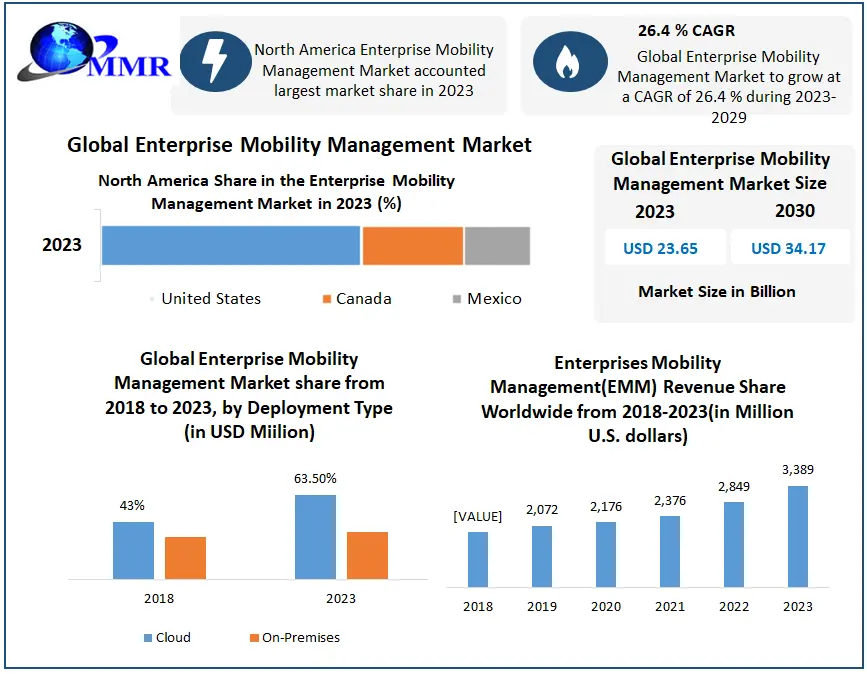
Global Enterprise Mobility Management Market size was valued at USD 23.65 Bn in 2023 and is expected to reach USD 34.17 Bn by 2030, at a CAGR of 26.4 %.
Enterprise Mobility Management (EMM) involves deploying and managing mobile devices, applications, and content within an organization. It encompasses Mobile Device Management (MDM), Mobile Application Management (MAM), and Mobile Content Management (MCM). Enterprise Mobility Management Market ensures secure and efficient mobile operations, allowing businesses to enhance productivity and streamline workflows. With the rising trend of remote work and the proliferation of mobile devices, EMM has become crucial for safeguarding corporate data, enforcing policies, and optimizing resource utilization. A major driver of the EMM market is the increasing adoption of bring-your-own-device (BYOD) policies. BYOD enhances employee flexibility but necessitates robust EMM solutions to manage diverse devices securely, driving the demand for comprehensive EMM solutions in the corporate landscape.
 To know about the Research Methodology :- Request Free Sample Report
VMware stands out prominently as a key player in the ever-evolving Enterprise Mobility Management (EMM) market. Their strategic acquisitions and innovative solutions have firmly established them as a powerhouse driving the industry forward. A pivotal move for VMware was the 2019 acquisition of Workspace ONE, a comprehensive platform integrating MDM, MAM, and MCM capabilities. This strategic integration positioned VMware to meet the growing demand for unified solutions in the expansive Enterprise Mobility Management market, projected to reach $46.7 billion by 2026. Workspace ONE, with over 20 million active users, underscores its widespread adoption.
To reinforce their commitment to EMM dominance, VMware launched Workspace ONE Unified Endpoint Management (UEM) in 2023. This ground-breaking offering extends beyond mobile devices, encompassing desktops, laptops, and various endpoints under a single management umbrella. This strategic move addresses the increasing need for holistic endpoint management within the dynamic Enterprise Mobility Management market.
Beyond impressive figures, VMware's impact is profound. Their emphasis on user experience and security resonates globally, with features like single sign-on, real-time device tracking, and robust data encryption making Workspace ONE a trusted choice for organizations prioritizing convenience and data protection. VMware's strategic acquisitions, innovative solutions, and focus on user experience have solidified their position as a leading force in the Enterprise Mobility Management market. Their ongoing commitment to expanding offerings and aligning with emerging trends positions them to capitalize on the significant growth potential within this dynamic landscape.
Enterprise Mobility Management Market Driver
Riding the Wave of Remote Work Revolution: Enterprise Mobility Management (EMM) Market Surges
The surge in the Enterprise Mobility Management (EMM) market is propelled by the seismic shift towards remote work. The United States is witnessing a notable uptick in EMM adoption as organizations prioritize empowering remote teams. Simultaneously, India is implementing comprehensive EMM strategies, contributing to the market's unprecedented growth. The pivotal role of EMM lies in providing secure and efficient mobile workforce management solutions, addressing the evolving needs of businesses in the remote work era. The demand for EMM solutions is fueled by the imperative to ensure seamless and protected mobility for a dispersed workforce, making it a driving force behind the market's robust expansion.
Security at the Forefront: EMM Market Thrives Amid Rising Cyber Threats
With escalating cyber threats globally, the Enterprise Mobility Management Market thrives as a linchpin for securing enterprise mobility. Recent developments in Germany showcase a reinforcement of EMM practices to safeguard sensitive data, while Singapore enhances EMM frameworks for government agencies, highlighting the heightened focus on EMM security measures. EMM's pivotal role in fortifying mobile ecosystems against evolving cyber threats positions it as a critical market driver. The increasing recognition of Enterprise Mobility Management Market as an essential component in the cybersecurity arsenal underscores its significance in ensuring the integrity and resilience of enterprise mobility in an era of persistent cyber challenges.
Enterprise Mobility Management (EMM): Navigating the Future Work Landscape Post-Pandemic
The Enterprise Mobility Management (EMM) market is gearing up for a dynamic trajectory, fuelled by two influential drivers: the paradigm shift towards hybrid work models and the persistent evolution of the cyber security landscape. In the wake of the pandemic, businesses are adopting remote and flexible work structures, making effective EMM paramount for managing, securing, and optimizing employee devices across diverse locations. Let's delve into the intricacies of these potent drivers and their profound impact on shaping the future of EMM. The Enterprise Mobility Management Market is on the brink of a transformative journey, propelled by the convergence of two pivotal drivers: the shift towards hybrid work models and the continual evolution of the cyber security landscape. In the aftermath of the pandemic, businesses are reimagining work structures, embracing remote and flexible paradigms, thereby accentuating the indispensable role of robust EMM solutions. This comprehensive approach is essential for the adept management, secure handling, and optimal performance of employee devices dispersed across diverse locations.
The first driver, labelled the Hybrid Hustle, encapsulates the profound transformation of the traditional office-centric work culture. With the rise of hybrid work, where employees seamlessly split their work time between traditional offices and remote locations, the demand for advanced Enterprise Mobility Management Market solutions has surged. This demand is driven by the diverse array of devices in use from laptops and tablets to smartphones – across various operating systems, necessitating EMM solutions that can adeptly manage this technological heterogeneity. Moreover, there is a heightened emphasis on data security and privacy, with sensitive corporate information transcending the conventional office boundaries, necessitating robust measures like data encryption and access controls. The efficient distribution, updating, and securing of work applications on devices, irrespective of their location, have become pivotal for streamlined operations in this hybrid work landscape. A noteworthy recent development is the collaboration between Reliance Jio and an EMM solution provider in India, underscoring the escalating demand for EMM solutions in the context of remote-first work environments.
The second driver, known as "Cyber Fort Knox," highlights the escalating cybersecurity threats in the face of an expanded attack surface due to increased device access. As malicious actors continually devise new strategies to exploit vulnerabilities and steal sensitive data, cybersecurity emerges as a critical consideration for Enterprise Mobility Management Market. The impact on EMM includes the integration of advanced threat detection technologies, such as malware detection, anti-phishing, and intrusion prevention, to fortify devices against evolving cyber threats. Granular control over user access and permissions becomes crucial to preventing unauthorized data access and breaches. Furthermore, compliance with stringent data privacy regulations, such as GDPR and CCPA, underscores the pivotal role of EMM solutions in ensuring data protection. The recent development of the European Union's announcement of the Cyber Resilience Act, mandating stricter cybersecurity measures for businesses, further underscores the essential role of robust EMM solutions in navigating the ever-evolving cybersecurity landscape.
As the EMM market stands at the precipice of explosive growth, driven by the dual forces of the hybrid workforce and escalating cybersecurity concerns, companies strategically investing in comprehensive EMM solutions will be well-positioned to empower their employees, safeguard their data, and thrive in the dynamic post-pandemic world.
Enterprise Mobility Management Market Restraints:
Despite the potential benefits of Enterprise Mobility Management (EMM) solutions, the market faces notable restraints. EMM vendors encounter challenges in customizing solutions to meet specific business requirements, leading to dissatisfaction among enterprises. Many struggle with the perceived inflexibility of EMM solutions, particularly in addressing the adaptability and agility needed for multi-client associations. Recognizing that each business possesses unique security needs for mobile devices accessing corporate networks adds another layer of complexity. Sellers also grapple with difficulties in seamlessly integrating EMM into an organization's existing security, management controls, and workflows within the dynamic Enterprise Mobility Management market.
However, a well-suited EMM solution holds the promise of enhancing both security and productivity by empowering IT administrators to efficiently control and monitor systems through a centralized portal. Yet, tailoring solutions to individual company needs proves challenging due to the diverse requirements across enterprises. The varied landscape of the Enterprise Mobility Management market demands different implementations of EMM solutions to ensure a consistently positive end-user experience while effectively addressing the distinct security needs of mobile devices within corporate networks.
Enterprise Mobility Management Market Opportunity:
The Enterprise Mobility Management market presents a significant opportunity in light of the rising threat of enterprise mobile phishing attacks. According to Lookout’s report, there has been a notable 37% global increase in enterprise mobile phishing attack rates since Q4 2019, with the US experiencing a particularly alarming 66% surge during the same period. As the deployment of cell phones in the workplace grows, there is a heightened need for training employees on proper mobile security protocols to mitigate such attacks.
To effectively counteract these threats, skilled cybersecurity professionals are essential, collaborating closely with developers to ensure robust security measures. For new organizations entering the Enterprise Mobility Management market, comprehensive data encryption using cryptographic hashes is imperative. Implementing a digital signature for each document, verified by the system to ensure data integrity, can help detect unauthorized access and notify concerned parties of any malicious activity promptly. Restricting data access through a robust verification system, including multifactor authentication for all network users, is crucial. Blockchain-based cybersecurity solutions, such as a digital identification system, can streamline the verification process. Additionally, adopting an AI-powered authentication mechanism that adjusts access privileges based on an employee's network and location further enhances security within the dynamic Enterprise Mobility Management market.
Enterprise Mobility Management Market Challenge:
Every organization must implement multiple workflow automation systems to operate seamlessly. In order to facilitate the sharing of crucial data, it is imperative to establish interconnectedness among various systems. Likewise, the coordination between devices, such as cell phones and workstations, should seamlessly integrate with sophisticated business frameworks. Failure to integrate cell phones with complex systems may result in data silos, where essential information is confined to one device and not shared across the organizational network. For instance, a remote employee who transitions to a different company but fails to share important files could create a data silo.
To address these challenges, advanced apps are essential. These applications should be capable of interacting with diverse complex business systems to streamline data processing and workflows. Additionally, in overcoming market challenges, Enterprise Mobility Management (EMM) plays a crucial role. EMM not only ensures the effective coordination of devices but also adds resilience to the overall workflow automation. The Enterprise Mobility Management market is an integral component in navigating the landscape of contemporary business challenges.
Enterprise Mobility Management Market Segment Analysis
Based On Component,
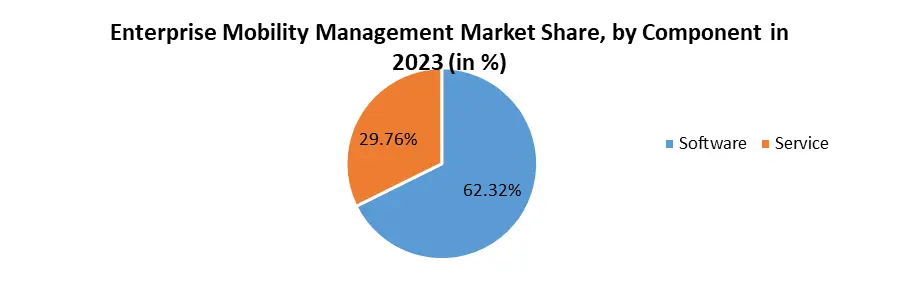
The Software segment stands out as the dominant force in the Enterprise Mobility Management (EMM) market. As organizations increasingly prioritize mobile device management, security, and application control, software solutions play a pivotal role in fulfilling these needs. EMM software offers comprehensive features for device management, ensuring data security, and facilitating seamless workflows. Recent developments in this segment include the integration of artificial intelligence and machine learning algorithms into EMM software, enhancing predictive analytics for proactive security measures.
Leading EMM software providers are focusing on user-friendly interfaces and robust functionalities to meet the dynamic requirements of businesses in an ever-evolving digital landscape. The continuous innovation and updates in EMM software contribute significantly to its dominance, offering organizations scalable and efficient solutions to manage their mobile ecosystems. The Enterprise Mobility Management Market, particularly in the software segment, continues to thrive with advancements that address the evolving challenges of mobile device management and security.
Based On End-User,
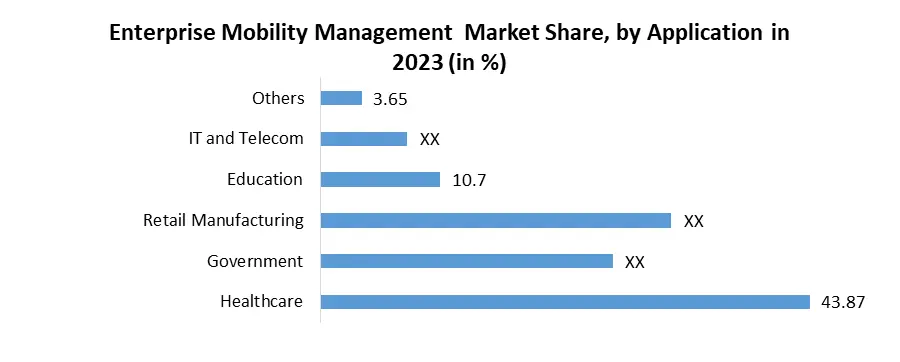
The Healthcare segment stands out as the dominant force in the Enterprise Mobility Management Market. The increasing adoption of mobile solutions for patient care, data management, and communication within healthcare facilities has propelled this sector to the forefront. Recent developments indicate a surge in mobile health applications and the integration of EMM to enhance the security and efficiency of healthcare data. Healthcare providers are leveraging EMM to ensure compliance with data protection regulations and safeguard sensitive patient information. The incorporation of advanced authentication methods and secure communication channels within EMM solutions aligns with the stringent privacy requirements of the healthcare sector. In a recent development, leading EMM providers have introduced customized solutions catering specifically to healthcare needs, fostering seamless mobility without compromising data integrity. The Enterprise Mobility Management Market, particularly within the healthcare segment, continues to evolve with innovative solutions, consolidating its dominance through tailored offerings and robust security measures.
Enterprise Mobility Management Market Regional Insights:
The North America region held the largest Enterprise Mobility Management Market share accounting for 27% in 2022. North America is expected to hold the largest market size and dominate the EMM market from 2023 to 2029. North America is home to multiple EMM vendors, such as IBM, Microsoft, ManageEngine, and Citrix, who offer EMM solutions and services. These organizations target higher incomes and business developments because of the solid rivalry across the North American district. Associations in North America center around advancements to stay aware of the most recent innovations on the lookout. Around here, verticals like BFSI, retail, and medical services and life sciences take on EMM solutions due to various benefits, such as efficient management of day-to-day transactions in the BFSI vertical, improved supply chain management process, and enhanced ability of healthcare machines to track patient health.
The objective of the report is to present a comprehensive analysis of the global Enterprise Mobility Management Market to the stakeholders in the industry. The past and current status of the industry with the forecasted market size and trends are presented in the report with the analysis of complicated data in simple language. The report covers all the aspects of the industry with a dedicated study of key players that include market leaders, followers, and new entrants.
PORTER, PESTEL analysis with the potential impact of micro-economic factors of the market have been presented in the report. External as well as internal factors that are supposed to affect the business positively or negatively have been analyzed, which will give a clear futuristic view of the industry to the decision-makers.
The reports also help in understanding the Enterprise Mobility Management Market dynamic, and structure by analyzing the market segments and projecting the Enterprise Mobility Management Market size. Clear representation of competitive analysis of key players by Design, price, financial position, product portfolio, growth strategies, and regional presence in the Enterprise Mobility Management Market make the report investor’s guide.
Enterprise Mobility Management Market Competitive Landscape
The competitive landscape of the Enterprise Mobility Management (EMM) market is characterized by a diverse array of key players vying for market share and innovation. Established players like VMware AirWatch, MobileIron, and Microsoft Intune continue to lead with comprehensive solutions, offering secure mobile device management and application control. Companies such as BlackBerry and SOTI focus on enhancing security measures, catering to industries with stringent compliance requirements. Cloud-based solutions from Jamf and Cisco Meraki emphasize scalability and flexibility, addressing the growing trend of remote work.
New entrants like Hexnode and Scalefusion are gaining prominence by providing user-friendly interfaces and cost-effective solutions. Kaspersky Endpoint Security for Business and Zimperium focus on robust security features, including threat detection and response capabilities. The EMM market also witnesses acquisitions, with Symantec being assimilated into Broadcom, adding strength to their overall enterprise offerings.
The competitive landscape is dynamic, driven by technological advancements, evolving security needs, and the increasing demand for seamless mobility solutions. As the market continues to expand globally, companies are differentiating themselves through innovation, strategic partnerships, and a customer-centric approach to capture a share of the burgeoning EMM market.
Enterprise Mobility Management Market Scope: Inquire before buying
| Global Enterprise Mobility Management Market | |||
|---|---|---|---|
| Report Coverage | Details | ||
| Base Year: | 2023 | Forecast Period: | 2024-2030 |
| Historical Data: | 2018 to 2023 | Market Size in 2023: | US $ 23.65 Bn. |
| Forecast Period 2024 to 2030 CAGR: | 26.4% | Market Size in 2030: | US $ 34.17 Bn. |
| Segments Covered: | by Component | Software Service |
|
| by Deployment Mode | Cloud On-Premises Hybrid |
||
| by End User | Healthcare Government Retail Manufacturing Education IT and Telecom Others |
||
Enterprise Mobility Management Market, by Region
North America (United States, Canada and Mexico)
Europe (UK, France, Germany, Italy, Spain, Sweden, Austria and Rest of Europe)
Asia Pacific (China, South Korea, Japan, India, Australia, Indonesia, Malaysia, Vietnam, Taiwan, Bangladesh, Pakistan and Rest of APAC)
Middle East and Africa (South Africa, GCC, Egypt, Nigeria and Rest of ME&A)
South America (Brazil, Argentina Rest of South America)
Enterprise Mobility Management Market Key players
North America
1. VMware AirWatch - United States
2. MobileIron - United States
3. IBM MaaS360 - United States
4. Microsoft Intune - United States
5. Citrix Endpoint Management - United States
6. SOTI - Canada
7. Sophos Mobile - United Kingdom
8. Cisco Meraki - United States
9. Jamf - United States
10. Manage Engine - United States
11. Ivanti - United States
12. Hexnode - United States
13. 42Gears - United States
14. Codeproof - United States
15. SureMDM - United States
16. Scalefusion - United States
17. Symantec - United States
18. Zimperium - United States
19. Lookout - United States
20. Apperian - United States
21. Blue Cedar - United States
Europe
1. Sophos Mobile (United Kingdom)
2. Mirador (Finland)
3. AppTec360 (Miradore - Switzerland)
4. Wandera (part of Jamf - United Kingdom)
5. Cortado (Germany)
6. Barramundi (Germany)
Asia Pacific
1. 1Mobility
2. Kaspersky Endpoint Security for Business
3. Snow Software
Frequently Asked Questions:
1] What is the growth rate of the Global Enterprise Mobility Management Market?
Ans. The Global Enterprise Mobility Management Market is growing at a significant rate of 26.4 % during the forecast period.
2] Which region is expected to dominate the Global Enterprise Mobility Management Market?
Ans. North America held a significant share in the global Enterprise Mobility Management market, primarily due to advanced healthcare infrastructure, a higher prevalence of respiratory diseases, and a well-established market for medical devices.
3] What is the expected Global Market size by 2030?
Ans. The Enterprise Mobility Management Market size is expected to reach USD 34.17 Bn by 2030.
4] Which are the top players in the Global Enterprise Mobility Management Market?
Ans. The major top players in the Global Enterprise Mobility Management Market are VMware AirWatch, MobileIron, IBM MaaS360, Microsoft Intune, Citrix Endpoint Management, SOTI, Sophos Mobile, Cisco Meraki.
5] What are the factors driving the Global Enterprise Mobility Management Market growth?
Ans. The Global Enterprise Mobility Management Market growth is primarily propelled by increasing cases of respiratory disorders like COPD, technological advancements improving device efficiency and portability, rising elderly population susceptible to respiratory conditions, and the convenience of at-home oxygen therapy. Additionally, the COVID-19 pandemic accentuated the demand for these devices, driving market expansion due to the virus's impact on respiratory health worldwide.
6] Which region is expected to hold the highest share in the Enterprise Mobility Management Market?
Ans. The North America region is expected to hold the highest share in the Enterprise Mobility Management Market