
Emergency Lighting Market – Industry Structure Evaluation, Demand Drivers Analysis, Regional Growth Analysis and Identification, Competitive Positioning Review & Global Market Size Forecast to 2032
Overview
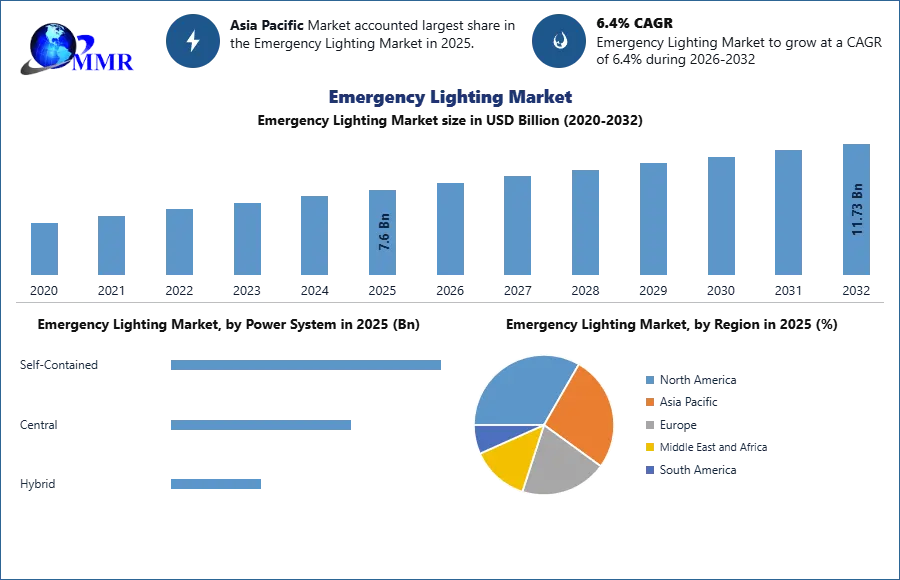
The Emergency Lighting Market size was valued at USD 7.6 Bn. In 2025 and the total Emergency Lighting Market revenue is growing by 6.4 % from 2026 to 2032, reaching nearly USD 11.73 Bn.
Emergency Lighting Market Overview:
Emergency lighting is designed to create personal safety and allow the safe evacuation of the building. Right across the world, environments are becoming increasingly urbanized and intricate, with a corresponding rise in associated safety threats. Highly populated, high-risk, or complex premises such as railway stations, shopping centers, airports, and government buildings need more safety. Emergency lighting is a lifeline in dangerous situations created by this complicated backdrop. Crucially, it enables the safe, prompt, and efficient evacuation of spaces and buildings. An effective emergency the lighting system also guides people in and around enclosed and open environments, as well as helps them locate safety equipment.
Emergency lighting systems help people get out of buildings quickly and safely during emergencies. They show clear paths to exits so that people don't run into obstacles, get hurt, or panic. Emergency Lighting systems also make sure that fire alarms, fire extinguishers, and first-aid kits are easy to see, which helps prevent accidents in dangerous places. These all factors help to boost the Emergency Lighting Market growth.
To know about the Research Methodology :- Request Free Sample Report
Emergency Lighting Market Trends:
The COVID-19 pandemic had a significant impact on the construction industry, as it did on many other industries. The pandemic reduces funding for public projects and delays in ongoing construction projects, due to economic uncertainty and supply chain disruptions. However, the construction industry is expected to recover in the period following the pandemic disease. The construction industry is expected to grow in the post-pandemic period which helps to boost the emergency lighting Market.
As a consequence of the pandemic disease, there is a greater awareness of the value of emergency lighting systems, which is expected to drive demand in the coming years. The emerging trend is the growing demand for NiMH batteries for application in pathway emergency lights and exit signs. There is an increasing demand for software for effectively controlling and monitoring the lights.
Also, the growing usage of software designed by manufacturers to analyze the work of their emergency lights drives the Emergency Lighting Market. The rising demand for effective emergency lighting systems will further fuel market growth. The primary factors influencing the growth of the market across the globe are rapid technological advancements, tremendously decreased LED cost, an increasing number of construction projects, environmental regulations, and government policies to support the adoption of energy-efficient lighting solutions and intense competition.
Emergency Lighting Market Dynamics:
Growing Awareness of Safety Boosts Market Growth
Growing awareness of safety is a significant factor driving the demand for emergency lighting systems. Due to growing awareness of safety reliable and efficient lighting solutions become important. Organizations and employers are increasingly prioritizing safety. They are aware that well-lit evacuation routes and clearly visible safety equipment make a significant difference in emergency situations. In places like factories and manufacturing plants where in dangerous situations, emergency lighting helps employees safely leave during fires or other emergencies Public places like shopping malls, theaters, stadiums, and convention centers have a responsibility to keep visitors safe.
People become more aware of safety, emergency lighting is installed in these areas. Its purpose is to guide people, keep them calm, and decrease the risk of accidents and injuries. For instance, in a crowded theater, properly illuminated exit signs and escape route lighting help patrons evacuate calmly and safely in case of an emergency.
Homeowners are becoming more conscious of safety measures within their properties. Emergency lighting systems, especially in residential buildings with multiple floors or complex layouts, provide clear pathways during power outages or emergencies. This awareness is driving the installation of emergency lighting solutions in homes to protect occupants from potential hazards and aid their evacuation. So, the growing awareness of safety has the increased adoption of emergency lighting systems in various environments. As individuals, organizations, and governments prioritize safety, the demand for reliable and efficient emergency lighting solutions continues to grow.
Increasing Focus on Energy Efficiency Drives the Market Growth
Energy-efficient emergency lighting systems, such as those utilizing LED technology, consume less electricity compared to traditional lighting sources. This results in reduced energy costs for buildings and facilities that use emergency lighting systems. Businesses remain motivated to invest in energy-efficient solutions for emergency lighting because of the potential for price savings in the long run. Energy-efficient emergency lighting systems, especially with LED technology, have a longer effective life compared to conventional lighting sources. This longevity drives the demand for these systems in the market.
This means less frequent replacement and lower maintenance costs over time. The prospect of reduced maintenance expenses further encourages the adoption of energy-efficient solutions in the market. The emergency lighting market is experiencing growth. For example, an analysis carried out by the Lawrence Berkeley National Laboratory found that LED emergency lights consume up to 80% less energy compared to traditional incandescent lights. This transition to LED emergency lights allows businesses and organizations to achieve substantial energy cost savings.
High installation and maintenance costs hamper the market growth
Emergency lighting systems require the purchase of specific equipment, including emergency luminaires, exit signs, batteries, control panels, and wiring. The cost of these components is high, especially for larger buildings or facilities that require a comprehensive emergency lighting system. Additionally, professional installation is necessary to ensure proper setup and compliance with safety regulations, adding to the overall costs. Also, Retrofitting existing buildings with emergency lighting systems is costly. It involves modifying the electrical infrastructure, rewiring, and installation of additional fixtures.
Emergency lighting systems need testing and maintenance on a regular basis to ensure they are working properly. Maintenance costs of Emergency lighting are high for larger and more complex systems. Emergency lighting systems require regular maintenance and testing to ensure their reliable operation during emergencies. This includes routine inspections, battery replacements, and testing procedures. These ongoing maintenance and testing costs add up over time, especially for large buildings with numerous emergency lighting fixtures. Failure to conduct proper maintenance compromises the effectiveness of the system, leading to potential safety risks.
Development of New Technologies Creates Lucrative Growth Opportunities for the Market Growth
Technological advancements help the development of more advanced lighting solutions for emergency lighting systems. LED technology offers energy efficiency, a longer lifespan, and improved brightness compared to traditional lighting sources. The adoption of LED emergency lighting systems is growing rapidly. Which creates new market opportunities for manufacturers and suppliers.
However, the integration of emergency lighting systems with the Internet of Things (IoT) and building automation technology enhances functionality and control. IoT-enabled sensors and devices provide real-time data on the status and performance of emergency lighting systems, enabling proactive maintenance and efficient resource allocation. The integration of emergency lighting with building automation systems creates new opportunities for system integrators and solution providers.
Advancements in wireless communication and battery technologies expanded the capabilities of emergency lighting systems. Wireless communication allows for flexible installation, remote control, and monitoring of emergency lighting fixtures. Improved battery technologies provide longer backup power durations and faster recharging capabilities, ensuring reliable operation during extended power outages. Technologies continue to evolve and new creations are introduced as these technologies continue to develop, they are expected to make emergency lighting systems more reliable, efficient, and cost-effective. These factors create ample growth opportunities for Emergency Lighting Market growth.
Emergency Lighting Market Segment Analysis:
Based on Power Systems, the Self-Contained segment dominates the global Emergency Lighting Market in the year 2022. A self-contained emergency luminaire has its own battery. Under normal conditions, this remains permanently on charge via the main lighting circuit until the power supply to the luminaire is lost and the battery takes over. Self-contained central battery systems provide a centralized power source for emergency lighting fixtures. This eliminates the need for individual batteries or backup power sources for each fixture, resulting in simplified installation, maintenance, and lower overall costs.
Self-contained central battery systems to meet the specific needs of different applications and building sizes. They offer flexibility in terms of accommodating various types of emergency lighting fixtures, allowing for customization based on specific requirements. Self-contained central battery systems are designed to provide reliable backup power during emergencies. The batteries used in these systems are typically long-lasting and require minimal maintenance. This reliability and durability make them a preferred choice for critical applications where uninterrupted emergency lighting is essential. This allows facility managers or building operators to monitor the status and performance of the emergency lighting system from a central control panel. Therefore Self-Contained segment significantly drives Growth during the forecast period.
Based on Lightning Type, the LED segment dominates the lighting-type segment of the global Emergency Lighting Market in the year 2025. Due to its numerous advantages and superior performance. Energy efficiency is a major factor helps to that dominates the segment. LED lights consume significantly less power compared to traditional lighting technologies. For example, an LED emergency light might consume only 10 watts of power, while an equivalent incandescent bulb might consume 60 watts.
This energy efficiency not only reduces electricity costs but also extends the backup power supply in emergency situations, making LED lights a preferred choice. Additionally, LED lights have a long lifespan, lasting up to 50,000 hours or more. In contrast, traditional bulbs typically last only around 1,000 hours. This extended lifespan reduces maintenance efforts and replacement costs, particularly in large-scale emergency lighting installations such as hospitals or commercial buildings. Therefore, the LED segment dominates the lightning-type segment of the global Emergency Lighting Market.
Based on the Application, The Industrial segment dominates the application segment of the global Emergency Lighting Market in the year 2025. Industrial environments, such as manufacturing plants, warehouses, and construction sites, are subject to stringent safety regulations. These regulations regularly instruct the installation of emergency lighting systems to ensure the safety of workers and occupants during power outages or emergency situations. Industrial settings typically involve higher risks compared to other sectors. These environments may include hazardous materials, heavy machinery, and complex operational processes.
This needs proper safety therefore demand for emergency lightning is increasing in the Industrial sector. Emergency lighting is considered an integral part of emergency response plans, along with other safety measures such as fire alarms, sprinkler systems, and evacuation procedures. Industrial facilities invest in robust emergency lighting systems to comply with regulations and enhance their emergency response capabilities. Due to these factors, the industrial segment such as manufacturing, energy, logistics, and construction, dominates the application segment of the global Emergency Lighting Market.
Emergency Lighting Market Regional Insight:
North America dominates the emergency lighting market in the year 2025. North America, particularly the United States, has stringent safety regulations and building codes that mandate the installation of emergency lighting systems in various facilities. These regulations ensure that buildings have adequate emergency lighting to guide occupants to safety during power outages or emergencies. Compliance with these regulations drives the demand for emergency lighting systems in the region.
The well-developed infrastructure, includes commercial buildings, industrial facilities, hospitals, educational institutions, and public spaces. These establishments require reliable emergency lighting systems to ensure the safety of occupants during emergencies. The existing infrastructure, coupled with the need for compliance with safety regulations, drives the demand for emergency lighting systems in the region.
Recent Industry Developments (2025–2026)
| Exact Date | Company | Development | Impact |
|---|---|---|---|
| 12 February 2026 | Schneider Electric SE | Launched the Exiway Smartsync platform, an AI-driven emergency lighting management system designed to automate regulatory testing and reporting. | This development reduces operational maintenance costs by up to 30% while ensuring 100% compliance with local safety mandates. |
| 22 January 2026 | Eaton Corporation plc | Introduced a new range of LiFePO4-powered emergency exit signs featuring a 10-year service life and ultra-slim profile for high-end commercial buildings. | The shift to advanced lithium chemistry eliminates the need for frequent battery replacements, significantly lowering the total cost of ownership. |
| 15 November 2025 | British Standards Institution (BSI) | Released the updated BS 5266-1:2025 code of practice, expanding the mandate for standby lighting in areas where high-risk tasks are performed. | The new regulation forces a market-wide upgrade of systems in industrial facilities, driving a surge in hardware replacement demand. |
| 10 September 2025 | Acuity Brands, Inc. | Completed the integration of Bluetooth Mesh technology into its Lithonia Lighting emergency units to enable wireless remote monitoring. | This integration simplifies retrofitting in older buildings by eliminating the need for dedicated data wiring for monitoring systems. |
| 18 June 2025 | Signify N.V. | Expanded the Interact connected lighting portfolio to include cloud-based automated emergency light testing for the Asia-Pacific region. | The expansion strengthens Signify’s foothold in the high-growth APAC market by offering scalable, IoT-enabled safety solutions. |
Emergency Lighting Market Scope: Inquire Before Buying
| Emergency Lighting Market | |||
|---|---|---|---|
| Report Coverage | Details | ||
| Base Year: | 2025 | Forecast Period: | 2026-2032 |
| Historical Data: | 2020 to 2025 | Market Size in 2025: | 7.6 USD Billion |
| Forecast Period 2026-2032 CAGR: | 6.4% | Market Size in 2032: | 11.73 USD Billion |
| Segments Covered: | by Power System | Self-Contained Central Hybrid |
|
| by Offerings | Hardware Software Services |
||
| by Battery Type | Ni-Cd Ni–MH LiFePO4 Lead–Acid |
||
| by Lighting Type | Fluorescent lighting Light - Emitting Diode Incandescent Others |
||
| by Application | Residential Commercial Industrial Others |
||
Emergency Lighting Market by Region:
North America (United States, Canada and Mexico)
Europe (UK, France, Germany, Italy, Spain, Sweden, Austria and Rest of Europe)
Asia Pacific (China, South Korea, Japan, India, Australia, Indonesia, Malaysia, Vietnam, Taiwan, Bangladesh, Pakistan and Rest of APAC)
Middle East and Africa (South Africa, GCC, Egypt, Nigeria and Rest of ME&A)
South America (Brazil, Argentina Rest of South America)
Key Players / Competitors Profiles Covered in Brief in Global Emergency Lighting Market Report in Strategic Perspective:
- Schneider Electric SE
- Eaton Corporation plc
- Signify N.V. (Philips Lighting)
- Legrand S.A.
- Acuity Brands, Inc.
- Zumtobel Group AG
- ABB Ltd.
- Honeywell International Inc.
- Emerson Electric Co.
- Hubbell Incorporated
- Panasonic Corporation
- Beghelli S.p.A.
- Osram GmbH
- Fulham Co., Inc.
- Daisalux S.A.U.
- Ventilux Ltd.
- Syska LED Lights Private Limited
- Tridonic GmbH & Co KG
- Fagerhult Group
- NVC Lighting
- Digital Lumens
- Lutron Electronics Co., Inc.
- Myers Emergency Power Systems
- Thomas & Betts
- Thorlux Lighting