
Global Dry Type Transformer Market- Industry Structure Evaluation, Demand Drivers Analysis, Regional Growth Analysis and Identification, Competitive Positioning / Landscape Review & Global Market Size Forecast to 2034
Overview
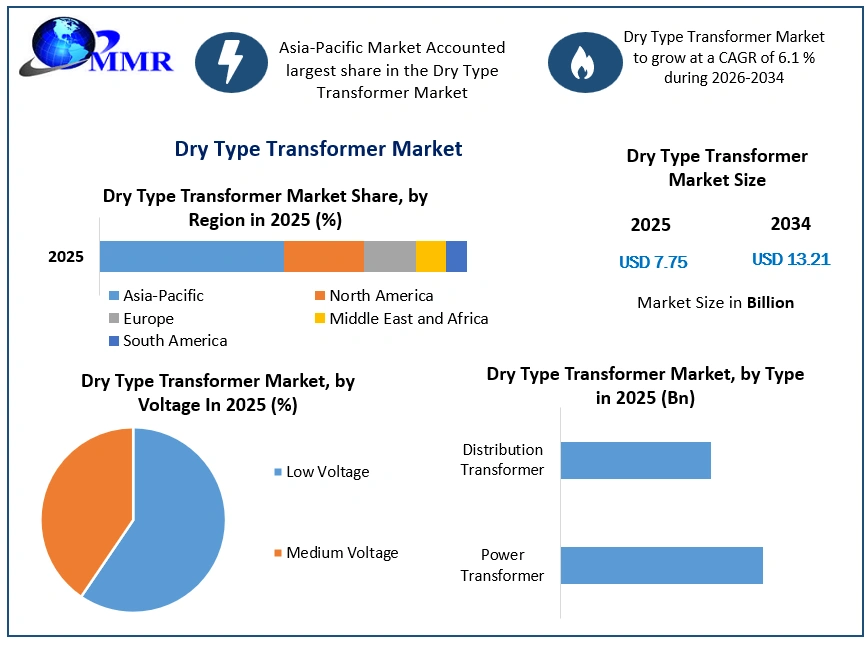
Dry Type Transformer Market size was valued at US$ 7.75 Bn. in 2025 and the total Dry Type Transformer revenue is expected to grow by 6.1% from 2026 to 2034, reaching nearly US$ 13.21 Bn.
Dry Type Transformer Market Overview:
A dry-type transformer does not utilize any insulating liquid and does not have its windings or core immersed in liquid. Rather, the windings and core are housed in an air-pressurized enclosed tank. The report explores the Dry Type Transformer market's segments (Voltage, Type, Phase, and Region). Data has been provided by market participants, and regions (North America, Asia Pacific, Europe, Middle East & Africa, and South America). It provides a thorough analysis of the rapid advances that are currently taking place across all industry sectors.
Facts and figures, illustrations, and presentations are used to provide key data analysis for the historical period from 2020 to 2025. The report investigates the Dry Type Transformer market's drivers, limitations, prospects, and barriers. This MMR report includes investor recommendations based on a thorough examination of the Dry Type Transformer market's contemporary competitive scenario.
Dry Type Transformer Market Analysis from 2025 to 2034
To know about the Research Methodology:-Request Free Sample Report
Dry Type Transformer Market Dynamics:
The advantages offered by dry-type transformers over oil-immersed transformers are expected to be a major driver of the market growth.
For example, in high moisture-prone locations, cast resin dry-type transformers (CRT) are adopted. This is because its main and secondary coils are enclosed in epoxy resin. This coating prevents moisture from penetrating and damaging the winding substance. This cast resin enclosure offers complete protection, allowing the transformer to operate without interruption in high moisture-prone locations. As a result, this transformer is nonhygroscopic. This transformer is manufactured in ratings ranging from 25 KVA to 12,500 KVA and has an insulating class of 90oC temperature.
This transformer offers certain distinct benefits. They are as follows:
1. Increased overload capacity.
2. Minimal partial discharge as well as low loss. As a result, efficiency is quite high.
3. As with non-inflammable coil insulation, it poses no risk of fire. As a result, it is appropriate for interior installation.
4. Can be installed outside in an IP 45 casing.
The fundamental drawbacks of dry-type transformers are expected to be a major restraint in the market growth.
Epoxy resin has inferior heat dissipation capability as contrasted to oil-immersed transformers. It is not as excellent as the oil radiator's heat dissipation efficiency, but its thermal conductivity is higher.
A dry-type transformer's temperature monitoring is dependent on an intelligent temperature sensor implanted in the transformer structure, and its reading point is static, so the temperature acquired is the temperature of a specified spot. Because of the possibility of local heat accumulation, the temperature displayed by the screen is not the actual average temperature. The oil-immersed transformer's insulation fluid is less viscous, and heat flow is rather uniform. The temperature represented on the monitor is the average temperature.
In comparison to the hardware compatibility and reusability of oil-immersed transformer insulation oil performance, the dry-type transformer covering is an epoxy resin integrated molding structure, with permanent performance degradation and aging and fault accumulation. This means, that if the transformer fails, it will be discarded as a whole.
A dry-type transformer's production process is difficult, and the final cost is more than that of an oil-immersed transformer. Finally, when the oil-immersed transformer has been discarded, it may be dismantled and recycled into its original elements. However, the dry-type transformer waste apparatus has low recovery ability, and epoxy resin castings dry-type transformer cannot be salvaged at that moment.
Dry Type Transformer Market Segment Analysis:
By Type, the distribution transformer segment is expected to grow at a CAGR of 3.8% in the forecast period. The dry-type transformer design has a minimal environmental impact and superior surge and short circuit strength, making it suitable for a wide range of applications ranging from residential buildings to small business structures. Distribution technologies are designed to be as efficient as possible at low loads. Additionally, to increase efficiency, the voltage regulation in these devices is maintained to a minimal level. As a result, distribution transformers are built with low leakage reactance in mind.
The number of consumers served by a specific distribution transformer varies with the number of customers in a given location. In metropolitan settings, a given transformer may power several households. Based on the mains voltage, the rural transmission may necessitate one transformer per client. Multiple distribution transformers will be found in big industrial and commercial facilities.
Platform mounted transformers i.e. transformers in closed metal enclosures set on a concrete pad, are utilized in metropolitan regions and neighborhoods where principal distribution lines run underground. Electric service is offered at the main distribution voltage in many large structures. Distribution transformers can also be encountered in wind turbine power distribution systems, where they scale up power from each rotor to transmit to a powerhouse that may be several miles away.
Middle Eastern and African nations e.g. Oman and Saudi Arabia are also focusing on the development and reorganization of distribution power networks, which is anticipated to boost the dry-type transformer market's growth potential. The Indian government introduced a revised transmission sector program in June 2021, based on improvements and outcomes.
The plan aims to enhance the operational efficiency and economic stability of all Power Departments, except private sector Distribution companies, by providing these entities with conditional financial aid for supply infrastructure upgrading. This is expected to increase the demand for dry-type transformers. As a result of the above, the distribution transformer demand is expected to grow at a rapid pace throughout the forecast period.
Dry Type Transformer Market Regional Insights:
Due to rising industrialization and urbanization, the APAC region is likely to lead the dry-type transformer market at the end of the forecast period. China's National Energy Administration is marketing green certificates as part of an ambitious renewable energy portfolio. This is likely to drive China's wind power sector. With increased renewable power generation, notably from wind and solar power sectors, demand for dry-type transformers in the country is likely to stay strong.
Coal-fired power production overshadowed India's power industry in 2025, accounting for about 65% of total installed capacity. The country has highlighted renewable energy's prospects of cutting emissions in the economy by reaching Paris Agreement commitments. Renewable energy accounted for nearly 20% of total developed capacity in the country.
The demand for improving current generation & distribution infrastructure is likely to rise as the generation of renewable energy grows. With nations e.g. the Philippines, Korea, and Australia focusing on renewable assimilation to fulfill their energy demands, the APAC region's demand for dry-type transformers is anticipated to grow rapidly throughout the forecast period.
The objective of the report is to present a comprehensive analysis of the Dry Type Transformer market to the stakeholders in the industry. The past and current status of the industry with the forecasted market size and trends are presented in the report with the analysis of complicated data in simple language. The report covers all the aspects of the industry with a dedicated study of key players that include market leaders, followers, and new entrants.
PORTER, PESTEL analysis with the potential impact of micro-economic factors of the market have been presented in the report. External as well as internal factors that are supposed to affect the business positively or negatively have been analyzed, which will give a clear futuristic view of the industry to the decision-makers.
The report also helps in understanding the Dry Type Transformer market dynamics, and structure by analyzing the market segments and projecting the Dry Type Transformer market size. Clear representation of competitive analysis of key players by product, price, financial position, product portfolio, growth strategies, and regional presence in the Dry Type Transformer market make the report investor’s guide.
Dry Type Transformer Market Recent Development
| Date | Company | Development | Impact |
|---|---|---|---|
| 15 September 2025 | Hitachi Energy | Hitachi Energy announced a USD 1 billion investment in U.S. manufacturing to expand grid infrastructure and transformer production capacity. | Indirectly improves the availability and supply scale of dry-type transformers to support heavy grid modernization. |
| 10 September 2025 | Emerald Lake Capital | Emerald Lake Capital finalized the acquisition of CORE Transformers to establish an integrated North American transformer platform. | Expands regional manufacturing capacity and enhances repair and servicing networks for dry-type and specialty units. |
| 05 September 2025 | Mehru Electrical & Mechanical Engineers | Mehru Electrical entered into a strategic agreement with Hyosung focused on advanced power and instrument transformer technologies. | Strengthens technological cooperation and expands product portfolios to meet stringent utility requirements. |
Dry Type Transformer Industry Ecosystem
Dry Type Transformer Market Scope: Inquire before buying
| Dry Type Transformer Market | |||
|---|---|---|---|
| Report Coverage | Details | ||
| Base Year: | 2025 | Forecast Period: | 2026-2034 |
| Historical Data: | 2020 to 2025 | Market Size in 2025: | USD 7.75 Bn. |
| Forecast Period 2026 to 2034 CAGR: | 6.1% | Market Size in 2034: | USD 13.21 Bn. |
| Segments Covered: | by Voltage | Low Voltage Medium Voltage |
|
| by Type | Power Transformer Distribution Transformer |
||
| by Phase | Single Phase Three Phase |
||
| by Application | Industrial Commercial Utilities Others |
||
Dry Type Transformer Market, by Region
North America (United States, Canada and Mexico)
Europe (UK, France, Germany, Italy, Spain, Sweden, Austria and Rest of Europe)
Asia Pacific (China, South Korea, Japan, India, Australia, Indonesia, Malaysia, Vietnam, Taiwan, Bangladesh, Pakistan and Rest of APAC)
Middle East and Africa (South Africa, GCC, Egypt, Nigeria and Rest of ME&A)
South America (Brazil, Argentina Rest of South America)
Dry Type Transformer Market, Key Players
1.Siemens AG
2.Schneider Electric SE
3.Eaton Corporation PLC
4.ABB Ltd
5.TBEA Co. Ltd
6.Hyundai Electric & Energy Systems Co. Ltd
7.Hammond Power Solutions Inc.
8.Kirloskar Electric Company Ltd
9.Hitachi Energy Ltd
10.Gujarat Transformers Private Limited
11.Fuji Electric
12.Toshiba
13.TRENCH
14.BHEL
15.Voltamp
Frequently Asked Questions:
1. Which region has the largest share in Global Dry Type Transformer Market?
Ans: Asia Pacific region held the highest share in 2025.
2. What is the growth rate of Global Dry Type Transformer Market?
Ans: The Global Dry Type Transformer Market is growing at a CAGR of 6.1% during forecasting period 2026-2034.
3. What is scope of the Global Dry Type Transformer Market report?
Ans: Global Dry Type Transformer Market report helps with the PESTEL, PORTER, COVID-19 Impact analysis, Recommendations for Investors & Leaders, and market estimation of the forecast period.
4. Who are the key players in Global Dry Type Transformer Market?
Ans: The important key players in the Global Dry Type Transformer Market are – Siemens AG, Schneider Electric SE, Eaton Corporation PLC, ABB Ltd, TBEA Co. Ltd, Hyundai Electric & Energy Systems Co. Ltd, Hammond Power Solutions Inc., Kirloskar Electric Company Ltd, Hitachi Energy Ltd, Gujarat Transformers Private Limited, Fuji Electric, Toshiba, TRENCH, BHEL, Voltamp.
5. What is the study period of this Market?
Ans: The Global Dry Type Transformer Market is studied from 2020 to 2034.