
Diphenylmethane Diisocyanate Market Size by Form, End Use Industry, Application, Region – Revenue Pool Analysis, Margin Structure Assessment, Capital Flow Trends, Competitive Benchmarking & Forecast to 2032
Overview
The Diphenylmethane Diisocyanate Market is expected to reach 8.63 Million metric tons by 2032, led by increase in the form, application, and end-use industry segments. The market dynamics by regions and end-user industries are covered in the report.
Diphenylmethane Diisocyanate Market Overview:
The global diphenylmethane diisocyanate market was volume at 5.81 Mn. metric tons in 2025, and it is expected to reach at 8.63 Mn. metric tons with a CAGR of 5.8 % during the forecast period.
Diphenylmethane Diisocyanate is a sub-type of aromatic diisocyanate. MDI is synthesized through condensation of aniline with formaldehyde to create methylenedianiline (MDA), which is then reacted with phosgene to produce diphenylmethane diisocyanate (MDI). It is most commonly used to make rigid polyurethane foams, which are used in insulators, packaging, consumer electronics, and industrial applications, among many other things. Non-foam applications include elastomers, adhesives and sealants, and paints and varnishes.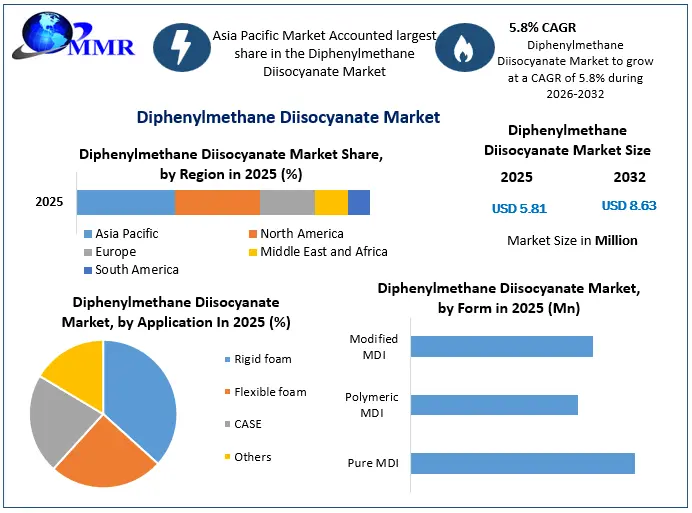
To know about the Research Methodology :- Request Free Sample Report
Diphenylmethane Diisocyanate Market Dynamics:
The expansion of construction industries, particularly with the growth in residential housing complexes across the globe, is expected to further drive the market for diphenylmethane diisocyanate (MDI). The construction sector, which is likely to drive the MDI market, is expected to benefit from the increased demand for polyurethane foams for insulation. MDI provides comfort, protection, and energy conservation in vehicles in the global automotive industry. As a result, the MDI market is expected to grow at a CAGR of 5.8% over the forecast period.
However, excessive exposure to Diphenylmethane Diisocyanate (MDI) can cause serious health problems such as dermatitis, asthma, skin and respiratory tract irritation, and some other conditions, which might severely hamper the growth of the market during the forecast period.
In Europe and North America, the major production companies are conducting research and development (R&D) activities to create bio-based products that comply with environmental standards in order to ensure better demand for products. The new applications are also being explored by R&D. During the forecast period, this factor is expected to create lucrative growth opportunities for the market.
During the forecast period, fluctuating costs of raw materials used to manufacture MDI is expected to face a challenge to the growth of the market.
Diphenylmethane Diisocyanate Market Segment Analysis:
On the basis of Form, the global Diphenylmethane Diisocyanate market is segmented into three types as follows, pure MDI, polymeric MDI, and modified MDI.
On the basis of Application, the global Diphenylmethane Diisocyanate market is segmented into four types as follows, rigid foam, flexible foam, coatings, adhesives, sealants, and elastomers (CASE), and others.
In 2025, the rigid foam sector of the market was dominant, holding 29.5 % of the overall market share, by application. Among the three isomers of MDI, 4,4’-MDI is the most commonly used, with a major application as a primary raw material for the production of rigid polyurethane (PU) foams. These foams are used in the manufacture of freezers and refrigerators, as well as in construction and automotive applications since they have strong thermal insulation properties. Polyurethane rigid insulating foams are a significant portion of the polyurethane (PU) sector, accounting for approximately 19.5 % of the market share and more than 1.3 million metric tonnes of demand. Refrigerators, freezers, hot water heaters, and vending machines are among the key appliances that use rigid polyurethane foam to insulate them. Rigid polyurethane foam is important and cost-effective material that can be used in consumer refrigerators and freezers to meet the required energy ratings.
On the basis of End-use Industry, the global Diphenylmethane Diisocyanate market is segmented into six types as follows, construction, automotive, electronics and appliances, packaging, furniture and interior, and footwear. Owing to the extensive use of rigid polyurethane foam as roof and wall insulation, insulated panels and gap fillers around doors and windows, the construction segment is expected to drive the market in terms of end-users, during the forecast period.
Diphenylmethane Diisocyanate Market Regional Insights:
Since the demand from industries like construction, electronic appliances, furniture, and automotive in countries like India, Japan, and China. Thus, Asia Pacific is expected to drive the market during the forecast period. China, the world’s largest producer and user of polyurethane holding about 44 % of the global demand is expected to grow to a market volume of 2.8 million metric tons by 2032, with a CAGR of 6.2% from 2026 to 2032. Japan and Canada are two important geographic markets, with expected growth rates of 4.6% and 4.5% respectively from 2026 to 2032.
In the United States, the market for diphenylmethane diisocyanate is expected to grow a market volume of 1.7 million metric tons by 2022. Germany is expected to grow at a CAGR of approximately 4.8%, during the forecast period.
Recent Industry Developments:
| Date | Company | Development | Impact |
|---|---|---|---|
| 23 March 2026 | BASF | The company announced a significant price increase for its Lupranate® Methylene Diphenyl Diisocyanate (MDI) products by $500 per metric ton across the East Asia region (excluding mainland China). | The price hike directly aims to offset escalating raw material, logistics, and energy costs while maintaining regional business sustainability. |
| 05 March 2026 | Huntsman Corporation | The company implemented an emergency €200 per metric ton natural gas surcharge on all MDI products supplied across Europe, Africa, the Middle East, and India (EMEI). | This measure was triggered by surging energy prices and shipping disruptions caused by Middle East geopolitical tensions, transferring cost burdens down the polyurethane supply chain. |
| 05 March 2026 | Dow Inc. | The company matched emergency global pricing actions by increasing MDI prices by €200 per metric ton in Europe and $300 per metric ton across India, the Middle East, and Africa. | The immediate adjustments targeted unprecedented inflationary pressures in feedstock chemical logistics and manufacturing operations. |
| 15 December 2025 | Kumho Mitsui Chemicals | The chemical manufacturer initiated a strategic capacity expansion project for its MDI production complex located in Yeosu, South Korea. | The expansion will successfully boost output capacity by 100,000 tons per year by 2027 to adequately satisfy booming regional demand and corporate sustainability targets. |
| 01 December 2025 | Huntsman Corporation | The company declared an unplanned operational outage on its primary, larger MDI production line at its Polyurethanes facility in Rotterdam, Netherlands. | The production freeze created immediate regional supply constraints and reduced the company's Q4 2025 adjusted EBITDA by approximately $10 million. |
| 27 October 2025 | Dow Inc. | The company's major MDI manufacturing facility in Freeport, Texas, successfully achieved the international ISCC PLUS Certification. | This milestone allows the plant to officially commercialize sustainable, bio-circular isocyanates via a mass balance approach, dramatically reducing product carbon footprints for commercial insulation and automotive clients. |
The objective of the report is to present a comprehensive analysis of the global Diphenylmethane Diisocyanate market to the stakeholders in the industry. The past and current status of the industry with the forecasted market size and trends are presented in the report with the analysis of complicated data in simple language. The report covers all the aspects of the industry with a dedicated study of key players that include market leaders, followers, and new entrants.
PORTER, PESTEL analysis with the potential impact of micro-economic factors of the market have been presented in the report. External as well as internal factors that are supposed to affect the business positively or negatively have been analyzed, which will give a clear futuristic view of the industry to the decision-makers.
The report also helps in understanding the global Diphenylmethane Diisocyanate market dynamics, structure by analyzing the market segments and project the global Diphenylmethane Diisocyanate market size. Clear representation of competitive analysis of key players by product, price, financial position, product portfolio, growth strategies, and regional presence in the global Diphenylmethane Diisocyanate market make the report investor’s guide.
Diphenylmethane Diisocyanate Market Scope: Inquire before buying
| Global Diphenylmethane Diisocyanate Market | |||
|---|---|---|---|
| Report Coverage | Details | ||
| Base Year: | 2025 | Forecast Period: | 2026-2032 |
| Historical Data: | 2020 to 2025 | Market Size in 2025: | US $ 5.81 Mn. |
| Forecast Period 2026 to 2032 CAGR: | 5.8% | Market Size in 2032: | US $ 8.63 Mn. |
| Segments Covered: | by Form | Pure MDI Polymeric MDI Modified MDI |
|
| by End Use Industry | Construction Automotive Electronics and appliances Packaging Furniture and interior Footwear |
||
| by Application | Rigid foam Flexible foam CASE (Coatings, Adhesives, Sealants, and Elastomers) Others |
||
Diphenylmethane Diisocyanate Market, by Region
North America (United States, Canada and Mexico)
Europe (UK, France, Germany, Italy, Spain, Sweden, Austria and Rest of Europe)
Asia Pacific (China, South Korea, Japan, India, Australia, Indonesia, Malaysia, Vietnam, Taiwan, Bangladesh, Pakistan and Rest of APAC)
Middle East and Africa (South Africa, GCC, Egypt, Nigeria and Rest of ME&A)
South America (Brazil, Argentina Rest of South America)
Diphenylmethane Diisocyanate Market, Key Players are:
1. BASF SE
2. Bayer
3. Gujarat Narmada Valley Fertilizers Limited
4. Hindustan Organic Chemicals Limited
5. Sumitomo Chemical Company Limited
6. Jilin Connell Chemical Industry Co.
7. Covestro AG
8. DHALOP CHEMICALS
9. Huntsman International LLC
10.Karoon Petrochemical Company
11.Kumho Mitsui Chemicals Corporation
12.Lanxess AG
13.Merck KGaA
14.Redox Pty Ltd.
15.Sadara Chemical Company
16.TCI Chemicals Pvt. Ltd.
17.The Dow Chemical Company
18.Tosoh Corporation
19.Wanhua Chemical Group Co., Ltd.
20.Others
Frequently Asked Questions:
1. What is the forecast period considered for Diphenylmethane Diisocyanate market report?
Ans. The forecast period for Diphenylmethane Diisocyanate market is 2026-2032.
2. Which key factors are hindering the growth of Diphenylmethane Diisocyanate market?
Ans. Excessive exposure to Diphenylmethane Diisocyanate (MDI) is the key factor expected to hinder the growth of the Diphenylmethane Diisocyanate market during the forecast period.
3. What is the compound annual growth rate (CAGR) of Diphenylmethane Diisocyanate market for the next 6 years?
Ans. The global Diphenylmethane Diisocyanate market is expected to grow at a CAGR of 5.8% during the forecast period (2026-2032).
4. What are the key factors driving the growth of Diphenylmethane Diisocyanate market?
Ans. The expansion of the construction and automotive industries across the globe are the key factors expected to boost the growth of the Diphenylmethane Diisocyanate market during the forecast period.
5. Which are the worldwide major key players covered for Diphenylmethane Diisocyanate market report?
Ans. The major key players in the Diphenylmethane Diisocyanate market across the globe are as follows, BASF SE, Bayer, Gujarat Narmada Valley Fertilizers Company Limited, Hindustan Organic Chemicals Limited, Sumitomo Chemical Company Limited, Jilin Connell Chemical Industry Co., Covestro AG, Dhalop Chemicals, Huntsman International LLC, Karoon Petrochemical Company, Kumho Mitsui Chemicals Corporation, Lanxess AG, Merck KGaA, Redox Pty Ltd., Sadara Chemical Company, TCI Chemicals Pvt. Ltd., The Dow Chemical Company, Tosoh Corporation, Wanhua Chemical Group Co., Ltd., and others.