
Dimethyl Carbonate Market - Industry Structure Evaluation, Demand Drivers Analysis, Regional Growth Analysis and Identification, Competitive Positioning Review & Global Market Size Forecast to 2034
Overview
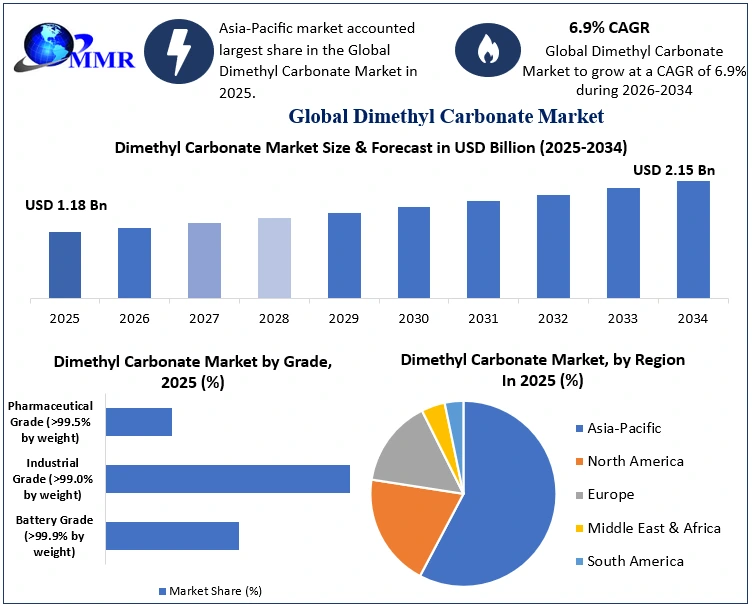
The Dimethyl Carbonate Market size was valued at USD 1.18 Billion in 2025 and the total Dimethyl Carbonate revenue is expected to grow at a CAGR of 6.9% from 2026 to 2034, reaching USD 2.15 Billion by 2034.
Dimethyl Carbonate Market Overview
Dimethyl Carbonate (DMC) is a clear, colorless and flammable organic chemical used as a green solvent, chemical intermediate, methylating agent and electrolyte solvent. It is widely used in polycarbonate production, paints and coatings, pharmaceuticals, agrochemicals, electronics and lithium-ion batteries. DMC is gaining attention because it can replace some conventional solvents and chemical intermediates while offering low toxicity and favorable environmental characteristics. Its importance is increasing particularly in battery electrolytes, where DMC is blended with other carbonate solvents to support lithium-ion battery performance. The product is therefore positioned across both traditional chemical applications and emerging electric vehicle, energy storage and advanced battery value chains.
The Global Dimethyl Carbonate Market is expanding as demand rises from lithium-ion batteries, electric vehicles, energy storage systems, polycarbonates, specialty chemicals, pharmaceutical manufacturing, electronics and environmentally preferable solvents. For context, the IEA reported that global electric car sales exceeded 17 million units in 2024, while EV battery demand surpassed 950 GWh, increasing by more than 25% from 2023. This expanding battery ecosystem is creating additional demand for electrolyte materials such as DMC. Asia-Pacific remains a major production and consumption center; one recent industry estimate placed the region at 60.4% of global DMC market value in 2025. Industry investment is also expanding supply capacity: UBE Corporation is developing a USD 700 million DMC and EMC facility in Louisiana, with planned annual capacity of 100,000 tonnes of DMC and 40,000 tonnes of EMC. The facility is scheduled to begin operations in November 2026, highlighting the increasing importance of localized battery-material supply chains.
The Maximize Market Research (MMR) Dimethyl Carbonate Market Report provides a detailed analysis of market size, growth trends, market dynamics, key drivers, restraints, opportunities and competitive developments. It covers market segmentation by grade, application, end-use industry and region, along with regional analysis, key companies, product developments, capacity expansions and strategic initiatives. The report helps clients identify emerging opportunities across battery electrolytes, electric vehicles, energy storage, electronics, pharmaceuticals, plastics, coatings and sustainable chemical applications through 2034.
Global Dimethyl Carbonate Market Growth Outlook
To know about the Research Methodology :- Request Free Sample Report
Dimethyl Carbonate Market Dynamics
Rising Lithium-Ion Battery and Electric Vehicle Production Is Increasing Demand for Battery-Grade Dimethyl Carbonate
The rapid expansion of lithium-ion batteries, electric vehicles, consumer electronics and energy storage systems is strengthening demand for high-purity DMC used in battery electrolytes. DMC helps improve electrolyte performance and is increasingly used alongside other carbonate solvents in lithium-ion battery formulations. The battery electrolyte application is projected to record an 8.32% CAGR through 2031, reflecting the increasing scale of global battery manufacturing and the growing requirement for electrolyte materials.
Feedstock Price Volatility and Production Costs Can Limit Dimethyl Carbonate Profitability
DMC producers remain exposed to fluctuations in the prices of methanol, carbon dioxide and other feedstocks, which can directly affect manufacturing economics and profit margins. Differences in production technology, energy consumption and purification requirements can further influence overall production costs. This is particularly important for battery-grade DMC, where very high purity, low moisture content and strict metal-ion specifications require additional processing and quality-control measures, increasing the cost of producing material suitable for advanced battery applications.
Expansion of Battery-Grade DMC Capacity Creates New Growth Opportunities Across Emerging Battery Supply Chains
The increasing investment in battery gigafactories, electrolyte manufacturing and regional battery supply chains is creating opportunities for DMC producers to expand high-purity production and establish closer relationships with battery and electrolyte manufacturers. Growing localization of battery-material supply chains in North America and other regions is also encouraging investment in domestic solvent capacity. For example, UBE Corporation's planned Louisiana facility is designed for annual production of 100,000 tonnes of DMC and 40,000 tonnes of EMC, supporting the development of the regional battery-material ecosystem and creating additional demand potential for high-purity carbonate solvents.
Maintaining High Purity and Consistent Quality for Advanced Battery Applications Remains a Key Industry Challenge
Battery manufacturers require DMC with stringent quality specifications, making purity control, moisture management, contamination prevention and consistent batch quality critical challenges for suppliers. Even small variations in moisture or impurities can affect electrolyte performance and battery reliability, increasing the importance of advanced purification and quality-control systems. The increasing use of DMC in advanced lithium-ion battery electrolytes is therefore raising the technical requirements for production and purification, particularly as battery-grade DMC requires purity levels exceeding 99.9%.
Dimethyl Carbonate Market Segment Analysis
By Application
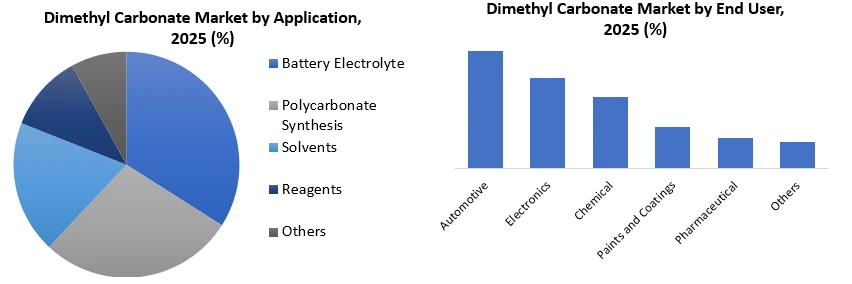
Battery Electrolyte is a major application of Dimethyl Carbonate, supported by the expanding use of DMC in lithium-ion battery electrolyte formulations. Rising electric vehicle production, consumer electronics manufacturing and energy-storage deployment are increasing the requirement for electrolyte solvents. Polycarbonate Synthesis is another important application, as DMC is used as a safer alternative in certain chemical processes. DMC is also widely used as a solvent because of its favorable properties and relatively low toxicity compared with some conventional solvents. Reagents represent another application across chemical processing, while other applications include coatings, adhesives and specialty chemical
By End User
The automotive industry represents an important end-user segment for Dimethyl Carbonate, particularly because of its connection with lithium-ion battery manufacturing and electric vehicle supply chains. Growing battery production is increasing the need for high-purity DMC used in electrolyte formulations. Electronics is another significant end-user segment, supported by demand for batteries used in smartphones, laptops, portable devices and other electronic equipment. The pharmaceutical industry uses DMC in selected chemical processes, while paints and coatings manufacturers use it as a solvent and formulation component. The chemical industry also consumes DMC across various synthesis and processing applications, with other industries contributing to overall market demand.
Dimethyl Carbonate Market Regional Insights
Asia-Pacific is the leading regional market, supported by strong battery and chemical manufacturing
Asia-Pacific held the largest share of the global Dimethyl Carbonate Market in 2025, supported by its large chemical manufacturing base, lithium-ion battery production, electronics industry and polycarbonate production. China is the major contributor, with substantial battery-cell and electrolyte manufacturing capacity, while Japan and South Korea remain important for advanced battery and electronics applications. India and Southeast Asian countries are also expanding their chemical and battery manufacturing capabilities, creating additional demand for DMC. Recent market estimates place Asia-Pacific's share at around 57.5% of global DMC revenue in 2025, although reported shares vary across market studies.
North America is expanding through battery supply-chain localization
North America is witnessing increasing demand for DMC as electric vehicle production, energy-storage systems and domestic battery manufacturing expand. The region is also seeing investments aimed at reducing dependence on imported battery materials and developing localized electrolyte supply chains. A notable example is UBE Corporation's Louisiana facility, which is designed to produce 100,000 tonnes of DMC and 40,000 tonnes of EMC annually, with operations planned for November 2026. The facility is intended to supply the growing U.S. battery and electrolyte ecosystem.
Europe is supported by automotive, battery and sustainable chemical applications
Europe represents an established market for DMC, supported by its automotive industry, battery manufacturing investments, electronics sector, polycarbonate production and demand for lower-impact chemical alternatives. The region's transition toward electric mobility is increasing the importance of battery-related applications, while DMC also continues to be used in chemical processing and solvent applications. European demand is therefore influenced by both traditional industrial uses and the development of regional battery supply chains.
Middle East & Africa is developing through chemical and industrial investments
The Middle East & Africa market is at an earlier stage compared with Asia-Pacific, North America and Europe but is supported by petrochemical development, chemical processing, coatings and industrial applications. Expanding downstream chemical production and investment in industrial infrastructure can create opportunities for DMC consumption, particularly where regional producers seek alternative solvents and chemical intermediates.
South America is supported by chemicals, coatings and emerging battery demand
South America represents a developing market for DMC, with demand linked mainly to chemical processing, paints and coatings, plastics and other industrial applications. Brazil is an important industrial base in the region, while increasing electrification and interest in battery supply chains could gradually expand demand for battery-grade DMC. The region's development will depend on industrial investment, local manufacturing capacity and the expansion of downstream applications.
Dimethyl Carbonate Industry Ecosystem
Dimethyl Carbonate Market Recent Developments
| Date | Company | Recent Development |
| January 2026 | Haike Xinyuan & BYD Lithium Battery | Haike Xinyuan entered into a three-year cooperation agreement with BYD Lithium Battery to supply at least 100,000 tonnes per year of lithium-battery solvents, including DMC, EC, EMC and DEC, to BYD’s Hubei project through pipeline transportation. |
| June 2026 | Balaji Amines | Balaji Amines reported continued development of its battery-chemical portfolio, with DMC, NMP and Propylene Carbonate positioned for energy-storage applications. The company was also supplying DMC samples for battery-grade applications to battery manufacturers. |
| June 2026 | Balaji Amines | Balaji Amines continued the development of its Unit IV facility in Solapur, which includes electronic-grade DMC production supporting applications in EV batteries, energy storage and electronics. |
| August 2026 | UBE Corporation | UBE provided an update on the construction of its DMC and EMC manufacturing facility in Louisiana, USA, highlighting the fabrication, transportation and installation of large-scale equipment modules for the project. |
| November 2026 | UBE Corporation | UBE continued construction of its Louisiana facility, which is designed to produce 100,000 tonnes of DMC and 40,000 tonnes of EMC annually. The facility is expected to strengthen domestic supply of battery-electrolyte materials in the United States and is planned to begin operations in 2027. |
Dimethyl Carbonate Market Scope: Inquire before buying
| Global Dimethyl Carbonate Market | |||
|---|---|---|---|
| Report Coverage | Details | ||
| Base Year: | 2025 | Forecast Period: | 2026-2034 |
| Historical Data: | 2020 to 2025 | Market Size in 2025: | USD 1.18 Bn. |
| Forecast Period 2026 to 2034 CAGR: | 6.9% | Market Size in 2034: | USD 2.15 Bn. |
| Segments Covered: | by Grade | Battery grade (>99.9% by weight) Industrial grade (>99.0% by weight) Pharmaceutical grade (>99.5% by weight) |
|
| by Application | Polycarbonate Synthesis Battery Electrolyte Solvents Reagents Others |
||
| by End User | Automotive Electronics Pharmaceutical Paints and Coatings Chemical Others |
||
Dimethyl Carbonate Market, by Region
North America (United States, Canada and Mexico)
Europe (UK, France, Germany, Italy, Spain, Sweden, Austria and Rest of Europe)
Asia Pacific (China, South Korea, Japan, India, Australia, Indonesia, Malaysia, Vietnam, Taiwan, Bangladesh, Pakistan and Rest of APAC)
Middle East and Africa (South Africa, GCC, Egypt, Nigeria and Rest of ME&A)
South America (Brazil, Argentina Rest of South America)
Dimethyl Carbonate Market, Key Players are
1. UBE Corporation
2. Mitsubishi Chemical Corporation
3. LOTTE Chemical Corporation
4. Merck KGaA
5. Kowa American Corporation
6. Kishida Chemical Co., Ltd.
7. Shandong Shida Shenghua Chemical Group Co., Ltd.
8. Guangzhou Tinci Materials Technology Co., Ltd.
9. Shandong Haike Chemical Group Co., Ltd.
10. Arrow Chemical Group Corporation
11. Panax Etec
12. Henan GP Chemicals Co., Ltd.
13. Wego Chemical Group
14. Aceto Corporation
15. Alfa Aesar (Thermo Fisher Scientific)
16. Connect Chemicals
17. Silver Fern Chemicals
18. Hefei TNJ Chemical Industry Co., Ltd.
19. Kingdun Chemical Co., Ltd.
20. Tokyo Chemical Industry Co., Ltd.
21. Qingdao Aspirit Chemical Co., Ltd.
22. Asahi Kasei Corporation
23. SABIC
24. Kuraray Co., Ltd.
25. Mitsui Chemicals, Inc.
26. BASF SE
27. Huntsman Corporation
28. Shinghwa Advanced Material Group Co., Ltd.
29. Dongying Hi-Tech Spring Chemical Industry Co., Ltd.
30. Shandong Depu Chemical Industry Science & Technology Co., Ltd.
31. Shandong Wells Chemicals Co., Ltd.
32. Tongling Jintai Chemical Co., Ltd.
33. Shandong Feiyang Chemical Co., Ltd.
34. Tangshan Chaoyang Chemical Co., Ltd.
35. Shandong Hualu Hengsheng Group Co., Ltd.
36. Eastern Hope Group
37. Yulin Yunhua Green Energy Co., Ltd.
38. Shanxi Zhongke Huian Chemical Co., Ltd.
39. Liaoning Oxiranchem, Inc.
40. Jiangsu Sailboat Petrochemical Co., Ltd.
Frequently Asked Questions:
1. Which region has the largest Global Dimethyl Carbonate Market share?
Ans: The Asia Pacific region held the highest share in 2025.
2. What was the Global Dimethyl Carbonate Market size in 2025?
Ans: The Global Dimethyl Carbonate Market size was USD 1.18 Billion in 2025.
3. What is the scope of the Global Dimethyl Carbonate market report?
Ans: The Global Dimethyl Carbonate Market report helps with the PESTEL, PORTER, and COVID-19 Impact analysis, Recommendations for Investors and leaders, and market estimation for the forecast period.
4. Who are the key players in the Global Dimethyl Carbonate market?
Ans: The key players in the Global Dimethyl Carbonate Market are Ube Industries Limited, Merck KGaA, Kowa American Corporation, Kishida Chemical Co. Limited, Shandong Shida Shenghua Chemical Group Co. Limited and Others.
5. What is the study period of this market?
Ans: The Global Dimethyl Carbonate Market is studied from 2025 to 2034.