
Dermatomyositis Treatment Market by Treatment Type, Route of Administration, End‑Users, and Distribution Channel – Global Market Size Estimation, Industry‑Wide Analysis, Competitive Landscape Assessment & Long‑Term Forecast to 2029
Overview
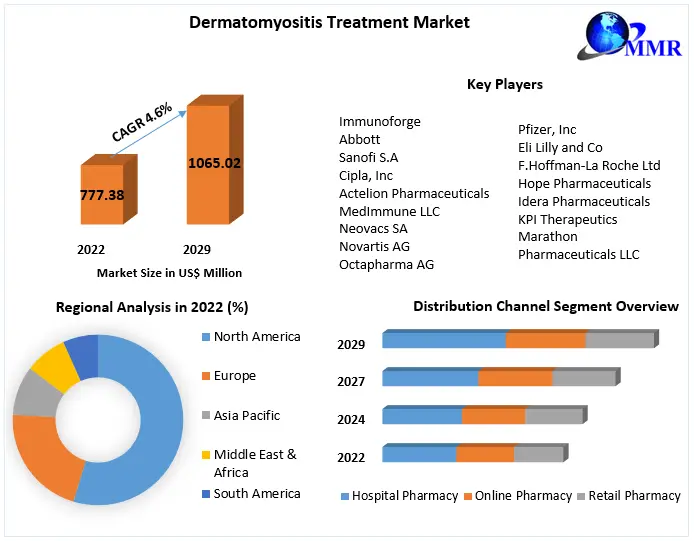
Dermatomyositis Treatment Market size was valued at US$ 777.38 Mn. in 2022 and the total Dermatomyositis Treatment revenue is expected to grow at 4.6% through 2023 to 2029, reaching nearly US$ 1065.02 Mn.
Dermatomyositis Treatment Market Overview:
Polymyositis and dermatomyositis are chronic rheumatic muscle illnesses characterized by symmetrical muscular weakness and tiredness in the limbs, knees, and neck, as well as muscular inflammation. Other organs, e.g. the skin in dermatomyositis, are commonly implicated. The inflammatory process can damage the lungs, heart, and bones in both polymyositis and dermatomyositis. The gastrointestinal tract is commonly implicated and can create nutritional difficulties. Chronic inflammation can also cause typical symptoms including weight loss, exhaustion, and fever, all of which can have an impact on health and nutrition. Most of these chronic illnesses need permanent therapeutic intervention, and adverse effects are prevalent.
 To know about the Research Methodology:- Request Free Sample Report
Polymyositis and dermatomyositis are very uncommon disorders, with around one instance per 100,000 persons each year. Women are 2 to 3 times more likely than males to be afflicted. Although polymyositis and dermatomyositis can begin at any age, including youngsters, the prevalence is highest in individuals in their 60s. These myositis types are found all over the world, although there is a geographical differential for polymyositis and dermatomyositis. The latter is more common towards the equator, while polymyositis is more common in the northern hemisphere.
In this report, the Dermatomyositis Treatment market's growth reasons, as well as the market's many segments (Treatment Type, Route of Administration, End-Users, Distribution Channel, and Region), are discussed. Data has been given by market players, regions, and specific requirements. This market report includes a comprehensive overview of all the significant improvements that are presently prevailing in all market segments. Key data analysis is presented in the form of statistics, infographics, and presentations. The study discusses the Dermatomyositis Treatment market's Drivers, Restraints, Opportunities, and Challenges. The report helps to assess the market growth drivers and determines how to use these drivers as a tool. The report also helps to rectify and resolve issues related to the global Dermatomyositis Treatment market situation.
Dermatomyositis Treatment Market Dynamics:
The prevalence of arthritis and autoimmune diseases is one of the primary drivers of the market. Polymyositis and dermatomyositis are both autoimmune illnesses in which the immune system, which typically defends individuals from outside invaders, attacks its tissues, causing inflammatory reaction and damage. The presence of autoantibodies in serum, which can be observed in 60% of patients, lends further validity to the diagnosis of polymyositis and dermatomyositis as autoimmune illnesses. Some of these autoantibodies are unique to myositis and cannot be found in other disorders. An anti-Jo-1 autoantibody is one of these myositis-specific autoantibodies. This autoantibody is seen in around 25% of myositis patients and is frequently related to arthritis in the hands and fingers, lung illness, Raynaud's syndrome, and skin disorders in the palms.
Limited studies and surveys related to these illnesses are expected to hamper the market growth in the aforementioned forecast period. There is presently only a minimal amount of data available on the lifespan of people with polymyositis and dermatomyositis. A very few studies are primarily focused on groups from a single hospital; they are not population-based, and only a limited number of patients are included. With this constraint in mind, two recent articles assessed 5-year survival to be 94 percent and 10-year survival to be 84 or 88 percent.
The key opportunity in the market is the rising consumption of dietary supplements from patients and its impact on the health conditions of patients affected by this disease. A diet attaining energy balance with around 30% fat, 50% to 60% carbs, and 10% to 20% proteins of the energy content is advised for healthy adults in some of the European nations and is likely to be acceptable for individuals affected with myositis as well. Dietary supplements have grown in popularity, and some of them have been examined in clinical studies in individuals suffering from a variety of chronic inflammatory disorders.
Dermatomyositis Treatment Market Segment Analysis:
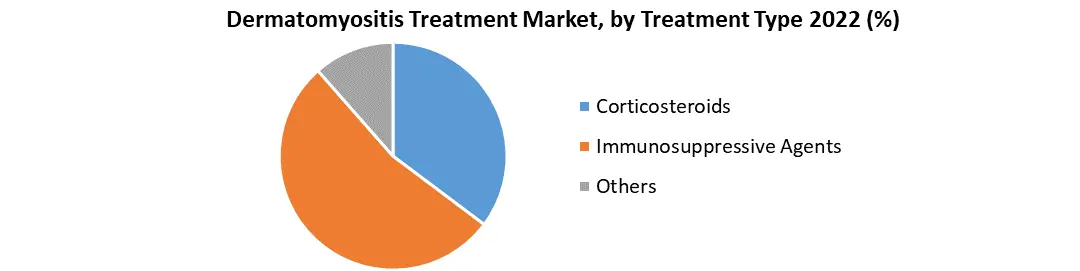
By Treatment Type, the corticosteroid segment is expected to witness the fastest growth in the aforementioned forecast period. This can be particularly attributed to the introduction and development of glucocorticoids for the treatment of this disease.
Although glucocorticoid therapy significantly improved patient life, it quickly became clear that some patients with myositis do not improve at all, but very few patients restore their previous muscular function. Additionally, one downside of high-dose glucocorticoid therapy is the significant risk of adverse effects. Combination therapy with additional immunosuppression medications has been created based on these factors. Glucocorticoids are still advised as first-line therapy but most researchers propose combining them with another immunosuppressive drug from the beginning as a glucocorticoid-saving medicine and to increase treatment effectiveness. Azathioprine and methotrexate are the most often utilized immunosuppressant drugs.
In severe instances, cyclophosphamide, tacrolimus, or elixirs of large doses of intravenous immunoglobulin are administered. Only a handful of these medications have undergone controlled trials of sufficient size and length to demonstrate therapeutic benefits. They are typically utilized because of demonstrated positive effects in isolated people or published case series. Because glucocorticoids can have a significant detrimental impact on metabolic activities, immunosuppression therapy of myositis is an essential consideration for nutritional status in individuals with dermatomyositis.
Dermatomyositis Treatment Market Regional Insights:
Because of the rising frequency of acute and chronic skin and muscle disorders, attractive financing policies, and an aging population, North America leads the market and is expected to hold its position at the end of the forecast period. In terms of creativity and product offerings, the healthcare business in the United States is one of the most developed and sophisticated markets in the world.
But on the other hand, the APAC market, which is made up of rapidly rising nations, has mostly gone untouched. The investigated market is continuously growing, which has offered several prospects for the introduction of new medicines. The APAC market is expected to grow the quickest in terms of possible growth potential. However, a lack of knowledge and medicinal cost-consciousness has significantly hampered market growth in developing nations e.g. India, China, Brazil, and many others.
The objective of the report is to present a comprehensive analysis of the Dermatomyositis Treatment market to the stakeholders in the industry. The past and current status of the industry with the forecasted market size and trends are presented in the report with the analysis of complicated data in simple language. The report covers all the aspects of the industry with a dedicated study of key players that include market leaders, followers, and new entrants.
PORTER, PESTEL analysis with the potential impact of micro-economic factors of the market have been presented in the report. External as well as internal factors that are supposed to affect the business positively or negatively have been analyzed, which will give a clear futuristic view of the industry to the decision-makers.
The report also helps in understanding the Dermatomyositis Treatment market dynamics, structure by analyzing the market segments and projecting the Dermatomyositis Treatment market size. Clear representation of competitive analysis of key players by product, price, financial position, product portfolio, growth strategies, and regional presence in the Dermatomyositis Treatment market make the report investor’s guide.
Dermatomyositis Treatment Market Scope: Inquire before buying
| Dermatomyositis Treatment Market | |||
|---|---|---|---|
| Report Coverage | Details | ||
| Base Year: | 2022 | Forecast Period: | 2023-2029 |
| Historical Data: | 2018 to 2022 | Market Size in 2022: | US $ 777.38 Mn. |
| Forecast Period 2023 to 2029 CAGR: | 4.6 % | Market Size in 2029: | US $ 1065.02 Mn. |
| Segments Covered: | by Treatment Type | Corticosteroids Immunosuppressive Agents Others |
|
| by Route of Administration | Oral Topical Others |
||
| by End-Users | Hospitals Homecare Specialty Clinics Others |
||
| by Distribution Channel | Hospital Pharmacy Online Pharmacy Retail Pharmacy |
||
Dermatomyositis Treatment Market, by Region
North America (United States, Canada and Mexico)
Europe (UK, France, Germany, Italy, Spain, Sweden, Austria and Rest of Europe)
Asia Pacific (China, South Korea, Japan, India, Australia, Indonesia, Malaysia, Vietnam, Taiwan, Bangladesh, Pakistan and Rest of APAC)
Middle East and Africa (South Africa, GCC, Egypt, Nigeria and Rest of ME&A)
South America (Brazil, Argentina Rest of South America)
Dermatomyositis Treatment Market Key Players
1. Immunoforge
2. Abbott
3. Sanofi S.A
4. Cipla, Inc
5. Actelion Pharmaceuticals
6. MedImmune LLC
7. Neovacs SA
8. Novartis AG
9. Octapharma AG
10. Pfizer, Inc
11. Eli Lilly and Co
12. F.Hoffman-La Roche Ltd
13. Hope Pharmaceuticals
14. Idera Pharmaceuticals
15. KPI Therapeutics
16. Marathon Pharmaceuticals LLC
FAQs:
1. Which is the potential market for Dermatomyositis Treatment in terms of the region?
Ans. North America leads the market and is expected to hold its position at the end of the forecast period.
2. What are the opportunities for new market entrants?
Ans. The key opportunity in the market is the rising consumption of dietary supplements from patients.
3. What is expected to drive the growth of the Dermatomyositis Treatment market in the forecast period?
Ans. The prevalence of arthritis and autoimmune diseases is one of the primary drivers of the market.
4. What is the projected market size & growth rate of the Dermatomyositis Treatment Market?
Ans. Dermatomyositis Treatment Market size was valued at US$ 777.38 Mn. in 2022 and the total Dermatomyositis Treatment revenue is expected to grow at 4.6% through 2023 to 2029, reaching nearly US$ 1065.02 Mn.
5. What segments are covered in the Dermatomyositis Treatment Market report?
Ans. The segments covered are Treatment Type, Route of Administration, End-Users, Distribution Channel, and Region.