
Critical Minerals Market By Mineral Type, By Extraction Method, By End-Use Application and Regional Insights 2034
Overview
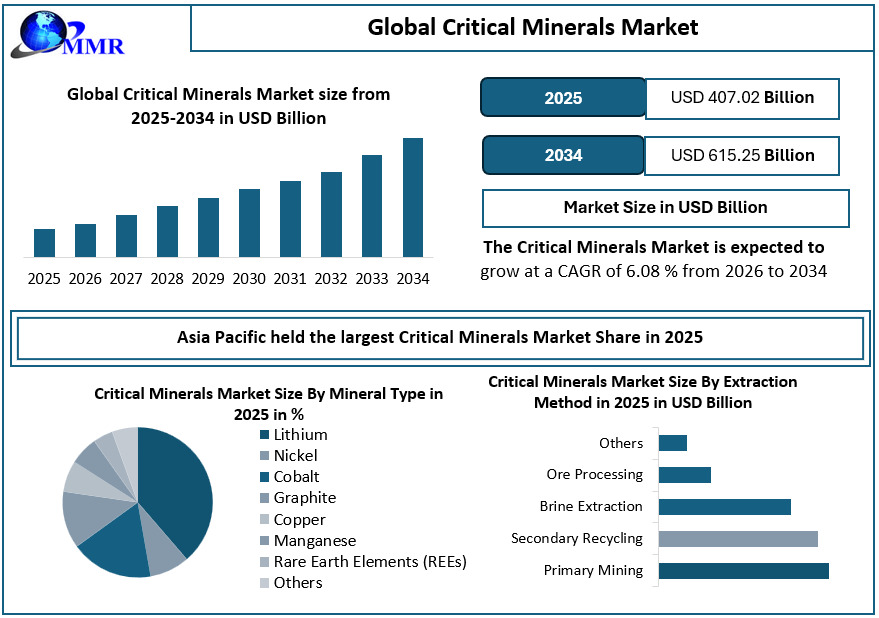
Global Critical Minerals Market size was valued at USD 407.02 Billion in 2025, and the total revenue is expected to grow at a CAGR of 6.08% from 2026 to 2034, reaching USD 615.25 Billion.
| Parameter | Value |
| Market Size (2025) | USD 407.02 Billion |
| Market Size (2034) | USD 615.25 Billion |
| CAGR | 6.08% |
| Historical Period | 2020 to 2025 |
| Forecast Period | 2026 to 2034 |
Global Critical Minerals Market Overview
The Critical Minerals Market focuses on the extraction, processing, refining, and supply of minerals that are essential for advanced manufacturing, clean energy technologies, electronics, defence systems, and industrial infrastructure. These minerals include lithium, cobalt, nickel, graphite, rare earth elements, copper, manganese, and other strategically important materials that support modern industrial and technological development. The Global Critical Minerals Market plays an important role in the energy transition and global manufacturing ecosystem as countries increasingly prioritize secure access to materials required for electric vehicles, battery storage, renewable energy systems, semiconductors, and advanced electronics. Mining companies and mineral processors are expanding exploration activities, developing domestic refining capabilities, and strengthening supply chains to reduce import dependency and secure long-term mineral availability. Growing demand for battery-grade materials, high-performance alloys, permanent magnets, and critical mineral-based components continues to strengthen the strategic importance of this market.
The Critical Minerals Market Trends highlight rising demand for responsibly sourced minerals, domestic mineral processing, advanced extraction technologies, recycling, and diversified supply chains. Major buyers include electric vehicle manufacturers, battery producers, semiconductor companies, renewable energy developers, aerospace manufacturers, defence contractors, and electronics companies. Emerging opportunities exist in lithium extraction, rare earth processing, battery-grade graphite, cobalt refining, copper exploration, and recovery of critical minerals from electronic waste. Asia-Pacific holds a strategically important position in the market, supported by China's dominant mineral processing capabilities and expanding manufacturing ecosystem, while North America and Europe are strengthening domestic mining projects and refining infrastructure to reduce dependence on concentrated international suppliers. According to the International Energy Agency (IEA), demand for lithium increased by nearly 30% in 2024, while demand for nickel, cobalt, graphite, and rare earth elements grew by 6–8%. The energy sector accounted for 85% of demand growth for battery metals over the same period.
Key industry participants include BHP Group, Rio Tinto, Glencore, Albemarle Corporation, Vale S.A., Freeport-McMoRan, MP Materials, Lynas Rare Earths, China Northern Rare Earth Group, and Tianqi Lithium. For example, Albemarle Corporation focuses on lithium production and advanced lithium materials, supplying critical inputs for electric vehicle batteries and energy storage applications, while MP Materials operates the Mountain Pass rare earth mine in the United States to strengthen domestic rare earth supply capabilities.
Maximize Market Research (MMR) Critical Minerals Market Analysis examines key growth drivers, mineral categories, mining and processing activities, application-based demand, regional supply dynamics, competitive strategies, and emerging investment opportunities. The research highlights how electric vehicle adoption, renewable energy expansion, semiconductor manufacturing, defence modernization, and national resource security influence the global critical minerals industry. It also evaluates challenges related to mineral price volatility, geopolitical tensions, export restrictions, lengthy mining approvals, environmental compliance, and concentrated refining infrastructure. According to the IEA, the average market share of the three largest refining countries for key energy minerals increased from approximately 82% in 2020 to 86% in 2024, highlighting the industry's dependence on a limited number of processing hubs. Furthermore, approximately USD 500 billion in new mining capital investment will be required between 2025 and 2040 under the IEA's Stated Policies Scenario.
Increasing investment in exploration, domestic refining, mineral recycling, and alternative extraction technologies creates strategic opportunities for mining companies, chemical processors, battery manufacturers, and governments. The Global Critical Minerals Market Growth Outlook through 2034 reflects the industry's focus on supply chain diversification, resource security, sustainable extraction, technological advancement, and the growing importance of minerals in the global energy transition.
Critical Minerals Market Growth and Share Analysis
To know about the Research Methodology :- Request Free Sample Report
• Strong Market Growth: The Global Critical Minerals Market is witnessing strong growth, supported by increasing demand for lithium, copper, cobalt, nickel, graphite, and rare earth elements across clean energy, electric mobility, and advanced manufacturing industries.
• Electric Vehicle and Battery Demand Accelerates: Global lithium demand increased by nearly 30% in 2024, driven by electric vehicle production, battery energy storage installations, and expanding demand for high-performance rechargeable battery materials.
• Asia-Pacific Leads the Critical Minerals Supply Chain: China strengthens regional dominance through extensive mineral processing and refining capabilities, particularly in graphite, rare earth elements, lithium, and battery-grade materials, while Australia and Indonesia remain important mining and production hubs.
• Advanced Processing and Recycling Transform Mineral Supply: Increasing adoption of direct lithium extraction, rare earth separation, battery recycling, and advanced mineral recovery technologies creates opportunities to improve resource efficiency and reduce dependence on primary mineral extraction.
• Leading Companies Drive Competitive Expansion: BHP Group, Rio Tinto, Glencore, Albemarle Corporation, Vale, Freeport-McMoRan, and MP Materials compete through mining expansion, refining investments, strategic partnerships, and development of secure critical mineral supply chains
Global Critical Minerals Market Dynamics
Drivers: Rising Demand for Critical Minerals from Electric Vehicles, Renewable Energy, and Advanced Manufacturing
The Critical Minerals Market Growth is driven by increasing demand for lithium, copper, cobalt, nickel, graphite, and rare earth elements across electric vehicles, battery storage, renewable energy, and electronics industries. Growing EV production and clean energy investments are increasing mineral consumption, particularly for battery-grade materials and electrical infrastructure. According to the IEA, lithium demand increased by nearly 30% in 2024, while demand for nickel, cobalt, graphite, and rare earth elements grew by 6–8%, highlighting the growing importance of critical minerals in global industrial supply chains.
Restraints: Mineral Price Volatility, Geopolitical Restrictions, and Concentrated Processing Infrastructure
The Critical Minerals Market faces restraints from fluctuating commodity prices, export restrictions, and concentrated refining operations. Lithium, cobalt, nickel, and rare earth prices are influenced by mining output, geopolitical developments, and battery manufacturing demand. The top three refining countries accounted for approximately 86% of global refining for key energy minerals in 2024, exposing manufacturers to supply disruptions and procurement risks. Additionally, stringent environmental regulations, mining approvals, and high infrastructure costs restrict new project development.
Opportunities: Expanding Mineral Recycling, Advanced Extraction Technologies, and Domestic Processing Investments
The Critical Minerals Market Opportunities expand through investments in battery recycling, direct lithium extraction, advanced refining, and domestic mineral processing. Manufacturers are developing technologies to recover lithium, cobalt, nickel, and copper from used batteries and electronic waste. According to the IEA, lithium demand from clean energy technologies could increase from 128 kilotonnes in 2024 to 809 kilotonnes by 2040 under its Stated Policies Scenario. These developments create opportunities for mining companies, recycling specialists, and mineral processing technology providers.
Challenges: Complex Mineral Extraction, Long Project Development Cycles, and Global Supply Chain Management
The Critical Minerals Market Challenges include declining ore grades, complex extraction processes, water availability, and inconsistent raw material supply. Mining companies face increasing pressure to improve recovery rates, reduce operating costs, and maintain environmental compliance. According to the IEA's 2026 outlook, announced mining projects indicate a potential 25% copper supply deficit by 2035. Lengthy project approvals, infrastructure requirements, and geopolitical uncertainties further complicate the development of reliable global mineral supply chains.
Critical Minerals Market Trends
| Key Market Trends | Critical Minerals Market Trends and Industry Insights |
| Direct Lithium Extraction and Advanced Recovery Technologies | Mining companies increasingly adopt direct lithium extraction technologies to improve recovery efficiency, shorten processing cycles, and access lithium resources from brines with lower water consumption. These technologies support battery-grade lithium production and diversify supply sources. |
| AI-Powered Mineral Exploration and Geological Mapping | Artificial intelligence and predictive geological modelling improve mineral discovery, drilling accuracy, and exploration efficiency across lithium, copper, cobalt, and rare earth deposits. |
| Battery Recycling and Critical Mineral Recovery | Growing electric vehicle battery waste drives investment in recycling technologies to recover lithium, nickel, and cobalt while reducing dependence on newly mined resources. |
| Rare Earth Processing and Supply Chain Diversification | Countries expand domestic rare earth refining and separation facilities to reduce import dependency. China accounted for approximately 90% of global rare earth refining in 2024. |
| Next-Generation Mineral Processing and Refining Technologies | Advanced flotation, hydrometallurgical processing, and automated mineral sorting improve recovery efficiency, reduce processing costs, and support lower-grade mineral extraction. |
Global Critical Minerals Market Segment Analysis
Global Critical Minerals Market, by Extraction Method
The Critical Minerals Market by Extraction Method is segmented into Primary Mining, Secondary Recycling, Brine Extraction, Ore Processing, and Others. Primary Mining supports the production of lithium, copper, cobalt, and nickel, while Secondary Recycling recovers valuable materials from used batteries and electronic waste. Brine Extraction remains important for lithium production, particularly in South America, whereas Ore Processing involves crushing, flotation, and chemical treatment to recover minerals. According to the IEA, lithium demand increased by nearly 30% in 2024, while demand for nickel, cobalt, graphite, and rare earth elements grew by 6–8%. These developments strengthen investment in advanced extraction, recycling, and mineral recovery technologies.
Global Critical Minerals Market, by End-Use Application
The Global Critical Minerals Market by End-Use Application is segmented into Electric Vehicles (EVs), Battery Energy Storage Systems (BESS), Renewable Energy Generation Equipment, Consumer Electronics, Aerospace & Defense, Industrial Machinery & Equipment, and Other Applications. Electric Vehicles drive demand for lithium, nickel, cobalt, and graphite, while BESS supports demand for battery-grade materials. Renewable energy equipment utilizes copper and rare earth elements in electrical infrastructure and wind turbines. Consumer electronics require specialty minerals for batteries and electronic components, whereas Aerospace & Defense uses titanium and rare earth elements in advanced equipment. According to the IEA, the energy sector accounted for 85% of battery-metal demand growth, while clean energy technology-related lithium demand is projected to increase from 128 kilotonnes in 2024 to 809 kilotonnes by 2040 under the Stated Policies Scenario.
Global Critical Minerals Market Regional Insights
Asia-Pacific holds a leading position in the Global Critical Minerals Market, supported by extensive mineral processing, refining infrastructure, and expanding battery manufacturing capabilities. China, Australia, Indonesia, and India represent major regional markets for lithium, nickel, graphite, copper, and rare earth elements. China accounts for approximately 90% of global rare earth refining, strengthening its position in critical mineral processing. Leading companies, including China Northern Rare Earth Group, Tianqi Lithium, and Ganfeng Lithium, support regional mineral extraction, refining, and battery material production.
North America presents significant Critical Minerals Market growth opportunities, driven by electric vehicle manufacturing, domestic mining projects, and government-backed supply chain initiatives. The United States and Canada support lithium, copper, cobalt, graphite, and rare earth development through exploration and processing investments. Companies such as MP Materials, Albemarle, and Freeport-McMoRan strengthen regional production capabilities, while increasing investment in battery manufacturing and mineral recycling creates opportunities for domestic suppliers.
Europe represents an important Critical Minerals Market, supported by battery manufacturing, strategic mineral exploration, and domestic refining investments. Germany, France, Finland, Sweden, and Portugal contribute to regional development through lithium, nickel, cobalt, graphite, and rare earth projects. Companies such as Boliden, Umicore, and LKAB strengthen mineral processing and recycling capabilities. Increasing investment in resource security and localized battery supply chains supports regional market expansion.
South America holds significant Critical Minerals Market potential, driven by extensive lithium reserves and established copper mining operations. Chile, Argentina, and Brazil represent important markets for lithium, copper, graphite, and niobium production. Chile and Argentina form part of the Lithium Triangle, a major global lithium-producing region. Companies including SQM, Albemarle, and Codelco contribute to regional mineral production, while investments in lithium extraction and copper mining strengthen South America's position in global supply chains.
The Middle East & Africa Critical Minerals Market is supported by substantial mineral reserves, expanding mining investments, and growing interest in domestic processing infrastructure. The Democratic Republic of Congo, South Africa, Zambia, and Morocco are important producers of cobalt, platinum group metals, copper, and phosphate minerals. The DRC accounts for approximately 75% of global mined cobalt production, highlighting its importance in battery material supply chains. Companies such as Glencore, CMOC, and Sibanye-Stillwater strengthen regional mining activities and mineral development.
Global Critical Minerals Market Recent Developments
| Published Date | Recent Developments |
| November 2026 | Freeport-McMoRan Inc. approves a USD 4.5 billion expansion and modernization programme at its Bagdad copper and molybdenum mine in Arizona. The project is expected to increase annual copper production by approximately 225 million pounds, targeting initial production in mid-2030. |
| October 2026 | Vale S.A. reports progress on its Salobo Copper Processing Facilities (CPF) project in Brazil, with a planned capacity of 30,000 tonnes annually, USD 215 million capital expenditure, and targeted commencement in the first half of 2028. |
| September 2026 | Glencore plc partners with the U.S. Export-Import Bank to establish VaultCo, a strategic critical minerals reserve. The initiative includes a USD 500 million commitment to strengthen U.S. mineral procurement, strategic inventories, and supply chain security. |
| September 2026 | dsm-firmenich announces a strategic partnership with Boltz PBC to integrate artificial intelligence into fragrance ingredient discovery, accelerating innovation in AI-driven aroma chemical development, scent molecules, and advanced perfume formulations. |
| July 2026 | Rio Tinto Group reports first production from its Fénix expansion and Sal de Vida lithium projects in Argentina during Q2 2026. The projects provide planned capacities of 10,000 and 15,000 tonnes of lithium carbonate equivalent annually, respectively. |
| August 2026 | BHP Group Limited reports approximately 2 million tonnes of copper production for the second consecutive year and advances its copper expansion pipeline across Chile, Australia, and Argentina, targeting approximately 40% production growth by FY2035. |
Global Critical Minerals Market Competitive Landscape
The Critical Minerals Market Competitive Landscape features major companies such as Albemarle Corporation, MP Materials, Freeport-McMoRan, Rio Tinto, Glencore, Vale, and China Northern Rare Earth Group. Albemarle competes through its strong lithium production capabilities, while MP Materials focuses on rare earth mining and domestic magnet supply chain development. Freeport-McMoRan strengthens its position through large-scale copper production, whereas Rio Tinto expands its presence across lithium, copper, and other strategic minerals. Glencore and Vale maintain diversified portfolios covering cobalt, nickel, and copper. Growing demand from electric vehicles, renewable energy, battery manufacturing, and semiconductor industries is encouraging producers to strengthen resource security, processing capabilities, and long-term supply agreements.
Critical Minerals Market Competitive Strategies
The Critical Minerals Market Competitive Strategies focus on exploration investments, strategic acquisitions, downstream processing, recycling, and supply chain diversification. In 2026, leading producers are increasing investments in lithium, copper, cobalt, and rare earth projects to secure long-term mineral supplies. According to the IEA, global battery demand exceeded 1.5 TWh in 2025, registering growth of more than 35%, while lithium demand increased by approximately 25%. Meanwhile, the top three refining countries accounted for 86% of refined production across key energy minerals in 2024. These supply concentrations are encouraging companies to invest in domestic refining, advanced extraction technologies, strategic partnerships, and long-term offtake agreements. Manufacturers are also prioritizing recycling and diversified sourcing to reduce geopolitical risks and strengthen their competitive positions in the Global Critical Minerals Market.
Global Critical Minerals Market Scope:Inquire before buying
| Global Critical Minerals Market | |||
|---|---|---|---|
| Report Coverage |
Details | ||
| Base Year: |
2025 | Forecast Period: | 2026-2034 |
| Historical Data: |
2020 to 2025 | Market Size in 2025: | USD 407.02 Billion |
| Forecast Period 2026 to 2034 CAGR: |
6.08 % | Market Size in 2034: | USD 615.25 Billion |
| Segments Covered: | By Mineral Type | Lithium Nickel Cobalt Graphite Copper Manganese Rare Earth Elements (REEs) Others |
|
| By Extraction Method | Primary Mining Secondary Recycling Brine Extraction Ore Processing Others |
||
| By End-Use Application | Electric Vehicles (EVs) Battery Energy Storage Systems (BESS) Renewable Energy Generation Equipment Consumer Electronics Aerospace & Defense Industrial Machinery & Equipment Other Applications |
||
Critical Minerals Market Region
North America (United States, Canada, and Mexico)
Europe (UK, France, Germany, Italy, Spain, Sweden, Austria, and the Rest of Europe)
Asia Pacific (China, South Korea, Japan, India, Australia, ASEAN, Indonesia, Philippines, Malaysia, Vietnam, Thailand, ASEAN, Rest of Asia Pacific)
Middle East & Africa (South Africa, GCC, Nigeria, Rest of ME&A)
South America (Brazil, Argentina, Rest of South America)
Global Critical Minerals Key Players
North America
1. Freeport-McMoRan Inc.
2. Southern Copper Corporation
3. Albemarle Corporation
4. Sherritt International Corporation
5. Nouveau Monde Graphite Inc.
6. Northern Graphite Corporation
7. MP Materials Corp.
8. Energy Fuels Inc.
9. Redwood Materials
10. Ascend Elements
Europe
11. Rio Tinto Group
12. Glencore plc
13. Eramet S.A.
14. Umicore SA
15. Neo Performance Materials Inc.
Asia-Pacific
16. BHP Group Limited
17. Vale S.A.
18. First Quantum Minerals Ltd.
19. CMOC Group Limited
20. Zijin Mining Group Co., Ltd.
21. South32 Limited
22. Ganfeng Lithium Group Co., Ltd.
23. Tianqi Lithium Corporation
24. Pilbara Minerals Limited
25. Mineral Resources Limited
26. IGO Limited
27. Zhejiang Huayou Cobalt Co., Ltd.
28. Tsingshan Holding Group
29. PT Vale Indonesia Tbk
30. Jinchuan Group Co., Ltd.
31. Sumitomo Metal Mining Co., Ltd.
32. China Northern Rare Earth (Group) High-Tech Co., Ltd.
33. China Rare Earth Group Co., Ltd.
34. Lynas Rare Earths Limited
35. Iluka Resources Limited
36. GEM Co., Ltd.
India
37. Attero Recycling Pvt. Ltd.
38. Lohum Cleantech Pvt. Ltd.
India Critical Minerals Key Players
39. Hindustan Copper Limited
40. IREL (India) Limited
41. Khanij Bidesh India Limited (KABIL)
42. National Aluminium Company Limited (NALCO)
43. NMDC Limited
44. MOIL Limited
45. Hindalco Industries Limited
46. Vedanta Limited
47. Hindustan Zinc Limited
48. Kutch Copper Limited
49. Odisha Mining Corporation Limited
50. Gujarat Mineral Development Corporation Limited
51. Mineral Exploration and Consultancy Limited
52. Sandur Manganese & Iron Ores Limited
53. Indian Metals & Ferro Alloys Limited
54. Kerala Minerals and Metals Limited
55. Travancore Titanium Products Limited
56. Trimex Sands Private Limited
57. Rajasthan State Mines and Minerals Limited
58. Tata Steel Limited
Global Critical Minerals Market FAQ:
1. What is the Global Critical Minerals Market size and forecast by 2034?
Ans: The Global Critical Minerals Market was valued at approximately USD 350.12 Billion in 2025 and is projected to reach USD 622.35 Billion by 2034, registering a CAGR of 6.60% during 2026–2034.
2. What are the major factors driving Critical Minerals Market growth?
Ans: Rising demand for electric vehicle batteries, renewable energy infrastructure, semiconductor manufacturing, electricity grids, and advanced defence technologies is driving critical minerals consumption. Lithium demand is particularly strong, while copper remains essential for grid expansion and electrification.
3. Which region leads the Global Critical Minerals Market?
Ans: Asia-Pacific holds a leading position in the Critical Minerals Market, supported by China's dominant mineral processing capabilities, Indonesia's nickel production, and Australia's lithium resources. The region also benefits from established battery manufacturing and electronics supply chains.
4. What are the major types of critical minerals used in industrial manufacturing?
Ans: The Critical Minerals Market includes lithium, cobalt, nickel, copper, graphite, manganese, rare earth elements, tungsten, and platinum group metals, supporting battery production, electronics, aerospace, defence, and renewable energy applications.
5. Who are the leading companies in the Global Critical Minerals Market?
Ans: Major Critical Minerals Market key players include BHP Group, Rio Tinto, Glencore, Vale, Freeport-McMoRan, Albemarle, SQM, Ganfeng Lithium, Zijin Mining, CMOC Group, Lynas Rare Earths, and MP Materials.
6. What are the emerging trends and growth opportunities in the Critical Minerals Market?
Ans: Major Critical Minerals Market trends include direct lithium extraction, mineral recycling, rare earth processing diversification, battery-grade graphite production, and domestic refining investments. According to the IEA, lithium demand could increase approximately 3.4 times between 2024 and 2040, creating significant opportunities across mining and processing industries.
7. What does the MMR Global Critical Minerals Market Report cover?
Ans: The MMR Critical Minerals Market Report covers market size, CAGR, mineral types, mining and processing activities, applications, end-use industries, regional demand, supply chain analysis, competitive landscape, strategic investments, emerging technologies, and growth opportunities through 2034.
Table of Contents
Table of contents is available on request.