
Continuous Integration Tools Market – Global Market Size, Strategic Growth Drivers, Risk Assessment Framework, Regulatory Landscape Review, Competitive Intensity Mapping & Long-Term Industry Outlook to 2032
Overview
The Global Continuous Integration Tools Market size was valued at USD 903.54 Mn. in 2024, revenue is expected to grow by 18.7 % from 2024 to 2032, reaching nearly USD 3560.85 Mn in 2032
Global Continuous Integration Tools Market Overview
Continuous Integration (CI) systems are the foundational connectivity piece that bridges software development with operational automation. CI tools enable teams to continually and reliably merge code changes together, while providing a set of systems that automate the building, testing, and deploying of applications, in accordance with the pace of modern-day DevOps pipelines.CI tools accelerate software release cycles, reduce human errors, and improve code quality through automated testing. The future of CI is expected to be shaped by AI-driven code analysis and continuous cloud-native deployments, driving further innovation in DevOps practices. Beyond traditional tech sectors, CI tools are increasingly vital for automating infrastructure-as-code, embedded systems, and AI/ML model deployment.
In fintech, they ensure compliance and security for high-frequency trading systems, while in healthcare, they support HIPAA-compliant application deployment. Additionally, energy and IoT sectors depend on CI for firmware updates and smart grid management. North America leads in CI adoption due to its mature DevOps culture and advanced cloud infrastructure. The Asia-Pacific region is rapidly expanding as startups and enterprises pursue digital transformation. Europe maintains a strong position with a focus on regulatory-compliant CI solutions addressing GDPR and cybersecurity needs. The Continuous Integration Tools Market is experiencing robust global growth driven by diverse industry demands and evolving technological advancements.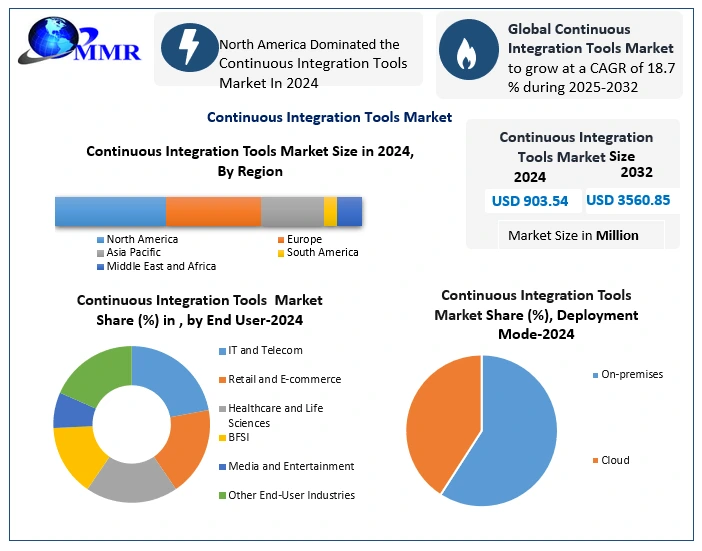 To know about the Research Methodology :- Request Free Sample Report
Global Continuous Integration Tools Market Dynamics
Increasing Adoption of DevOps and Agile Methodologies Drives Market Growth
The widespread adoption of DevOps and Agile methodologies is significantly driving the growth of the Continuous Integration Tools Market. DevOps practices emphasize continuous collaboration between software development and operations teams to deliver software faster and more reliably. Agile methodologies prioritize iterative development, rapid feedback, and frequent releases. CI tools fit perfectly into these frameworks by automating code integration, testing, and deployment processes, which helps teams identify and resolve integration issues early in the development cycle.
The implementation of CI reduces manual efforts and human errors, accelerating the overall software delivery lifecycle. This leads to faster time-to-market, improved software quality, and increased customer satisfaction. Enterprises of all sizes, from startups to large organizations, are investing in CI tools to maintain competitive advantage in the fast-paced digital economy. According to MMR Report, over 80% of enterprises globally have adopted some form of CI/CD (Continuous Integration/Continuous Delivery) pipeline, underlining the critical role these tools play in modern software development. Industries such as IT and telecom, BFSI, retail, and healthcare are increasingly dependent on reliable software delivery, driving further demand for CI tools. The ability to support continuous testing, integration, and deployment aligns with business needs for agility and innovation. This adoption trend, combined with increasing digital transformation initiatives, will continue to boost the Continuous Integration Tools Market.
Security and Compliance Concerns limits the Continuous Integration Tools Market Growth
Continuous Integration tools offer substantial benefits, they also introduce security and compliance challenges that limit their adoption and deployment, especially in regulated industries. The CI process typically involves multiple interconnected tools, code repositories, build servers, and third-party plugins, creating a complex ecosystem vulnerable to cyber threats. Improper configuration, unsecured credentials, and outdated dependencies may lead to security breaches, data leaks, or unauthorized access.
Regulatory compliance requirements add another layer of complexity. Organizations in sectors such as healthcare, finance, and government must adhere to strict standards like GDPR (General Data Protection Regulation), HIPAA (Health Insurance Portability and Accountability Act), and SOC 2 (System and Organization Controls). Ensuring that CI pipelines maintain audit trails, enforce access controls, and provide data encryption is critical to meet these compliance mandates. Failure to comply can result in penalties, legal issues, and reputational damage. Integrating legacy applications and infrastructure with modern CI pipelines remains a significant hurdle. Large enterprises with complex IT environments often struggle to unify traditional software systems with agile, automated workflows. This integration challenge slows down the full adoption of CI tools and limits the ability to achieve seamless end-to-end automation.
Integration of AI and Cloud-Native Technologies Creates Growth Opportunities
The integration of artificial intelligence (AI) and cloud-native technologies into Continuous Integration tools is unlocking new growth opportunities and reshaping the market landscape. AI-driven CI platforms utilize machine learning algorithms to optimize build processes, automate test case selection, and detect anomalies in code quality or pipeline performance. This reduces manual intervention and enhances the accuracy and efficiency of the CI process.
AI capabilities also improve predictive analytics, enabling teams to forecast potential integration failures or bottlenecks before they impact production. Automated test generation and intelligent prioritization help accelerate software release cycles while maintaining high quality standards. By minimizing human error and improving pipeline robustness, AI-powered CI tools significantly enhance developer productivity and operational excellence. The shift toward cloud-native development and deployment models fuels demand for scalable, flexible, and accessible CI solutions. Cloud-based CI tools eliminate the need for extensive on-premises infrastructure, reduce setup and maintenance costs, and support globally distributed development teams. Integration with major cloud service providers such as AWS, Microsoft Azure, and Google Cloud enables seamless multi-cloud and hybrid-cloud environments. This convergence of AI and cloud technologies allows organizations to implement continuous delivery pipelines with greater agility and resilience. Consequently, vendors are investing heavily in developing AI-enabled and cloud-integrated CI tools, which is expected to boost the market. The growing emphasis on automation, scalability, and intelligent workflows positions the Continuous Integration tools market for rapid growth.
Continuous Integration Tools Market, Segmentation
Based on Deployment Mode, Continuous Integration Tools Market is segmented into On-premise and Cloud. The On-premise segment dominated the Deployment Mode segment in 2024. Due to several key factors. Many large enterprises and regulated industries prefer on-premise CI solutions because they offer greater control over data security, privacy, and compliance. On-premise setups allow organizations to host sensitive codebases and CI pipelines within their own secure infrastructure, reducing risks associated with data breaches or unauthorized access. Additionally, companies with complex legacy systems often find on-premise integration more feasible, as it allows customization and compatibility with existing IT environments. The ability to tailor infrastructure resources to specific performance requirements attracts organizations requiring high-speed builds and low latency. Furthermore, concerns around cloud dependency, potential downtime, and regulatory constraints in certain regions have driven sustained demand for on-premise CI tools. While cloud adoption is growing rapidly, on-premise remains preferred in sectors prioritizing stringent security and full control over software development workflows.
Continuous Integration Tools Market, Regional Growth
North America dominated the Continuous Integration Tools Market in 2024. The region’s dominance stems from early adoption and deep integration of advanced software development practices, such as DevOps and Agile, within enterprises. Major technology giants headquartered in North America including Amazon Web Services, IBM, Microsoft, and Google have heavily invested in developing innovative CI solutions, driving widespread adoption. Strong IT infrastructure, high internet penetration, and strong digital literacy contribute to the rapid deployment of CI tools across diverse industries, including finance, healthcare, telecommunications, and technology. Organizations in these sectors emphasize accelerating software delivery cycles, improving code quality, and enhancing operational efficiency through automation and continuous testing. North American businesses also face stringent regulatory and compliance standards such as HIPAA, SOX, and GDPR (for multinational operations), which necessitate rigorous testing and validation processes supported by CI tools.
The region benefits from substantial investments in research and development, fostering innovation in AI-driven automation, cloud-native CI platforms, and security enhancements. The convergence of technological maturity, regulatory pressure, and high digital transformation initiatives makes North America the most advanced and largest market for continuous integration tools globally.
Government Initiative and Funding by Region
| Government/Region | Initiative | Funding | Focus Area |
| U.S. (DARPA) | Secure CI/CD for Defense Systems | USD 150 Mn. | Cybersecurity-hardened CI pipelines for military software development. |
| EU (Horizon Europe) | EuroDevOps 2030 | USD 220 Mn. | Standardizing CI/CD practices for GDPR-compliant cloud-native applications. |
| Japan (METI) | J-Cloud DevOps Initiative | JPY 0.10 Bn. | AI-driven CI tools for automotive & semiconductor industries. |
Global Continuous Integration Tools Market Competitive Landscape
The Continuous Integration Tools Market is highly dynamic, drive by a mix of dominant players and innovative newcomers driving rapid evolution. GitHub (Microsoft) stands out as the market leader with GitHub Actions, leveraging its extensive developer community and deep integration with Azure cloud services. GitLab offers a popular all-in-one DevOps platform, especially favored for its self-managed CI/CD capabilities. Jenkins, supported by CloudBees, remains a powerful open-source solution valued for its flexibility and extensive plugin ecosystem, although it faces user experience challenges compared to more modern alternatives.
New entrants such as Atlassian’s Bitbucket Pipelines and cloud-native CircleCI are quickly gaining ground through seamless integrations and developer-friendly workflows. Niche companies such as Harness provide AI-driven insights into CI pipelines, while Travis CI benefits from a strong open-source following. With North America leading cloud-based innovations and Asia-Pacific targeting cost-effective solutions for startups, competition is intensifying around features like security, predictive analytics, and multi-cloud support, positioning the CI tools market as a vibrant and fast-growing segment in enterprise software.
Global Continuous Integration Tools Market Recent Development
• In July 2022, CircleCI declared general availability of support for GitLab SaaS users, enabling seamless integration between CircleCI’s DevOps platform and GitLab technologies. This interoperability provides GitLab-based development teams with CircleCI’s industry-leading speed, intelligent test splitting, and the widest range of resource classes and compute options to optimize their continuous integration and delivery workflows.
• In December 2022, Amazon introduced Amazon CodeCatalyst, a unified service that streamlines software development and delivery on AWS. It helps teams design, build, collaborate, and deploy applications faster with reduced friction throughout the development lifecycle. The platform offers issue management with traceability across commits, pull requests, and deployments, automated CI/CD pipelines using flexible, managed infrastructure, and dashboards displaying project activities such as commits, pull requests, and test reports.
Global Continuous Integration Tools Market Trends
• AI automation is revolutionizing CI/CD.
AI technologies like Jenkins Vision and Bitrise optimize build processes by detecting flaky tests and improving reliability. This automation reduces manual effort, accelerates development cycles, and enhances build accuracy, enabling teams to deliver software faster while maintaining high quality and minimizing downtime.
• The optimization of cloud costs and performance has emerged as a top priority.
Cloud-native CI/CD platforms prioritize cost efficiency and speed. BitBucket’s auto-scaling runners dynamically adjust resources to match demand, while Travis CI’s ARM64 support boosts build speed up to five times. These innovations reduce operational expenses and accelerate delivery pipelines, improving overall developer productivity.
• Security and compliance are becoming native CI functionality.
With increasing regulations, CI/CD pipelines now embed security and compliance features. Red Hat’s Tekton Chains offers software supply chain management to ensure integrity and traceability of builds in regulated environments. This native security approach mitigates risks and supports organizational compliance requirements seamlessly during development.
Continuous Integration Tools Market Scope: Inquire before buying
| Continuous Integration Tools Market | |||
|---|---|---|---|
| Report Coverage | Details | ||
| Base Year: | 2024 | Forecast Period: | 2025-2032 |
| Historical Data: | 2019 to 2024 | Market Size in 2024: | USD 903.54 Mn. |
| Forecast Period 2025 to 2032 CAGR: | 18.7% | Market Size in 2032: | USD 3560.85 Mn. |
| Segments Covered: | by Deployment Mode | Cloud-based On-premises |
|
| by Organization Size | Large Enterprises Small-Sized Enterprises Medium-Sized Enterprises (SMEs) |
||
| by End User Industry | IT and Telecom Retail and E-commerce Healthcare and Life Sciences BFSI Media and Entertainment Other End-User Industries |
||
Global Continuous Integration Tools Market by Region
North America (United States, Canada and Mexico)
Europe (UK, France, Germany, Sweden, Italy, Spain, Russia, and Rest of Europe)
Asia Pacific (China, South Korea, Japan, India, Australia, Indonesia, Philippines, Malaysia, Vietnam, Thailand, and Rest of Asia Pacific)
Middle East and Africa (South Africa, Saudi Arabia, GCC, and Rest of the Middle East &Africa)
South America (Brazil, Argentina, Colombia, Chile, and Rest of South America)
Global Continuous Integration Tools Market Key Players
North America:
1. IBM (U.S.)
2. Microsoft (GitHub Actions) (U.S.)
3. AWS (AWS CodePipeline) (U.S.)
4. CircleCI (U.S.)
5. Puppet (U.S.)
6. CloudBees (Jenkins) (U.S.)
7. Travis CI (U.S.)
8. SmartBear (U.S.)
9. Electric Cloud (U.S.)
10. AutoRABIT (U.S.)
11. GitLab Inc.(U.S.A)
Europe:
1. Atlassian (Bitbucket Pipelines) (UK/Australia)
2. JetBrains (TeamCity) (Czech Republic)
3. Drone.io (Germany)
4. Bitrise (Hungary)
5. Nevercode (Estonia)
Asia-Pacific:
1. Red Hat (US)
2. Shippable (India)
3. Buildkite (Australia)
Frequently Asked Questions:
1.Which region has the largest share in the Global Market?
Ans: North America region held the highest share in 2024.
2. What is the growth rate of the Global Continuous Integration Tools Market?
Ans: The Global Market is growing at a CAGR of 18.7% during the forecasting period 2025-2032.
3. What is the scope of the Global Continuous Integration Tools Market report?
Ans: The Global Continuous Integration Tools Market report helps with the PESTEL, PORTER, , Recommendations for Investors& Leaders, and market estimation of the forecast period.
4. Who are the key players in the Global Continuous Integration Tools Market?
Ans: The important key players in the Global Market are – Microsoft, GitLab, AWS, CircleCI, CloudBees, and Others
5.What is the study period of this Market?
Ans: The Global Market is studied from 2024 to 2032.