
Content Intelligence Market Size by Deployment Type, Organization Size, Industry Vertical, Region – Segment-Level Market Assessment, Growth Opportunity Analysis, Competitive Mapping & Forecast to 2032
Overview
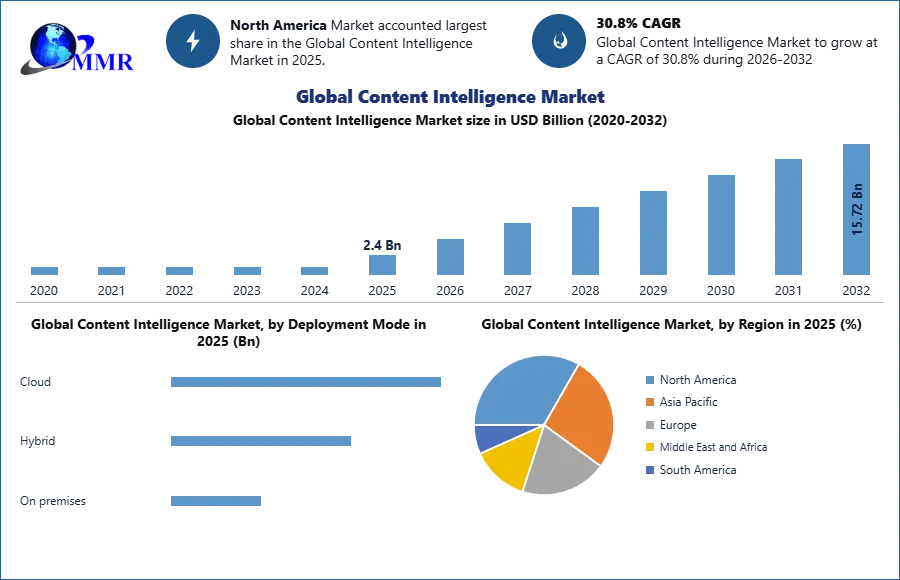
The Global Content Intelligence Market is projected to expand from USD 2.4 billion in 2025 to USD 15.72 billion by 2032, registering a robust CAGR of 30.8% and signaling accelerated adoption of data-driven content strategies worldwide.
Content Intelligence Market Overview:
Content Intelligence is a content marketing strategy that employs artificial Intelligence (AI)-powered technologies and software to translate content and enterprise data into actionable insights in order to create an effective content strategy. Organizations can utilize content Intelligence to develop high-value, data-driven, targeted, and conversion-focused content. According to MMR research, Content Intelligence market is expected to register CAGR of 30.8% during the forecast period .
 To know about the Research Methodology :- Request Free Sample Report
2025 is considered as a base year to forecast the Market from 2026 to 2032. 2025’s Market size is estimated on real numbers and outputs of the key players and major players across the globe. Past five years trends are considered while forecasting the Market through 2032. 2020 is a year of exception and analyzed specially with the impact of lockdown by region.
Content Intelligence Market Dynamics:
One of the most common ways for marketers to reach out to prospects and customers online is through content marketing. Although precise figures are difficult to come by, reports estimates that hundreds of millions of pieces of content are created every day. When you consider all of the numerous sorts of content that marketers create, from blog posts and white papers to photographs, videos, and social media postings, the amount of information that marketers create is simply staggering and hence considered as key factor driving the market growth.
Furthermore, given the massive amount of information being created, it's becoming increasingly difficult to acquire a complete picture of its impact, which is where content Intelligence comes in. Big data analysis, which artificial Intelligence and machine learning systems can give, can substantially benefit in measuring the impact of mass-produced content. Content Intelligence tools assist content marketers in better understanding the impact of their content by offering real-time reporting on its effectiveness as well as actionable insights for developing effective content that produces outcomes.
Better Audience Understanding:
Content Intelligence gives you vital information into your audience, allowing you to better match their needs and fine-tune your targeting for increased engagement. A content Intelligence platform will analyze all of your consumer data, including demographics, interests and preferences, previous encounters with your brand, and browsing history, to give you useful insights into the type of content you should be creating. According to UN Data Centre Report, 80% of content Intelligence tools are created by keeping the audience understanding in the mind.
Higher customer experience:
One is able to improve the entire experience for their consumers or users and aid to boost the brand reputation by being able to develop more effective and valuable content for actual audience. Every one of the consumers is expected to be at a different point in their purchasing process. Content Intelligence may assist one in fine-tuning the content marketing strategy to create various sorts of content at each point of the journey. One will be able to more easily convert leads into sales and keep current customers engaged. One can also use content Intelligence to "hyper-personalize" the content for a specific audience, making it more relevant and likely to convert.
Improvement in content marketing experience:
The 80:20 rule applies to content marketing, as it does to many other facets of business and life. In general, only 20% of your material is likely to produce 80% of result outcomes. The trick is to immediately spot this high-performing material and develop more of it in order to replicate its impact. The key to this is content Intelligence, which can evaluate thousands of data points to figure out exactly what's working for the specific audience. This will assist anyone in developing an effective "content recipe" that consistently produces excellent outcomes. When powerful content Intelligence tools can help improve the content development and obtain the highest potential ROI from efforts, there's no reason to keep wasting time on unproductive material.
Spotting customer needs for future and spotting trends:
Artificial Intelligence is particularly good at detecting trends in data and extrapolating data to anticipate future outcomes. A smart content Intelligence platform can not only assist you select what to write about in the future, but it can also notice changes in social media usage and marketing effectiveness. E.g. If creating Facebook content still a suitable strategy for one’s company in 2026? Content Intelligence can assist in determining this.
Content Intelligence platforms can also use natural language processing to assess individual pieces of content and identify features like style and tone of voice, as well as give recommendations for content authors on SEO and other content enhancements. Because these suggestions are data-driven, they help remove some of the uncertainty from the content production process. As content Intelligence relies on a huge amount of data to function, it necessitates a close relationship with the content management system. Some systems can function simply by connecting to analytics tools like Google Analytics, while others require a deeper integration with the content management system where the content is stored. CMS functionality is available in many content Intelligence systems.
Content Intelligence Risks:
Increased awareness of such technology could raise concerns, especially in the wake of large-scale data misuse. Publishers must weigh the advantages of obtaining firsthand empirical knowledge against the risk of influencing how their audiences see them. Gathering or purchasing aggregate data may be a solution, but the granularity required for true content Intelligence is unlikely to be achieved. They won't be able to solve the other problem, which is cost. Data acquisition is costly, and data purchased from third parties must be processed multiple times. Data has never aged as quickly as it does today, and data that needs to be acted on must be refreshed on a regular basis, accepted as the store increases, and discarded as it becomes obsolete. Content production is only half of an effective content Intelligence operation, and it's the easier side to satisfy to some extent.
Content Intelligence Market Segmentation:
Cloud segment is dominating the market in terms of deployment:
Cloud segment is dominating the content Intelligence market with market share of 65%. To boost mobility and decentralize data storage and computation, businesses prefer to employ content Intelligence solutions via the cloud. The uptake of cloud services is hampered by security concerns. However, by having third parties do rigorous security checks to the highest standards, this problem is rapidly being eliminated. Furthermore, significant improvements in cloud technology, with security as a top focus, as well as the rising cost of support and maintenance for on-premises solutions, is expected to propel cloud-based content Intelligence forward.
Emerging Trends in the Content Intelligence Market:
• From brief creation to tailoring CTAs, the top content Intelligence solutions include tools for every point of the cycle. Some can even compare a company's performance to that of its strongest competitors. Smart speakers and voice assistants use anonymized data to improve their knowledge outside of the web, so it's no surprise if relevant adverts show up in social feeds after you've viewed comparable information elsewhere. Cookies track your online movements, and Bluetooth-enabled in-store beacons add to your profile. Lead scoring is a method of filtering huge data so that brands may determine which image, narrative, or ad is most likely to engage users on an individual level. It's how they save money on marketing while getting the most bang for their buck.
• The technologies that enable good content Intelligence necessitate human oversight, but they free up marketing professionals to focus on the big picture and an overarching plan rather than the tedious task of generating tailored subject lines and calls to action by hand. Content Intelligence provides them with a once-in-a-lifetime opportunity to do what they do best: promote the brands they represent in new and increasingly profitable ways. That is, after all, why they took the job in the first place, and it is also what managers who want to apply content Intelligence must emphasize if they want their staff to buy in.
• Using Intelligence to directive the content: Projects involving effective content Intelligence in the future. Reading statistics, calculating what worked in the past, and thinking of methods to improve are all part of traditional marketing. Brands may analyses content before it's created using tools like Adobe's Sensei and data-driven content studio services. E.g. Sensei can repurpose content for the web rapidly, add metadata, and optimize short-form content for small displays, allowing content to be reused multiple times. It can also crop and hide photographs to meet brand guidelines while keeping the focus areas intact. Content Intelligence is compared as "auto navigation for your marketing" by Salesforce. Marketing Cloud Einstein, the company's tool for predicting how people will react to content while it's being created, assists marketers in crafting content that speaks to certain demographics, determining its most likely emotional impact, and optimizing distribution.
• Vertex AI has a comprehensive set of MLOps capabilities. Vertex ML Metadata, for example, monitors the inputs and outputs of an ML pipeline as well as the provenance of artefacts in the event of auditability. Vertex Model Monitoring ensures that models are operating as intended after they are in production, alerting data scientists to data drift or other issues. These features facilitate debugging and provide the visibility required for regulatory compliance and overall data hygiene. Similarly, the platform is developed with security in mind, with features like Private Endpoints that reduce the risk of data breaches and provide users peace of mind that their models and underlying data are safe.
North America is dominating the Content Intelligence Market:
Because of the presence of significant vendors such as Adobe Inc., Scoop.it, OpenText Corporation, Atomic Reach Inc., and Vennli Inc. in North America, the region retains the majority of the market share. Furthermore, according to a research published by the Interactive Advertising Bureau and PricewaterhouseCoopers, digital ad spending in the United States has surpassed USD 100 billion, indicating the potential expansion of market Intelligence platforms like content Intelligence.
Furthermore, in terms of active social media users, content creators, and smartphone penetration, the region is expected to grow at a strong rate. It indicates an increase in the volume of data created in the region, which may be used by platforms like content Intelligence to generate insights about trends, boosting market growth.
The objective of the report is to present a comprehensive analysis of the Content Intelligence Market to the stakeholders in the industry. The past and current status of the industry with the forecasted Market size and trends are presented in the report with the analysis of complicated data in simple language. The report covers all the aspects of the industry with a dedicated study of key players that include Market leaders, followers, and new entrants.
PORTER, PESTEL analysis with the potential impact of micro-economic factors of the Market have been presented in the report. External as well as internal factors that are supposed to affect the business positively or negatively have been analyzed, which will give a clear futuristic view of the industry to the decision-makers.
The report also helps in understanding the Content Intelligence Market dynamics, structure by analyzing the Market segments and project the Content Intelligence Market size. Clear representation of competitive analysis of key players by Type, price, financial position, Type portfolio, growth strategies, and regional presence in the Content Intelligence Market make the report investor’s guide.
Content Intelligence Market Scope: Inquire before buying
| Global Content Intelligence Market | |||
|---|---|---|---|
| Report Coverage | Details | ||
| Base Year: | 2025 | Forecast Period: | 2026-2032 |
| Historical Data: | 2020 to 2025 | Market Size in 2025: | 2.4 USD Billion |
| Forecast Period 2026-2032 CAGR: | 30.8% | Market Size in 2032: | 15.72 USD Billion |
| Segments Covered: | by Deployment Mode | Cloud Hybrid On premises |
|
| by Application | Content Analytics Audience Segmentation Campaign Optimization Competitor Analysis |
||
| by Organization Size | Large Enterprises SMEs |
||
| by End User | Media & Entertainment Marketing and Advertising Retail & e-Commerce Healthcare Education Others |
||
Content Intelligence Market, by region
North America (United States, Canada and Mexico)
Europe (UK, France, Germany, Italy, Spain, Sweden, Austria and Rest of Europe)
Asia Pacific (China, South Korea, Japan, India, Australia, Indonesia, Malaysia, Vietnam, Taiwan, Bangladesh, Pakistan and Rest of APAC)
Middle East and Africa (South Africa, GCC, Egypt, Nigeria and Rest of ME&A)
South America (Brazil, Argentina Rest of South America)
Key Players/Competitors Profile Covered in Brief in Global Content Intelligence Market Report in Strategic Perspective :
Adobe
M-Files
OpenText
Curata
Scoop.it
Socialbakers
Atomic Reach
OneSpot
Vennli
Idio
Abbyy
Content Insights
Knotch
Smartlogic
Conductor
Concured
Ceralytics
Salsify Inc.
Hitachi Vantara Corporation
QORDOBA
LinkedIn Corporation
Verizon Media
Amazon Web Services, Inc.