
Computer Aided Design (CAD) Market by Technology Type, Deployment Model, Component, End-Use Industry Region - Global Market Size Estimation, Industry-Wide Analysis, Competitive Landscape Assessment & Long-Term Forecast to 2032
Overview
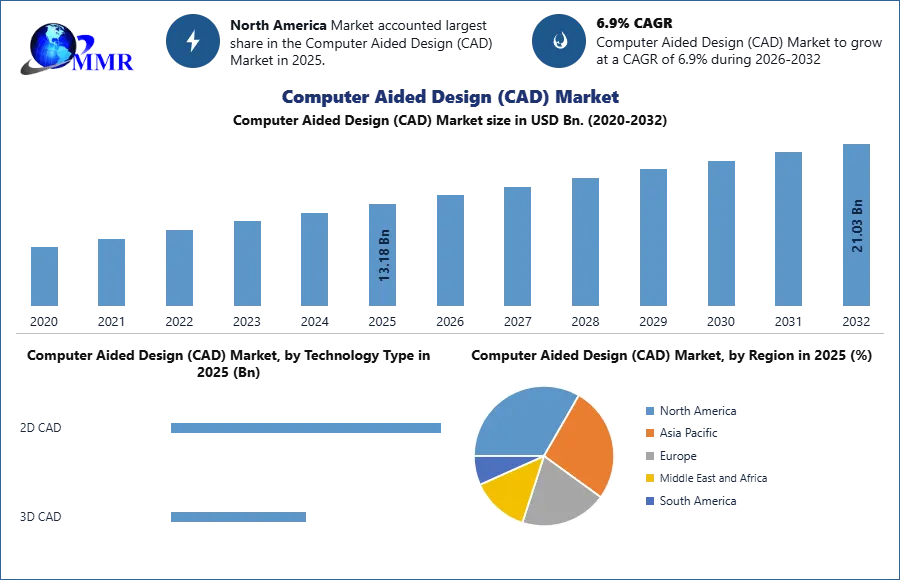
The Computer Aided Design (CAD) Market was valued at USD 13.18 Bn in 2025, and the total revenue of the Computer Aided Design (CAD) Market is expected to grow at a CAGR of 6.9% from 2026 to 2032, reaching USD 21.03 Bn by 2032.
Computer Aided Design (CAD) Market Overview:
Computer Aided Design is a type of software that is used to create 2D and 3D models and designs. CAD software is used in a variety of sectors and occupations to create architectural designs, building plans, floor plans, electrical schematics, mechanical drawings, technical drawings, blueprints, and even special effects in movies and television shows. 2D, and 3D are the two types of the designs of the Computer aided design (CAD). Windows, UNIX, Linux, and Mac OS X are the four types of the operating systems of the Computer aided design (CAD). Automotive, Aerospace and Defense, Building and Construction, Industrial Machinery, Electrical and Electronics, and Pharmaceuticals and Healthcare are some of the end-users of the computer aided design (CAD).
To know about the Research Methodology:- Request Free Sample Report
Computer Aided Design (CAD) Market Dynamics:
Mobile access has become one of the most important features that businesses and consumers want in practically any technology. A growing number of CAD developers are implementing methods for accessing planned data on mobile platforms. Another interesting trend in the CAD market is software subscriptions over the cloud. Cloud storage advancements are propelling CAD technology, allowing designers and developers to save their creations on cloud platforms. Cloud CAD software has a number of advantages, including ease of updating, enhanced mobility, increased storage capacity, and significant cost savings. For example, in 2016, Autodesk released Fusion 360, a largely cloud-based software that only requires a small portion of a user's hard drive. These user-friendly developments in CAD software technology gave the sector a much-needed boost.
Prior to the introduction of computer-aided design, drawings had to be drawn by hand with a pencil and paper. Using rulers, protractors, and other drafting equipment, each item, line, and curve had to be drawn by hand. Calculations, such as the structural load on a building component, would have to be done manually by an engineer or designer, which would take a long time and be prone to errors. All of this was altered via CAD software. Designs may be produced, altered, and stored in a considerably shorter amount of time. CAD drawings are not constrained by the 2D space of a sheet of paper, and may be inspected from a variety of perspectives to verify proper fit and design. The computer does the calculations, making it considerably easier to test the practicality of designs. In real time, designs may be shared and collaborated on, thus reducing the amount of time required.
Computer aided design (CAD) offers plenty of benefits such as better quality design, simplify communication, a streamlined design process, plenty of documentation, a manufacturing database, and design data saved. The computer aided design (CAD) market revenue share of Autodesk Inc. was 29% in 2025, whereas, the computer aided design (CAD) market revenue share of Dassault was 23% in 2025.
CAD software is expensive, and running it on a computer requires additional hardware support, which is expected to restrains the growth of the global computer aided design (CAD) market during the forecast period 2026-2032.
Computer Aided Design (CAD) Market Segment Analysis:
Based on the Technology Type, the computer aided design (CAD) market is segmented into 2D and 3D. The 3D design type segment is expected to hold the largest market share by 2032. 3D CAD software offers plenty of benefits, such as avoiding costly mistakes, working more efficiently, increasing designer productivity, visualising your end product, and other benefits it provides. For major plant design disciplines, 3D CAD modelling software aids productivity gains. It enables owner-operators and engineering, procurement, and construction (EPC) firms to visualise the completed plant more clearly and make more informed decisions and forecasts based on data. Clients also have access to many "what-if" scenarios during the design process. Non-CAD and non-design stakeholders can engage in the process by creating virtual models.
Engineering 3D modelling improves data management by allowing users to organise and manage design assets and papers. It allows users to standardise detailing and drafting techniques, automating workflow and improving output speed and accuracy. Automatic ISO creation aids in material consumption accuracy as well as procurement and fabrication time efficiency.
Based on Component, the computer-aided design (CAD) market is segmented into software and services. The Software held the largest share in 2025, supported by continuous upgrades in design automation, AI-driven design optimisation, and user-friendly interfaces. The growing integration of CAD with PLM (Product Lifecycle Management) systems and simulation software boosted adoption. Services such as training, consulting, and customisation provided essential support but accounted for a smaller revenue share compared to core software.
Computer Aided Design (CAD) Market Regional Insights:
North America dominates the Computer Aided Design (CAD) market during the forecast period 2026-2032. North America is expected hold the largest market share by 2032. This is due to the rising adoption of the mechanical computer aided design (CAD) software in the automotive industry, and building and construction industry in the North America region. This is the key factor that is expected to boost the growth of the North America region in the Computer aided design (CAD) market during the forecast period 2026-2032.
Asia Pacific is expected to grow rapidly during the forecast period 2026-2032. This is due to the growing utilization of the computer aided design (CAD) technology for designing various instruments and infrastructure in the Asia Pacific region. This is the key driver that is expected to drives the growth of the Asia Pacific region in the market during the forecast period .
Recent Industry Developments (2025–2026)
| Exact Date | Company | Development | Impact |
|---|---|---|---|
| 11 February 2026 | Dassault Systèmes | The company reported a successful shift to subscription-based models, reaching a €4.50 billion Annual Run Rate (ARR) by the end of 2025. | This financial stability enables aggressive reinvestment into AI-native generative design tools for 2026. |
| 27 January 2026 | PTC Inc. | PTC released Windchill AI Parts Rationalization, a tool designed to optimize CAD component reuse through machine learning algorithms. | The launch reduces design redundancy and accelerates time-to-market for large-scale industrial manufacturing clients. |
| 06 January 2026 | PTC Inc. | Launched AI-powered FlexPLM capabilities at NRF 2026, integrating generative AI directly into retail and consumer product design workflows. | This development bridges the gap between CAD and retail PLM, allowing for rapid iterative design cycles. |
| 22 October 2025 | Siemens Digital Industries Software | Announced the Solid Edge 2026 update featuring Design Copilot, a conversational AI assistant embedded within the CAD environment. | The update automates up to 80% of 2D drawing views, significantly lowering the technical barrier for complex engineering documentation. |
| 13 July 2025 | Synopsys Inc. / Ansys Inc. | Synopsys completed the landmark $35 billion acquisition of Ansys Inc., merging electronic design automation with industry-leading simulation. | The merger creates a dominant force in multi-physics simulation, forcing other CAD providers to seek similar integrated partnerships. |
| 01 January 2025 | Hexagon AB | Officially completed the takeover of CAD Service to integrate advanced visualization and Enterprise Asset Management (EAM) capabilities. | This acquisition strengthens Hexagon’s digital twin portfolio, specifically targeting the transportation and energy sectors. |
The objective of the report is to present a comprehensive analysis of the Global Market to the stakeholders in the industry. The past and current status of the industry with the forecasted market size and trends are presented in the report with the analysis of complicated data in simple language. The report covers all the aspects of the industry with a dedicated study of key players that include market leaders, followers, and new entrants.
PORTER, PESTEL analysis with the potential impact of micro-economic factors of the market have been presented in the report. External as well as internal factors that are supposed to affect the business positively or negatively have been analyzed, which will give a clear futuristic view of the industry to the decision-makers.
The reports also help in understanding the Global Market dynamic, structure by analyzing the market segments and project the Global Market size. Clear representation of competitive analysis of key players by product, price, financial position, product portfolio, growth strategies, and regional presence in the Global Market make the report investor’s guide.
Computer Aided Design (CAD) Market Scope: Inquire before buying
| Computer Aided Design (CAD) Market | |||
|---|---|---|---|
| Report Coverage | Details | ||
| Base Year: | 2025 | Forecast Period: | 2026-2032 |
| Historical Data: | 2020 to 2025 | Market Size in 2025: | 13.18 USD Bn. |
| Forecast Period 2026-2032 CAGR: | 6.9% | Market Size in 2032: | 21.03 USD Bn. |
| Segments Covered: | by Technology Type | 2D CAD 3D CAD |
|
| by Deployment Model | On-Premises Cloud |
||
| by Component | Software Services |
||
| by End-Use Industry | Automotive Aerospace & Defense Building & Construction Healthcare / Medical Devices Electronics & Semiconductor Others |
||
Computer Aided Design (CAD) Market, by Region
North America (United States, Canada and Mexico)
Europe (UK, France, Germany, Italy, Spain, Sweden, Austria, Turkey, Russia and Rest of Europe)
Asia Pacific (China, India, Japan, South Korea, Australia, ASEAN and Rest of APAC)
Middle East and Africa (South Africa, GCC, Egypt, Nigeria and Rest of ME&A)
South America (Brazil, Argentina, Columbia and Rest of South America)
Key Players / Competitors Profiles Covered in Brief in Global Computer Aided Design (CAD) Market Report in Strategic Perspective:
- Autodesk Inc.
- . Dassault Systèmes
- Siemens Digital Industries Software
- PTC Inc.
- Hexagon AB
- Bentley Systems Inc.
- Ansys Inc.
- Altair Engineering Inc.
- Cadence Design Systems Inc.
- Trimble Inc.
- Autodesk Inc.
- Bricsys NV
- Graphisoft
- IronCAD LLC
- ZWSOFT Co., Ltd.
- Robert McNeel & Associates
- Nemetschek SE
- EPLAN Software & Service LLC
- Gstarsoft Co., Ltd.
- TurboCAD (IMSI Design)
- Kubotek3D
- VariCAD
- Open Design Alliance
- Graebert GmbH
- NanoSoft (nanoCAD)