
Composites Market Size by Fiber Type, Resin Type,Manufacturing Process, End-User and Region - Segment-Level Market Assessment, Growth Opportunity Analysis, Competitive Mapping & Forecast to 2032
Overview
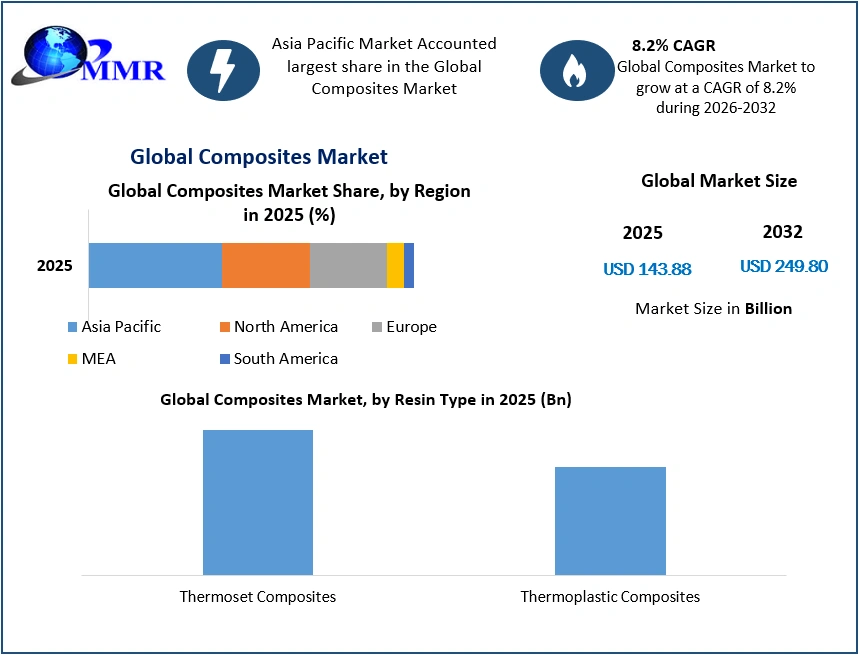
The Composites Market size was valued at USD 143.88 Billion in 2025 and the total Composites revenue is expected to grow at a CAGR of 8.2% from 2026 to 2032, reaching nearly USD 249.80 Billion by 2032.
Global Composites Market Overview
Composites are engineered materials made by combining two or more distinct substances typically a reinforcement (like carbon fiber or glass fiber) and a matrix (such as polymer, metal, or ceramic). These materials work together to produce a final product that is stronger, lighter, and more durable than the individual components. The Composites Market is experiencing strong global expansion, driven by increasing demand for lightweight materials across automotive, aerospace, energy, and infrastructure sectors.
The advancements in composite applications, particularly in transportation, where metals with FRP materials, carbon fiber, and glass fiber, enable 10–20% weight reduction and improved energy efficiency. Growth patterns highlighted in the Composite Materials Industry Analysis show that the Glass Fiber Market remains dominant, while the Carbon Fiber Composites Market is growing rapidly due to rising adoption in EVs and aircraft. Innovation in polymer matrix composites and expanding use of thermoset composites and thermoplastic composites are strengthening demand.
To know about the Research Methodology :- Request Free Sample Report
Trend: Rapid Adoption of Lightweight Materials in Transportation
Automakers and aerospace manufacturers are increasingly replacing traditional metals with GFRP (Glass Fiber Reinforced Polymer) and CFRP (Carbon Fiber Reinforced Polymer) components to improve overall efficiency, safety, and performance. In the Automotive Composites Market, the use of GFRP and CFRP contributes to 10–15% vehicle weight reduction, enabling improved fuel economy for conventional engines and enhanced battery range for electric vehicles (EVs). As EV production expands, expected to exceed 30 million units by 2030, the demand for lightweight, high-strength composites is set to rise proportionally.
Advanced composites now constitute over 50% of the structural weight of new-generation aircraft such as the Boeing 787 and Airbus A350. This shift is driven by the need for higher fuel efficiency, reduced maintenance costs, and superior fatigue resistance. The growing dominance of composites in aerospace applications reinforces the growth of the Aerospace and Advanced Composites Market.
The lightweight trend influences related sectors such as logistics, rail transport, and marine mobility, where reducing weight directly enhances load capacity and operating efficiency. The continued focus on carbon reduction targets and sustainability goals is expected to further elevate the importance of lightweight composite components worldwide, boosting long-term growth across the Composite Market Size.
Rising Demand for Wind Energy Installations to drive the Composites Market
The rapid expansion of global wind energy infrastructure has emerged as a strong driver for the Composite Materials Market. Modern wind turbines, particularly large offshore models, rely extensively on Glass Fiber Composites, polymer matrix composites, and thermoset composites due to their exceptional strength-to-weight ratio, stiffness, and fatigue resistance. As wind turbine blades continue to increase in size, exceeding 80 to 100 meters, the demand for durable yet lightweight FRP materials, composite resin, and specialized reinforcements has surged.
In 2025, global wind capacity additions surpassed 110 GW, marking one of the strongest years for renewable installations. This expansion directly benefits the Glass Fiber Composites Market, as more than 80% of wind blades are manufactured using GFRP. Thermoset systems, including epoxy and polyester resins, remain essential for blade fabrication due to their long-term stability and structural integrity. The growth in offshore wind led by China, the U.S., and Northern Europe is intensifying demand across the Composite Fiber Market.
The shift toward sustainable energy sources is prompting governments to announce large-scale renewable energy commitments. Countries worldwide aim to increase wind power capacity to meet carbon neutrality targets by 2050, which will significantly elevate composite consumption. The Asia-Pacific region, in particular, is witnessing fast-paced expansion, supporting broader growth outlined in the Asia-Pacific Composites Market Growth.
Limited Recycling Infrastructure to restrain the Composites Market
The limited recycling infrastructure for composite waste, especially thermoset composites. Due to their cross-linked molecular structure, thermoset materials cannot be remelted or reshaped, making traditional recycling processes ineffective. As a result, only 15–20% of global composite waste is currently recoverable, creating substantial environmental and economic challenges.
This issue is particularly pronounced in sectors such as wind energy, automotive, and aerospace, where high volumes of composite materials enter the waste stream after decades of use. For example, wind turbine blades, typically made from GFRP and epoxy resins, are difficult to process at end-of-life. With thousands of turbines set to retire over the next decade, the volume of composite waste is expected to rise sharply, intensifying pressure on the sustainable composites and bio-composites market to develop innovative recycling solutions. Regulatory bodies in Europe and North America are implementing stricter sustainability guidelines, which may slow adoption in regions lacking adequate recycling systems. This challenge directly impacts the Composite Market Share. Although emerging technologies such as pyrolysis, solvolysis, and mechanical grinding show potential, they remain costly and limited in scalability.
Global Composites Market Segment Analysis
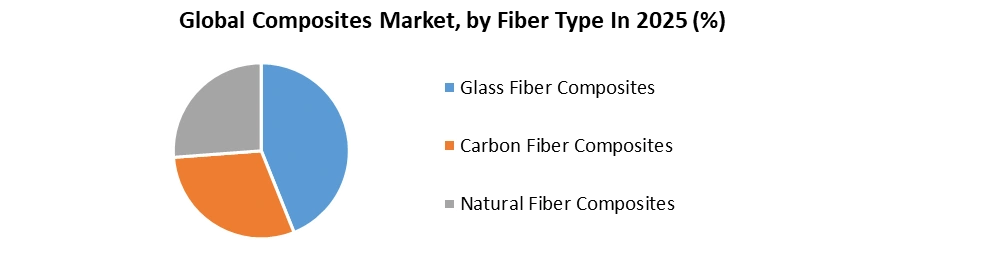
Based on Fiber Type, the market is segmented into Glass Fiber Composites, Carbon Fiber Composites and Natural Fiber Composites. Glass Fiber Composites dominated the Global Composites Market in 2025. The Glass fiber remains the leading fiber type due to its strong balance of cost-effectiveness, performance, and wide applicability. These materials offer strong mechanical properties, corrosion resistance, and flexibility in molding, making them essential to the GFRP market, Composite Materials Industry Analysis, and the evolving lightweight materials market.
Their versatility enables mass adoption across industries such as automotive composites, marine composites, wind energy composites, and electrical applications. Glass fiber is preferred because it delivers significant weight reduction compared to metals while maintaining durability for structural and semi-structural applications. In wind energy and construction, glass fiber supports long fatigue life and environmental resistance, strengthening its position in the Glass Fiber Composites Market. Its compatibility with various resin systems supports its use in multiple composite manufacturing processes.
Based on Resin Type, the market is categorized into Thermoset Composites and Thermoplastic Composites. Thermoset Composites is expected to dominate the Composites Market over the forecast period. As part of the Thermoset Composites Market, these resins form a permanent, crosslinked structure upon curing, providing long-term durability, minimal deformation, and high structural integrity. Industries such as aerospace composites, automotive composites, wind energy, construction, and marine rely heavily on thermosets because they deliver reliable performance under demanding conditions.
In aerospace and automotive applications, they are used for structural panels, reinforcements, and components requiring long-term load-bearing performance. In wind energy, they are essential for producing robust turbine blades, while in marine applications, they resist moisture and corrosion, helping companies strengthen their position in the Advanced Composites Industry. Thermoset composites continue to dominate the polymer matrix composites market because they consistently deliver the strength, stability, and longevity required for high-performance applications. The capabilities of thermoplastic composites are still developing on a large scale.
Global Composites Market Regional Insights
Asia Pacific dominated the Composites Market in 2025 and is expected to continue its dominance over the forecast period. The rapid industrialization, expanding manufacturing capabilities, and strong demand from high-growth sectors. The benefits region from a well-established supply chain for carbon fiber, glass fiber, composite resin, and advanced reinforcement materials. Countries like China, Japan, South Korea, and India are significantly shaping the Composite Market Size through large-scale production and continuous technological innovation.
The major factor behind this dominance is the strong adoption of composite applications in industries such as automotive composites, aerospace composites, construction, and renewable energy. China and India are experiencing a surge in EV manufacturing, increasing demand across the CFRP market, GFRP market, and the broader Polymer Matrix Composites Market. Japan and South Korea remain leaders in the Advanced Composites Market, particularly in high-performance aerospace components.
Asia Pacific leads the world in wind turbine installations, boosting demand for FRP market solutions and enhancing growth highlighted in the Forecast for Glass Fiber Composites in Wind Energy. With governments promoting sustainability, the region is investing heavily in bio-composites, sustainable composites, and emerging technologies such as thermoplastic composites and the ceramic matrix composites market. As infrastructure development expands and industries shift toward lightweight materials, the region is poised to maintain its leadership in the Global Composites Market.
Composites Market Competitive Landscape
The composites market is highly competitive and characterized by a mix of global chemical giants, specialized composite manufacturers, and emerging regional players. Leading companies such as Toray Industries, Hexcel Corporation, Owens Corning, Solvay, SGL Carbon, and Teijin dominate the market through strong product portfolios in carbon fiber, glass fiber, and advanced resin systems. These players focus on innovation, high-performance materials, and strategic partnerships with aerospace, automotive, wind energy, and construction industries.
Mergers, acquisitions, and capacity expansions are common strategies to strengthen market presence and meet rising demand for lightweight, durable, and sustainable materials. Mid-tier companies such as Gurit, Saertex, AOC, and Polynt-Reichhold compete by offering specialized composite solutions and cost-efficient manufacturing. Meanwhile, emerging players in China, India, and Southeast Asia are intensifying competition through lower production costs and rapid technological advancements.
Recent Developments
• On October 16, 2024, Hexcel announced its strategy for high-rate aerospace composites at the Carbon Fiber 2024 Conference in Charleston, SC. The company highlighted the need for cost-efficient, sustainable, and maintainable composite solutions for next-generation single-aisle aircraft and Advanced Air Mobility (AAM). Hexcel emphasized its vertically integrated production of carbon fiber, prepregs, and honeycomb, along with advanced processes such as out-of-autoclave curing and compression molding, to support faster, more scalable aerospace manufacturing.
• On November 6, 2024, Toray Advanced Composites announced the acquisition of Gordon Plastics’ assets, technology, and IP to expand its continuous fiber-reinforced thermoplastic composites portfolio. The Englewood, Colorado, facility adds significant R&D and production capacity for high-performance UD tapes made with PEI, PPS, PES, PA6, and PA11 matrices. This move strengthens Toray’s position in industrial, sporting goods, and energy sectors while supporting the growing demand for advanced thermoplastic composite solutions.
Composites Market Scope: Inquire before buying
| Global Composites Market | |||
|---|---|---|---|
| Report Coverage | Details | ||
| Base Year: | 2025 | Forecast Period: | 2026-2032 |
| Historical Data: | 2020 to 2025 | Market Size in 2025: | USD 143.88 Bn. |
| Forecast Period 2026 to 2032 CAGR: | 8.2% | Market Size in 2032: | USD 249.80 Bn. |
| Segments Covered: | by Fiber Type | Glass Fiber Composites Carbon Fiber Composites Natural Fiber Composites |
|
| by Resin Type | Thermoset Composites Thermoplastic Composites |
||
| by Manufacturing Process | Layup Process Filament Winding Process Injection Molding Process Pultrusion Process Compression Molding Process Resin Transfer Molding Process Others |
||
| by End-User | Aerospace & Defense Automotive & Transportation Wind Energy Building & Construction Electrical & Electronics Marine Industrial Consumer Goods Others |
||
Composites Market, by Region
Asia Pacific (China, South Korea, Japan, India, Australia, Indonesia, Malaysia, Vietnam, Taiwan, Bangladesh, Pakistan and Rest of APAC)
Europe (UK, France, Germany, Italy, Spain, Sweden, Austria and Rest of Europe)
North America (United States, Canada and Mexico)
Middle East and Africa (South Africa, GCC, Egypt, Nigeria and Rest of ME&A)
South America (Brazil, Argentina Rest of South America)
Composites Key Players
1. Hexcel Corporation
2. Toray Industries Inc.
3. Owens Corning
4. SGL Carbon
5. Solvay
6. Teijin Limited
7. Mitsubishi Chemical Group
8. Huntsman Corporation
9. AOC LLC
10. Saertex GmbH
11. Gurit Holding AG
12. Hexion Inc.
13. Jushi Group
14. Nippon Sheet Glass (NSG)
15. U.S. Liner Company
16. Strongwell Corporation
17. Molded Fiber Glass Companies (MFG)
18. Polynt-Reichhold
19. Park Aerospace Corp.
20. Zoltek Companies
21. Porcher Industries
22. Celanese Corporation
23. Axiom Materials
24. Hexagon Composites
25. Euro-Composites S.A.
26. Creative Composites
27. Kreysler & Associates
28. Gurit
29. TPI Composites
30. Jiangsu Hengshen Co., Ltd.
Frequently Asked Questions:
1] What is the growth rate of the Global Composites Market?
Ans. The Global Composites Market is growing at a significant rate of 8.2% during the forecast period.
2] Which region is expected to dominate the Global Composites Market?
Ans. The Asia Pacific is expected to dominate the Composites Market during the forecast period.
3] What was the Global Composites Market size in 2025?
Ans. The Composites Market size is expected to reach USD 143.88 billion in 2025.
4] What is the expected Global Composites Market size by 2032?
Ans. The Composites Market size is expected to reach USD 249.80 billion by 2032.
5] Which are the top players in the Global Composites Market?
Ans. The major players in the Global Composites Market are Hexcel Corporation, Toray Industries Inc., Owens Corning, SGL Carbon, Solvay and Others.
6] What are the factors driving the Global Composites Market growth?
Ans. The Global Composites Market is driven by increasing demand for lightweight, durable, and high-strength materials, rapid growth in aerospace, automotive, wind energy, and construction sectors, along with advancements in resin systems, automation, sustainability, and cost-efficient composite manufacturing technologies.