
Coating Additives Market - Industry Structure Evaluation, Demand Drivers Analysis, Regional Growth Analysis and Identification, Competitive Positioning Review & Global Market Size Forecast to 2034
Overview
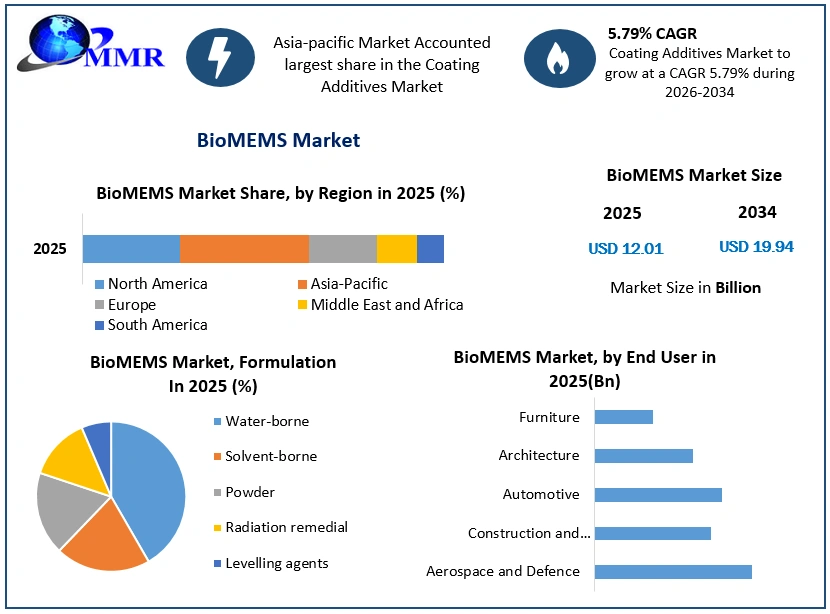
Coating Additives Market was valued at US$ 12.01 Bn in 2025 and is expected to grow with a CAGR of 5.79 % from 2026 to 2034 reaching US$ 19.94 Bn.
Coating Additives Market Overview
Coating additives are small portions of about 5% of the total formulation prepared which are added to paints to raise their performance and quality. However, the small portion can significantly improve properties like consistency, appearance, color control, adhesion, dilution. The use of coating additives is increasing in automotive, construction & buildings, aerospace, architecture industry due to rising developments in these areas. The water-borne coatings are highly preferred by industries due to government regulations being imposed in many countries for maintaining a sustainable environment.
Coating Additives Market Size, Growth & Share Analysis
To know about the Research Methodology :- Request Free Sample Report
The coating additives market has a growth for acrylic coatings due to its high performance and relatively reduced prices than other types. The coating additives are used for decoration, identification and as anti-corrosive agents. The Asia-Pacific region holds largest coating additives market share due to rising investments in construction and automotive sectors certainly in China, Japan, India. The other emerging regions following Asia-pacific are Europe and North America. The market is dominated by global players such as Sherwin-Willams, ALTANA, BASF, Evonik, Dow chemical companies. The leading importers of Coating Additives are Vietnam (12,693 shipments), India (859 shipments) and China (788 shipments) due to investments in construction and other sectors. The exporters for the market are Germany, China and Vietnam. The construction, agriculture segment has switched towards greener technologies which are being adopted in protective coatings used in steel and ship building industries.
In 2025, San Marco Group, collaborated with Asian Paints Ltd in providing Novacolor’s premium decorative paints across the globe, and making Italian designs affordable to everyone. The innovations such as Anti-bacterial paints, aerospace paints, Volatile Organic Compounds free paints, 3D Color paints and many more are the growing trends of the coating additive market.
Overall, the coating additives market is projected to grow with a CAGR of 5.79% till 2034. The emerging regions in the forecast period are Europe and North America due to rising demand from construction sectors. The coating additives market has potential use of water-borne formulations due to regulations being imposed by government bodies. The companies in the coating additives market are finding sustainable and eco-friendly solutions to remain in the competition with the introduction of various start-ups.
Coating Additives Market Dynamics
Factors driving the Coating Additives Market
The construction, automotive, furniture, ship industry has a greater impact on the growth of coating additives market. The environmental regulations imposed by government has changed the view of coating additives market towards bio-material based paint alternatives. The regulations on Volatile Organic Compounds (VOC) have increased the demand for water-based coatings to enhance their performance. The aerospace, naval, automotive industry is witnessing growth that leads to demand for coating additives. Nanotechnology driven coating additives have improved the properties of coatings during application. The urbanization rate in China has reached 64.7% in the year 2022 improving urban living conditions, thus leading to growth in construction and furniture industry.
1. Arxada is expanding its vertical for Z line which is specifically for green systems. These Z line additives do not emit VOCs, HAPs to prevent low performance of formulations. The company recently launched Troysol ZLAC, which is a green multifunctional silicone-free additive that imparts flow &levelling, adhesion, gloss and colour uniformity in aqueous coatings and adhesives.
The unavailability of raw material slows down the production process, thus is a major restraint to coating additives market. The fluctuations in price of raw materials drastically impacts the coating additives market as higher costs create reduced profit margins. In response to this, manufacturers should implement innovative strategies to effectively manage fluctuations. Government regulations on ESG guidelines can affect the production of additive manufacturers. Recently, the Chinese government has passed legislation for reduction in Volatile Organic Compound (VOC) emissions generated from industries, manufacturing plants, coatings and paints due to which the ground level ozone composition has increased. The markets impacted were wood coatings, floor coatings, automotive refinishes, marine coatings. The problem is resolved by shifting to water-borne or powder coating application.
The automotive, construction and aerospace sectors have been emerging substantially leading to demand in the coating additives market. These industries heavily rely on high-performance additive applications. There is also a scope for developments in sustainable coatings by using environment friendly practices. The use of nanotechnology is a new trend for production of coating additive materials. Companies have developed nanomaterial additions and are incorporating these materials to improve coating properties without damaging the existing characteristics. The use of Bromosphaerol is done as an important additive in maritime sector as it is compatible with oceanic environments. The problem of Biofouling in Maritime Industry is resolved by use of copper nanocontainers to obtain antifouling and anticorrosive results.
Recent Trends driving the Coating Additives Market
1. Glow in Dark Paints- These paints comprise of phosphorescent pigments that emit light after exposure to light source. These play role in providing both functional and artistic applications. In sectors such as aerospace, automotive, emergency signage, the luminous paints offer visibility during low-light conditions.
2. VOC Free Compounds- VOC free compounds are used in paints to address environmental issues which cause air pollution and impose adverse health effects. They also play a role in promoting sustainable practices within industry by improving air quality and adverse respiratory issues.
3. Aerospace Paints- The Aerospace paints are formulated to meet rigid requirements of the aviation sector to ensure longevity and performance of aircrafts. These paints offer better protection and appearance of aircrafts. Companies manufacture coatings with nano-scale additives to resist UV radiation, corrosion, wear and tear and extreme climatic conditions.
4. Anti-bacterial Paints- These paints are formulated with antimicrobial additives that inhibit bacteria and fungi on surfaces, especially used for living spaces. The demand for anti-bacterial paints is growing due to need for health-conscious environment. These paints have a wide application in healthcare facilities, housing areas and public spaces.
Coating additives market segment analysis-
Acrylic Coatings are growing at a robust pace
By Type Acrylic coatings account for 25% of total value of coatings across the globe. Acrylic coating additives comprise a wide range of chemical compounds that are used to enhance the long-term performance of coatings. These additives improve the leveling, adhesion, durability, resistance, corrosion and overall quality of coatings. The acrylic coating additives have a wide application in furniture, automotive, decorative finishes and industrial goods industry. Acrylic coatings are leading finishes used in paints over the past few years. In regions of North America and Western Europe, there is use of acrylic latexes in the automotive finish market. Global players dominating the coating additives market for acrylic coatings are Dow, Celanese, etc. In the year 2022, the Rheology modifier application is expected to hold 29% of value share, due to demand in architectural sector for smooth surface finishing.
Growing demand for water-borne coating additives
By Formulation The demand for water-borne coatings is increasing from paint and construction sectors, which will replace the solvent-based coating. The growth is due to changing legal regulations and environment sustainability norms. Recent examples include Volatile Organic Compounds (VOCs) restrictions enforced in regions of Europe, North America and China. The drivers of water-borne coatings are compliance with sustainability aspects of construction standards. The DIY, architectural, construction sector already has the largest market share for water-borne coatings. Especially, in countries like China where investment is higher in housing projects and industrial buildings, water-borne coating additives are preferable. Water-borne coatings have potential application on huge metal structures such as trains, transport vehicles and industrial machinery. The water-borne coatings account for 70-80% of total Original Equipment Manufacturing (OEM) market.
Coating additives market Regional Insights
The Asia-Pacific region held the largest coating additives market share with 43% of value among the total global production of coating additives in 2025. The emerging construction, automotive, home renovation and furniture industries demand a higher proportion of coating additives. Thus, these sectors enhance Asia’s share in the coating additive market. Due to increased demand for paints from the construction industry, nations such as China and India are primarily contributing to regional coating additives market growth. Because of the increased demand for paints from the building industry in these nations, China, Japan, and India are the primary countries contributing to regional coating additives market growth. Europe ranks second with 7 million tons of production followed by the region of North America.
The Construction and Architectural sectors are witnessing rapid growth in the coating additives market. Coating additives play a role in protecting buildings against environmental stress. The additives serve dual purpose by enhancing the visualization by regulating gloss levels and protection against moisture. They also play a role in providing adhesion, durability, anti-corrosive shield against UV, dust and other external conditions.
Coating additives market Competitive Landscape
The global key players are implementing novel components in the production materials while extending their geographical reach to maintain their strong presence in the global market. Long-term contracts are being signed with suppliers of raw materials to meet the growing demand in the market.
1. The speciality chemicals company BYK-Chemie GmbH (Altana) in the year 2019 announced its expansion of chemical division in Shanghai, China which will serve customers in the rapidly growing Asian market.
2. Ashland Inc. speciality chemicals company in the year 2019 expanded its water-borne architectural line by addition of speciality phosphate ester surfactant ie. Strodex PK-86NV.
3. In 2025, at American Coating Show, Arkema introduced bio-based solutions for UV curable additives, water-borne additives, which has almost 97% bio-base content.
4. Gerdau Graphene (2022) is a nanotechnology pioneering company which advanced graphene-enhanced materials for industrial applications and also announced the introduction of water-based architectural paint that is significantly more resistant and durable to external stress than traditional paints.
5. Antiviral Protection, a Spanish startup manufactures coatings that protect against harmful bacteria. For Eg. VirucideP, an elastic paint composed of acrylic polymers based on water prevents growth of algae and also offers odourless, low emission application. The paints are used for indoor and outdoor applications to offer protection against pollutants.
6. Alora, a Singapore based startup manufactures eco-friendly paints for both commercial and residential application which possess zero-VOC method to emit pollutants. Its anti-mold technology reduces mold formation on painted surfaces thus keeping indoor spaces hygenic.
Coating Additives Market Recent Industry Developments
| Date | Company | Development | Impact |
|---|---|---|---|
| 14 May 2025 | Evonik Industries AG | Evonik Coating Additives launched four new silica and alumina-based particle dispersions under its AERODISP® brand engineered for waterborne inkjet ink receptive coatings. | The new additives significantly improve dot sharpness and image resolution in digital printing while allowing seamless incorporation into aqueous coating formulations. |
| 24 October 2025 | Evonik Industries AG | Evonik officially inaugurated its new Alu5 manufacturing plant in Yokkaichi, Japan, to produce advanced fumed alumina under the AEROXIDE® product line for coating additives. | The mid-double-digit million-euro facility enhances supply chain reliability and delivers high-purity surface additives for ultra-thin powder coatings and electric vehicle battery applications across Asia. |
| 15 June 2026 | Evonik Industries AG | Evonik upgraded its siloxane coating additives portfolio, achieving over 95% compliance with less than 0.1% Substances of Very High Concern (SVHCs). | This benchmark enables paint and ink manufacturers to meet strict EU REACH regulations and maintain Ecolabel certifications without requiring costly product reformulations. |
Coating Additives Market Scope: Inquire before Buying
| Global Coating Additives Market | |||
|---|---|---|---|
| Report Coverage | Details | ||
| Base Year: | 2025 | Forecast Period: | 2026-2034 |
| Historical Data: | 2020 to 2025 | Market Size in 2025: | US $ 12.01 Bn. |
| Forecast Period 2026 to 2034 CAGR: | 5.79% | Market Size in 2034: | US $ 19.94 Bn. |
| Segments Covered: | by Product Type | Acrylic Deformers Rheological Modifiers Wetting Agents Automotive Coating |
|
| by Formulation | Water-borne Solvent-borne Powder Radiation remedial Levelling agents |
||
| by End User | Aerospace and Defence Construction and Buildings Automotive Architecture Furniture |
||
Coating Additives Market, by Region
North America (United States, Canada and Mexico)
Europe (UK, France, Germany, Italy, Spain, Sweden, Austria, Turkey, Russia and Rest of Europe)
Asia Pacific (China, India, Japan, South Korea, Australia, ASEAN and Rest of APAC)
Middle East and Africa (South Africa, GCC, Egypt, Nigeria and Rest of ME&A)
South America (Brazil, Argentina, Columbia and Rest of South America)
Key Players-
1. Solvay SA (Brussels, Belgium)
2. Lord Corporation (North Carolina, United States)
3. Altana AG (Wesel,Germany )
4. Evonik (Essen, Germany)
5. Eastman Chemical Company (Tennessee, United States)
6. Clariant (Muttenze, Switzerland)
7. Cabot Corporation (Boston, United States)
8. Sherwin-Williams (United States)
9. Double Bond Chemical Ind. Co Ltd (Taiwan)
10. Dynea as (Norway)
11. Kenrich petrochemicals (New Jersey)
12. Berger paints (India)
13. Beckers Group (Berlin)
14. Arkema SA (France)
15. KCC paint (Malaysia)
16. Nippon Paint (Japan)
17. Kansai Paint (Japan)
18. PPG Industries (Pennsylvania, United States)
19. BASF SE (Munster, Germany)
20. Nouryon (Netherlands)
21. AkzoNobel (Netherlands)
22. Axalta (United States)
23. Alora (Singapore)
Frequently Asked Questions:
1. Which region is expected to hold the largest coating additives market share over the forecast period?
Ans. The region of Asia-Pacific is expected to hold the largest market share.
2. Who are the top players in the Global Coating Additives Market?
Ans. The leading global companies are Dow, BASF, Altana, Sherwin-Williams, BYK Chemie.
3. What are the growth factors driving the market?
Ans. The growth in the market is accelerated by expansion of automotive and construction industries, recent developments in the chemical industry.
4. Which segments are covered for the coating additives market?
Ans. The market is segmented on the basis of Product type, Formulation, Region and End User.
5. What is the market size of coating additives market in 2034?
Ans. The coating additives market is estimated to reach US$ 19.94 Bn by 2034.