
Carbon Nanomaterials Market – Industry Structure Evaluation, Demand Drivers Analysis, Regional Growth Analysis and Identification, Competitive Positioning Review & Global Market Size Forecast to 2030
Overview
Carbon Nanomaterials Market size was valued at US$ 19.47 Bn. in 2023 and it is expected to reach US$ 25.8 Bn. by 2030, at a CAGR of 4.1% through out the forecast period.
Carbon Nanomaterials Market Overview:
Carbon nanomaterials are used in various applications including energy storage and conversion, field emission devices, drug delivery, composite materials, sensors, as well as carbon nanomaterials, find their applications in nanoscale electronic components.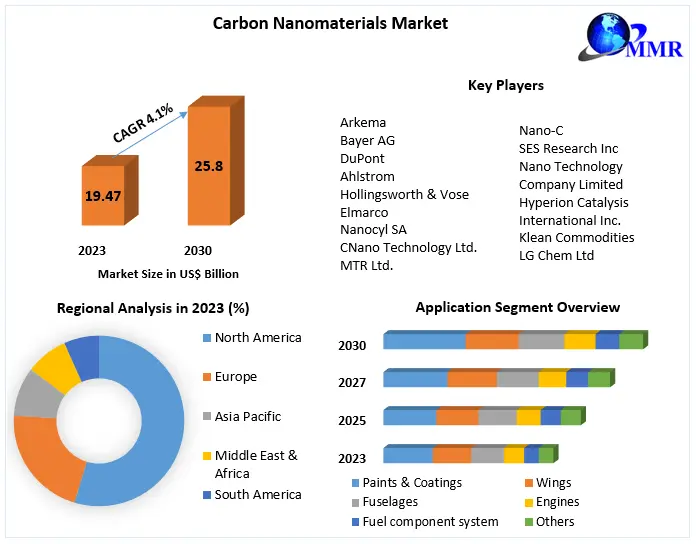 To know about the Research Methodology :- Request Free Sample Report
Carbon Nanomaterials Market Dynamics:
Increasing applications of carbon nanomaterials in the automotive industry for designing and manufacturing car interiors and exteriors thanks to their favorable mechanical properties and lightweight. The product is extensively utilized in automobiles to reduce the aluminum engine weight, for better grip and low rolling resistance, in lithium-ion batteries to decrease the charge time, boost the tensile strength, and reduce the weight of automobiles. These factors fuelling the global carbon nanomaterials market growth. Moreover, carbon nanomaterials are finding their use in aerospace applications like coatings, cockpit, crew gear, space durable mirrors, nozzles, equipment enclosures, aircraft interiors, and solar array substrates.
Carbon nanomaterials are widely used in medicine and pharmaceuticals for the sensitive detection of key biological molecules, more precise and safer imaging of diseased tissues, and novel form of therapeutics thanks to their electrical, optical, mechanical, and chemical properties. Some carbon nanomaterials-based therapeutic and diagnostic agents have developed for the treatment of asthma, pain, allergy, cancer, diabetes, and infections, these factors are expected to propel the market growth during the forecast period.
Multi-walled carbon nanomaterials are widely utilized because of ease of synthesizing when compared with other types of carbon nanomaterials thanks to their properties like diameter length ratio, high strength, etc. The simple addition of carbon nanomaterials doesn’t produce any desired outcomes in the rubber mixture. Moreover, the usage of carbon black as fillers has improved technological, mechanical, and gas barrier properties. After inhaling these particles can irritate the lungs and cause coughing as well as irritating the eyes, nose, and throat. These aforementioned health hazards hamper the carbon nanomaterial market growth.
Carbon Nanomaterials Market Segment Analysis:
By Type, the carbon nanomaterials market is segmented into carbon nanotubes, fullerenes, graphene, and carbon nanofibers. The carbon nanotube segment accounted for the XX% market share in 2019, thanks to its individual properties including electrical conductivity, flexibility, electron field emitter, conductivity, elasticity, and low thermal expansion coefficient. Carbon nanotubes composites can absorb or conjugate various therapeutic molecules including antibodies, DNA, drugs, proteins, and enzymes as they have a major surface area, high chemical stability, and rich electronic polyaromatic structure. Rising demand for carbon nanotubes composites for applications like field emission, conductive adhesives, molecular electronics, catalyst supports, actuators, sensors, EMI shielding, thermal conductivity, and energy storage and biomedical is driving the carbon nanomaterials market demand.

By Method, the market is segmented into arc discharge, liquid phase carbon nanotubes purification, laser ablation, chemical vapor deposition, high-pressure carbon monoxide reaction, and others. The chemical vapor deposition segment is accepted to hold the largest market share during the forecast period. Chemical vapor deposition is a widely used method of film deposition for the semiconductor industry because of its high throughput, high purity, and low cost of operation. The method is also used in optoelectronics applications, optical coatings, and coatings of wear-resistant parts. Chemical vapor deposition has various advantages over physical vapor deposition processes including better molecular beam evaporation and sputtering. Furthermore, the chemical vapor deposition method does not require high vacuum levels, and can generally process substrates in major batches. These all factors drive the segment growth in the carbon nanomaterials industry.
By End-Use Industry, the market is segmented into automotive, packaging, electrical & electronics, aviation, energy, healthcare, and consumer goods. The electronics segment led the market and is expected to register a CAGR of around 16.3% in 2019 thanks to its wide applications in electronic industries as sensor materials for pressure on account of its properties including electrical and thermal conductivity, magnetic properties, and mechanical strength. The electrical and magnetic properties of nanomaterials improve the electrical conductivity in ceramics, increases the electric resistance in nano metals thereby making it unique and widely utilized in electronic materials like optoelectronics, superconductivity, sensor fabrication, electromagnetic interference shielding, and memory chips, which is expected to drive the carbon nanomaterials market demand during the forecast period.
Carbon Nanomaterials Market Regional Insights:
Asia Pacific is dominating the Global Carbon Nanomaterials Market
Rising application of carbon nanomaterials in developing countries including India and China. Japan is expected to be the largest supplier of carbon nanomaterials during the forecast period followed by China and South Korea. Major end-use industries including electronics, automotive, and defense boost the product demand in the region. Rising disposable income especially in India and China is also contributing to the market growth.
Europe is expected to be the largest region of the carbon nanomaterials market thanks to the presence of a well-developed automotive industry in the region. The electronic, defense, and automotive industries are expected to propel the market in North America because of growing defense research in the region. Latin America is expected to witness significant growth during the forecast period attributed to the expansion of the automotive and electronics industries in economies like Brazil.
The objective of the report is to present a comprehensive analysis of the Global Magnetic Beads market to the stakeholders in the industry. The past and current status of the industry with the forecasted market size and trends are presented in the report with the analysis of complicated data in simple language. The report covers all the aspects of the industry with a dedicated study of key players that include market leaders, followers, and new entrants.
PORTER, PESTEL analysis with the potential impact of micro-economic factors of the market have been presented in the report. External as well as internal factors that are supposed to affect the business positively or negatively have been analysed, which will give a clear futuristic view of the industry to the decision-makers.
The report also helps in understanding the Global Magnetic Beads market dynamics, structure by analyzing the market segments and project the Global Magnetic Beads market size. Clear representation of competitive analysis of key players by product, price, financial position, product portfolio, growth strategies, and regional presence in the Global Magnetic Beads market make the report investor’s guide.
Carbon Nanomaterials Market Scope: Inquire before buying
| Carbon Nanomaterials Market | |||
|---|---|---|---|
| Report Coverage | Details | ||
| Base Year: | 2023 | Forecast Period: | 2024-2030 |
| Historical Data: | 2018 to 2023 | Market Size in 2023: | US $ 19.47 Bn. |
| Forecast Period 2024 to 2030 CAGR: | 4.1% | Market Size in 2030: | US $ 25.8 Bn. |
| Segments Covered: | by Type | Carbon nanotubes Graphene Carbon Nanofibers Fullerenes Others |
|
| by Method | Arc Discharge Laser Ablation Chemical Vapor Deposition High-Pressure Carbon Monoxide Reaction Liquid Phase Carbon Nanotubes Purification Others |
||
| by Application | Paints & Coatings Wings Fuselages Engines Fuel component system Others |
||
| by End-Use | Automotive Electrical & Electronics Aviation Energy Healthcare Packaging Consumer Goods |
||
Carbon Nanomaterials Market, by Region
North America (United States, Canada and Mexico)
Europe (UK, France, Germany, Italy, Spain, Sweden, Austria, Turkey, Russia and Rest of Europe)
Asia Pacific (China, India, Japan, South Korea, Australia, ASEAN and Rest of APAC)
Middle East and Africa (South Africa, GCC, Egypt, Nigeria and Rest of ME&A)
South America (Brazil, Argentina, Columbia and Rest of South America)
Global Carbon Nanomaterials Market Key Players
1. Arkema
2. Bayer AG
3. DuPont
4. Ahlstrom
5. Hollingsworth & Vose
6. Elmarco
7. Nanocyl SA
8. CNano Technology Ltd.
9. MTR Ltd.
10. Nano-C
11. SES Research Inc
12. Nano Technology Company Limited
13. Hyperion Catalysis International Inc.
14. Klean Commodities
15. LG Chem Ltd
Frequently Asked Questions:
1. Which region has the largest share in Global Carbon Nanomaterials Market?
Ans: Asia Pacific region held the highest share in 2023.
2. What is the growth rate of Global Carbon Nanomaterials Market?
Ans: The Global Carbon Nanomaterials Market is growing at a CAGR of 4.1% during forecasting period 2024-2030.
3. What is scope of the Global Carbon Nanomaterials Market report?
Ans: Global Carbon Nanomaterials Market report helps with the PESTEL, PORTER, COVID-19 Impact analysis, Recommendations for Investors & Leaders, and market estimation of the forecast period.
4. Who are the key players in Global Carbon Nanomaterials Market?
Ans: The important key players in the Global Carbon Nanomaterials Market are – Arkema, Bayer AG, DuPont, Ahlstrom, Hollingsworth & Vose, Elmarco, Nanocyl SA, CNano Technology Ltd., MTR Ltd., Nano-C, SES Research Inc, Nano Technology Company Limited, Hyperion Catalysis International Inc., Klean Commodities, and LG Chem Ltd.
5. What is the study period of this Market?
Ans: The Global Carbon Nanomaterials Market is studied from 2023 to 2030.