
Biorational Pesticides Market by Type, Source, Application, Crop Type, Formulation and Regional Insights 2034
Overview
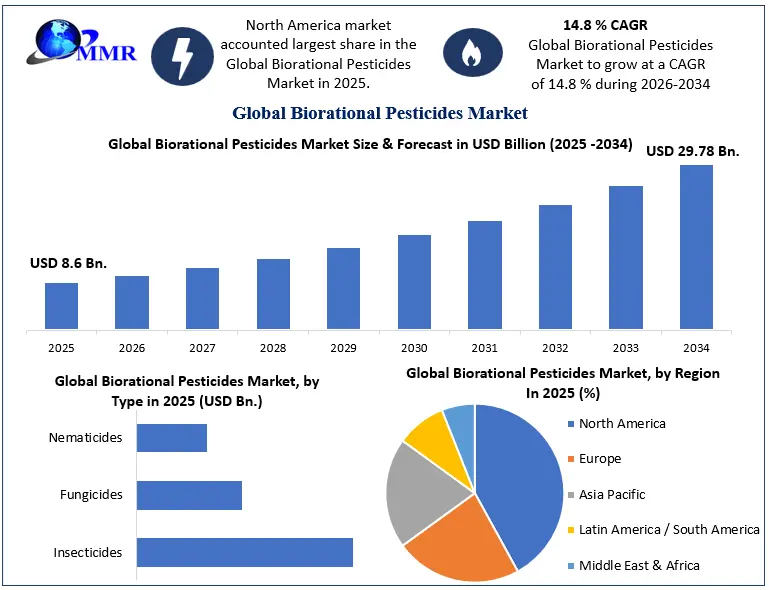
Global Biorational Pesticides Market size was valued USD 8.6 Bn. in 2025 and the total revenue is to grow at 14.8% from 2026 to 2034, reaching USD 29.78 Bn.
Biorational Pesticides Market Overview
Global Biorational pesticides are pest-control products derived from naturally occurring microorganisms, plant extracts, pathogens, and other biological sources. They are designed to control agricultural pests while generally offering lower environmental impact and reduced toxicity to non-target organisms compared with many conventional chemical pesticides. These products include microbial pesticides, botanical pesticides, and other biologically based pest-management solutions.
The Global Biorational Pesticides Market is growing as farmers increasingly adopt sustainable crop-protection practices, integrated pest management, and environmentally friendly agricultural inputs. The market is projected to grow at a CAGR of 14.8% from 2026 to 2034, supported by increasing demand for residue-conscious food production, organic farming, and biological crop-protection solutions. Asia Pacific represents a significant regional market, supported by large agricultural production, increasing awareness of sustainable farming, and growing adoption of biological pest-management products. Key companies operating in the market include BASF SE, Bayer AG, Syngenta Group, and Marrone Bio Innovations.
The MMR report provides a detailed assessment of the Biorational Pesticides Market, covering market size and forecasts, market dynamics, growth drivers, restraints, opportunities, technological developments, regional analysis, and competitive landscape. The report also examines the market by product type, source, application, crop type, and region, helping clients understand emerging opportunities, competitive developments, regional demand patterns, and factors shaping the market through 2034.
Biorational Pesticides Market Size, Growth & Share Analysis
To know about the Research Methodology :- Request Free Sample Report
Biorational Pesticides Market Dynamics:
Market Drivers
• Growing aversion to chemically derived pesticides is encouraging farmers to adopt biological and environmentally friendly crop-protection solutions.
• Rising consumer preference for organic and residue-conscious food products is increasing demand for biorational pesticides.
• Increasing awareness of environmental sustainability and concerns regarding the impact of conventional pesticides are supporting market growth.
• Wider adoption of Integrated Pest Management (IPM) is creating opportunities for biological pest-control products.
• Government initiatives, sustainable agriculture programs, farmer awareness campaigns, and subsidies are supporting the adoption of biorational pesticides.
Market Restraints
• Limited availability of certain biorational pesticide products can restrict adoption in some agricultural markets.
• The short shelf life of some biological pesticide formulations creates challenges in storage, transportation, and distribution.
• Higher sensitivity to environmental conditions can affect the effectiveness and consistency of certain biological products.
• Limited awareness and technical knowledge among some farmers can slow the adoption of biorational pest-management solutions.
Market Growth Opportunities
• Expansion of organic farming is creating significant opportunities for biorational pesticide manufacturers.
• Increasing demand for sustainable and low-residue crop protection can support product development and market expansion.
• Technological advancements in microbial, botanical, and biochemical formulations can improve product stability, effectiveness, and shelf life.
• Growing agricultural production in Asia Pacific and other emerging economies provides opportunities for market penetration.
• Development of new biological formulations and combination products can expand applications across fruits, vegetables, cereals, grains, and commercial crops.
Market Challenges
• Maintaining product stability and shelf life throughout storage and transportation remains a key challenge.
• Variable field conditions, including temperature, humidity, and UV exposure, can influence the performance of biological pesticides.
• Competition from conventional chemical pesticides may limit adoption where farmers prioritize immediate pest-control results or lower costs.
• Regulatory approval and product registration requirements can increase the time and investment required to commercialize new biorational pesticide products.
• The need for farmer education regarding proper application, dosage, and storage can affect widespread adoption.
Global Biorational Pesticides Market Segment Analysis
By Type: The Biorational Pesticides Market is segmented into Microbial Pesticides, Botanical Pesticides, and Biochemical Pesticides. Microbial pesticides are widely adopted because they use naturally occurring microorganisms such as bacteria, fungi, and viruses to target specific pests. Botanical pesticides derived from plant-based compounds are also gaining attention due to increasing demand for natural and environmentally friendly crop-protection products.
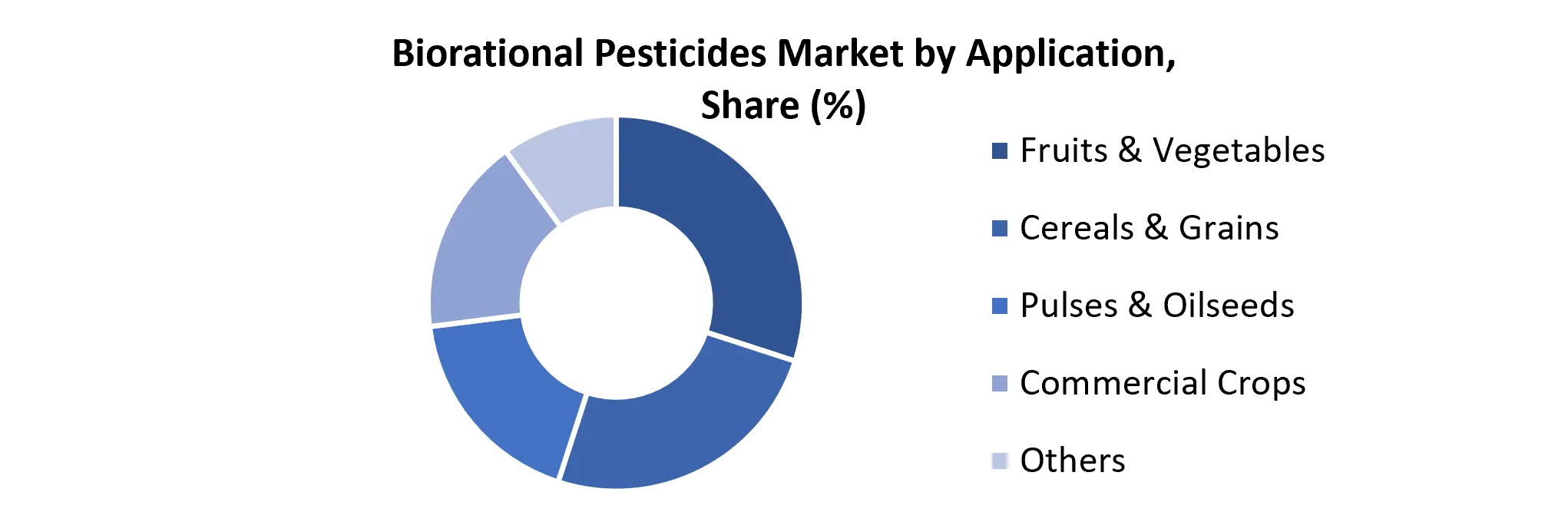
By Application: Based on application, the market is segmented into Fruits & Vegetables, Cereals & Grains, Pulses & Oilseeds, Commercial Crops, and Others. The Fruits & Vegetables segment is expected to hold a significant share, supported by the need to control insects, fungal diseases, and other pests while maintaining low chemical residues. Increasing demand for safe and high-quality fresh produce is also encouraging the use of biorational pesticides.
Biorational Pesticides Market Regional Analysis:
North America: North America is expected to maintain a significant position in the global Biorational Pesticides Market, supported by large-scale agricultural production, extensive cultivation of fruits and vegetables, and increasing adoption of sustainable pest-management practices. The region benefits from advanced agricultural technologies and growing awareness of biological crop-protection solutions.
Europe: Europe represents an important market for biorational pesticides due to increasing demand for sustainable agriculture, strict regulations concerning pesticide residues, and growing organic farming practices. The adoption of biological and environmentally friendly pest-control products is supported by the region’s focus on reducing the environmental impact of conventional pesticides.
Asia Pacific: Asia Pacific is expected to witness strong market growth, driven by extensive agricultural activities, a large farming population, rising food demand, and increasing awareness of integrated pest management. Countries such as China, India, Japan, and Australia are contributing to the growing adoption of biological crop-protection products.
Middle East & Africa: The Middle East & Africa market is supported by increasing efforts to improve agricultural productivity, protect crops from pests, and promote efficient farming practices. Growing investment in modern agricultural technologies and controlled-environment farming is creating opportunities for biorational pesticide adoption.
South America: South America is an important agricultural region with substantial production of soybeans, fruits, vegetables, cereals, and other commercial crops. Increasing export-oriented agricultural production and the need to meet international residue and food-safety requirements are encouraging farmers to adopt biological and lower-impact pest-control solutions.
Biorational Pesticides Market Competitive Landscape
The Biorational Pesticides Market is characterized by competition among major agricultural-input companies and specialized biological crop-protection manufacturers. Key players are focusing on expanding biological product portfolios, strengthening R&D capabilities, improving formulation technologies, and increasing production capacity. Major companies active in the broader biological and crop-protection space include BASF SE, Bayer AG, Syngenta Group, Corteva Agriscience, FMC Corporation, UPL Limited, and AgBiTech. BASF identifies Bayer, Corteva, FMC, Syngenta, and UPL among its major agricultural competitors.
Key Competitive Strategies
• BASF SE is expanding its biological crop-protection portfolio through acquisitions and biotechnology investments. In March 2026, BASF completed its acquisition of AgBiTech, strengthening its biological insect-control portfolio, particularly in Brazil and other agricultural markets.
• Syngenta Group is strengthening its biologicals business alongside conventional crop protection. The company reported double-digit sales growth in biologicals during 2025 and expanded its global biological manufacturing network, including a production facility in South Carolina.
• BASF commissioned its new BioHub fermentation plant in Ludwigshafen in May 2026, with commercial production of biological active ingredients including Bacillus amyloliquefaciens beginning during 2026.
• Bayer AG is increasing investment in engineered biological crop-protection technologies. In September 2026, Bayer's Leaps investment arm participated in Robigo's Series A financing to advance engineered microbial biopesticides for fungal disease control.
• Companies are increasingly emphasizing microbial technologies, biological insect control, biological fungicides, seed treatments, advanced formulations, and integrated crop-protection solutions to differentiate their offerings.
| Date | Company | Recent Development | Market Impact |
| January 2026 | BASF SE | BASF announced an agreement to acquire AgBiTech, a biological insect-control company specializing in naturally occurring virus-based solutions for caterpillar pests. | Strengthens BASF’s biological crop-protection portfolio and expands its presence in biological insect control. |
| May 2026 | BASF SE | BASF commissioned its new BioHub fermentation plant in Ludwigshafen, Germany, with commercial production of key biological active ingredients beginning in 2026. | Expands in-house production capacity for biological fungicides and biological seed-treatment solutions and improves supply-chain flexibility. |
| 2026 | Syngenta Group | Syngenta reported that biologicals sales continued to perform strongly across regions during the first half of 2026. | Reflects continued commercial demand for biological crop-protection solutions. |
| January–May 2026 | Syngenta Group | Syngenta inaugurated its Nantong crop-protection formulation plant in January, with commercial production beginning in May 2026. | Increases formulation and manufacturing capabilities for crop-protection products in China. |
| July 2026 | Bayer AG | Bayer launched Trance™ in India for managing sucking pests such as aphids, jassids, and whitefly nymphs in cotton. | Expands Bayer’s pest-management portfolio for Indian cotton farmers and addresses multiple pest pressures. |
Biorational Pesticides Market Scope: Inquire before buying
| Biorational Pesticides Market | |||
|---|---|---|---|
| Report Coverage | Details | ||
| Base Year: | 2025 | Forecast Period: | 2026-2034 |
| Historical Data: | 2020 to 2025 | Market Size in 2025: | 8.6 USD Billion |
| Forecast Period 2026-2034 CAGR: | 14.8% | Market Size in 2034: | 29.78 USD Billion |
| Segments Covered: | by Type | Insecticides Fungicides Nematicides |
|
| by Source | Botanical Microbial Non-organic |
||
| by Crop Type | Fruits & vegetables Cereals & grains Oilseeds & pulses |
||
| by Formulation | Liquid Dry |
||
| by Application | Foliar spray Soil treatment Trunk injection |
||
Biorational Pesticides Market, by Region
North America (United States, Canada and Mexico)
Europe (UK, France, Germany, Italy, Spain, Sweden, Austria and Rest of Europe)
Asia Pacific (China, South Korea, Japan, India, Australia, Indonesia, Malaysia, Vietnam, Taiwan, Bangladesh, Pakistan and Rest of APAC)
Middle East and Africa (South Africa, GCC, Egypt, Nigeria and Rest of ME&A)
South America (Brazil, Argentina Rest of South America)
Key Players / Competitores Proflies Coverd Biorational Pesticides Market Report in Strategic Perspective
1. Bayer
2. Syngenta
3. Monsanto Bioag
4. BASF SE
5. Dowdupont
6. Valent Biosciences
7. Isagro SAP
8. Koppert
9. Marrone Bio Innovations
10. Russell IPM
11. Gowan Company, LLC
12. McLaughlin Gormley King Company
13. Summit Chemical, Inc
14. Prisms India Private Limited
15. Godrej Agrovet Limited
16. Suterra
17. Agralan Ltd
18. Rentokil Initial plc
19. McLaughlin Gormley King Company
20. Summit Chemical, Inc
21. Safsorganic
22. Novonesis
23. UPL Limited
24. Corteva, Inc.
25. FMC Corporation
26. Certis Belchim B.V.
27. BioWorks, Inc.
28. Andermatt Biocontrol AG
29. Biobest Group NV
30. Lallemand Inc.
31. Valent BioSciences LLC
32. Chr. Hansen Holding A/S
33. Seipasa
34. Bioline AgroSciences Ltd.
35. Pro Farm Group Inc.
36. Stockton Group
37. Symborg
38. Koppert Biological Systems
39. Bioceres Crop Solutions Corp.
40. Marrone Bio Innovations
41. Certis USA LLC
42. Vestaron Corporation
43. Provivi, Inc.
44. Isagro S.p.A.
45. Bionema Group Ltd.
46. AgroSpheres, Inc.
Global Biorational Pesticides Market – FAQs
1. What was the Global Biorational Pesticides Market size in 2025?
The Global Biorational Pesticides Market was valued at approximately USD 8.6 billion in 2025, driven by increasing demand for sustainable crop protection, growing adoption of integrated pest management, and rising preference for low-residue agricultural products.
2. What is the expected growth rate of the Global Biorational Pesticides Market?
The Global Biorational Pesticides Market is projected to grow at a CAGR of 14.8% from 2026 to 2034, supported by the increasing adoption of biological pest-control solutions and expansion of sustainable farming practices.
3. What will be the Global Biorational Pesticides Market size by 2034?
The Global Biorational Pesticides Market is expected to reach approximately USD 29.78 billion by 2034, compared with USD 8.6 billion in 2025, reflecting strong demand for environmentally friendly and sustainable crop-protection products.
4. What are the major factors driving the Global Biorational Pesticides Market growth?
Key factors driving the Global Biorational Pesticides Market include growing concerns over the environmental impact of conventional pesticides, increasing organic farming, rising consumer demand for residue-conscious food, wider adoption of integrated pest management (IPM), and government support for sustainable agriculture.
5. Which factors may restrain the growth of the Global Biorational Pesticides Market?
The growth of the Global Biorational Pesticides Market may be constrained by limited availability of certain products, short shelf life of some biological formulations, sensitivity to environmental conditions, storage and transportation challenges, and limited farmer awareness regarding proper application and handling.