
Biorational Market – Global Market Size, Strategic Growth Drivers, Risk Assessment Framework, Regulatory Landscape Review, Competitive Intensity Mapping & Long-Term Industry Outlook to 2032
Overview
The Global Biorational Market size was valued at USD 7.08 Bn in 2025 and is expected to reach USD 16.45 Mn by 2032, at a CAGR of 12.8%.
Overview of the Biorational Market
Biorational are substances or products with minimal environmental impact that are primarily derived from biological sources. In cases where Biorational is artificially synthesized, they possess a similar chemical structure and exhibit comparable functionality to naturally occurring materials. The category of Biorationals encompasses both biopesticides and non-pesticidal products, which serve various purposes such as managing crop stress, promoting advantageous plant physiology, regulating root growth, and facilitating postharvest activities. The graphical representation and structural exclusive information showed dominating region of the Biorational Market. The detailed and constructive formation of key drivers, opportunities, and unique segmentation outputs structural and optimistic data. Validated using primary as well as secondary research methodology and scope of the Biorational Market.
Biorational Market Snapshot
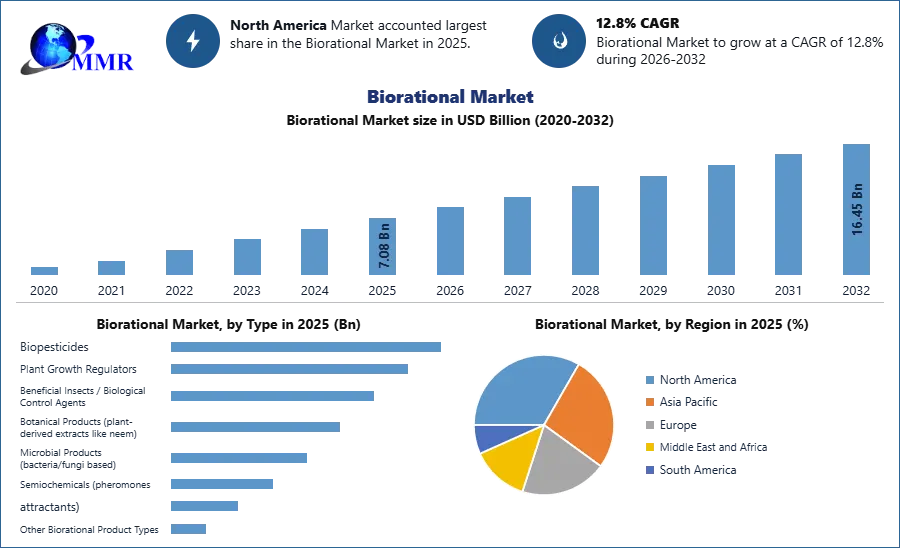 To know about the Research Methodology :- Request Free Sample Report
Biorational Market Dynamics
Growing concerns about food safety and stringent regulations on conventional agrochemicals are the major drivers of the Biorational Market
The major categories of bio-rational pesticides include botanicals, microbial, minerals, and synthetic materials. Botanicals are plant-derived materials such as rotenone, pyrethrum, sabadilla, ryania, etc. Nicotine products, although natural, are not considered bio-rational due to their high mammalian toxicity. Pesticides vary in their toxicity and in their potential to cause undesirable ecological impacts. Pest control materials that are relatively non-toxic with few ecological side-effects are sometimes called ‘bio-rational' pesticides. Consumers are increasingly demanding food that is produced using safe and sustainable methods. Biorational pesticides are seen as a way to meet this demand, as they are less toxic to humans and the environment than traditional chemical pesticides in the Biorational Market. Governments over the globe are implementing stricter regulations on the use of unnatural artificial pesticides and fertilizers due to their significant unnatural effects on human health and the environment. Biorational products, which are often exempt from certain regulatory requirements or have more favorable safety profiles, offer a viable solution for farmers and growers to comply with these regulations.
Pest and disease resistance to conventional pesticides has become a significant challenge for farmers. Biorational products offer an alternative approach by utilizing different modes of action, making them effective against resistant pests and diseases. This drives the adoption of Biorational solutions to manage pests and diseases effectively. Integrated Pest Management emphasizes the use of multiple pest control strategies, including biological controls, cultural practices, and Biorational products, to minimize reliance on chemical pesticides. Biorational products are an integral part of IPM programs as they provide effective pest control while reducing environmental impacts and preserving beneficial organisms.
Demand for Sustainable Agriculture is the biggest opportunity in the Biorational Market
The global demand for sustainable agricultural practices that reduce reliance on conventional chemical pesticides is on the rise. Biorational products provide an environmentally friendly alternative that aligns with the preferences of consumers and regulatory bodies. Biorational products are often tailored to target specific pests or diseases, resulting in enhanced crop quality and yield. This offers a compelling value proposition for farmers, directly impacting their profitability and competitive edge. Consumers are becoming more aware of the environmental and health impacts associated with conventional pesticides. Biorational products, being less toxic and leaving fewer residues, resonate well with consumers who seek safer and healthier food options in the Biorational market.
Effectiveness and Consistency are the major challenges in the Biorational industry
Biorational products may not consistently provide the same level of efficacy as their chemical counterparts. Achieving optimal results often requires adopting an integrated pest management approach and combining Biorational products with other control methods. Many farmers still lack familiarity with Biorational products or hold misconceptions regarding their effectiveness. Building awareness and providing education on the benefits and proper usage of these products are crucial steps to increase their adoption. The Biorational market is characterized by fragmentation, with numerous small and medium-sized companies offering products of varying quality and efficacy. This fragmentation complicates farmers' navigation of the market and the selection of the most suitable products for their specific needs.
Biorational Market Segment Analysis
Application:
Crop Protection: Biopesticides are certain types of pesticides derived from such natural materials as animals, plants, bacteria, and certain minerals. For instance, canola oil and baking soda have pesticidal applications and are considered biopesticides. Growers use biological to complement chemical products in an integrated pest management (IPM) program, or as a stand-alone method, for protecting plants from disease, insect pests, and competition from weeds.
Soil Management: Enhancing soil health by increasing soil organic matter is a crucial goal in agriculture. Soil organic matter plays a vital role in storing and releasing energy and nutrients that become accessible for plant uptake. Besides nutrient availability, soil organic matter contributes to improved soil texture, structure, and chemical equilibrium, while creating a favorable habitat for diverse soil flora and fauna. Adopting soil management techniques that prioritize the augmentation of soil organic matter can result in systems that possess sufficient nutrient reservoirs and storage capacity. Biorational products are used for improving soil health, fertility, and nutrient management in the Biorational Market.
Post-Harvest Management: In the field of post-harvest management, Biorational products play a significant role in controlling diseases caused by fungi and bacteria. Microbial-based biopesticides and bio fungicides are examples of Biorational products that offer an environmentally friendly substitute for traditional chemical treatments in managing post-harvest diseases. Farmers can effectively combat diseases by utilizing these products while minimizing the ecological impact. Additionally, Biorational strategies encompass the use of beneficial insects, mites, or nematodes to control post-harvest pests. These naturally occurring predators specifically target pests that tend to infest stored crops. By harnessing the power of these natural enemies, the reliance on chemical insecticides can be reduced, further enhancing the environmental sustainability of post-harvest pest control practices.
Biorational Market Recent Industry Developments (2025–2026)
| Exact Date | Company | Development | Impact |
|---|---|---|---|
| 13 March 2025 | Syngenta Group | Launched NETURE, a new biological insecticide targeting soybean and corn pests in global markets. | Expanded the biorational product portfolio with a nature-derived crop protection solution, enhancing sustainable pest management. |
| 08 July 2025 | ICL Group Ltd / Evogene Ltd | Completed the acquisition of Lavie Bio’s ag‑biologicals activities, including its MicroBoost AI platform, to expand sustainable agriculture solutions. | Strengthened ICL’s biologicals R&D and product pipeline for next‑generation biorational crop protection technologies. |
| 30 June 2025 | Syngenta | Opened a 22,000 m² dedicated biologicals manufacturing facility in Orangeburg, SC, USA to produce biostimulants at scale. | Enhanced global production capacity for sustainable biorational inputs and supported faster commercialization of biological solutions. |
| 18 November 2025 | Valent BioSciences & Seipasa | Formed a strategic partnership to bring novel biostimulant products to the U.S. agricultural market. | Broadened the reach of biorational product offerings, supporting grower adoption of sustainable crop inputs. |
Biorational Market Regional Analysis
North America boasts a well-established Biorational market, driven by robust regulatory support for sustainable agricultural practices. The United States and Canada play pivotal roles as key contributors to the Biorational market in the region. Increasing awareness of environmental sustainability and consumer preferences for pesticide-free food is driving the demand for Biorational products in North America. Europe exhibits a mature Biorational market, backed by stringent regulations favoring sustainable agricultural practices. Major players in the European Biorational market include Germany, France, and Spain. The adoption of Biorational products is facilitated by the emphasis on organic farming practices and efforts to reduce chemical pesticide usage.
The Asia Pacific region is witnessing significant growth in the Biorational market due to the rising demand for safe and sustainable agricultural practices. China, India, and Japan hold leading markets in the region, these countries are driven by the expansion of the organic farming sector and the need for eco-friendly crop protection solutions. These factors are supporting the rapid population growth, increasing incomes, and changing consumer preferences for pesticide-free food products are fueling the demand for Biorational products in the Asia Pacific. Latin America represents an emerging market for Biorational products, fueled by the region's robust agricultural sector and growing awareness of environmental sustainability. Brazil, Mexico, and Argentina are key markets in Latin America, with a strong focus on sustainable farming practices and organic certifications. The adoption of Biorational products in the region is also motivated by export requirements, as many countries demand residue-free agricultural produce.
Biorational Market Competitive Landscape
Bayer Extends Partnership with Peking University to Foster Pharmaceutical Innovation in China. Bayer and Peking University (PKU) will collaborate to foster the translation of basic pharmaceutical research into drug discovery and development while accelerating scientific research on cutting-edge technologies across the pharmaceutical value chain. This new agreement builds on a strategic academic partnership between Bayer and PKU under which a joint research center at Peking University has been founded to advance the translation of drug discovery and research. Syngenta acquisition of Macspred Australia to boost focus in global forestry and landscape markets. The acquisition marks Syngenta’s entry through its Professional Solutions business into the forestry products and vegetation markets. It also secures Syngenta’s ability to service both large-scale commercial plantation customers, as well as a growing farm forestry clientele focused on improving financial sustainability and environmental biodiversity on the farm.
Syngenta and Biotalys enter into strategic partnerships in biological innovation to advance solutions for sustainable agriculture. Syngenta Crop Protection and Biotalys (Euronext – BTLS) announced a collaboration to research, develop and commercialize new biocontrol solutions to manage key pests in a broad variety of crops. Marrone Bio Innovations, Inc. (NASDAQ: MBII) is a growth-oriented agricultural company leading the movement to environmentally sustainable farming practices through the discovery, development, and sale of innovative biological products for crop protection, crop health, and crop nutrition. In 2022, Marrone Bio Innovations, Inc. Shareholders Approve Merger Agreement with Bioceres Crop Solutions Corp. March 2022, Marrone Bio Expands Biological Seed Treatment Collaboration for Row Crops. Marrone Bio Innovations, Inc. signed an agreement with Corteva Agriscience (NYSE: CTVA) that expands the opportunity for MBI technologies to be used on seeds sold by Corteva for row crops globally. Marrone Bio currently provides seed treatment solutions to Corteva for use throughout Europe.
Biorational Market Scope: Inquire Before Buying
| Biorational Market | |||
|---|---|---|---|
| Report Coverage | Details | ||
| Base Year: | 2025 | Forecast Period: | 2026-2032 |
| Historical Data: | 2020 to 2025 | Market Size in 2025: | 7.08 USD Billion |
| Forecast Period 2026-2032 CAGR: | 12.8% | Market Size in 2032: | 16.45 USD Billion |
| Segments Covered: | by Type | Biopesticides Plant Growth Regulators Beneficial Insects / Biological Control Agents Botanical Products (plant-derived extracts like neem) Microbial Products (bacteria/fungi based) Semiochemicals (pheromones, attractants) Other Biorational Product Types |
|
| by Application | Foliar Spray Soil Treatment Seed Treatment Other |
||
| by Source | Microbial Sources (bacteria/fungi) Botanical Sources (plant-derived) Synthetic / Low-Impact Non-Organic Biorationals Minerals / Processed Natural Compounds |
||
| by End User | Agriculture (Open Field) Horticulture Organic Farming Sector Crop Protection Industry Food Production Segments |
||
Biorational Market, by Regions
North America (United States, Canada and Mexico)
Europe (UK, France, Germany, Italy, Spain, Sweden, Austria, Turkey, Russia and Rest of Europe)
Asia Pacific (China, India, Japan, South Korea, Australia, ASEAN and Rest of APAC)
Middle East and Africa (South Africa, GCC, Egypt, Nigeria and Rest of ME&A)
South America (Brazil, Argentina, Columbia and Rest of South America)
key players / competitors profiles covered in the Biorational Market report in strategic perspective
Bayer CropScience
Syngenta AG
BASF SE
Marrone Bio Innovations Inc.
Valent BioSciences Corporation
Certis USA LLC
Koppert Biological Systems
Isagro S.p.A.
Bioworks Inc.
Novozymes A/S
Dow AgroSciences LLC
FMC Corporation
Gowan Company LLC
Russell IPM Ltd.
Sipcam-Oxon Group
Agralan Ltd.
Nufarm Limited
Corteva Agriscience
Bioceres Crop Solutions Corp.
Chengdu New Sun Biotechnology Co., Ltd.
Real IPM Kenya Ltd.
Camson Bio Technologies Ltd.
Eden Research plc