
Global Bath Salts Market Size, Share, Growth and Forecast 2026 - 2034
Overview
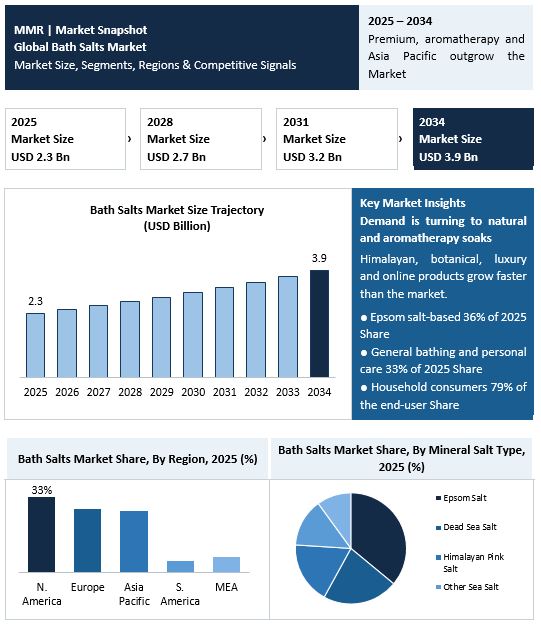
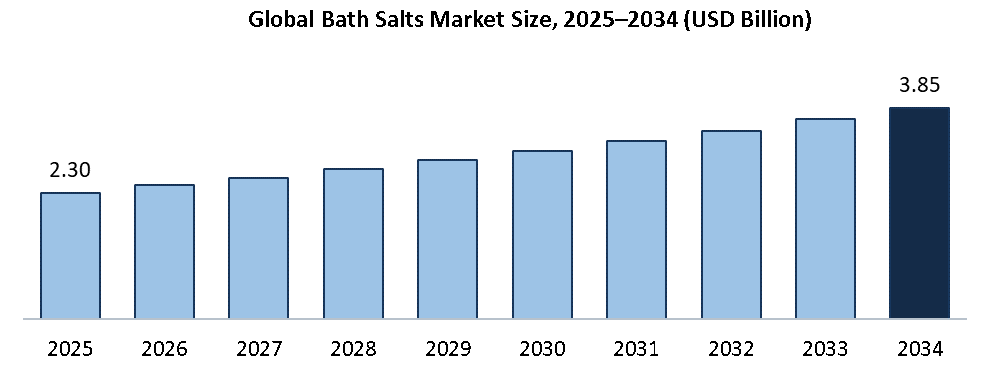
The Global Bath Salts Market was valued at USD 2.3 Bn in 2025 and is expected to reach USD 3.9 Bn by 2034, growing at a CAGR of 5.9% during 2026–2034. Bath salts are water-soluble mineral salt products, mainly Epsom salt (magnesium sulfate), Dead Sea salt, Himalayan pink salt, sea salt and other specialty mineral blends, that are dissolved in bath water, with essential oils, botanical extracts or colourants, for relaxation, personal care, foot soaking and spa treatments. The Global Bath Salts Market, also referred to as the bath soak or Mineral Bath Salts market Penetration, spans retail and professional products that turn an ordinary bath into a mineral soak and an at-home spa ritual.
This Bath Salts Market analysis is valuable for bath salts manufacturers, private-label and contract blenders, mineral salt and fragrance suppliers, beauty and wellness retailers, spa and hospitality buyers and investors, and for what brand managers, procurement teams and product developers want to know, from how mineral salts differ in composition and price to the economics of private label, e-commerce and premium aromatherapy ranges, cosmetic regulation and sustainable packaging.
Epsom salt anchors the Bath Salts industry and household consumers are the largest buyers, but Bath Salts Market growth is shifting toward Himalayan and Dead Sea salts, botanical and essential oil-infused formulations, compressed tablets and sachets, premium and luxury ranges, online retail and Asia Pacific as wellness spending, natural-ingredient preferences and digital discovery reshape product and channel demand.
Maximize Market Research provides a comprehensive Bath Salts Market Research Report covering the global bath salts market size, share, mineral salt type, formulation, product form, price positioning, packaging format, application, end user, distribution channel and regional segmentation, the Bath Salts Market competitive landscape, strategic scenarios and growth opportunities. The report helps bath salts manufacturers, mineral salt processors, fragrance and packaging suppliers, retailers, distributors and investors decide which segments, products and countries to prioritise through 2034.
|
2025 | Base Year |
2034 | Forecast |
Growth Rate |
Largest Region |
|
USD 2.3 Bn |
USD 3.9 Bn |
5.9% |
North |
Bath Salts Market Size, Market Growth and Industry Outlook to 2034
The Bath Salts Market is measured at the product level: Epsom salt, Dead Sea salt, Himalayan pink salt, other sea salt and other mineral salt bath products, in loose crystal, granular, powder, tablet and sachet form, sold to households and to spas, hotels, salons and other professional users worldwide. Bath bombs, bubble baths, shower gels, oils and other bath products without a predominant mineral salt base, culinary salt, spa service fees and bathing equipment are excluded to prevent double counting.
Three shifts shape 2026–2034: demand is broadening from plain Epsom soaks to mineral-specific, botanical and aromatherapy products; value is moving toward premium and luxury ranges with clean-label, traceable and sustainably packaged claims; and Bath Salts Market growth is rotating toward online retail, compressed and single-use formats and Asia Pacific as self-care spending broadens. Bath salts manufacturers are answering price pressure and retailer consolidation with private-label programmes, ingredient storytelling and multi-sensory launches.
To know about the Research Methodology :- Request Free Sample Report
Key Findings: Insights Shaping the Global Bath Salts Market
Market Growth: The Global Bath Salts Market is estimated at USD 2.3 Billion in 2025 and projected to reach USD 3.9 Billion by 2034, reflecting the supplied forecast of 5.9% CAGR. Growth in mineral-based personal care, aromatherapy products and premium spa formulations is expected to support manufacturing expansion, retail distribution and product innovation.
Product Segmentation: Epsom salt-based products accounted for 36% of 2025 market value, while Himalayan pink salt products are projected to grow at 7.3% CAGR and botanical formulations at 8.2% CAGR. Natural mineral sourcing, essential oil blends and premium positioning are expected to strengthen product differentiation and price realization.
Regional Performance: North America held 33% of 2025 market value, supported by established Epsom salt consumption, mass retail distribution and online sales. Asia Pacific is projected to grow at 7.6% CAGR, with China, Japan, India and South Korea supporting demand through wellness spending, beauty retail expansion and premium personal care adoption.
Aromatherapy and Relaxation Demand: Relaxation and aromatherapy bathing represented 31% of 2025 market value, with a projected 7.0% CAGR through 2034. Lavender, eucalyptus and botanical-infused formulations support premium product positioning, while EU regulations require labeling of specified fragrance allergens above 0.01% in rinse-off cosmetics, with 56 additional allergens covered under updated requirements.
Premiumization and Sustainable Packaging: Luxury bath salts are projected to grow at 8.4% CAGR, compared with 7.6% for premium products, supported by mineral traceability, glass jars and spa-inspired packaging. EU packaging recycling targets for 2030 include 85% for paper and cardboard, 75% for glass and 55% for plastic, encouraging recyclable and refillable packaging alternatives.
Regulatory Compliance and Market Competition: Cosmetic safety requirements are increasing manufacturers' focus on ingredient transparency, formulation testing and product traceability. Under the US Modernization of Cosmetics Regulation Act (MoCRA), covered manufacturers must renew facility registrations every 2 years, while responsible persons must update cosmetic product listings annually. These requirements, together with EU fragrance allergen regulations, are strengthening the importance of compliance capabilities among bath salt manufacturers.
How Big Is the Global Bath Salts Market, and How Fast Is It Growing?
Global Bath Salts Market Dynamics: Drivers, Challenges, Opportunities and Trends
Bath Salts Market Drivers: Wellness Spending, At-Home Spa Rituals, Magnesium Awareness and Premiumisation
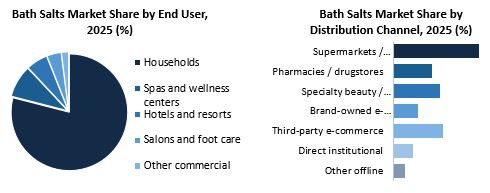
Rising consumer spending on self-care, sleep wellness and stress relief is strengthening bath salts Market demand, as mineral bathing offers an affordable and convenient relaxation experience at home. Epsom salt remains popular for post-activity bathing, while Dead Sea and Himalayan salts attract consumers through their distinctive mineral compositions, natural sourcing and premium positioning. Essential oil-infused formulations support bath salts consumption by combining cleansing, aromatherapy, foot care and gifting applications. These Bath Salts Market drivers encourage frequent household purchases, product experimentation and demand for premium mineral blends. Household consumers accounted for 79% of Bath Salts Market value in 2025, highlighting the importance of home-based wellness routines in supporting repeat purchases and long-term market growth.
Premiumisation is a second driver of Bath Salts Market growth. Brands are moving up from plain bagged Epsom salt to essential oil-infused, botanical and mineral-specific ranges in glass jars and gift sets, and premium and luxury tiers together hold about 32% of 2025 value but grow at 7.6% and 8.4% CAGR. In February 2026, Dr Teal's launched its Skin Renewal series, pairing a Triple Magnesium Complex salt soak with a foaming milk bath, an example of leading brands layering skin-care claims onto mineral soaks.
Online retail grows from XX% of 2025 value to about 33% by 2034, and brand-owned e-commerce is the fastest channel at 9.2% CAGR. Social media, reviews, and subscriptions help smaller natural and aromatherapy brands reach consumers without large shelf-space budgets, widening the competitive set for Bath Salts Market growth.
Wellness tourism, spa and hospitality demand add layers. Spas and wellness centres are the fastest end-user group at 7.0% CAGR, hotels and resorts grow at 6.6%, and professional foot-soak and mineral treatment menus pull bulk and branded products into the commercial channel. Compressed tablets, sachets and single-use units, growing at 7.9% CAGR, serve travel, gifting and hospitality amenity needs.
Bath Salts Market Challenges and Restraints: Cost Volatility, Private-Label Pressure, Claims Scrutiny and Packaging
Raw material, fragrance, packaging and freight costs are the most visible challenges for bath salts manufacturers. Bulk Epsom salt is a low-cost commodity, so margin depends on blending, fragrance and packaging rather than the mineral itself, and swings in essential oil prices, plastic resins and ocean freight can compress margins quickly. Low barriers to entry, strong private-label programmes at mass retailers and constant promotion keep price pressure on economy products, which hold about 30% of 2025 value and grow slowest at 4.0% CAGR.
Bath salts are generally regulated as cosmetics, so brands need safety substantiation, GMP-compliant manufacturing, facility and product listings where required, fragrance allergen labelling, and defensible marketing claims, and statements about muscle recovery, detoxification or magnesium absorption can attract scrutiny. Authenticity is an issue for Dead Sea and Himalayan products, where mislabelled origin, inconsistent purity and traceability gaps can damage brand trust, and single-use plastic pouches face growing environmental and retailer pressure.
Bath Salts Market Opportunities Through 2034
The Natural Bath Salts Market, the Aromatherapy Bath Salts Market, Himalayan and Dead Sea mineral products and online-first premium brands are among the most significant Bath Salts Market opportunities because they raise average selling prices and loyalty. Botanical-infused unfragranced salts grow at 8.2% CAGR, essential oil-infused salts at 6.8%, and sensitive-skin and fragrance-free ranges address a consumer group that is poorly served by heavily scented mass products. Suppliers that combine traceable mineral sourcing, certified natural claims and clean formulations are better positioned to secure retailer listings and strengthen their competitive presence. Increasing Bath Salts Market demand for premium, sustainable and skin-friendly products is encouraging manufacturers to improve Bath Salts Production processes through consistent mineral quality, responsible raw material sourcing and environmentally friendly packaging. These developments support product differentiation, consumer trust and expanding distribution opportunities across global wellness and personal care markets.
New regions, formats and partnerships offer routes to growth. Asia Pacific is expected to be the fastest-growing region at 7.6% CAGR over the forecast period as China, Japan, India and South Korea expand wellness retail and cross-border e-commerce, the Middle East and Africa grow at about 6.3% on luxury spa and hospitality demand, and South America at about XX%. Paper-based and composite packaging grows at 8.1% CAGR, glass at 6.9%, and private-label and contract manufacturing, hotel amenity programmes and refillable systems add longer-dated optionality.
Bath Salts Market Trends: Natural and Premium Products, Aromatherapy, Compressed Formats and Sustainable Packaging
The Bath Salts Market is evolving through five major trends, including natural ingredients, aromatherapy, premiumization, convenient product formats and sustainable packaging. First, natural bath salts are gaining consumer attention as manufacturers introduce mineral-based formulations with shorter ingredient lists, reduced synthetic dyes and transparent labeling. Aromatherapy and sleep-oriented bath salts featuring lavender, eucalyptus and chamomile essential oils are strengthening Bath Salts Market demand by addressing growing consumer interest in relaxation, stress relief and home-based wellness routines.
Relaxation and aromatherapy bathing accounted for 31% of global Bath Salts Market value in 2025, while general bathing and personal care held XX%. Household consumers represented XX% of total market value, highlighting strong demand for at-home wellness products. Increasing bath salts market penetration across supermarkets, specialty beauty stores, pharmacies and e-commerce platforms is improving product accessibility, supporting repeat purchases and encouraging manufacturers to introduce premium aromatherapy formulations.
Manufacturers are expanding premium aromatherapy formulations to capture rising bath salts consumption and strengthen their presence in the global wellness and personal care industry. In the European Union, labelling requirements covering 56 additional fragrance allergens, with disclosure thresholds of 0.01% for rinse-off cosmetics, are encouraging greater ingredient transparency. The premiumization is driving the introduction of luxury glass jars, spa-inspired collections and seasonal gifting products, increasing product value per kilogram.
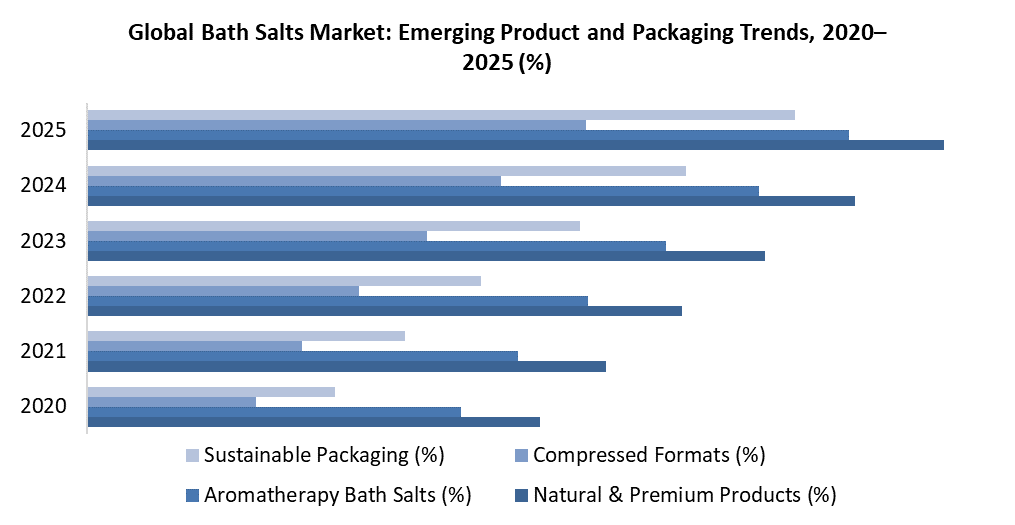
The convenient formats such as single-use sachets, compressed tablets and rapid-dissolving fine salts are gaining relevance across household, travel and hospitality applications. Fifth, sustainable packaging is becoming increasingly important as manufacturers adopt recyclable, refillable and paper-based alternatives. EU packaging recycling targets for 2030 include 85% for paper and cardboard, 75% for glass and 55% for plastic, encouraging packaging innovation. Additionally, US cosmetic facility registration requirements include renewal every 2 years, strengthening regulatory compliance across the personal care industry.
Bath Salts Product Landscape: Mineral Salts, Formulations, Aromatherapy and Packaging
Bath Salts Product Landscape: From Plain Epsom Soaks to Mineral-Specific and Aromatherapy Ranges
Epsom salt is magnesium sulfate, a crystalline salt that dissolves readily in warm water and is sold in cosmetic and USP-grade qualities. The Epsom Salt Market is the base of the category because the mineral is inexpensive, widely understood and easy to scent, and Epsom salt-based products hold about 36% of 2025 value. Dead Sea salt, harvested from one of the world's most saline water bodies, is distinguished by its mineral-rich composition, with Dead Sea brine containing 315 grams of dissolved minerals per litre, compared with 33.68 grams per litre in regular seawater. Its magnesium concentration reaches 39.2 g/L, compared with 1.27 g/L in seawater, while potassium measures 7 g/L against 0.4 g/L, and bromide reaches 5 g/L against 0.07 g/L. These mineral characteristics support the differentiation of Dead Sea bath salts in premium personal care and spa formulations.
The Himalayan pink salt, primarily sourced from Pakistan's Khewra Salt Mine, contains an average 98% sodium chloride purity and is extracted from 7 major salt seams extending across a cumulative thickness of 150 metres. The Khewra mine covers 3,398.53 acres and recorded production of 314,397 tonnes in 2022–2023. Its distinctive pink coloration, crystalline structure and mineral-origin positioning support its use in luxury bath salts, aromatherapy products and premium wellness collections.
Performance and positioning depend on purity, crystal size, dissolution speed, fragrance stability and packaging. Fine granular salts dissolve quickly and hold about 30% of 2025 value, coarse crystalline salts about 34%, and powders and compressed tablets serve rapid-dissolving and single-use needs. Ingredient safety, heavy metal and microbiological limits, anti-caking agents and moisture control are essential for shelf life, and premium brands increasingly document origin, processing and testing to defend their prices.
Dead Sea Bath Salts and Mineral-Rich Products: Sourcing, Authenticity and Premium Positioning
The Dead Sea Bath Salts Market, or Dead Sea Salt Market, holds about 22% of 2025 value, about USD XX Bn, and grows at a 6.5% CAGR. Dead Sea bath salt products range from natural, unfragranced mineral salts to premium fragranced and aromatherapy-infused formulations distributed through spas, travel retail, pharmacies and online platforms.
Dead Sea brine contains 315 grams of dissolved minerals per litre, including 39.2 g/L of magnesium, 7 g/L of potassium and 5 g/L of bromide, providing a distinctive mineral composition compared with conventional seawater. Product sourcing, mineral purity, processing methods and certification of origin are important competitive factors, as consumers increasingly seek authentic Dead Sea mineral products.
Manufacturers differentiate their offerings through mineral-content verification, ingredient transparency, premium packaging and traceable sourcing. Established Dead Sea bath salt brands also face competition from lower-priced alternatives marketed with Dead Sea-inspired positioning, making product authenticity, quality assurance and transparent labeling important for maintaining consumer trust and premium pricing.
Himalayan Bath Salts and Natural Bath Salts: Traceability, Botanicals and Clean-Label Claims
Himalayan bath salts hold about XX% of 2025 value and are the fastest-growing mineral type at 7.3% CAGR, supported by coarse and fine formats, aromatherapy blends and premium gift packaging. The Natural Bath Salts Market, which includes botanical-infused, herbal, floral and fragrance-free products with natural or organic-positioned claims, is the broader theme: botanical-infused unfragranced salts grow at 8.2% CAGR and plain unfragranced products hold about 31% of 2025 value. Traceability, certification and honest ingredient labelling are the main differentiators.
Aromatherapy Bath Salts: Essential Oils, Sleep and Multi-Sensory Bathing
The Aromatherapy Bath Salts Market is anchored by essential oil-infused salts, which hold about 34% of 2025 value and grow at 6.8% CAGR. Lavender, eucalyptus, chamomile, citrus and mint blends are positioned around sleep, stress relief and recovery, and relaxation and aromatherapy bathing is the fastest-growing application at 7.0% CAGR. Fragrance stability, essential oil compatibility at 0.5–2% concentrations, moisture control, allergen labeling and sensitive-skin formulations are critical, with EU regulations requiring allergen disclosure above 22% in rinse-off cosmetic products.
Product Forms, Price Tiers and Packaging: Pouches, Jars, Tablets and Sachets
Flexible pouches and bags lead packaging with about 41% of 2025 value, followed by rigid plastic containers at 27%, glass at 16% and paper-based and composite containers at 11%. Mid-range products hold about 38% of value, economy 30%, premium 23% and luxury 9%. Compressed tablets and single-use units grow at 7.9% CAGR, and brands are testing refill pouches, recyclable paper-based packs and reduced-plastic formats to meet retailer sustainability targets.
Emerging Bath Salts Innovation: Rapid-Dissolving Formats, Sensitive-Skin Blends and Sustainable Packaging
Innovation is concentrated in rapid-dissolving, low-residue salts, fragrance-free and sensitive-skin formulas, skin-care actives such as vitamin C, zinc and potassium blended with magnesium, multi-sensory sets that combine salts with foaming baths and body care, and refillable or paper-based packaging. Dr Teal's, described by industry press as the leading Epsom salt brand in the United States, is the clearest example of a mass brand using dual-phase and skin-benefit launches to defend share.
Regulatory change is also shaping formulation. Under EU rules that expanded fragrance allergen labelling (Regulation (EU) 2023/1545), new products must follow the longer allergen list from 2026 and existing products from 2028, pushing brands toward simpler fragrance systems or clearer labels. In the United States, MoCRA adds facility registration, product listing and safety substantiation duties for cosmetic manufacturers, including bath salt makers and private-label brand owners.
Bath Salts Product Maturity: Commercial Maturity by Product Category
|
Technology |
Primary |
Commercial |
|
Epsom salt |
Low-cost |
Mature; mass |
|
Dead Sea |
Mineral-rich, |
Established; |
|
Himalayan |
Coarse and |
Growing; |
|
Essential |
Aromatherapy, |
Mature core; |
|
Botanical and |
Natural |
Growing; |
|
Compressed |
Single-use, |
Early to |
|
Fragrance-free |
Minimal-ingredient |
Growing |
|
Refillable |
Reduced-plastic |
Early |
Global Bath Salts Market Segmentation: By Mineral Salt Type, Formulation, Product Form, Price Positioning, Packaging, Application, End User, Distribution Channel and Region
Bath Salts Market by End User and Distribution Channel: Households, Spas, Online Retail and Mass Retail
Epsom Salt Market, Dead Sea Salt Market and Himalayan Bath Salts: Mineral Type, Formulation and Application Analysis
By mineral salt type, Epsom salt-based products led with about 36% of the 2025 value for the Bath Salts Market growth, followed by Dead Sea salt at XX%, Himalayan pink salt at XX%, other sea salt at 14% and other mineral salts at 10%. Epsom salt contains 9.9% elemental magnesium by weight and approximately 49% magnesium sulfate on an anhydrous-equivalent basis, supporting its use in mineral bathing formulations. Its high water solubility, consistent crystalline structure and compatibility with essential oils make it suitable for aromatherapy bath soaks and personal care products.
Dead Sea salts offer a distinctive mineral composition, with source brine containing 39.2 g/L of magnesium and 7 g/L of potassium, supporting premium spa and wellness product positioning. Himalayan pink salt, containing predominantly sodium chloride with trace minerals, is valued for its natural pink coloration, coarse crystalline texture and mineral-origin branding. Manufacturers are increasingly introducing botanical-infused blends, fragrance-free formulations and premium packaging to differentiate products, strengthen consumer appeal and expand distribution through specialty beauty retailers, pharmacies and online platforms.
By product form, coarse crystalline salts held about 34% of 2025 value, fine granular 30%, powders XX% and compressed tablets and units XX%. Coarse crystals support traditional mineral bathing, while fine granular products improve handling and dissolution convenience. Commercial Epsom salt grades have a median particle size of 0.75–0.8 mm, supporting consistent blending, packaging and product performance. Manufacturers are also developing single-use tablets and compact formats for hospitality, travel and retail applications.
By application, general bathing and personal care held about 33% of value, relaxation and aromatherapy bathing 31%, foot soaking and foot care XX% and professional spa and wellness treatments XX%. Aromatherapy products incorporate essential oils and botanical ingredients to differentiate bathing experiences. EU regulations require disclosure of specified fragrance allergens above 0.01% in rinse-off cosmetics and cover 56 additional fragrance allergens, increasing formulation transparency and labeling requirements.
Bath Salts Market Regional Outlook: North America, Europe, Asia Pacific, Middle East & Africa and South America
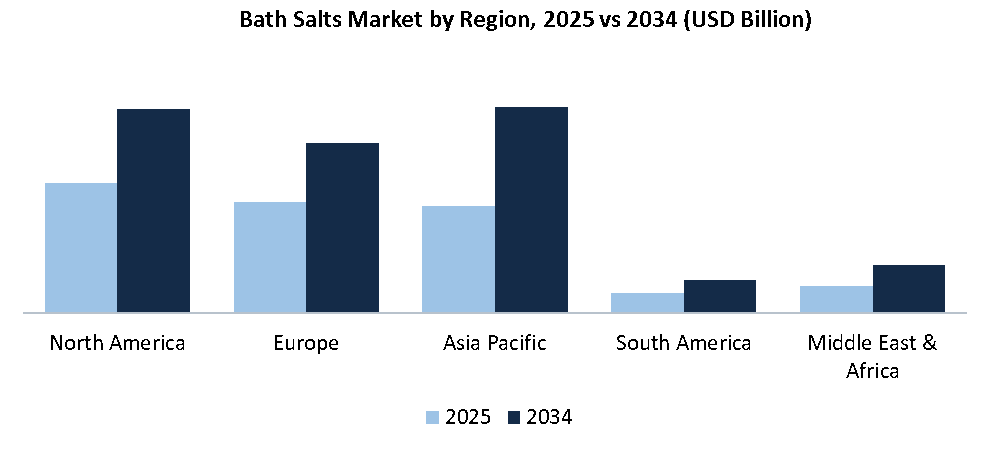
The North America Bath Salts Market held the largest Bath Salts Market Share, about 33% of global value in 2025. The United States anchors demand through Epsom salt familiarity, mass retail and pharmacy distribution, leading private-label and national brands and a mature e-commerce ecosystem, while Canada and Mexico add smaller volumes. Growth is projected at about 5.1% CAGR as premium, aromatherapy and online channels offset flat mass volumes. Europe holds about XX% of 2025 value, led by Germany, the United Kingdom, France and Italy, where a strong bathing and spa culture, pharmacy and drugstore distribution and demand for natural cosmetics shape the market; growth is about XX% CAGR.
The Asia Pacific Bath Salts Market is expected to be the fastest-growing region, with a 7.6% CAGR through 2034, rising from XX% of 2025 value to about 31% by 2034 and narrowly overtaking North America. Japan has a deep onsen and bath-additive tradition, China is scaling online wellness retail, India is expanding natural and Ayurvedic personal care, and Australia and South Korea add premium demand. The Middle East and Africa, about XX% of 2025 value, grows at about 6.3% CAGR as Gulf and Israeli luxury spa, hospitality and Dead Sea-linked products expand.
Bath Salts Market Revenue Forecast 2026–2034: Growth Phases, Bath Salts Market CAGR and Scenario Drivers
The MMR Bath Salts Market revenue forecast shows the Bath Salts Market growing from USD 2.3 Bn in 2025 to USD 2,436 Mn in 2026 and USD 3.9 Bn by 2034, a Bath Salts Market CAGR of 5.9% over 2026–2034 that adds USD 1.6 Bn of annual revenue over the period. Annual revenue added rises from USD XX Mn in 2026 to USD XX Mn in 2034, as the larger base compounds. In 2026–2027, premium and skin-benefit launches, private-label expansion and the first EU fragrance allergen deadlines set the pace. In 2028–2031, online-first brands, sustainable packaging and Asia Pacific wellness retail lift the growth mix. In 2032–2034, personalised blends, refillable systems and luxury hospitality programmes could add upside beyond the base case. Downside risks include sharper cost inflation, weaker discretionary spending and tighter claims enforcement.
Bath Salts Market Key Players: Competitive Landscape and Bath Salts Manufacturers
The Bath Salts Market Competitive Landscape includes several distinct groups rather than a single set of comparable companies. Mass-market Epsom and mineral soak brands such as Dr Teal's, Village Naturals Therapy, Epsoak and Westlab sell through supermarkets, pharmacies and e-commerce. Spa, aromatherapy and natural cosmetics brands including Kneipp, L'Occitane, The Body Shop, Aromatherapy Associates, ESPA and Neal's Yard Remedies compete on formulation and brand experience. Dead Sea specialists such as AHAVA, Premier Dead Sea and Dead Sea Collection, salt producers such as SaltWorks and San Francisco Salt Company, Asia Pacific brands such as MUJI, Kao and Forest Essentials, and Latin American personal care groups such as Natura and Granado complete the ecosystem. These groups should not be ranked as though they were identical producers.
Bath Salts Market competition is increasingly shaped by brand equity, retailer relationships, ingredient storytelling and cost control. In February 2026 Dr Teal's added a dual-phase Skin Renewal bath care system to Walmart and Target, and in August 2026, its parent PDC Brands began operating as Arthēa, described by industry press as the home of the leading US Epsom salt brand. Smaller players differentiate through botanical blends, certified natural claims, plastic-free packaging and direct-to-consumer subscriptions. Partnerships, private-label supply agreements and portfolio acquisitions are likely to continue as retailers consolidate suppliers and favour brands with clear claims and compliant supply chains.
Global Bath Salts Market Recent Developments and Product Launches | 2025–2026
|
Date |
Development |
Why it matters |
|
2025 |
The bath salts market was at about USD 1.4 |
Shows |
|
19 Feb 2026 |
Dr |
Shows leading brands |
|
31 Jul 2026 |
EU expanded fragrance allergen labeling |
Raises |
|
27 Aug 2026 |
PDC |
Signals portfolio and |
Global Bath Salts Market Scope: Inquire before buying
|
Global Bath Salts Market |
|||
|
Report Coverage |
Details |
||
|
Base Year: |
2025 |
Forecast Period: |
2026-2034 |
|
Historical Data: |
2020 to 2025 |
Market Size in 2025: |
USD 2.3 Billion |
|
Forecast Period 2026 to 2034 CAGR: |
5.9% |
Market Size in 2034: |
USD 3.9 Billion |
|
Bath Salts Market Segments Covered: |
By Mineral Salt Type |
Epsom Salt-Based Bath Salts Dead Sea Salt-Based Bath Salts Himalayan Pink Salt-Based Bath Salts Other Sea Salt-Based Bath Salts Other Mineral Salt-Based Bath Salts |
|
|
By Formulation Type |
Plain and Unfragranced Bath Salts Essential Oil-Infused Bath Salts Other Fragranced Bath Salts Botanical-Infused, Unfragranced Bath Salts |
||
|
By Product Form |
Coarse Crystalline Bath Salts Fine Granular Bath Salts Powdered Bath Salts Compressed Bath Salt Tablets and Units Other Bath Salt Forms |
||
|
By Price Positioning |
Economy Bath Salts Mid-Range Bath Salts Premium Bath Salts Luxury Bath Salts |
||
|
By Packaging Format |
Flexible Pouches and Bags Rigid Plastic Containers Glass Containers Paper-Based and Composite Containers Other Packaging Formats |
||
|
By Application |
General Bathing and Personal Care Relaxation and Aromatherapy Bathing Foot Soaking and Foot Care Professional Spa and Wellness Treatments Other Bathing Applications |
||
|
By End User |
Household Consumers Commercial and Institutional Users Spas and Wellness Centers Hotels and Resorts Salons and Professional Foot Care Establishments Other Commercial and Institutional Users |
||
|
By Distribution Channel |
Supermarkets and Hypermarkets Pharmacies and Drugstores Specialty Beauty and Wellness Stores Online Retail Brand-Owned E-Commerce Third-Party E-Commerce Platforms Direct Institutional and Professional Sales Other Offline Retail Channels |
||
Global Bath Salts Market, By Region
North America (United States, Canada, Mexico)
Europe (Germany, United Kingdom, France, Italy, Spain, Netherlands, Switzerland, Sweden, Denmark, Belgium, Austria, Poland, Rest of Europe)
Asia Pacific (China, Japan, India, South Korea, Australia, New Zealand, Singapore, Taiwan, Thailand, Malaysia, Indonesia, Rest of Asia Pacific)
Middle East and Africa (United Arab Emirates, Saudi Arabia, Israel, Turkey, South Africa, Egypt, Nigeria, Algeria, Morocco, Angola, Kenya, Ghana, Rest of Middle East and Africa)
South America (Brazil, Argentina, Chile, Colombia, Rest of South America)
Key players/Competitors profiles covered in the Bath Salts Market report from a strategic perspective
North America
- Dr Teal's (Arthēa, formerly PDC Brands)
- Village Naturals Therapy
- Ancient Minerals
- Epsoak
- Westlab USA
- Kneipp USA
- Bath & Body Works
- The Body Shop North America
- San Francisco Salt Company
- SaltWorks, Inc.
- Better Bath Better Body
- Coach Soak
- Pursoma
- Herbivore Botanicals
- Little Moon Essentials
Europe
- Kneipp GmbH
- Westlab Ltd.
- The Body Shop
- L'Occitane en Provence
- Aromatherapy Associates
- ESPA International
- Neal's Yard Remedies
- Tisserand Aromatherapy
- Olverum
- Dresdner Essenz
- Tetesept
- Sea Magik
- La Sultane de Saba
- Scottish Fine Soaps
- Treets Traditions
Asia Pacific
- MUJI (Ryohin Keikaku)
- BATHCLIN Corporation
- Kao Corporation
- Earth Corporation
- Cow Brand Soap Kyoshinsha
- SAKURA & NATURAL
- Forest Essentials
- Kama Ayurveda
- Soulflower
- Nykaa Cosmetics
- Kimirica
- Khadi Natural
- The Moms Co.
- Juicy Chemistry
- Organic Harvest
Middle East & Africa
- AHAVA Dead Sea Laboratories
- Sea of Spa
- Premier Dead Sea
- Dead Sea Collection
- Rivage Natural Dead Sea Minerals
- Kawar Dead Sea Products
- Sothys South Africa (Regional Distribution)
- Africology
- Healing Earth
South America
- Granado Pharmácias
- Phebo
- L'Occitane au Brésil
- Natura
- Bio Extratus
- Feito Brasil
Others
Global Bath Salts Market FAQs: Frequently Asked Questions
What is the Bath Salts Market Size?
Ans. MMR values the global bath salts market at USD 2.3 Bn in 2025, USD XX Bn in 2026 and USD 3.9 Bn by 2034, a 5.9% CAGR over 2026–2034.
What Drives Bath Salts Market Growth?
Ans. Bath salts market growth is driven by wellness and self-care spending, at-home spa rituals, magnesium and mineral awareness, demand for natural and aromatherapy products, premiumisation, gifting, and the reach of online retail, which grows from XX% to about 33% of value by 2034. Spa and hospitality demand adds a professional layer.
Which region and country is the largest bath salts market?
Ans. North America holds the largest bath salts market share in 2025, at about 33%, led by the United States. Europe follows at about XX% and Asia Pacific at about XX%. Asia Pacific is the fastest-growing region at 7.6% CAGR, led by China, Japan, India and South Korea, and is projected to narrowly overtake North America by 2034.
Which bath salts segments are growing fastest?
Ans. Epsom salt is the largest mineral type at about 36% of 2025 value, while Himalayan pink salt grows fastest at 7.3% CAGR, followed by Dead Sea salt at XX%. Botanical-infused unfragranced salts grow at XX%, compressed tablets at XX%, luxury products at XX% and brand-owned e-commerce at XX%, all above the XX% market rate.
Who are the leading bath salts companies and bath salts manufacturers?
Ans. Leading names include Dr Teal's (Arthēa), Village Naturals Therapy, Westlab, Kneipp, SaltWorks, San Francisco Salt Company, L'Occitane, The Body Shop, Aromatherapy Associates, ESPA, MUJI, Kao, Forest Essentials, AHAVA and Natura, alongside Dead Sea specialists and private-label and contract manufacturers.
How do Epsom salt, Dead Sea salt and Himalayan bath salts differ?
Ans. Epsom salt is magnesium sulfate, a low-cost crystalline salt associated with muscle and foot soaks. Dead Sea salt is harvested from the Dead Sea and is richer in magnesium, potassium and bromide than sodium chloride-dominated sea salt. Himalayan pink salt is mainly sodium chloride with trace minerals that give it its pink colour, sold in coarse and fine grades.
What are the main bath salts market trends and future outlook?
Ans. The bath salts market trends and future outlook centre on five themes: natural and clean-label formulations, essential oil and sleep-oriented aromatherapy, premium and gift products, convenient tablet and sachet formats, and sustainable packaging. MMR expects the market to grow about 1.7 times to USD 3.9 Bn by 2034, with Asia Pacific, Himalayan and Dead Sea salts, botanical blends and online channels growing fastest.
Where are the bath salts market opportunities through 2034?
Ans. Opportunities sit in natural and botanical bath salts, aromatherapy and sleep ranges, Himalayan and Dead Sea mineral products, fragrance-free and sensitive-skin formulations, brand-owned e-commerce and subscriptions, hotel and spa programmes, private-label supply and paper-based or refillable packaging, especially in Asia Pacific and the Middle East. Returns depend on traceability, compliance, retailer relationships and cost control.
Global Bath Salts Market Research Methodology
The MMR Bath Salts Market Analysis sized the Bath Salts Market top-down from a 2025 base of USD 2.3 Bn and a 5.9% CAGR for 2026–2034, company announcements, regulatory notices and trade press (including Dr Teal's and Arthēa announcements) through November 2026. The Bath Salts Market boundary covers bath products whose predominant ingredient is a mineral salt, namely Epsom, Dead Sea, Himalayan pink, other sea salt and other mineral salt products, and excludes bath bombs, bubble baths, shower gels, culinary salt, spa service fees and bathing equipment. Segment shares and regional splits are MMR estimates anchored to published splits (for example Epsom salt as the largest mineral type and North America and Asia Pacific as the largest regions) and are normalised so every segment sums to the Bath Salts Market total. Annual values are constant-CAGR interpolated. Segment CAGRs are the effective rates after normalisation; scenario analysis and opportunity levers are MMR judgement.