
Avionics Data Loaders Market By Loader Type, ,By Component, By Connectivity, By Aircraft Type, By Application, By End User and Regional Insights 2034
Overview
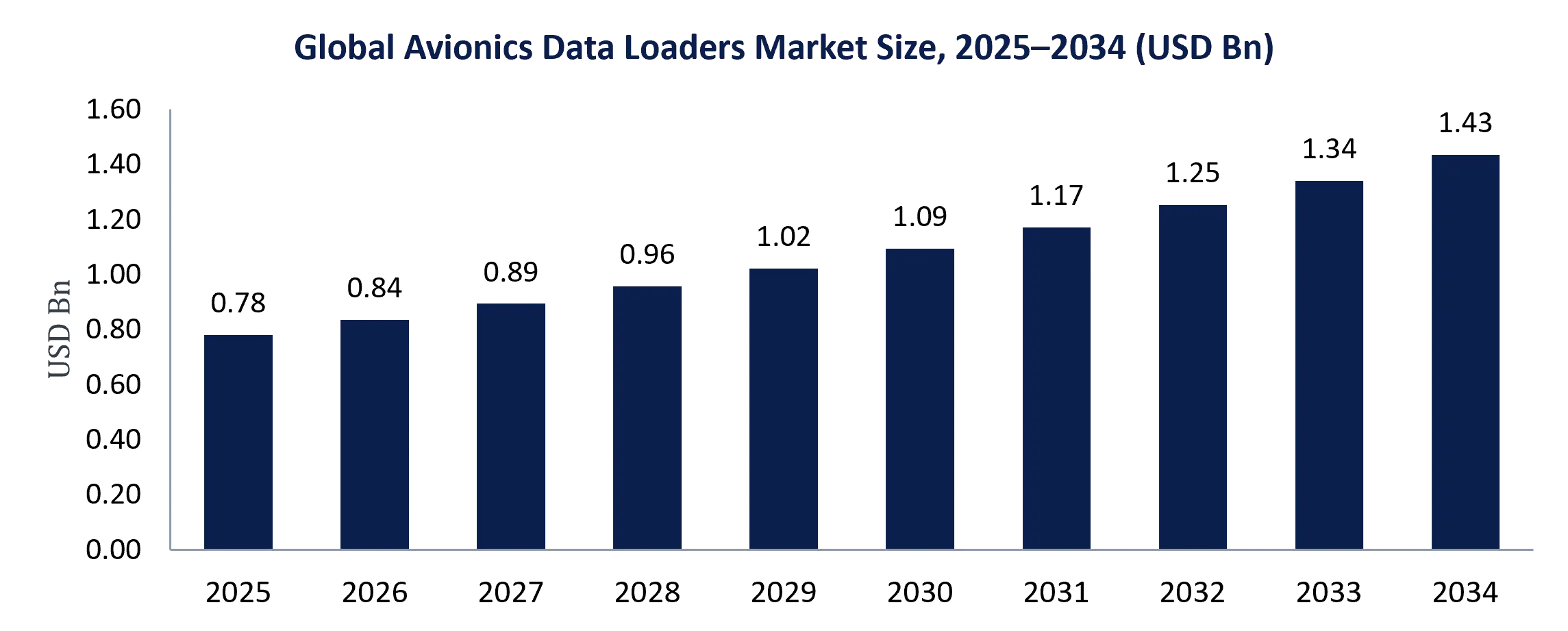
The Global Avionics Data Loaders Market was valued at USD 0.78 billion in 2025 and is projected to reach USD 1.43 billion by 2034, growing at a CAGR of 7.0% during 2026–2034, according to Maximize Market Research (MMR). Avionics data loaders are the portable, aircraft-integrated, embedded, ground-based and wireless systems that move navigation databases, flight management system (FMS) software, flight control software, mission data and configuration files into aircraft avionics.
This report answers both sides of the search: what the avionics data loader market is worth for OEMs, suppliers, airlines and investors, and what engineers, maintenance planners and buyers want to know, from how an ARINC 615A data loader works and how often a navigation database must be updated, to wireless data loading, cybersecurity rules, and which companies lead.
Commercial fixed-wing aircraft anchor demand, military mission data loading and unmanned aerial vehicles (UAVs) are the fastest-rising use cases, and wireless and software-led loading is outgrowing the portable USB loaders that still carry the largest share. Growth rests on fleet expansion, the unchanging 28-day AIRAC database cycle, higher defence aircraft procurement and new aviation cybersecurity obligations.
Maximize Market Research provides comprehensive analysis of the global avionics data loaders market size, share, loader type, component, connectivity, aircraft type, application and end-user segmentation, regional outlook, regulatory drivers, competitive landscape and growth opportunities. The report helps avionics suppliers, airlines, MRO providers, defence integrators and investors decide which products, interfaces and regions to prioritise through 2034.
| 2025 | BASE YEAR | 2034 | FORECAST | GROWTH RATE (CAGR 2026–2034) | LARGEST REGION |
| USD 0.78 Bn | USD 1.43 Bn | 7.0% | North America |
Global Avionics Data Loaders Market Overview:
The market is measured at the level of supplier revenue for data loading hardware, loading software and related services (installation, integration, certification support, subscription and technical support) sold worldwide for civil and military aircraft. Navigation and terrain database content itself is excluded; the database supplier chain is analysed as a demand driver, not as market revenue.
Three shifts shape 2026–2034: loading is moving from handheld USB devices to onboard and wireless fleet-wide distribution; cybersecurity and software-traceability rules are turning the data loader into a controlled, auditable asset; and defence and UAV programmes are adding mission data loading to the traditional navigation database workload.
MMR | MARKET SNAPSHOT | 2025 – 2034
Global Avionics Data Loaders Market: Market size, segments, regions and demand signals. Portable loaders lead today; wireless loaders, software and services, UAV applications and Asia Pacific grow faster than the market.
| 2025 MARKET SIZE | 2028 MARKET SIZE | 2031 MARKET SIZE | 2034 MARKET SIZE |
| USD 0.78 Bn | USD 0.96 Bn | USD 1.17 Bn | USD 1.43 Bn |
KEY MARKET INSIGHT | LOADING GOES WIRELESS AND SECURE
Every certified avionics database has to be reloaded on a fixed 28-day cycle, so the installed fleet creates recurring work. Growth is shifting from handheld devices to wireless, fleet-wide software distribution, and from one-time hardware to software and services. Market about 1.8× larger by 2034; software and services about 48% of 2025 revenue; wireless loaders the fastest loader type at 11.8% CAGR.
To know about the Research Methodology :- Request Free Sample Report
 Avionics Data Loaders Quick Answers: 20 Most-Searched Questions, Answered in One Line
This report is built around what engineers, buyers and investors actually search for. Use this table for instant answers, then jump to the section named in the last column.
| Question people search | Short answer | Section |
| How big is the avionics data loaders market? | USD 0.78 Bn in 2025 (MMR estimate); USD 1.43 Bn by 2034 at 7.0% CAGR | Market Size |
| What is an avionics data loader? | A portable, onboard, embedded or ground system that transfers software, databases and configuration files into aircraft avionics | Overview |
| What does a data loader do? | Loads FMS navigation databases, flight control and communication software, mission data and configuration parts into line replaceable units (LRUs) | Applications |
| How often is a navigation database updated? | Every 28 days under the AIRAC cycle, 13 times a year (AvMap; Jeppesen) | Applications |
| What is ARINC 615A? | An Ethernet-based protocol for loading software into avionics; supported by Teledyne's PMAT XS portable and eADL XS onboard loaders | Connectivity |
| Portable or onboard data loader: which is better? | Portable suits mixed fleets and shops; onboard loaders cut handling and enable wireless distribution across the fleet | Loader Type |
| What is wireless data loading? | Software parts sent from a ground server to an onboard loader over Wi-Fi or cellular, with no media carried to the aircraft | Loader Type |
| How much time does wireless loading save? | Honeywell cites up to 50% less loading time for its Aircraft Data Gateway; Teledyne cites up to USD 11,700 a month saved on 42 Boeing 737NGs | Drivers |
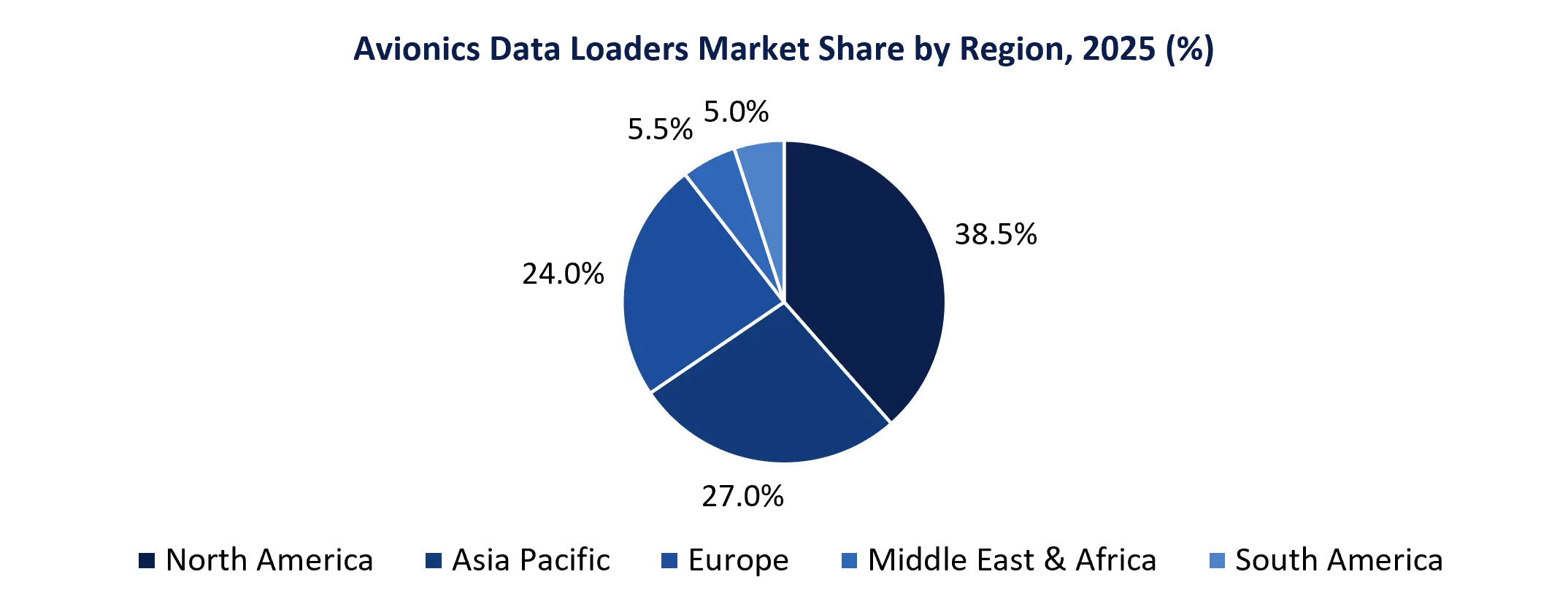
| Which region has the largest market? | North America at 38.5% of 2025 revenue (MMR estimate) | Regional |
| Which region is growing fastest? | Asia Pacific at about 8.6% CAGR (MMR estimate) | Regional |
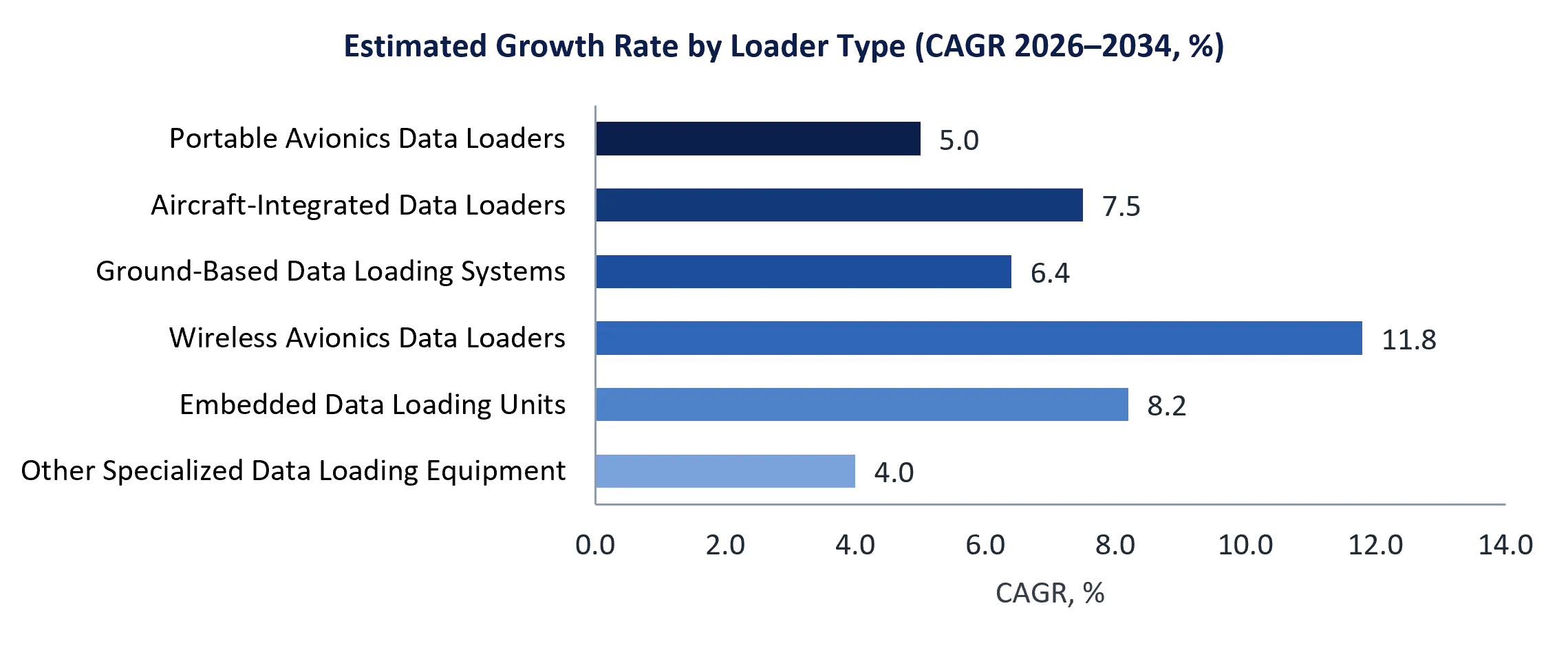
| Which loader type grows fastest? | Wireless avionics data loaders at about 11.8% CAGR (MMR estimate) | Loader Type |
| Which loader type is largest today? | Portable avionics data loaders at about 31% of 2025 revenue (MMR estimate) | Loader Type |
| Who are the top data loader companies? | Teledyne Controls, Honeywell, Collins Aerospace, Garmin, Universal Avionics, GE Aerospace and Astronautics, plus the data suppliers Jeppesen and Skywise | Companies |
| Which rule governs navigation databases? | FAA AC 20-153B with RTCA DO-200B, supported by FAA Order 8110.55B | Regulation |
| Which cyber rules affect data loading? | EASA Part-IS: Regulation (EU) 2022/1645 from 16 Oct 2025 and (EU) 2023/203 from 22 Feb 2026 | Regulation |
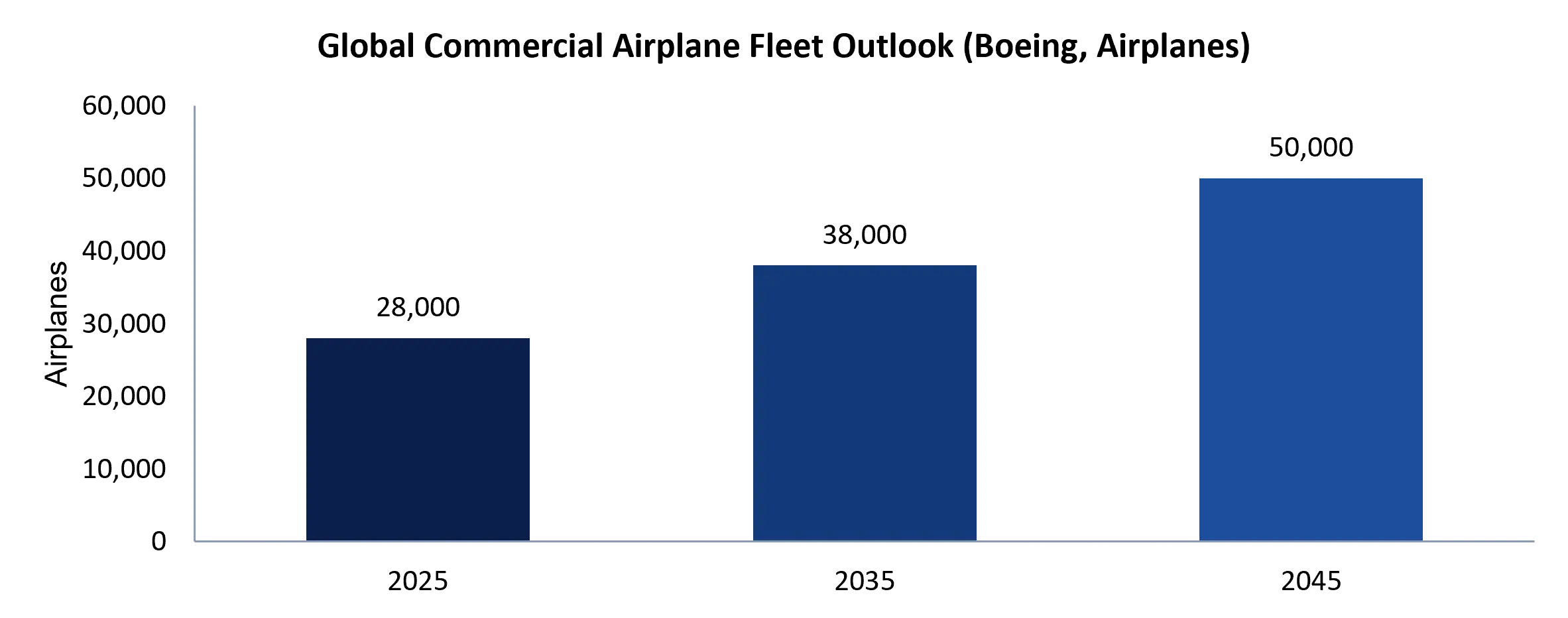
| How does fleet growth drive demand? | Boeing projects the fleet rising from 28,000 airplanes in 2025 to 38,000 by 2035 and 50,000 by 2045 | Demand Signals |
| What is the military demand signal? | U.S. Air Force aircraft procurement requested at USD 30.1 Bn for FY2027 (DoD Exhibit P-1) | Demand Signals |
| Do drones need data loaders? | Yes: mission data and software loading; FAA expects commercial UAS to grow from 1.1 million (2025) to 1.5 million (2030) | Aircraft Type |
| Is the market growing in India? | Yes: Indian scheduled airlines fly 860 aircraft with 2,056 on order, of which 427 are delivered (Lok Sabha reply, Aug 2026) | India |
| What is the biggest restraint? | Long certification cycles, proprietary interfaces on legacy fleets and security approval of wireless loading | Restraints |
Key Findings: Eight Insights Shaping the Global Avionics Data Loaders Market
MMR's analysis of published government data, regulator guidance and company disclosures points to eight findings that explain where value is created through 2034.
| # | Finding | Evidence | So what |
| 1 | The market grows about 1.8× by 2034 | USD 0.78 Bn (2025) to USD 1.43 Bn (2034) at 7.0% CAGR (MMR) | Steady, annuity-like growth rather than a boom-bust hardware cycle |
| 2 | The 28-day AIRAC cycle creates recurring work | Jeppesen distributes over 2 million aeronautical data records every 28-day cycle; 13 cycles a year | Every aircraft in service must be reloaded; automation has a clear ROI |
| 3 | Fleet growth widens the installed base | Boeing: 28,000 airplanes (2025) to 50,000 (2045); 43,625 deliveries 2026–2045 | More aircraft, more loaders, more data to distribute |
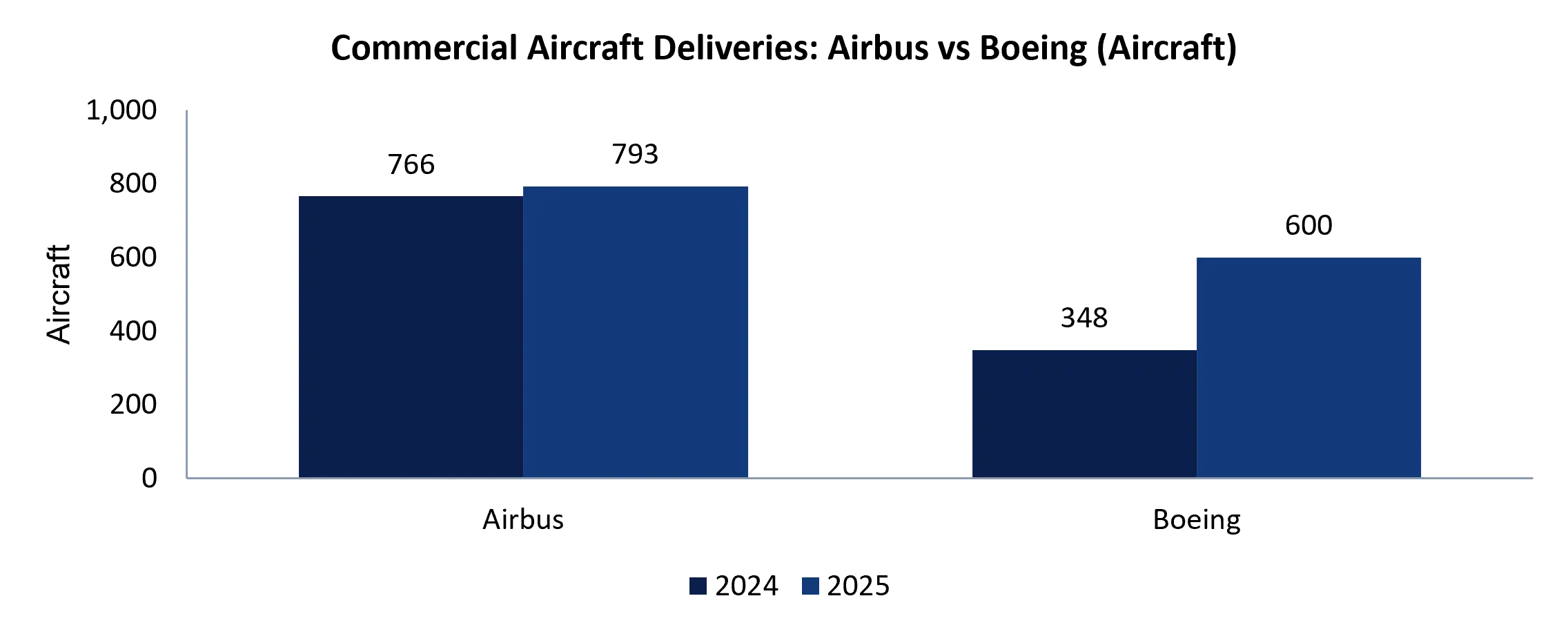
| 4 | OEM output is recovering | 2025 deliveries: Airbus 793 (766 in 2024), Boeing 600 (348 in 2024); backlogs 8,754 and over 6,100 | Factory-fit and embedded loaders ride on delivery volumes |
| 5 | Wireless is the fastest segment | Wireless loaders 11.8% CAGR (MMR); Honeywell cites up to 50% less loading time | Suppliers must show secure, certified wireless paths |
| 6 | Defence adds mission data loading | FY2027 request: USD 30.1 Bn Air Force aircraft procurement; about USD 1.0 Bn for Collaborative Combat Aircraft | Military and UAV loaders are a premium, qualification-heavy niche |
| 7 | Cyber rules reshape the product | EASA Part-IS applicable 22 Feb 2026; Teledyne eADL XS is marketed as the first onboard loader meeting ARINC 645-1 | Security and audit trails become buying criteria |
| 8 | Asia Pacific is the growth leg | India: 860 aircraft in operation, 2,056 on order; Boeing: about 55% of new deliveries to emerging markets | Fastest regional CAGR (about 8.6%, MMR) from a smaller base |
Global Avionics Data Loaders Market Size, Share and Forecast, 2025–2034
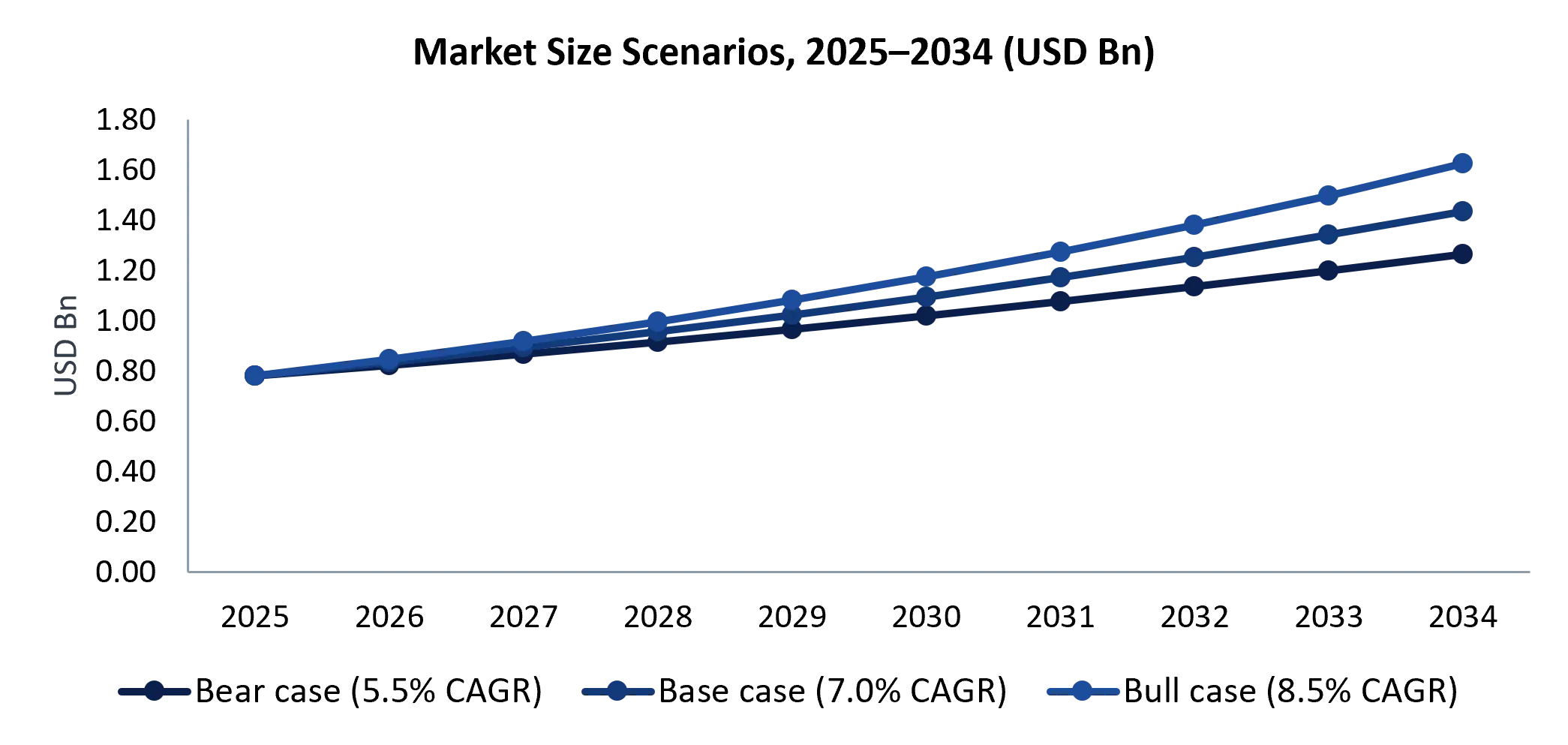
MMR sizes the market at USD 0.78 billion in 2025, rising to USD 0.83 billion in 2026 and USD 1.43 billion in 2034, a 7.0% CAGR. The market adds about USD 0.65 billion over the period; about 46% of the 2034 market is revenue that does not exist today.
How Big Is the Global Avionics Data Loaders Market, and How Fast Is It Growing?
MMR READ-THROUGH
Annual revenue added rises from USD 55 Mn in 2026 to USD 94 Mn in 2034. The last three years add USD 263 Mn, about 40% of all revenue added over the period. Growth is back-loaded, so wireless and software investments made in 2026–2027 carry the largest payoff.
How Does MMR Build the Estimate, and Why Do Avionics Data Loader Market Sizes Differ?
There is no government statistic for "avionics data loaders", so published estimates differ widely depending on scope: some count only hardware, some include navigation database subscriptions, and some cover only commercial aircraft. MMR therefore builds the market bottom-up from government and company data: the installed and delivered fleet (FAA, DGCA, Boeing, Airbus), the loading workload set by the 28-day AIRAC cycle (Jeppesen, AvMap), defence aircraft procurement (DoD Exhibit P-1), and the product mix and price points of loader suppliers (Teledyne Controls, Honeywell, Collins Aerospace, Garmin). Hardware, software and services revenue is then allocated by loader type and end user. All market values and shares in this report are MMR estimates, and every government and company number used as an input is cited in the source lines.
Global Avionics Data Loaders Market Forecast 2034: Bull, Base and Bear Scenarios
| Scenario | CAGR | 2034 market (USD Bn) | vs base (USD Bn) | What would have to be true |
| Bear | 5.5% | 1.26 | -0.17 | OEM delivery ramps slip, airlines keep manual USB loading, wireless security approvals are slow |
| Base | 7.0% | 1.43 | – | Fleet grows with Boeing's outlook, wireless adoption continues, defence procurement holds |
| Bull | 8.5% | 1.62 | +0.19 | Wireless and onboard loaders become standard fit, UAV and CCA programmes scale faster, Part-IS drives replacement |
How Sensitive Is the 2034 Market to the Growth Rate?
| CAGR assumed | 5.0% | 6.0% | 7.0% (base) | 8.0% | 9.0% |
| 2034 market (USD Bn) | 1.21 | 1.32 | 1.43 | 1.56 | 1.69 |
Avionics Data Loaders Market Dynamics:
Growth Drivers: Fleet Growth, 28-Day Database Cycles, Wireless Loading, Defence Spending and Cybersecurity
| Driver | How it adds demand | Evidence / signal |
| Commercial fleet growth | More aircraft in service means more loads, more loaders and more fleet configuration management | Boeing: fleet 28,000 (2025) to 38,000 (2035) to 50,000 (2045); 43,625 deliveries 2026–2045 |
| Recovering OEM output | Factory-fit and embedded loaders are supplied with each new aircraft | Airbus delivered 793 aircraft in 2025 and targets around 870 in 2026; Boeing delivered 600 in 2025 |
| Mandatory 28-day database cycle | Navigation, terrain and obstacle data must be reloaded on a fixed schedule | Jeppesen: 246 data sources, 47,000 data items and over 2 million records distributed per cycle |
| Wireless and automated loading | Removes media handling and labour; improves traceability | Honeywell: up to 50% less loading time; Teledyne: USD 11,700 a month saved on 42 Boeing 737NGs |
| Defence modernisation | Mission data, software and tactical updates for fighters, tankers, helicopters and UAVs | FY2027 request: USD 30.1 Bn Air Force aircraft procurement (P-1); Navy cites 123 aircraft for USD 34.4 Bn |
| Aviation cybersecurity rules | Controlled, auditable loading becomes a compliance need | EASA Part-IS applicable from 16 Oct 2025 and 22 Feb 2026 |
| UAV and advanced air mobility growth | Mission and configuration loading for unmanned platforms | FAA: commercial UAS fleet 1.1 million (2025) to 1.5 million (2030) |
Restraints: Certification Cycles, Legacy Interfaces, Security Approval and Price Pressure
| Restraint | Why it matters | Mitigation |
| Long certification and approval cycles | Onboard and wireless loaders need FAA/EASA design approval; Teledyne's eADL XS needed a Boeing 737NG STC amendment, with other platforms in progress | Drop-in form factors and platform-by-platform STC roadmaps |
| Legacy and proprietary interfaces | Older fleets use ARINC 615-3, ARINC 429 or OEM-specific loaders, which slows migration | Multi-protocol loaders supporting 615-3, 615-4 and 615A |
| Security approval of wireless paths | Operators must prove network security under their security programmes and Part-IS | ARINC 645-1 secure loading, signed software parts, audit trails |
| Low-cost portable alternatives | Standard laptops and USB loading remain cheap for small fleets | Fleet-management software and bundled services |
| Defence programme timing | Budget requests depend on appropriation; many items ride on reconciliation funds | Diversify between military and commercial customers |
| Supply-chain constraints | OEMs report engine and supplier shortages that cap deliveries | Aftermarket retrofit programmes |
What Are the Biggest Avionics Data Loader Market Opportunities Through 2034?
| Opportunity | Basis | Illustrative size lever |
| Wireless and cellular fleet loading | Fastest loader type at about 11.8% CAGR (MMR) | Retrofit programmes on 737NG, A320 and 787 fleets |
| Software and services subscriptions | Software 27% and services 21% of 2025 revenue (MMR) | Fleet configuration, load reporting and compliance tools |
| UAV and Collaborative Combat Aircraft | UAV fastest aircraft segment at about 12.5% CAGR (MMR); about USD 1.0 Bn CCA procurement in the FY2027 request | Secure mission data loading for unmanned platforms |
| Asia Pacific and India | India: 860 aircraft in operation and 2,056 on order | Factory-fit loaders and local MRO support |
| Business and general aviation | FAA: active GA fleet to rise 12.1% between 2026 and 2046, turbine fleet 2.1% a year | Wi-Fi/tablet loaders for FMS and avionics suites |
| MRO and technician workforce tools | Boeing: 728,000 new maintenance technicians needed through 2045 | Handheld and guided load tools that cut labour |
Global Avionics Data Loaders Market Segment Analysis:
The segmentation below follows the structure used throughout this report. Shares are MMR estimates of 2025 revenue; growth rates are MMR estimates of 2026–2034 CAGR.
By Loader Type
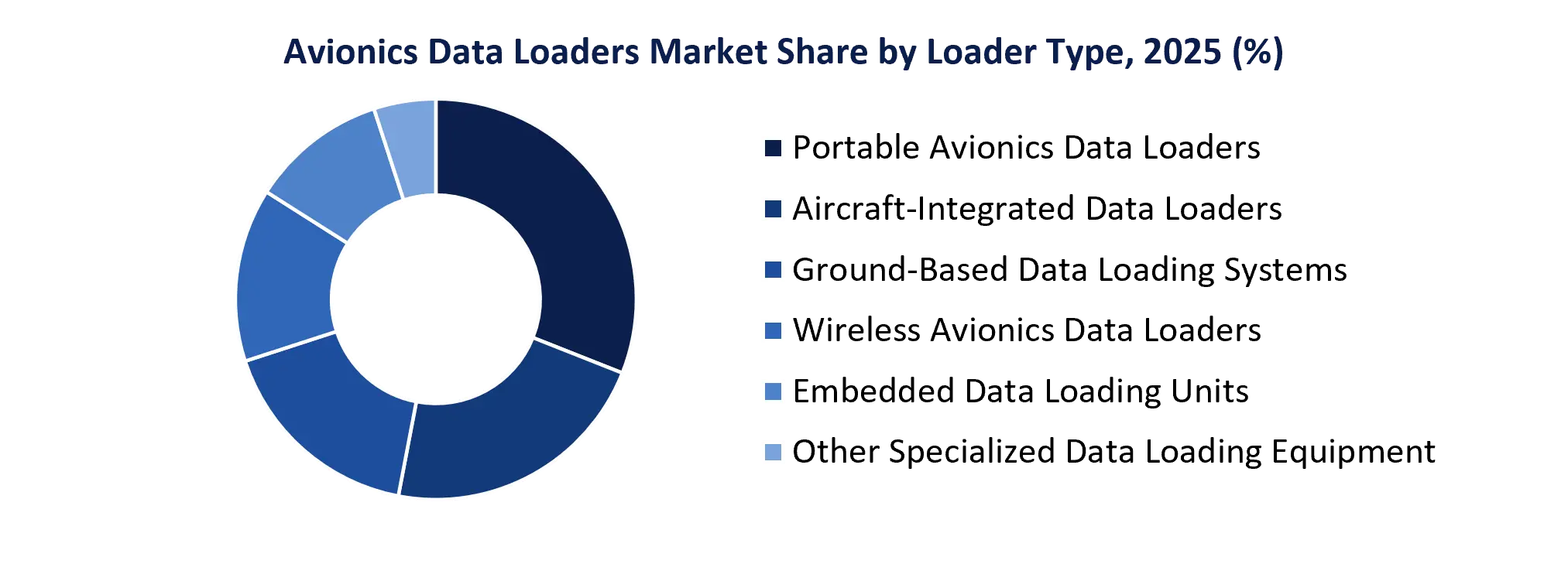
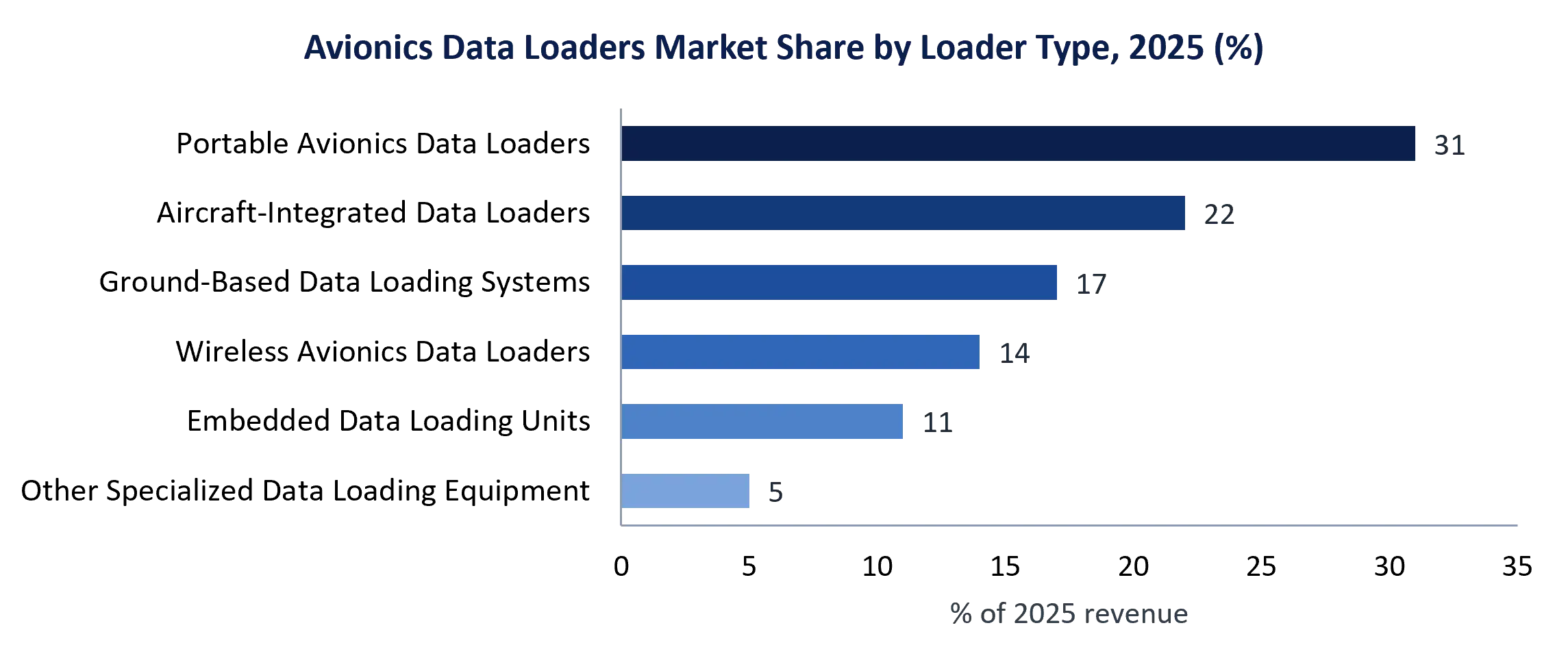
Portable avionics data loaders are the largest group at about 31% of 2025 revenue because every airline, MRO and business aviation shop keeps them for line and hangar loading. Wireless avionics data loaders are the fastest-growing group: Honeywell's Aircraft Data Gateway and Teledyne's GroundLink-based distribution replace carried media with ground-to-aircraft transfer, and Teledyne's eADL XS onboard loader is built as a drop-in replacement for existing form factors.
| Loader type | 2025 share (MMR est.) | Est. 2025 value | CAGR 2026–2034 (MMR est.) |
| Portable Avionics Data Loaders | 31% | ≈ USD 242 Mn | 5.0% |
| Aircraft-Integrated Data Loaders | 22% | ≈ USD 172 Mn | 7.5% |
| Ground-Based Data Loading Systems | 17% | ≈ USD 133 Mn | 6.4% |
| Wireless Avionics Data Loaders | 14% | ≈ USD 109 Mn | 11.8% |
| Embedded Data Loading Units | 11% | ≈ USD 86 Mn | 8.2% |
| Other Specialized Data Loading Equipment | 5% | ≈ USD 39 Mn | 4.0% |
By Component
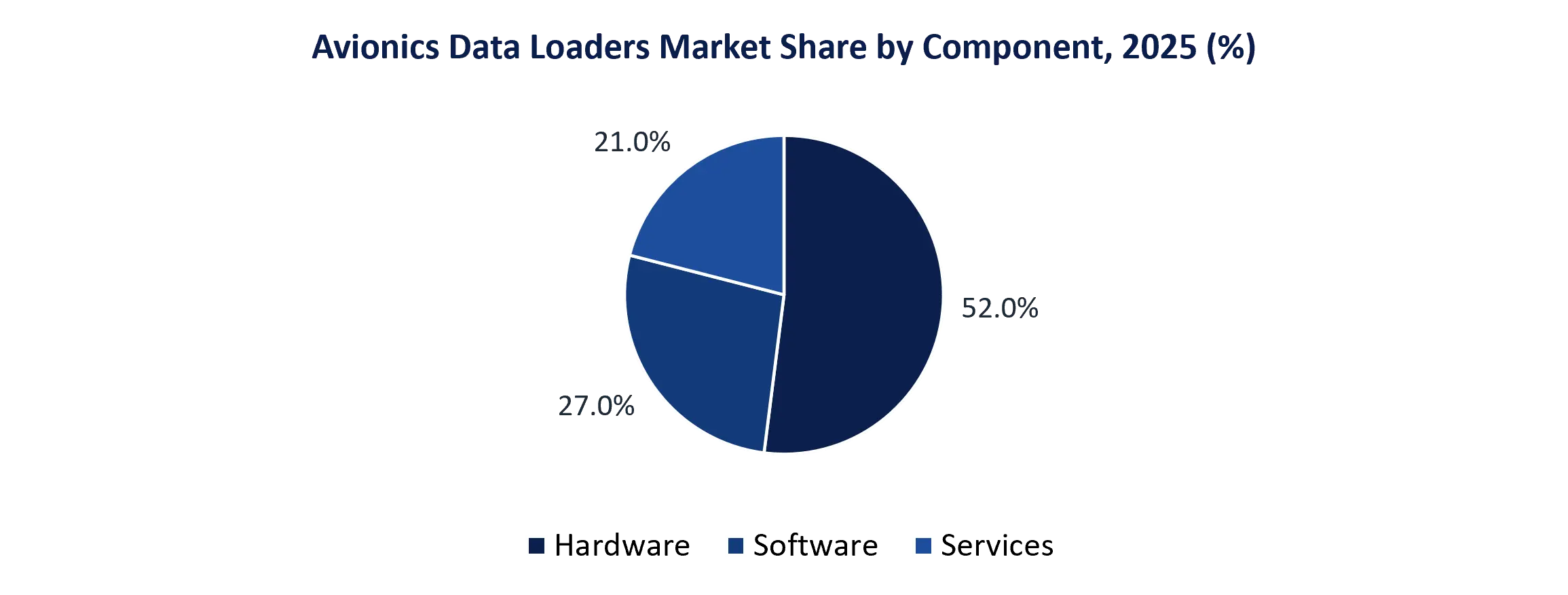
Hardware is about 52% of 2025 revenue, but software (loading applications, fleet configuration management, load reporting) and services (installation, support, subscriptions) together are about 48% and grow faster. Teledyne markets the same ARINC 615A loading software across portable, onboard and wireless methods and adds LSE 3 for configuration control and reporting, a pattern that moves revenue toward software.
| Component | 2025 share (MMR est.) | Est. 2025 value | CAGR 2026–2034 (MMR est.) |
| Hardware | 52% | ≈ USD 406 Mn | 5.6% |
| Software | 27% | ≈ USD 211 Mn | 8.6% |
| Services | 21% | ≈ USD 164 Mn | 8.4% |
By Connectivity
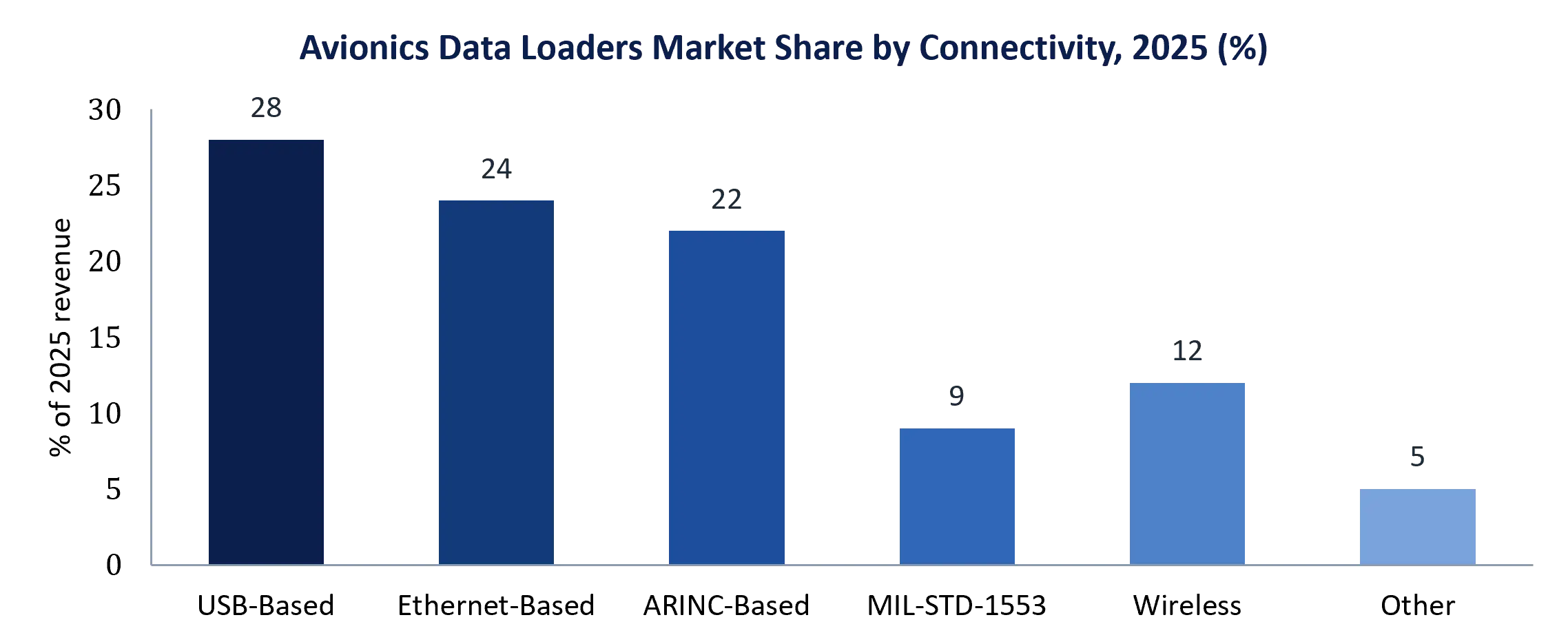
USB remains the most common loading interface, with the Collins DBU-5000 and Honeywell DL-1000 examples of USB or SD-based units, but Ethernet (ARINC 615A) and wireless connectivity grow faster. ARINC-based connectivity (ARINC 429 with 615-3, ARINC 664/615A on newer aircraft) covers most commercial platforms, while MIL-STD-1553 is the data bus for many military aircraft.
| Connectivity | 2025 share (MMR est.) | Est. 2025 value | CAGR 2026–2034 (MMR est.) |
| USB-Based Connectivity | 28% | ≈ USD 218 Mn | 5.6% |
| Ethernet-Based Connectivity | 24% | ≈ USD 187 Mn | 7.8% |
| ARINC-Based Connectivity | 22% | ≈ USD 172 Mn | 6.2% |
| MIL-STD-1553 Connectivity | 9% | ≈ USD 70 Mn | 5.2% |
| Wireless Connectivity | 12% | ≈ USD 94 Mn | 12.4% |
| Other Communication Interfaces | 5% | ≈ USD 39 Mn | 6.5% |
By Aircraft Type
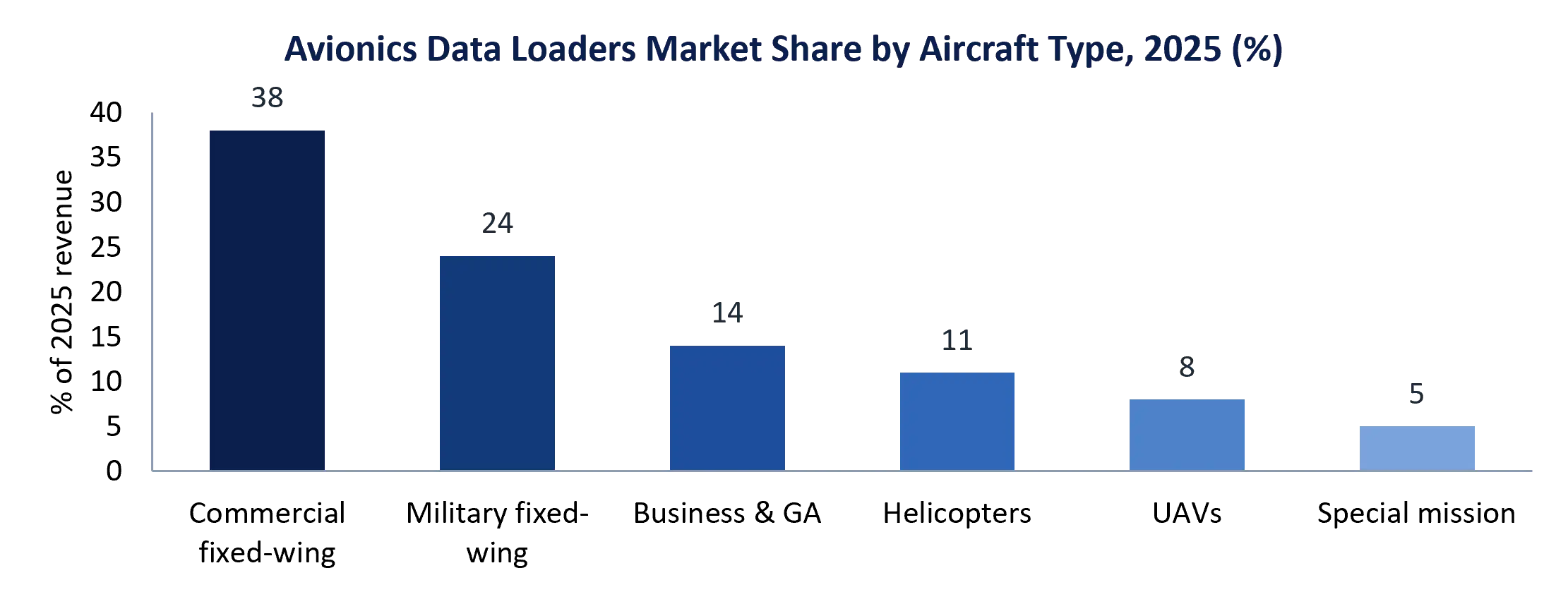
Commercial fixed-wing aircraft are the largest group at about 38% of 2025 revenue, tied to the Boeing and Airbus fleets and delivery streams. Military fixed-wing aircraft follow, supported by the DoD's FY2027 aircraft procurement request. UAVs are the fastest-growing group: the FAA expects the commercial UAS fleet to grow from about 1.1 million in 2025 to 1.5 million in 2030, and the U.S. Air Force request includes nearly USD 1.0 billion to begin buying Collaborative Combat Aircraft.
| Aircraft type | 2025 share (MMR est.) | Est. 2025 value | CAGR 2026–2034 (MMR est.) |
| Commercial Fixed-Wing Aircraft | 38% | ≈ USD 296 Mn | 6.2% |
| Military Fixed-Wing Aircraft | 24% | ≈ USD 187 Mn | 6.8% |
| Business and General Aviation Aircraft | 14% | ≈ USD 109 Mn | 6.0% |
| Helicopters and Rotary-Wing Aircraft | 11% | ≈ USD 86 Mn | 7.4% |
| Unmanned Aerial Vehicles (UAVs) | 8% | ≈ USD 62 Mn | 12.5% |
| Special Mission Aircraft | 5% | ≈ USD 39 Mn | 8.0% |
By Application
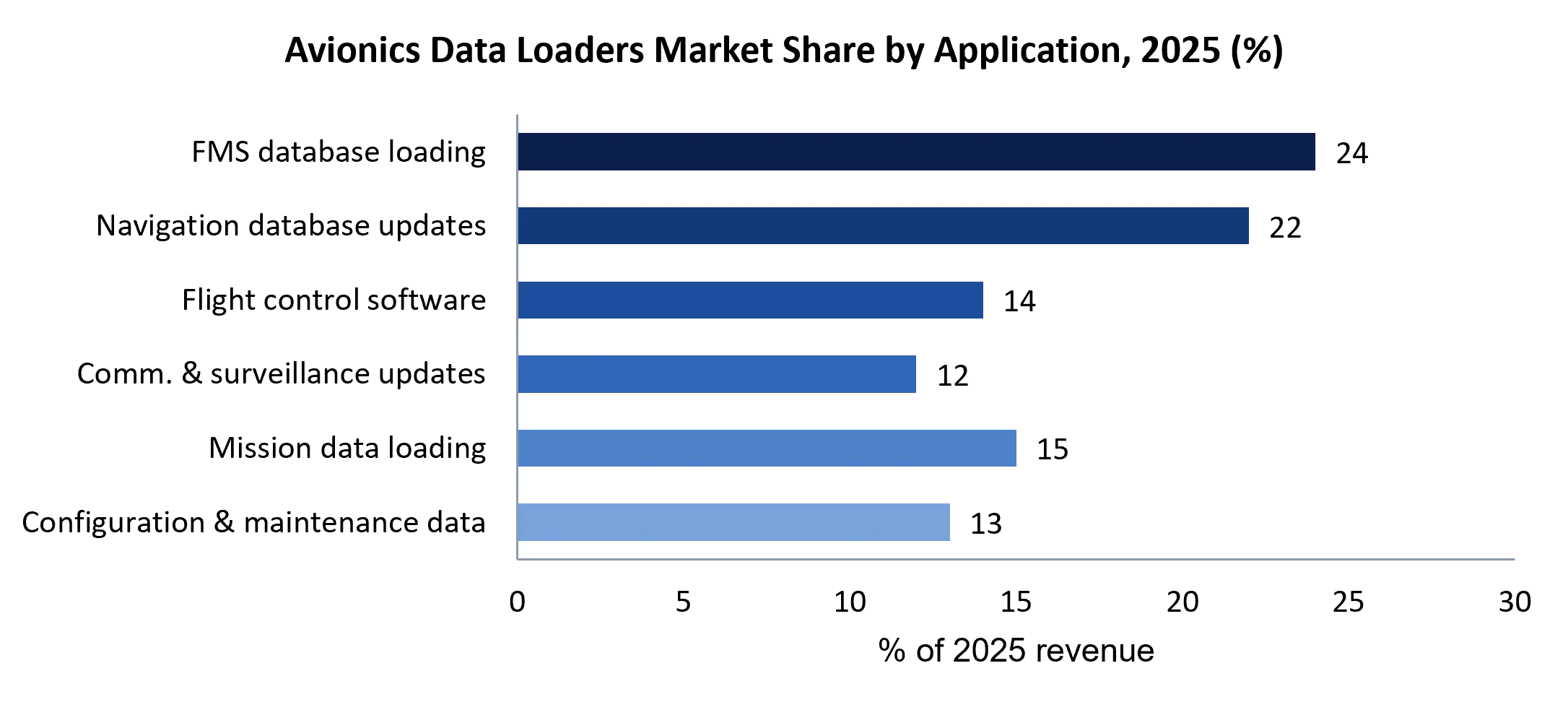
FMS database loading and navigation database updates make up about 46% of 2025 revenue because the AIRAC database must be refreshed 13 times a year. Mission data loading and communication and surveillance updates grow faster as defence and UAV programmes expand and as cybersecurity patching becomes routine.
| Application | 2025 share (MMR est.) | Est. 2025 value | CAGR 2026–2034 (MMR est.) |
| Flight Management System Database Loading | 24% | ≈ USD 187 Mn | 5.8% |
| Navigation Database Updates | 22% | ≈ USD 172 Mn | 6.2% |
| Flight Control Software Loading | 14% | ≈ USD 109 Mn | 7.2% |
| Communication and Surveillance System Updates | 12% | ≈ USD 94 Mn | 7.8% |
| Mission Data Loading | 15% | ≈ USD 117 Mn | 8.2% |
| Aircraft Configuration and Maintenance Data Transfer | 13% | ≈ USD 101 Mn | 7.6% |
By End User
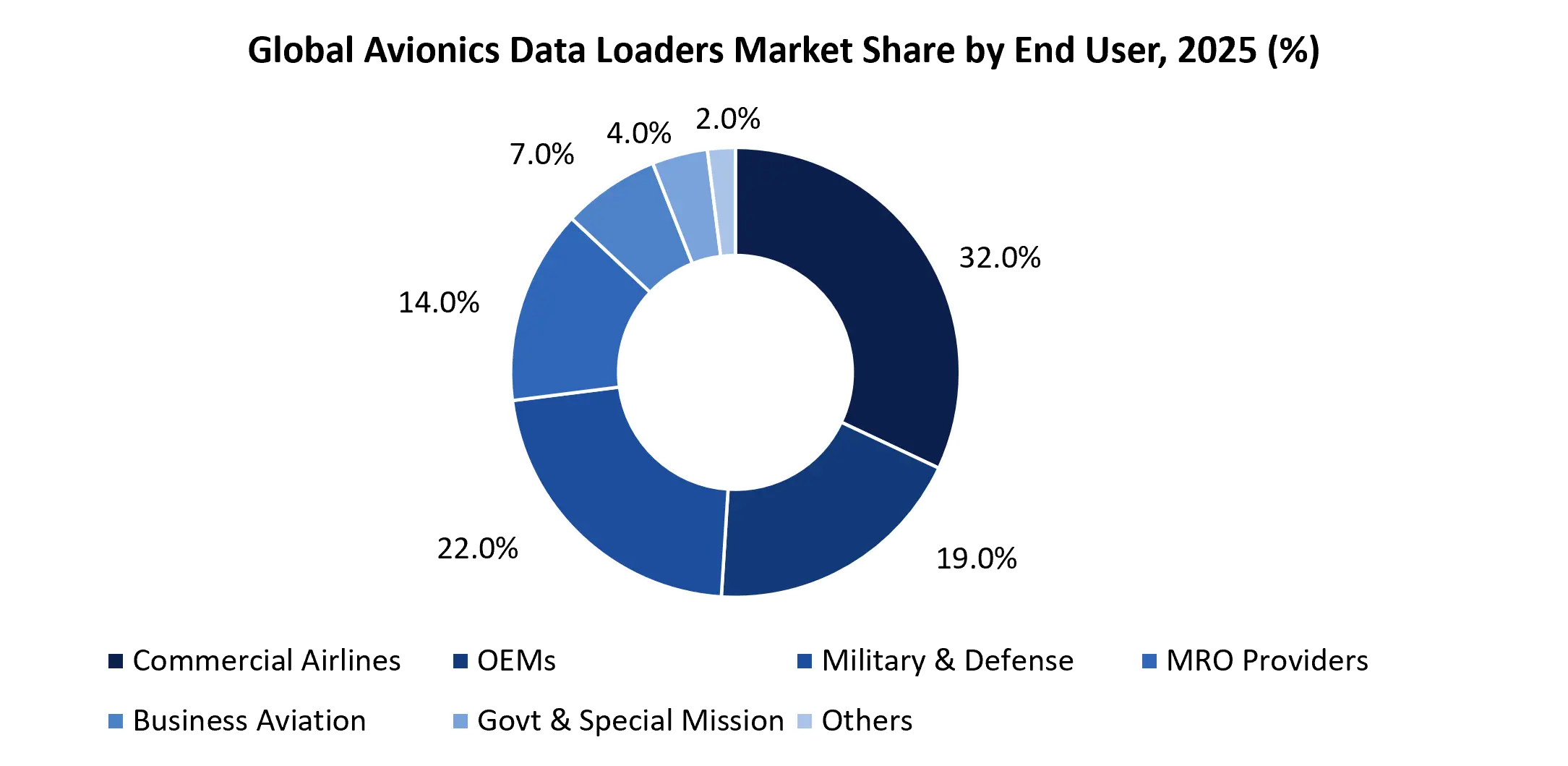
Commercial airlines are the largest buyers at about 32% of 2025 revenue. OEMs buy for production and test, military organisations for mission and software loading, and MRO providers for line and base maintenance; Boeing projects demand for 728,000 new maintenance technicians through 2045, which raises the value of tools that cut loading labour.
| End user | 2025 share (MMR est.) | Est. 2025 value | CAGR 2026–2034 (MMR est.) |
| Commercial Airlines | 32% | ≈ USD 250 Mn | 6.0% |
| Aircraft Manufacturers (OEMs) | 19% | ≈ USD 148 Mn | 7.2% |
| Military and Defense Organizations | 22% | ≈ USD 172 Mn | 7.6% |
| Aircraft Maintenance, Repair and Overhaul Providers | 14% | ≈ USD 109 Mn | 7.8% |
| Business Aviation Operators | 7% | ≈ USD 55 Mn | 7.0% |
| Government and Special Mission Operators | 4% | ≈ USD 31 Mn | 8.0% |
| Others | 2% | ≈ USD 16 Mn | 5.0% |
Demand Signals From Government and Company Data: Fleet, Deliveries, Defence Budgets and UAS
These published figures are the observable inputs behind MMR's estimate. They are leading indicators of demand, not measures of data loader revenue.
Global Avionics Data Loaders Market Regional Analysis:
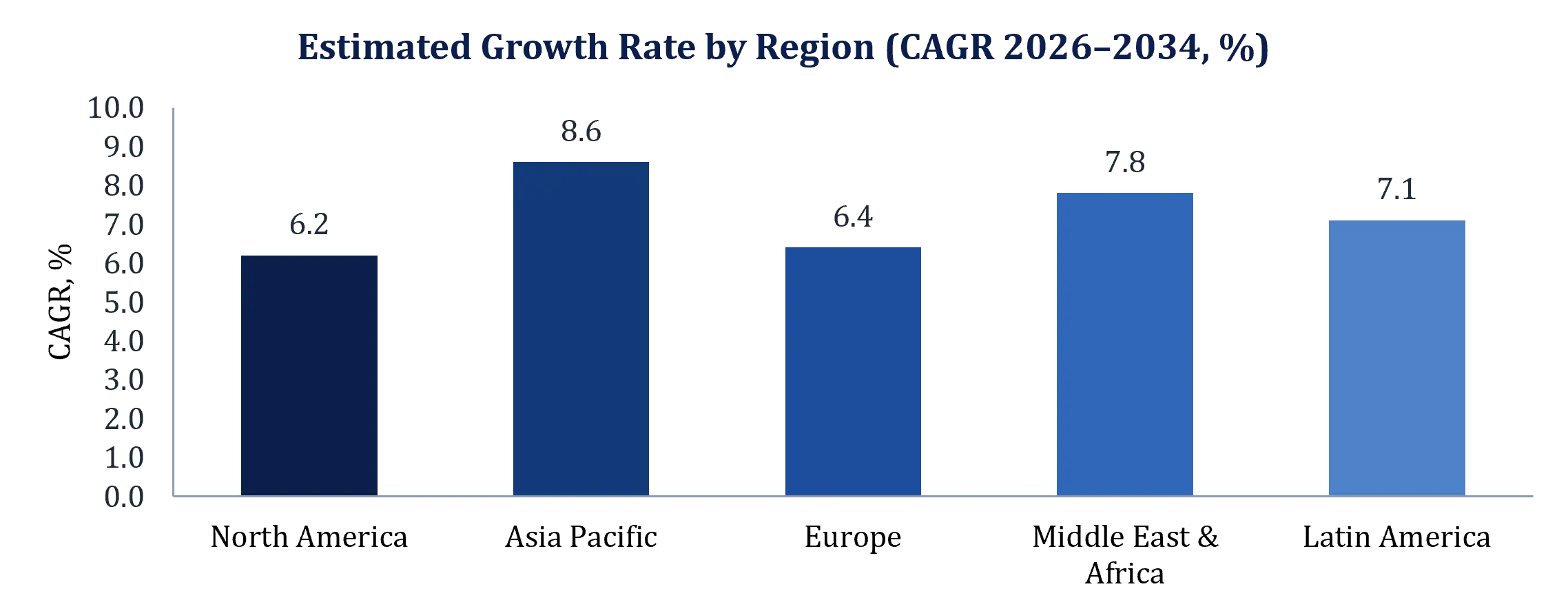
| Region | 2025 share (MMR est.) | Est. 2025 value (USD Mn) | CAGR (MMR est.) | Notes |
| North America | 38.5% | 300 | 6.2% | Home of the main loader makers; FAA AC 20-153B; large defence and business aviation base |
| Asia Pacific | 27.0% | 211 | 8.6% | Fleet growth, India and China deliveries; Boeing: about 55% of new deliveries go to emerging markets |
| Europe | 24.0% | 187 | 6.4% | Airbus production base; EASA Part-IS cybersecurity rules from 2025–2026 |
| Middle East & Africa | 5.5% | 43 | 7.8% | Boeing: 2,995 new airplanes for the Middle East by 2045, 85% of the 2045 fleet new-generation |
| Latin America | 5.0% | 39 | 7.1% | Regional fleets and retrofit demand |
Avionics Data Loaders Market in India: Fleet Growth, Government Data and Outlook
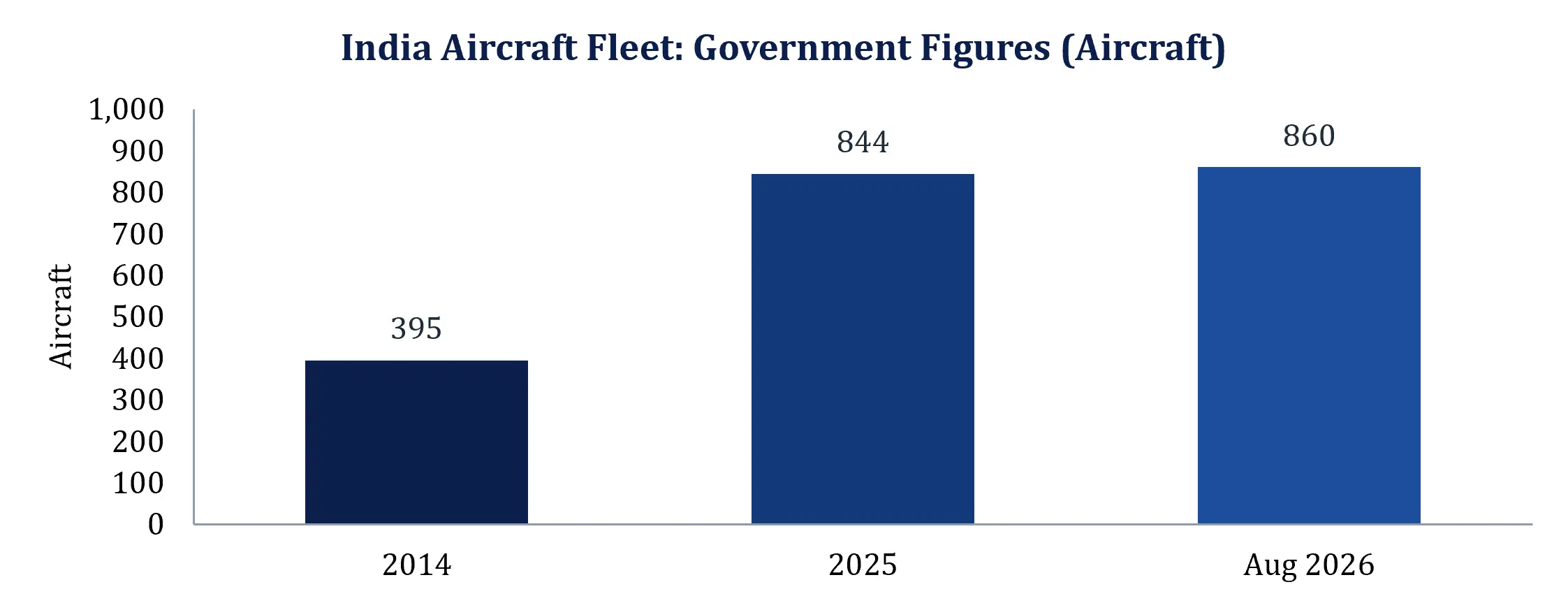
India is a small but fast-growing part of the Asia Pacific market. According to a reply by the Civil Aviation Minister in Parliament (August 2026), 11 scheduled and commuter airlines operate 860 aircraft, with orders for 2,056 aircraft of which 427 have been delivered. The Civil Aviation Secretary said in December 2025 that the aircraft fleet had more than doubled from 395 in 2014 to 844 in 2025, and the DGCA's Handbook on Civil Aviation Statistics 2025–26 records 2,218 registered aircraft on 31 March 2026 and 78.7 million international passengers.
| India indicator | Published value | Source |
| Scheduled airline fleet in operation | 860 aircraft; 11 airlines | Ministry of Civil Aviation, Lok Sabha reply (Aug 2026) |
| Aircraft on order / delivered | 2,056 on order; 427 delivered | Ministry of Civil Aviation (Aug 2026) |
| Fleet growth 2014 to 2025 | 395 to 844 aircraft | Civil Aviation Secretary, All India Radio (Dec 2025) |
| Registered aircraft, 31 Mar 2026 | 2,218 (all categories) | DGCA Handbook on Civil Aviation Statistics 2025–26 |
| International passengers FY2025–26 | 78.7 million | DGCA Handbook 2025–26 |
| Domestic traffic growth 2015–16 to 2025–26 | 7.0% CAGR | DGCA Handbook 2025–26 |
 MMR view: India's factory-fit demand follows aircraft deliveries, and its aftermarket demand follows the fleet's 28-day loading workload. Local MRO capacity and DGCA approval of onboard and wireless loaders are the practical entry points for suppliers.
Avionics Data Loading Regulations and Standards: FAA, EASA, ARINC and Military Interfaces
Compliance is the gate between a software part and a legal load. MMR summarises the main frameworks from published guidance; this is general information, not legal advice.
| Framework | Authority / body | What it covers | Why it matters for loaders |
| AC 20-153B (issued 19 Apr 2016) with RTCA DO-200B | FAA | Acceptance of aeronautical data processes and associated databases; Letters of Acceptance (LOA) | Defines how navigation database suppliers and installations are accepted |
| FAA Order 8110.55B | FAA | Evaluation of aeronautical data processes and databases in certification projects | Sets how FAA staff review database acceptance for TSO, TC, STC or LOA projects |
| EASA Part-IS: Reg. (EU) 2022/1645 and 2023/203 | EASA / European Commission | Information security management; applicable 16 Oct 2025 and 22 Feb 2026 | Loaders and loading processes fall under operators' and MROs' security programmes |
| AIRAC cycle (ICAO Annex 15) | ICAO | Navigation data effective dates every 28 days | Sets the fixed loading rhythm for every aircraft |
| ARINC 615A / 615-3 / 665 / 645-1 | ARINC / SAE ITC | Loading protocols, loadable software part format and secure distribution | Interoperability between loaders, ground tools and avionics |
| MIL-STD-1553 | U.S. DoD | Military avionics data bus | Interface for mission data loading on military platforms |
Avionics Data Loaders Companies and Competitive Landscape:
MMR separates participants by role, because a loader manufacturer, a database supplier and a regulator do not compete with each other. Company claims below are as published by the companies.
| Group | Examples | Published evidence / role |
| Data loader and fleet distribution specialists | Teledyne Controls | PMAT XS portable and eADL XS onboard loaders, LSE 3, GroundLink wireless; eADL XS certified on Boeing 737NG (Nov 2024) and described as the first onboard loader meeting ARINC 645-1 |
| Avionics OEMs with loaders | Honeywell, Collins Aerospace, Garmin, Universal Avionics | Honeywell Aircraft Data Gateway (up to 50% less loading time) and DL-1000 with MyHDM app; Collins DBU-5000 USB loader; Garmin Flight Stream 510 wireless updates; Universal Avionics 28-day database downloads |
| Defence and specialist loaders | Astronautics Corporation of America and defence integrators | ARINC 615/615A loading and database loading solutions for classic and modern platforms |
| Aeronautical data suppliers | Jeppesen (Boeing), Skywise (Airbus), GE Aerospace, Honeywell NavDB | Process data to ARINC 424 and hold FAA Letters of Acceptance under AC 20-153B and DO-200B; Jeppesen distributes over 2 million records per cycle |
| Aircraft OEMs | Boeing, Airbus | Factory-fit loaders and data services; 2025 deliveries of 600 and 793 aircraft |
| Regulators and standards bodies | FAA, EASA, DGCA, ICAO, RTCA, ARINC | Certification, security and data-quality rules |
Competitive Positioning Strategies
| Strategy | How it wins | Risk |
| Drop-in replacement and retrofit | Same form factor as legacy loaders (eADL XS replaces eADL, ARINC 615-3 ADL, MDDU) with approval through STC amendment | Platform-by-platform certification time |
| Fleet-wide wireless distribution | Ground server to onboard loader via Wi-Fi or cellular; load status reports | Network security approval |
| Software and subscription bundles | Loading software, configuration control and support sold together | Customer lock-in concerns |
| Avionics OEM ecosystems | Loader bundled with FMS, cockpit and database subscriptions | Limited multi-vendor flexibility |
| Defence qualification | Rugged loaders for military buses and mission data | Long programme cycles and budget timing |
How to Choose an Avionics Data Loader: MMR Checklist for Buyers
| Criterion | Why it matters | What to ask |
| Protocol coverage | Mixed fleets use ARINC 615-3, 615-4 and 615A | Which aircraft and LRUs are supported? |
| Security | Part-IS and operator security programmes | Is loading signed, encrypted and logged (ARINC 645-1)? |
| Approval status | Onboard loaders need design approval | Is there an STC or TSO for the target aircraft? |
| Wireless option | Cuts labour and media handling | Wi-Fi or cellular? Which ground server? |
| Fleet management | Traceability of what is loaded where | Does software report load status and configuration? |
| Total cost | Labour dominates over hardware | Compare hours saved per 28-day cycle |
Avionics Data Loaders Market Trends 2026–2034
| Trend | What it is | MMR view |
| Wireless and cellular loading | Software parts and databases sent from ground servers to onboard loaders | Highest growth; security approval is the gating item |
| Secure, signed loading | ARINC 645-1 style secure distribution and audit trails | Mainstream by the end of the decade |
| Software-defined fleet management | Configuration control and load reporting across the fleet | Shifts revenue to software and services |
| Mission data loading for UAVs and CCAs | Tactical data and software for unmanned and autonomous platforms | Small but fastest segment |
| Business aviation tablet loading | Wi-Fi SD cards and tablet apps for FMS databases | Strong in turbine GA |
| Consolidation of loading, connectivity and data gateways | One onboard unit handles loading, flight data and connectivity | Favours integrated suppliers |
Global Avionics Data Loaders Market Recent Industry Developments
| Date | Company | Development | Impact |
|---|---|---|---|
| 15 March 2025 | Collins Aerospace | Received an USD 80 million contract to deploy its Mosarc open-architecture platform on US Army Black Hawk helicopters. | Enhances interoperability and software loading efficiency across military tactical avionics systems. |
| 10 September 2025 | Thales Group | Launched an advanced cyber-secured wireless data loading architecture compliant with updated EASA cybersecurity mandates. | Strengthens data integrity and shields flight management systems against unauthorized data access. |
| 14 July 2026 | Honeywell International Inc. | Secured a major selection by IndiGo to equip 810 A320neo family aircraft with advanced data gateway solutions. | Reduces aircraft loading times by up to 50 percent across large commercial single-aisle fleets. |
| 22 August 2026 | Teledyne Controls LLC | Introduced its next-generation automatic ground communication module streamlining ARINC 615A data distributions. | Drives substantial operational cost savings and eliminates manual media handling for global operators. |
Global Avionics Data Loaders Market Scope:Inquire before buying
| Avionics Data Loaders Market | |||
|---|---|---|---|
| Report Coverage | Details | ||
| Base Year: | 2025 | Forecast Period: | 2026-2034 |
| Historical Data: | 2020 to 2025 | Market Size in 2025: | 0.78 USD Billion |
| Forecast Period 2026-2034 CAGR: | 7.0% | Market Size in 2034: | 1.43 USD Billion |
| Segments Covered: | by Loader Type | Portable Avionics Data Loaders Aircraft-Integrated Data Loaders Ground-Based Data Loading Systems Wireless Avionics Data Loaders Embedded Data Loading Units Other Specialized Data Loading Equipment |
|
| by Component | Hardware Software Services |
||
| by Connectivity | USB-Based Connectivity Ethernet-Based Connectivity ARINC-Based Connectivity MIL-STD-1553 Connectivity Wireless Connectivity Other Communication Interfaces |
||
| by Aircraft Type | Commercial Fixed-Wing Aircraft Military Fixed-Wing Aircraft Business and General Aviation Aircraft Helicopters and Rotary-Wing Aircraft Unmanned Aerial Vehicles (UAVs) Special Mission Aircraft |
||
| by Application | Flight Management System Database Loading Navigation Database Updates Flight Control Software Loading Communication and Surveillance System Updates Mission Data Loading Aircraft Configuration and Maintenance Data Transfer |
||
| by End User | Commercial Airlines Aircraft Manufacturers (OEMs) Military and Defense Organizations Aircraft Maintenance, Repair and Overhaul Providers Business Aviation Operators Government and Special Mission Operators Others |
||
Global Avionics Data Loaders Market Region
North America (United States, Canada, and Mexico)
Europe (UK, France, Germany, Italy, Spain, Sweden, Austria, and the Rest of Europe)
Asia Pacific (China, South Korea, Japan, India, Australia, ASEAN, Indonesia, Philippines, Malaysia, Vietnam, Thailand, ASEAN, Rest of Asia Pacific)
Middle East & Africa (South Africa, GCC, Nigeria, Rest of ME&A)
South America (Brazil, Argentina, Rest of South America)
Global Avionics Data Loaders Market Key Players
1. Honeywell International Inc.
2. Rockwell Collins (RTX Corporation)
3. Thales Group
4. General Dynamics Corporation
5. L3Harris Technologies Inc.
6. Northrop Grumman Corporation
7. Garmin Ltd.
8. The Boeing Company
9. Airbus SE
10. Teledyne Controls LLC
11. Universal Avionics Systems Corporation
12. GE Aerospace
13. Astronautics Corporation of America
14. Curtiss-Wright Corporation
15. AstroNova Inc.
16. RUAG Group
17. Flight Data Systems Pty. Ltd.
18. FLYHT Aerospace Solutions Ltd.
19. Spectralux Avionics
20. Cobham Advanced Electronic Solutions
21. Safran SA
22. Parker-Hannifin Corporation
23. MOOG Inc.
24. UTC Aerospace Systems
25. BAE Systems plc
26. Leonardo S.p.A.
27. Diehl Stiftung & Co. KG
28. Esterline Technologies Corporation
29. Meggit PLC
30. Chelton Limited
Frequently Asked Questions:
1. Which region has the largest share in Global Avionics Data Loaders Market?
Ans: Asia Pacific region held the highest share in 2025.
2. What is the growth rate of Global Avionics Data Loaders Market?
Ans: The Global Avionics Data Loaders Market is growing at a CAGR of 7.0% during forecasting period 2026-2034.
3. What is scope of the Global Avionics Data Loaders Market report?
Ans: Global Avionics Data Loaders Market report helps with the PESTEL, PORTER, COVID-19 Impact analysis, Recommendations for Investors & Leaders, and market estimation of the forecast period.
4. What is the study period of this Market?
Ans: The Global Avionics Data Loaders Market is studied from 2020 to 2034.