
Automotive Haptic Technology Market - Industry Structure Evaluation, Demand Drivers Analysis, Regional Growth Analysis and Identification, Competitive Positioning Review & Global Market Size Forecast to 2032
Overview
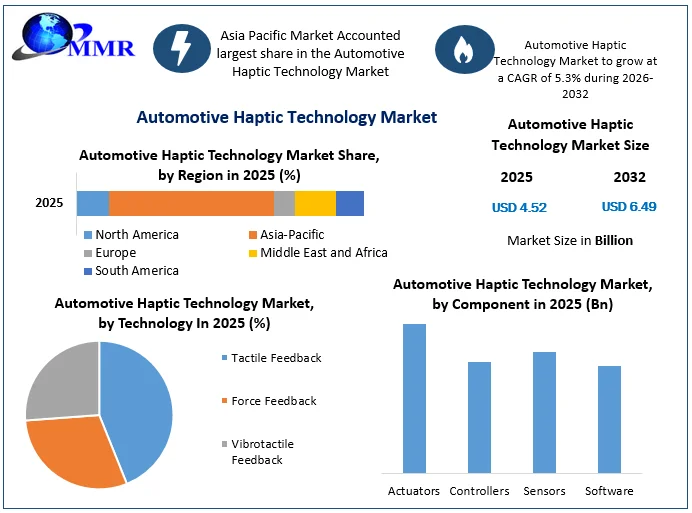
Global Automotive Haptic Technology Market size was valued at USD 4.52 Bn. in 2025 and the total Industrial Robotics revenue is expected to grow by 5.3% from 2026 to 2032, reaching nearly USD 6.49 Bn.
Automotive Haptic Technology Market Overview
Automotive haptic technology is used to assist in controlling the vehicle functions with touch control. The haptic driver product or technology is used to create a touch experience with feedback by applying motions, vibrations, or forces to the user for human-machine interface and improves driver engagement. The report covers the detailed analysis of the global automotive haptic technology market industry with the classifications of the market based on application, component, feedback type, vehicle type, sales channel, and region. Analysis of past market dynamics from 2020 to 2025 is given in the report, which will help readers to benchmark the past trends with current market scenarios and the key players' contributions in it.
To know about the Research Methodology :- Request Free Sample Report
The report has profiled major key players in the market from different regions. Nevertheless, the report has considered all market leaders, followers, and new entrants with investors while analyzing the market and estimating the size of the same. The manufacturing environment in each region is different, and focus is given on the regional impact on the cost of manufacturing, supply chain, availability of raw materials, labor cost, availability of technology, and trusted vendors which are analyzed, and the report has come up with recommendations for a future hotspot in the North America region. The major countries’ policies about manufacturing and their impact on telecom millimeter wave technology demand are covered in the report.
Automotive Haptic Technology Market Dynamics
Shifting Towards Connected & Autonomous Vehicles and Adoption of Electric Vehicle Favors the Market Growth
Automotive manufacturers are progressively shifting their focus towards implementation of connected and autonomous technology in their vehicles. This is anticipated to open up a significant path for the growing need and demand for automotive haptic technology as it assists in reducing driver distraction and also improves driver safety. Moreover, the rising eco-conscious consumers increasingly preferring electric vehicles over fuel-consuming vehicles is likely to favor the need for the product. As electric vehicles incorporate the use of haptic controls for silent feedback systems, digital dashboards, and others.
Increasing Use in Augmented Reality (AR) and Virtual Reality (VR) is Expected to Act as an Opportunity for the Market Development
The rising incorporation of automotive haptic technology in Augmented Reality (AR) and Virtual Reality (VR) is likely to generate a positive route in creating more opportunity for the market progression. This is considered to be driven by the rising number due to the booming growth of the gaming industry and increasing utilization of the product in driver-assist visualization systems. Moreover, the growing inclination toward the use of the product for driver training and simulation is expected to have a positive impact in generating more opportunity for the market development.
Automotive Haptic Technology Market Segment Analysis
Based on Component, the market is segmented into actuators, controllers, sensors, and software. The sensors segment dominated the market in 2025 and is expected to hold the largest market share during the forecast period. Sensors play an important role in detecting physical interactions, such as touch, pressure, or vibrations, which are then converted into haptic feedback for the user. Modern vehicles increasingly integrate touch-based infotainment systems, advanced driver-assistance systems (ADAS), and gesture-controlled interfaces, and the demand for highly responsive and accurate sensors has surged. Sensors are essential for enabling real-time haptic responses, especially in safety-critical applications like steering wheel feedback and touchscreen controls.
Based on Technology, the market is segmented into Tactile Feedback, Force Feedback, and Vibrotactile Feedback. The tactile feedback segment dominated the market in 2025 and is expected to hold the largest market share during the forecast period, due to its cost-effectiveness, responsiveness, and ease of integration into automotive touchscreens, buttons, and control surfaces. It provides immediate physical sensations like vibrations or surface changes that enhance user interaction with infotainment systems, climate controls, and in-vehicle interfaces. As the automotive industry focuses on driver distraction reduction and intuitive controls, tactile feedback offers a practical solution that improves safety and user experience.
Automotive Haptic Technology Market Recent Development
| Date | Company | Development | Impact |
|---|---|---|---|
| 15 April 2025 | Boréas Technologies | The company announced that premium electric vehicle manufacturer NIO integrated its high-power piezo-based haptic module into the TUI Bar infotainment interface of the luxury NIO ET9 sedan. | This implementation replaces older LRA technology to deliver crisp, context-sensitive tactile feedback that enhances user satisfaction and minimizes driver distraction within the smart digital cockpit. |
| 06 January 2026 | Alps Alpine | At CES 2026, the company showcased its new Digital Cabin Solution Technology featuring localized multi-point haptic feedback systems embedded inside vehicle seat devices and cockpit control surfaces. | The integration of multi-sensory stimuli (touch, sound, and smell) provides drivers with intuitive decision-making cues and immersive alerts that significantly elevate in-cabin safety. |
| 02 February 2026 | Alps Alpine North America | The corporation released a major version 1.1 software update for its Haptic Evaluation Kit (EVK) application to support dual-direction drive hardware. | This enables automotive engineers to wirelessly simulate, customize, and fine-tune accurate haptic sine wave amplitudes over Bluetooth Low Energy, accelerating the prototyping of tactile automotive controls. |
| 24 April 2026 | Fact.MR | A specialized industrial study confirmed that automotive component suppliers are commercializing advanced capacitive and piezoelectric haptic layers designed to simulate mechanical physical button behaviors. | This development supports the automotive industry's massive transition toward unified human-machine interfaces, securing a projected $4.4 billion market valuation for tactile switch and button platforms in 2026. |
| 14 May 2026 | Snaptron | Industry design tracking revealed that major automotive manufacturers like Audi, Volkswagen, and Hyundai are integrating multi-layered haptic interfaces to blend surface textures with physical responses. | By relying on high-fidelity localized tactile confirmations rather than completely smooth touchscreens, automakers are successfully reducing driver eye-off-the-road time and boosting interaction accuracy at high speeds. |
Automotive Haptic Technology Market Regional Insights
Asia Pacific is expected to hold the leading share in the automotive haptic technology market. The automotive industry in Asia Pacific witnessing increasing growth over the years is anticipated to play a positive role in escalating the demand for automotive haptic technology. Similarly, the escalating economic progression of Asia Pacific countries, especially China and India, is resulting in fueling the preference for vehicles which have touch-based and tactile feedback attributes, thus favoring the market development. Moreover, the presence of strong market players in semiconductors and electronics, such as Samsung, Sony, TDK, Alps, and others, is expected to have a significant contribution to the market progression.
Europe is expected to witness substantial development in the automotive haptic technology market. Countries in Europe putting high priority towards the safety of drivers are expected to have a significant impact on the increasing product demand. This is attributable to automotive haptic technology's ability to alert drivers through tactile feedback, through vibration or pulse, to warn drivers about forward collisions, lane departures, and others. Furthermore, consumers in this region's ability to quickly adopt new and innovative products, including automotive haptic technology, is expected to favor the market growth.
Automotive Haptic Technology Market Scope: Inquire before Buying
| Automotive Haptic Technology Market | |||
|---|---|---|---|
| Report Coverage | Details | ||
| Base Year: | 2025 | Forecast Period: | 2026-2032 |
| Historical Data: | 2020 to 2025 | Market Size in 2025: | USD 4.52 Bn. |
| Forecast Period 2026 to 2032 CAGR: | 5.3% | Market Size in 2032: | USD 6.49 Bn. |
| Segments Covered: | by Component | Actuators Controllers Sensors Software |
|
| by Technology | Tactile Feedback Force Feedback Vibrotactile Feedback |
||
| by Application | Touchscreens Steering Wheels Control Panels Gear Shifters |
||
| by End Use | Passenger Cars Commercial Vehicles Electric Vehicles |
||
Automotive Haptic Technology Market, by Region:
North America (United States, Canada and Mexico)
Europe (UK, France, Germany, Italy, Spain, Sweden, Austria and Rest of Europe)
Asia Pacific (China, South Korea, Japan, India, Australia, Indonesia, Malaysia, Vietnam, Taiwan, Bangladesh, Pakistan and Rest of APAC)
Middle East and Africa (South Africa, GCC, Egypt, Nigeria and Rest of ME&A)
South America (Brazil, Argentina Rest of South America)
Automotive Haptic Technology Market, Key Players
1. Immersion Corporation
2. Texas Instruments Incorporated
3. Ultraleap Ltd.
4. Microchip Technology Inc.
5. Johnson Electric Holdings Limited
6. AAC Technologies
7. TDK Corporation
8. Synaptics Incorporated
9. ON Semiconductor Corporation
10. Renesas Electronics Corporation
11. Alps Alpine Co., Ltd.
12. Continental AG
13. Denso Corporation
14. Bosch Group
15. Valeo SA
16. Visteon Corporation
17. Magna International Inc.
18. Harman International
19. Bose Corporation
20. Clarion Co., Ltd.
21. Aptiv PLC
22. ZF Friedrichshafen AG
23. Panasonic Corporation
Frequently Asked Questions:
1] What is the growth rate of the Global Market?
Ans. The Global Market is growing at a significant rate of 5.3% during the forecast period.
2] Which region is expected to have the highest growth rate in the Global Market?
Ans. The Asia Pacific region is expected to hold the highest growth rate in the Market during the forecast period.
3] What is the market size of the Global Market by 2032?
Ans. The market size of the Market by 2032 is expected to reach USD 6.49 Bn.
4] What are the major key players of the Global Market?
Ans. The major key players of the global market include Immersion Corporation, Texas Instruments Incorporated, Ultraleap Ltd., Microchip Technology Inc., and Johnson Electric Holdings Limited
5] What factors are driving the growth of the Global Market in 2025?
Ans. The rising adoption of technology in automotive industry and increasing utilization of virtual simulation driving training are the major factors expected to drive the Global Market during the forecast period