
Automated Overhead Cranes Market Size by Lifting Capacity, Mode of Operation, Product, End-User Industry, Region, Industry-Wide Analysis, Competitive Landscape Assessment & Long-Term Forecast to 2032
Overview
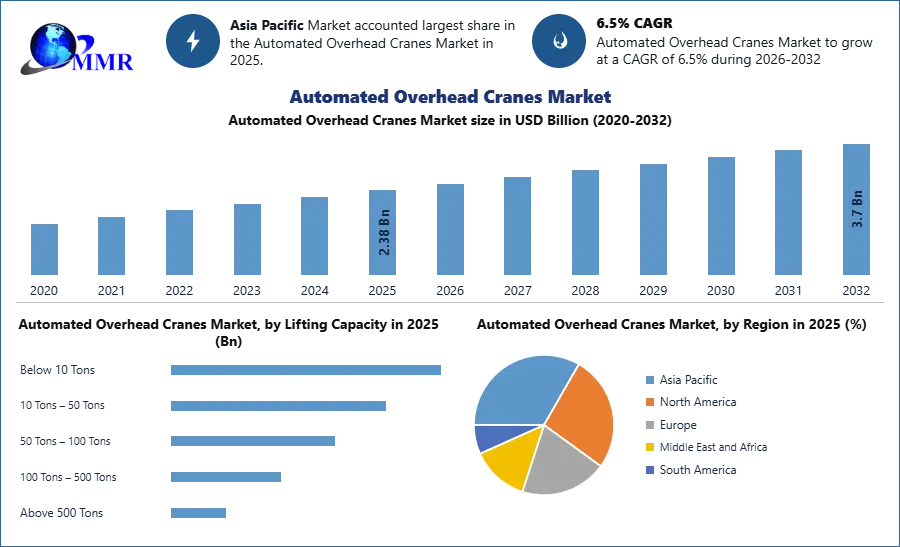
Global Automated Overhead Cranes Market size was valued at USD 2.38 Bn in 2025 and is expected to reach USD 3.7 Bn by 2032, at a CAGR of 6.5%.
Automated Overhead Cranes Market Overview
An Automation process including grabbing or securing a part, lifting, horizontal travel, lowering, and release or placement of the part using overhead cranes is known as Automated Overhead Cranes. The process is fully automated with portions of operation performed by an operators. The increasing trend of industrial automation is a significant driver for the adoption of automated overhead cranes. As industries sought to optimize their material handling processes and improve productivity, they turned to automated solutions and is expected to boost the Automated Overhead Cranes market growth. Automated overhead cranes found applications in various industries, including manufacturing, automotive, aerospace, steel, construction, and more. Their versatility made them suitable for different material handling requirements.
Automated Overhead Cranes Market Snapshot
 To know about the Research Methodology :- Request Free Sample Report
Automated Overhead Cranes Market Dynamics
Increasing demand for material handling automation to boost the Automated Overhead Cranes Market growth
With industries striving to improve operational efficiency and reduce manual labor, there was a growing demand for automated solutions, including overhead cranes. Automated cranes are able to handle heavy loads efficiently, leading to increased adoption across various industries. Automated overhead cranes are designed to enhance workplace safety by minimizing human intervention in hazardous environments. Additionally, these cranes optimize workflow, reduce downtime, and increase overall productivity and is expected to boost the Automated Overhead Cranes Market growth.
The rapid expansion of e-commerce and the increasing demand for efficient logistics and warehousing solutions have driven the need for automated overhead cranes. These cranes are essential for handling, moving, and organizing goods in large distribution centers and warehouses. In certain industries, there has been a shortage of skilled labor for manual material handling tasks. Automated overhead cranes provide a reliable alternative, ensuring that operations continue smoothly even with a limited workforce. As various countries continue to industrialize and develop their manufacturing and infrastructure sectors, the demand for material handling equipment, including automated overhead cranes, has seen a significant upswing in Automated Overhead Cranes Market Share.
Safe Features for Overhead Cranes
Intelligent lifting with Safe Features
Most automated Overhead Carnes are equipped with safe features, software that provides greater control over the material handling during production processes. As soon as the operators will take charge of crane, the work will get easier. A more efficient operator increases productivity by saving time and money as load cycle times go down.
Load control for smooth operation
The load control features bring steady movement with maximum load control, improved productivity with shorter load cycles, and greater safety for operators and work environment.
Area control for maximum productivity and efficiency
The features provide more control over the working area of the crane by improving the efficiency and accuracy of load positioning with the adaption of available space to the physical layout of the production line.
Benefits of Automated Overhead Cranes
An automated handling system is able to control a complete intralogistics system within a single computer program. Along with increased safety, accuracy, and efficiency, automated overhead crane system have many competitive benefits:
1. Slashed production costs and labor costs
2. Lower capital expenses compared to forklift systems
3. Lower overall equipment costs
4. Ability to track inventory
5. Optimized storage space
6. Decreased product damage
7. Less maintenance
8. Reduced downtime
Complexity and Integration Challenges to restraint the Automated Overhead Cranes Market Growth
Integrating automated overhead cranes with existing manufacturing or warehouse systems is complex and time-consuming. Businesses face challenges in ensuring seamless compatibility and data exchange between different automated components, leading to delays and additional expenses. The implementation of automated overhead cranes involves substantial upfront costs, including the purchase of sophisticated equipment, integration with existing systems, and training of personnel. For some businesses, this high initial investment is a significant barrier to adoption and is expected to restraints the Automated Overhead Cranes Market growth. The increasing adoption of automation in industries has raised concerns about potential job displacement. As automated overhead cranes replace some manual labor tasks, there is resistance from labor unions and certain stakeholders, which will slow down market growth in some regions and restraint the Automated Overhead Cranes industry growth.
Opportunity in the Automated Overhead Cranes Market: The growing trend of offering automated overhead cranes on a rental basis is expected to create new opportunities for the Global Automated Overhead Cranes Market during the forecast period. The demand for rental basis crane service is very high in APAC countries thanks to the growing manufacturing and metal & steel sector in emerging countries. Developing the construction sector in road making, shopping mall construction, industrial construction, and others in emerging countries will create immense opportunities for the global automated overhead cranes industry during the forecast period.
Automated Overhead Cranes Market Segment Analysis
Based on Lifting Capacity, the market is segmented into Below 10 Tons, 10 Tons to 50 Tons, 50 Tons to 100 Tons, 100 Tons to 500 Tons, and Above 500 Tons. 50 Tons to 100 Tons segment is expected to dominate the market over the forecast period. The 50 Ton to 100 Ton lifting capacity range is well-suited for heavy industries such as steel manufacturing, metal fabrication, and heavy machinery production. These industries require cranes that handle large and heavy loads with precision and efficiency, making the automated overhead cranes in this segment highly sought after and is expected to boost the Automated Overhead Cranes Market. The adoption of automated overhead cranes in the 50 Ton to 100 Ton range offers significant improvements in efficiency and productivity. Automated cranes handle heavy loads quickly, accurately, and consistently, reducing production downtime and optimizing material handling processes.
Based on Mode of Operation, the market is segmented into Semi-Automated and Fully-Automated. The fully-Automated segment dominated the market in 2025 and is expected to hold the largest Automated Overhead Cranes Market share over the forecast period. Fully-automated cranes operate continuously and at high speeds, resulting in improved productivity and reduced downtime. They handle repetitive tasks without fatigue or human errors, leading to consistent and reliable performance, and increasing the Automated Overhead Cranes Market penetration. Fully-automated overhead cranes find applications in a wide range of industries, including automotive manufacturing, aerospace, logistics, steel mills, and more. Their versatility makes them suitable for various material handling needs. With fully-automated cranes, businesses significantly reduce their reliance on manual labor for material handling tasks. This leads to cost savings in labor expenses and allows companies to reallocate human resources to other value-added activities.
Based on Product, the market is segmented into Single Girder Cranes, Double Girder Cranes, Box Girder Cranes, Truss Girder Crane, I-beam Crane, Straddle Crane, and Others. The Double Girder Crane segment is expected to dominate the market over the forecast period. Double Girder Cranes are designed to handle heavy loads, making them suitable for industries with substantial material handling requirements. Their robust construction and two-girder design provide increased lifting capacity compared to single-girder cranes. The presence of two girders in the Double Girder Crane design enhances its stability and structural strength. This increased stability allows for smooth and precise material handling, even with heavier loads. Industries with heavy-duty material handling needs, such as steel mills, foundries, shipbuilding, and aerospace, often rely on Double Girder Cranes to handle their large and heavy loads, and is expected to boost the Automated Overhead Cranes industry.
Automated Overhead Cranes Market Regional Insight
Industrial Growth and Modernization in North America to boost the Automated Overhead Cranes Market Growth
North America dominated the market in 2025 and is expected to hold the largest Automated Overhead Cranes market share over the forecast period. The region's industrial growth and modernization efforts have driven the demand for advanced material-handling equipment, including automated overhead cranes. With the rapid growth of e-commerce, there has been an increased demand for advanced warehousing and logistics solutions. Automated overhead cranes play a vital role in optimizing warehouse operations and meeting the growing demand for efficient order fulfillment.
The oil and gas sector in North America contributes to the demand for automated overhead cranes, particularly in offshore drilling operations and petrochemical plants and helps to increase the Automated Overhead Cranes industry share. North American governments have been promoting the adoption of automation in industries to drive economic growth and competitiveness. Financial incentives, grants, and tax benefits have encouraged businesses to invest in automation technologies, which is expected to boost the North America Automated Overhead Cranes Market growth.
Growing manufacturing sectors in Asia Pacific to dominate the Automated Overhead Cranes Market over the forecast period
The region's robust manufacturing sector, includes industries like automotive, electronics, steel, and heavy machinery, has been a key driver for the adoption of automated overhead cranes in the region. These cranes are essential for handling heavy and bulky materials in manufacturing facilities. The region is witnessing continuous advancements in automation technologies, robotics, AI, and IoT. These innovations have resulted in more sophisticated and efficient automated overhead crane solutions, attracting businesses looking to improve their material handling processes. The power generation and energy sectors in the Asia Pacific contribute to the demand for automated overhead cranes, especially for handling heavy equipment and components in power plants.
Automated Overhead Cranes Market Competitive Landscape
Competition in the market has driven companies to focus on continuous product innovation. Key players invest in research and development to develop advanced and more efficient automated overhead cranes that cater to specific industry needs. Automated Overhead Cranes manufacturers in the market are constantly incorporating new technologies, such as robotics, IoT, AI, and automation, into their crane systems to enhance their capabilities and offer value-added features.
Konecranes announced the launch of new automated overhead crane, the K-RC500. The crane is designed for high-speed and high-precision lifting applications, and it features a number of new innovations, including a self-diagnostic system and a wireless remote control.
In July 2021, three new cranes were installed by Hoj Innovations in the facility — two on the new runway and one on an existing runway. Schultz said that the overhead cranes travel in narrow aisles or corridors and move in multiple directions. This enables efficient movement of materials through spaces that are too small for floor-based movers, such as forklifts. Hoj Innovations also provided operator training and after-sales support as part of the three-crane project.
Recent Industry Developments
| Exact Date | Company | Development | Impact |
|---|---|---|---|
| 12 March 2026 | Konecranes | The company completed the global rollout of its X-series overhead crane featuring lean electrical architecture and over-the-air software upgrades. | Sets a new industry benchmark for future-proof material handling through digital-first crane hardware. |
| 04 February 2026 | Columbus McKinnon | Completed the massive strategic acquisition of Kito Crosby to consolidate leadership in smart lifting and automation. | Creates a dominant global entity with enhanced scale to deploy automated hoisting solutions across diverse industrial sectors. |
| 19 January 2026 | Demag Cranes | Unveiled the DHR rope hoist series at LogiMAT, integrating smart assistance features for semi-automated positioning. | Improves operational safety and precision in high-performance industrial environments. |
| 23 October 2025 | STAHL CraneSystems | Launched the SXD wire rope hoist range equipped with pole-changeable motors for variable-speed automated cycles. | Enhances the adaptability of overhead systems for complex, multi-speed automated manufacturing lines. |
| 22 July 2025 | Columbus McKinnon | Introduced the Magnetek ZLTX radio remote controls, combining handheld ergonomics with bellybox durability for automated crane interfaces. | Provides operators with superior ruggedized control for high-frequency automated lifting in metals and aerospace production. |
| 19 March 2025 | Volkswagen Group (PowerCo) | Awarded a major contract to Columbus McKinnon for automated stacking and intralogistics technology at its new Gigafactories. | Signals a major shift toward fully integrated automated overhead logistics in the global EV battery manufacturing sector. |
Automated Overhead Cranes Market Report Scope: Inquire Before Buying
| Automated Overhead Cranes Market | |||
|---|---|---|---|
| Report Coverage | Details | ||
| Base Year: | 2025 | Forecast Period: | 2026-2032 |
| Historical Data: | 2020 to 2025 | Market Size in 2025: | 2.38 USD Billion |
| Forecast Period 2026-2032 CAGR: | 6.5% | Market Size in 2032: | 3.7 USD Billion |
| Segments Covered: | by Lifting Capacity | Below 10 Tons 10 Tons – 50 Tons 50 Tons – 100 Tons 100 Tons – 500 Tons Above 500 Tons |
|
| by Mode of Operation | Manual Semi-Automated Fully Automated |
||
| by Product | Single Girder Overhead Crane Double Girder Overhead Crane Gantry Crane Jib Crane Workstation Crane Others |
||
| by End-User Industry | Manufacturing Automotive Aerospace & Defense Logistics & Warehousing Construction Metals & Mining Energy & Power Others |
||
Automated Overhead Cranes Market by Region
North America (United States, Canada and Mexico)
Europe (UK, France, Germany, Italy, Spain, Sweden, Austria, Turkey, Russia and Rest of Europe)
Asia Pacific (China, India, Japan, South Korea, Australia, ASEAN and Rest of APAC)
Middle East and Africa (South Africa, GCC, Egypt, Nigeria and Rest of ME&A)
South America (Brazil, Argentina, Columbia and Rest of South America)
Key Players / Competitors Profiles Covered in Brief in Global Automated Overhead Cranes Market Report in Strategic Perspective:
- Konecranes
- Demag Cranes & Components
- GH Cranes & Components
- Columbus McKinnon
- Terex Corporation
- Liebherr Group
- Gorbel
- Kito Crosby
- Ralf Teichmann
- ABUS Kransysteme
- Street Crane Company
- LOADMATE Industries
- Sumitomo Heavy Industries
- SANY Group
- Eilbeck Cranes
- Morris Material Handling
- STAHL CraneSystems
- SWF Krantechnik
- Clescrane
- American Equipment
- Weihua Group
- ZPMC
- Tadano
- Mazzella Companies
- Aicrane