ATM Market - Industry Structure Evaluation, Demand Drivers Analysis, Regional Growth Analysis and Identification, Competitive Positioning Review & Global Market Size Forecast to 2030

4.9%
CAGR (2024-2030)
3.8 USD Bn.
Forecast Market Size
304
Report Pages
133
Market Tables

Overview

The ATM Market size was valued at USD 25.61 Billion in 2025 and the total ATM revenue is expected to grow at a CAGR of 4.9% from 2026 to 2032, reaching nearly USD 35.80 Billion by 2032.

ATM Market Overview
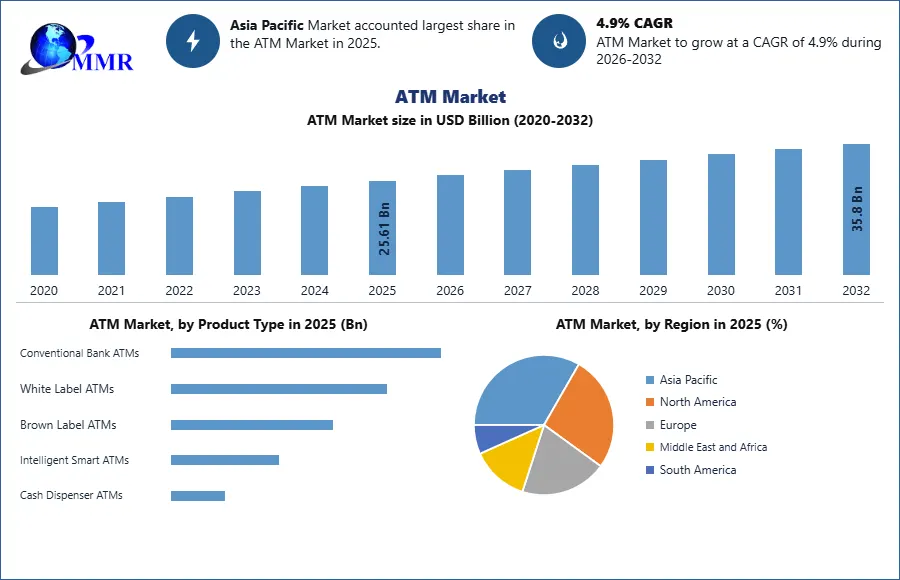
An Automated Teller Machine (ATM) is a self-service banking terminal that enables customers to perform basic financial transactions such as cash withdrawals, deposits, balance inquiries, fund transfers, and  other banking services without direct assistance from bank staff. ATMs provide 24/7 access to financial services and help banks improve customer convenience while reducing operational costs. The market is driven by increasing ATM deployments, advancements in digital banking infrastructure, and the adoption of smart technologies such as cash recycling, biometric authentication, and enhanced security systems. Cash recycling solutions are gaining importance as they improve cash management efficiency, reduce handling costs, detect counterfeit currency, and enhance overall banking service quality.

ATM MarketTo know about the Research Methodology :- Request Free Sample Report

Global ATM Market Dynamics

Market Drivers

The global ATM market continues to grow due to the continuous demand for convenient, secure, and accessible cash withdrawal services, particularly in emerging economies where cash remains an important payment method. Expansion of banking infrastructure, financial inclusion initiatives, and increasing deployment of ATMs in rural and semi-urban areas are supporting market growth. Banks and financial institutions are increasingly adopting advanced ATM solutions, including smart ATMs, cash recyclers, and self-service banking terminals, to improve operational efficiency and enhance customer experience.

Technological advancements in the banking sector are also driving market expansion. The integration of artificial intelligence (AI), Internet of Things (IoT), cloud-based monitoring, biometric authentication, and real-time transaction analytics is enabling more secure and efficient ATM operations. The growing demand for 24/7 banking access, reduced dependency on branch-based services, and the expansion of digital banking infrastructure are further contributing to the adoption of advanced ATM systems.

Market Restraints

The increasing adoption of digital payment solutions, including mobile banking, internet banking, digital wallets, and contactless payment platforms, is creating challenges for the traditional ATM market. Consumers are increasingly shifting toward cashless transaction methods due to their speed, convenience, and accessibility, which may reduce dependence on physical cash withdrawal channels in developed and digitally advanced economies.

Additionally, high installation costs, maintenance expenses, security requirements, and cash management challenges associated with ATM networks can limit market growth. Banks are required to invest significantly in cybersecurity, fraud prevention systems, software upgrades, and compliance measures to maintain secure ATM operations.

Market Opportunities

The growing adoption of next-generation ATMs presents significant opportunities for market players. Financial institutions are increasingly deploying multifunctional ATMs that offer services beyond cash withdrawal, including bill payments, account management, cardless transactions, deposits, and digital banking assistance. Cash recycling ATMs are gaining traction as they reduce cash handling costs and improve operational efficiency.

The increasing focus on financial inclusion in developing regions also provides growth opportunities, as governments and banks continue expanding banking access through ATM networks. Furthermore, advancements in biometric authentication, facial recognition, QR-based transactions, and contactless ATM services are expected to create new opportunities for secure and customer-friendly banking solutions.

Market Trends

A major trend shaping the global ATM market is the transition from traditional cash dispensers toward intelligent self-service banking platforms.

Banks are increasingly upgrading ATM networks with advanced security technologies such as EMV chip authentication, biometric verification, two-factor authentication, and AI-based fraud detection systems to reduce transaction risks.

The market is also witnessing a shift toward managed ATM services, where banks outsource ATM deployment, maintenance, and cash management operations to specialized service providers.

In addition, the rise of digital banking is encouraging ATM manufacturers to develop hybrid solutions that integrate physical cash access with digital banking features, enabling ATMs to remain relevant in an increasingly cashless financial ecosystem.

ATM Market Segment Analysis:

By  Product Type

Based on the product type the market is segmented into Conventional Bank ATMs, White Label ATMs,Brown Lable ATMs , Intelligent Smart ATMs ,Cash Dispenser ATMs .The Conventional Bank ATM segment holds a significant market share due to its widespread deployment by financial institutions. These ATMs provide essential banking services and allow banks to maintain direct control over operations, security, and customer service.

The White Label ATM segment is expected to grow steadily as banks increasingly adopt outsourced ATM models to expand service coverage. These ATMs improve financial accessibility while reducing operational costs for banking institutions.

The Brown Label ATM segment is supported by increasing demand for cost-efficient ATM management models. Third-party service providers manage ATM infrastructure and maintenance, while banks handle cash management and customer transactions.The Intelligent Smart ATM segment is projected to witness strong growth due to rising adoption of advanced features such as biometric authentication, cash recycling, cardless transactions, and AI-based monitoring systems.The Cash Dispenser ATM segment remains widely adopted due to its affordability and ability to provide essential services such as cash withdrawal and balance inquiries, especially in cash-dependent economies.

By Deployment Type / Solution

Onsite ATMs (Bank Branch)
The Onsite ATM segment is expected to hold a significant market share due to its deployment within bank branches, offering enhanced security, direct supervision, and easier maintenance. These ATMs are preferred by financial institutions as they provide better control over operations and improve customer trust through reliable banking access.

Offsite ATMs (Retail Locations)
The Offsite ATM segment is projected to witness steady growth due to increasing installations in retail outlets, shopping malls, airports, and transportation hubs. These ATMs help banks expand their service reach beyond branches and provide customers with convenient 24/7 access to cash and basic banking services.

Worksite ATMs (Corporate/Industrial)
The Worksite ATM segment supports market growth through increasing adoption in corporate offices, industrial facilities, and large workplaces. These ATMs improve employee convenience by providing easy access to cash services within workplace environments and reducing dependency on nearby banking facilities.

Mobile ATMs (Temporary or Event-Based)
The Mobile ATM segment is expected to grow due to rising demand for flexible banking solutions during events, festivals, emergencies, and locations with limited banking infrastructure. These ATMs enable financial service providers to quickly expand cash accessibility based on temporary or seasonal requirements.

Others
The Others segment includes ATMs installed in locations such as educational institutions, healthcare facilities, government premises, and hospitality establishments. Growing demand for convenient self-service banking access across various public and private locations contributes to the growth of this segment.

Regional Insights

North America

North America is expected to hold a significant share of the global ATM market during the forecast period, supported by the presence of advanced banking infrastructure, high adoption of self-service banking solutions, and continuous technological upgrades. Countries such as the United States and Canada are witnessing increased deployment of smart ATMs, cash recycling machines, and advanced security-enabled terminals to improve customer experience and operational efficiency. The growing adoption of biometric authentication, contactless transactions, and AI-based fraud prevention technologies is further supporting market growth in the region. However, increasing digital payment adoption and reduced cash usage in some developed markets may limit traditional ATM demand.

Europe

Europe is projected to witness steady growth in the ATM market due to the modernization of banking networks and increasing investments in secure and automated financial services. Countries such as Germany, the United Kingdom, France, and Italy are focusing on upgrading existing ATM infrastructure with advanced technologies including cash recycling, cardless transactions, and enhanced cybersecurity systems. The demand for ATMs remains supported by the need for reliable cash access, particularly in rural areas and among consumers who continue to prefer cash-based payments. Additionally, regulatory initiatives promoting secure payment systems are encouraging financial institutions to adopt next-generation ATM solutions.

Asia-Pacific

Asia-Pacific is expected to register significant growth and remain one of the fastest-growing regions in the global ATM market during 2025–2032. The growth is driven by expanding banking networks, rising financial inclusion initiatives, increasing urbanization, and growing demand for automated banking services in countries such as India, China, Japan, and Southeast Asian economies. Governments and financial institutions are investing in ATM deployment to improve access to banking services in rural and underserved areas. The adoption of smart ATMs, biometric authentication, and digital banking integration is further accelerating market expansion across the region.

Latin America

Latin America is anticipated to experience moderate growth in the ATM market, supported by increasing banking penetration, rising demand for convenient cash access, and expansion of financial services in emerging economies. Countries such as Brazil, Mexico, and Argentina continue to invest in ATM networks to enhance banking accessibility and reduce dependence on traditional branches. The adoption of advanced ATM technologies, including contactless services and improved security systems, is expected to create growth opportunities. However, the increasing popularity of digital wallets and mobile banking platforms may create challenges for long-term ATM demand.

Middle East & Africa

The Middle East & Africa ATM market is expected to grow steadily due to increasing financial inclusion efforts, expanding banking infrastructure, and rising demand for accessible financial services. Countries such as Saudi Arabia, the United Arab Emirates, and South Africa are investing in modern banking technologies, including smart ATMs and automated service terminals. The expansion of retail banking, government initiatives to improve financial accessibility, and increasing adoption of secure transaction technologies are supporting regional growth. However, limited banking infrastructure in some developing economies may affect market penetration.

Regulatory Framework For The Global ATM Market

Regulation / Standard Region Description Impact on ATM Market
PCI DSS (Payment Card Industry Data Security Standard) Global Establishes security requirements for protecting cardholder data, securing payment environments, and reducing risks associated with card-based transactions. Encourages ATM operators to adopt stronger cybersecurity measures, encryption, and secure transaction systems.
EMV (Europay, Mastercard, Visa) Standards Global Promotes chip-based card authentication technology to replace traditional magnetic stripe cards and improve transaction security. Reduces card fraud and supports adoption of advanced ATM authentication technologies.
General Data Protection Regulation (GDPR) European Union Regulates the collection, processing, and protection of customer data, including information handled through digital banking systems and biometric ATMs. Drives investment in secure data management and privacy-compliant ATM solutions.
PSD2 (Payment Services Directive 2) European Union Requires strong customer authentication and secure electronic payment services across financial platforms. Supports adoption of multi-factor authentication and secure self-service banking technologies.
FFIEC Guidance for Electronic Banking & Cybersecurity United States Provides risk management and cybersecurity guidelines for financial institutions operating electronic banking channels, including ATMs. Increases demand for secure ATM infrastructure, monitoring systems, and fraud prevention solutions.
Reserve Bank of India (RBI) ATM Security Guidelines India Defines requirements related to ATM security, card technology upgrades, transaction protection, and customer safety measures. Encourages adoption of EMV cards, biometric authentication, and enhanced ATM security systems.

Recent Developments in the Global ATM Market

  • January 2025: Diebold Nixdorf expanded its managed services partnership with Geldmaat in the Netherlands to strengthen ATM network monitoring, maintenance, and operational support capabilities. This highlights the growing adoption of managed ATM services to improve uptime and efficiency.
  • March 2025: NCR Atleos focused on expanding ATM-as-a-Service (ATMaaS) solutions, enabling financial institutions to outsource ATM deployment, monitoring, and maintenance operations. This reflects the industry's shift toward service-based ATM management models.
  • June 2025: Euronet Worldwide continued strengthening its global payment technology infrastructure, including ATM network expansion and digital payment solutions to support financial accessibility across emerging markets.
  • July 2025: NCR Atleos expanded its self-service banking solutions through advanced ATM deployments and managed service offerings, supporting the transition toward smart and connected ATM ecosystems.
  • 2025: ATM manufacturers and service providers increased investments in smart ATM technologies, including biometric authentication, AI-based monitoring, cybersecurity solutions, and cash recycling capabilities to improve security and operational efficiency.
  • 2025: Banks and financial institutions accelerated adoption of cloud-based ATM management platforms and remote monitoring solutions to reduce operational costs and enhance transaction reliability.

Global ATM Market Competitive Landscape

The global ATM market is characterized by the presence of established ATM manufacturers, banking technology providers, and service companies competing through technological innovation, product development, and service expansion. Leading players are focusing on the development of smart ATMs, cash recycling solutions, biometric authentication, AI-based fraud detection, and cloud-based ATM management platforms to improve security and operational efficiency.

Companies are increasingly shifting from traditional ATM hardware sales toward ATM-as-a-Service (ATMaaS) and managed service models, allowing banks to outsource ATM deployment, monitoring, maintenance, and cash management activities. Strategic partnerships with banks, expansion into emerging markets, and investments in digital banking infrastructure are key strategies adopted by major players.

Company Strategic Focus / Key Strategy
NCR Atleos Focuses on ATM-as-a-Service (ATMaaS), managed ATM services, and cloud-based ATM management solutions. The company is expanding self-service banking platforms and helping financial institutions reduce ATM ownership and operational costs through outsourced services.
Diebold Nixdorf Concentrates on smart ATM technology, automation, and connected banking solutions. The company is investing in software-driven ATM management, cybersecurity, remote monitoring, and cash management solutions to improve ATM uptime and efficiency.
Hyosung Innovue Focuses on cash recycling ATMs, retail banking automation, and advanced self-service solutions. The company is expanding smart ATM offerings with features such as biometric authentication, cardless transactions, and enhanced customer interfaces.
Euronet Worldwide Expands through global ATM network growth, payment infrastructure, and independent ATM services. The company focuses on increasing ATM accessibility, especially in emerging markets, while integrating digital payment capabilities.
Fujitsu Limited Focuses on advanced banking technology integration, including secure self-service terminals, digital transformation solutions, and automation technologies for financial institutions.
Hitachi Payment Services Focuses on ATM deployment, managed services, and financial inclusion solutions, particularly in emerging markets. The company supports banks through ATM outsourcing, payment infrastructure, and transaction processing services.
GRGBanking Emphasizes smart ATM manufacturing and expansion in international markets. The company develops intelligent ATMs with biometric security, cash recycling, and digital banking capabilities.
Triton Systems Focuses on independent ATM solutions and cost-effective ATM systems, serving retail, convenience stores, and non-bank ATM operators with flexible deployment models.

Major Competitive Strategies:

  • Development of smart and intelligent ATM solutions
  • Expansion of ATM-as-a-Service (ATMaaS) offerings
  • Integration of AI, biometrics, and cybersecurity technologies
  • Partnerships with banks and financial institutions
  • Growth of managed ATM networks in emerging economies
  • Modernization of existing ATM infrastructure

ATM Market Scope: Inquire before buying

ATM Market
Report Coverage Details
Base Year: 2025 Forecast Period: 2026-2032
Historical Data: 2020 to 2025 Market Size in 2025: 25.61 USD Billion
Forecast Period 2026-2032 CAGR: 4.9% Market Size in 2032: 35.8 USD Billion
Segments Covered: by Product Type Conventional Bank ATMs
White Label ATMs
Brown Label ATMs
Intelligent Smart ATMs
Cash Dispenser ATMs
by Type Onsite ATMs (Bank Branch)
Offsite ATMs (Retail Locations)
Worksite ATMs (Corporate/Industrial)
Mobile ATMs (Temporary or Event-Based)
Others
by Screen Size 15' and Below
Above 15'
by Application Cash Withdrawal Only
Cash Deposit Enabled
Fund Transfer
Cardless or Contactless Transactions
Biometric Authentication


ATM Market, by Region

North America (United States, Canada and Mexico)
Europe (UK, France, Germany, Italy, Spain, Sweden, Austria and Rest of Europe)
Asia Pacific (China, South Korea, Japan, India, Australia, Indonesia, Malaysia, Vietnam, Taiwan, Bangladesh, Pakistan and Rest of APAC)
Middle East and Africa (South Africa, GCC, Egypt, Nigeria and Rest of ME&A)
South America (Brazil, Argentina Rest of South America)

ATM Market, Key Players

North America
1.Euronet
2. Diebold Nixdorf
3. NCR Corporation, Cardtronics
4. Payment Alliance International (PAI)
5. Euronet Worldwide
6. Brink’s Company
7. Convergint Technologies
8. Outerwall Inc
Europe
9. HESS Cash Systems GmbH & Co. KG
10. Giesecke+Devrient, Bankomat AB
11. Loomis AB
12. Cennox Group
13. Cashzone
14. Euronet Services UK
15. Triton Systems Europe
Asia Pacific
16. Hitachi-Omron Terminal Solutions, Ltd.
17. Fujitsu Limited
18. Hyosung TNS Inc.
19. OKI Electric Industry Co., Ltd.
20. GRG Banking Equipment Co., Ltd.
21. Vortex Engineering Pvt. Ltd
22. AGS Transact Technologies Ltd
23. Financial Software and Systems (FSS)
Middle East & Africa
24. Alhamrani Universal
25. Bytes Technology Group
26. CNS Middle East
27. FSS Technologies ME
28. ATMIA Africa
South America
29. TecBan
30. Perto S.A.
31. Itautec
32. Diebold Procomp
33. Banco24Horas
Others

Frequently Asked Questions:

1] What is the growth rate of the Global Market?
Ans. The Global Market is growing at a significant rate of 4.9% during the forecast period.

2] Which region is expected to have the highest growth rate in the Global Market?
Ans. The Asia Pacific region is expected to hold the highest growth rate in the Market during the forecast period.

3] What is the market size of the Global Market by 2032?
Ans. The market size of the Market by 2032 is expected to reach USD 35.80 Bn.

4] What are the major key players of the Global Market?
Ans. The major key players of the Global Market are Diebold Nixdorf, NCR Corporation, Triton Systems, Hitachi-Omron Terminal Solutions, GRG Banking Equipment, Hyosung, and others.

5] What factors are driving the growth of the Global Market in 2025?
Ans. Cash still being considered to be a preferred transaction mode by individuals around the world is expected to have a significant impact on the global ATM market growth.

Table of Contents

1. ATM Market: Market Introduction 1.1. Executive Summary 1.2. Market Size (2025) & Forecast (2026-2032), 1.3. Market Size (USD Million) and Market Share (%) - By Segments, Regions and Country 2. Competitive Landscape 2.1. MMR Competition Matrix 2.2. Competitive Analysis of Key Players 2.3. Key Players Benchmarking 2.3.1 Company Name 2.3.2 Headquarter 2.3.3 Business Portfolio 2.3.4 End User Segment 2.3.5 Total Company Revenue (2025) 2.3.6 Profit Margin (%) 2.3.7 Sustainability Certification 2.3.8 Technology Innovation 2.3.9 Cost Of Sales 2.3.10 R&D Investment (%) 2.3.11 Customer Loyalty & Retention Rate (%) 2.3.12 Installed Base 2.3.13 Service and Support 2.3.14 Regulatory Compliance 2.3.15 Global Reach 2.4. Market Structure 2.4.1 Market Leaders 2.4.2 Market Followers 2.4.3 Emerging Players 2.5. Mergers and Acquisitions Details 3. ATM Market Dynamics 3.1. ATM Market Trends 3.2. ATM Market Dynamics 3.2.1 Drivers 3.2.2 Restraints 3.2.3 Opportunities 3.2.4 Challenges 3.3. PORTER’s Five Forces Analysis 3.4. PESTLE Analysis 4. Regulatory Landscape Analysis 4.1 Regional variations in ATM interchange fee caps 4.2 Cross-border transaction compliance standards 4.3 Regulatory push for financial inclusion via ATM expansion 4.4 Government mandates for rural ATM penetration 4.5 Contactless and cardless withdrawal compliance standards 4.6 Evolving cybersecurity guidelines for financial infrastructure 4.7 Central bank oversight on white-label ATM operators 5. Technology and Innovation Landscape 5.1 Migration toward intelligent and smart ATMs 5.2 Integration of biometric authentication systems 5.3 Contactless, NFC, and QR-based withdrawal technologies 5.4 Cloud-based ATM monitoring and predictive maintenance 5.5 ATM-as-a-Service (ATMaaS) operational models 5.6 AI-driven fraud detection systems 5.7 Remote software updates and digital signage capabilities 6. Consumer Behavior and Usage Trends 6.1 Preference for contactless and cardless transactions 6.2 Growing demand for cash deposit-enabled ATMs 6.3 Increased adoption of biometric authentication 6.4 Consumer trust in secure, bank-owned ATM networks 6.5 Usage frequency variations across urban and rural areas 6.6 Shift toward multifunctional ATMs beyond cash withdrawal 6.7 Demand for faster transaction processing and reduced downtime 7. Service Model Evolution 7.1 Shift from CAPEX-heavy ownership to managed services 8. Investment and Infrastructure Trends 8.1 Modernization of aging ATM fleets 8.2 Investment in biometric-enabled machines 8.3 Smart ATM rollout in developed markets 8.4 Expansion of mobile ATMs for temporary banking needs 8.5 Deployment in high-traffic retail and transport hubs 8.6 Growth of modular ATM systems 8.7 Sustainable ATM design (energy-efficient models) 9.Regional Growth Outlook 9.1 Asia Pacific leading in ATM volume deployment 9.2 Africa and Latin America driven by financial inclusion 9.3 North America focused on modernization and upgrades 9.4 Europe emphasizing regulatory compliance and security 9.5 Middle East investing in smart banking infrastructure 9.6 Urban-rural deployment gap closing in emerging markets 9.7 Government-backed rural ATM programs accelerating adoption 10. Trade, Supply Chain, and Manufacturing Dynamics 10.1 Semiconductor shortages affecting ATM production 10.2 Localization of manufacturing to reduce import dependency 10.3 Rising component costs impacting pricing 10.4 Vendor diversification strategies 10.5 Cash handling equipment supply chain resilience 10.6 Integration of IoT modules into ATM hardware 10.7 Maintenance contract standardization across regions 11. Strategic Opportunities and Future Outlook 11.1 Growth of multifunctional smart ATMs 11.2 Integration with digital wallets and fintech ecosystems 11.3 Expansion of ATMaaS business model 11.4 Increased biometric and AI adoption 11.5 Role of ATMs in hybrid branch transformation 11.6 Sustainable and low-energy ATM development 11.7 Long-term coexistence of cash and digital payments 12. ATM Software and Digital Integration 12.1 ATM software integration with core banking systems 12.2 Cloud-based ATM management platforms 12.3 Remote monitoring and predictive maintenance software 12.4 Integration with mobile banking applications 12.5 Software-driven personalization of ATM interfaces 12.6 API-enabled ATM connectivity with fintech platforms 12.7 Real-time transaction monitoring and reporting systems 13. Installed Base and ATM Network Density Analysis 13.1 Total global ATM installed base by region 13.2 ATM penetration per 100,000 adults 13.3 Urban vs rural ATM density comparison 13.4 Bank-owned vs white-label ATM installed base 13.5 Replacement cycle and aging ATM fleet analysis 13.6 Market saturation levels in developed economies 13.7 Expansion potential in underbanked regions 14. Transaction Volume and Usage Analysis 14.1 Annual ATM transaction volume by region 14.2 Average transactions per ATM per day 14.3 Cash withdrawal vs deposit transaction share 14.4 Cardless transaction growth trends 14.5 ATM usage decline trends in digital-first markets 14.6 Seasonal and economic impact on ATM usage 14.7 Regional transaction growth forecast 15. ATM Hardware Manufacturing and Component Supply Chain 15.1 ATM hardware manufacturing hubs globally 15.2 Key component suppliers (card readers, dispensers, screens) 15.3 Semiconductor dependency and supply risks 15.4 Localization trends in ATM manufacturing 15.5 OEM vs contract manufacturing models 15.6 Hardware lifecycle and replacement demand 15.7 Supply chain disruption risk assessment 16 Financial Institution Investment and Budget Allocation Trends 16.1 Bank ATM investment priorities 16.2 CAPEX vs OPEX spending trends 16.3 Shift toward ATMaaS and outsourcing models 16.4 Regional ATM investment outlook 16.5 Digital transformation impact on ATM budgets 16.6 ROI analysis of ATM modernization 16.7 Investment trends by bank size 17. Risk Assessment and Compliance Management 17.1 Policy uncertainty and evolving environmental mandates 17.2 Risk of product bans or restricted use classifications 17.3 Re-registration costs due to regulatory updates 17.4 Litigation and liability risks related to safety claims 17.5 Supply chain disruptions due to compliance failures 17.6 Currency and cost escalation in certification renewals 17.7 Proactive regulatory monitoring as mitigation strategy 17.8 Hardware lifecycle and replacement demand 17.9 Supply chain disruption risk assessment 16 Financial Institution Investment and Budget Allocation Trends 16.1 Bank ATM investment priorities 16.2 CAPEX vs OPEX spending trends 16.3 Shift toward ATMaaS and outsourcing models 16.4 Regional ATM investment outlook 16.5 Digital transformation impact on ATM budgets 16.6 ROI analysis of ATM modernization 16.7 Investment trends by bank size 17. Risk Assessment and Compliance Management 17.1 Policy uncertainty and evolving environmental mandates 17.2 Risk of product bans or restricted use classifications 17.3 Re-registration costs due to regulatory updates 17.4 Litigation and liability risks related to safety claims 17.5 Supply chain disruptions due to compliance failures 17.6 Currency and cost escalation in certification renewals 17.7 Proactive regulatory monitoring as mitigation strategy 18. Global ATM Market: Size and Forecast By Segmentation (By Value in USD Million) (2025-2032) 18.1. Global ATM Market Size and Forecast, By Type 18.1.1 Conventional Bank ATMs 18.1.2 White Label ATMs 18.1.3 Brown Label ATMs 18.1.4 Intelligent Smart ATMs 18.1.5 Cash Dispenser ATMs 18.2. Global ATM Market Size and Forecast, By Deployment 18.2.1 Onsite ATMs (Bank Branch) 18.2.2 Offsite ATMs (Retail Locations) 18.2.3 Worksite ATMs (Corporate/Industrial) 18.2.4 Mobile ATMs (Temporary or Event-Based) 18.2.5 Others 18.3. Global ATM Market Size and Forecast, By Screen Size 15' and Below 15.1 Above 15' 18.4. Global ATM Market Size and Forecast, By Application 18.4.1 Cash Withdrawal Only 18.4.2 Cash Deposit Enabled 18.4.3 Fund Transfer 18.4.4 Cardless or Contactless Transactions 18.4.5 Biometric Authentication 18.5. Global ATM Market Size and Forecast, By Region 18.5.1 North America 18.5.2 United States 18.5.3 Canada 18.5.4 Mexico 18.5.5 Europe 18.5.6 United Kingdom 18.5.7 France 18.5.8 Germany 18.5.9 Poland 18.5.10 Belgium 18.5.11 Netherlands 18.5.12 Italy 18.5.13 Spain 18.5.14 Sweden 18.5.15 Russia 18.5.16 Rest of Europe 18.5.17 Asia Pacific 18.5.18 China 18.5.19 Japan 18.5.20 South Korea 18.5.21 India 18.5.22 Australia 18.5.23 Malaysia 18.5.24 Thailand 18.5.25 Vietnam 18.5.26 Indonesia 18.5.27 Philippines 18.5.28 Rest of Asia Pacific 18.5.29 Middle East and Africa 18.5.30 South Africa 18.5.31 GCC 18.5.32 Nigeria 18.5.33 Egypt 18.5.34 Turkey 18.5.35 Rest of ME&A 18.5.36 South America 18.5.37 Brazil 18.5.38 Argentina 18.5.39 Colombia 18.5.40 Chile 18.5.41 Rest Of South America 19. Company Profile: Key Players 19.1. Diebold Nixdorf 19.1.1 Overview 19.1.2 Business Portfolio 19.1.3 Financial Overview 19.1.4 SWOT Analysis 19.1.5 Strategic Analysis 19.1.6 Recent Developments 19.2. NCR Atleos 19.3. Hyosung Americas 19.4. Hitachi Omron Terminal Solutions 19.5. OKI Electric Industry Co., Ltd. 19.6. GRG Banking Equipment Co., Ltd. 19.7. Triton Systems of Delaware LLC 19.8. Genmega Inc. 19.9. Puloon Technology Inc. 19.10 Guangzhou KingTeller Technology Co., Ltd. 19.11 Shenzhen Yihua Computer Co., Ltd. 19.12 Itautec S.A. 19.13 Vortex Engineering Pvt. Ltd. 19.14 Perto S.A. 19.15 Sigma S.p.A. 19.16 Cashway Technology Co., Ltd. 19.17 Tidel Engineering, LP 19.18 Auriga S.p.A. 19.19 Saber Softech Private Limited 19.20 Hengyin Financial Technology Co., Ltd. 19.21 Diebold Financial Equipment Co., Ltd. 19.22 Eastern Communications Co., Ltd. 19.23 Hangxin Deli Information System (Shanghai) Co., Ltd. 19.24 Anxun (Beijing) Financial Equipment Systems Co., Ltd. 19.25 Guangzhou Yuyin Technology Co., Ltd. 19.25.1 Others 20. Key Findings 21 Strategic Outlook & Future Opportunities 22. Global ATM Market: Research Methodology

Custom Market Research Services

We Will Customise The Research For You, In Case The Report Listed Above Does Not Meet With Your Requirements