1. Chip Crusher Market : Market Introduction
1.1. Executive Summary
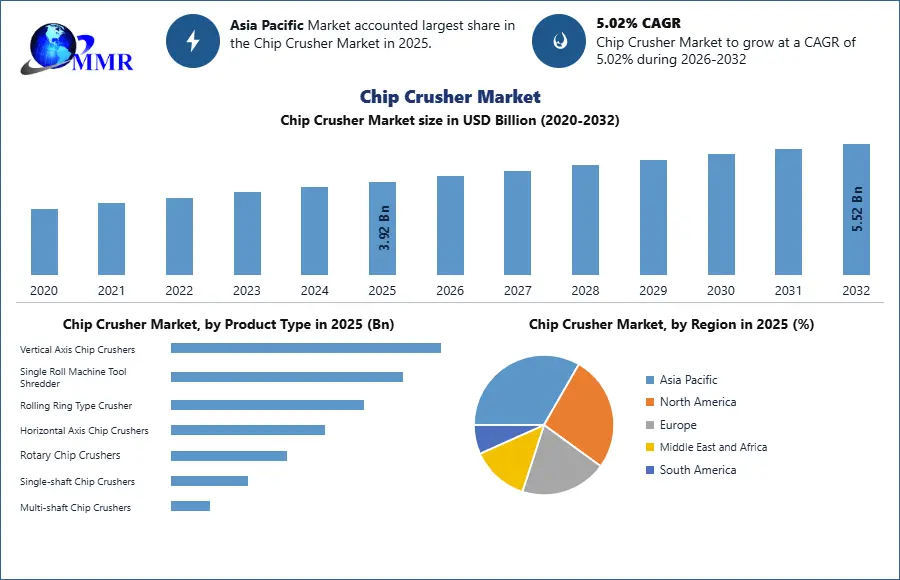
1.2. Market Size (2025) & Forecast (2026-2032)
1.3. Market Size (Value in USD Million and Volume in 000'Units) and Market Share (%) - By Segments, Regions and Country
2. Competitive Landscape
2.1. MMR Competition Matrix
2.2. Competitive Analysis of key players
2.3. Key Players Benchmarking
2.3.1 Company Name
2.3.2 Headquarter
2.3.3 Product Portfolio
2.3.4 Production Capacity (000'Units)
2.3.5 Market Share (%)
2.3.6 R&D Investments
2.3.7 Revenue 2025
2.3.8 Revenue Growth Rate (Y-O-Y) (%)
2.3.9 Profit Margin (%)
2.3.10 Patents
2.3.11 Carbon Footprint Disclosure
2.3.12 Technological Innovation
2.3.13 Certifications
2.3.14 ESG / sustainability policies
2.3.15 Geographical Presence
2.4. Market Structure
2.4.1 Market Leaders
2.4.2 Market Followers
2.4.3 Emerging Players
2.5 Global Competitive Overview
2.5.1 Market Concentration: Top-10 Market Share of Leading Chip Crusher Manufacturers
2.5.2 Global Leaders in Chip Crushing Systems – Revenue, Product Portfolio, and Industrial Presence
2.5.3 Emerging Players Driving Innovation in Compact, Automated, and High-Capacity Crushers
2.5.4 Regional Market Structure – Fragmentation vs Consolidation Across North America, Europe, Asia-Pacific
2.5.5 Competitive Positioning Based on Product Range, Customization Capabilities, and Service Strength
2.6 Product & Technology Positioning
2.6.1 Comparative Analysis of Chip Crusher Capabilities – Throughput Capacity, Durability, Automation Level
2.6.2 Application Integration – CNC Machining, Metal Chip Processing, Scrap Handling Systems
2.6.3 Service Offerings – Custom Equipment Design, Installation, Maintenance, and Retrofit Services
2.6.4 Technology Differentiators – Automated Systems, Integrated Filtration, Coolant Recovery Solutions
2.6.5 Design Variations – Single-Shaft, Multi-Shaft, Vertical/Horizontal and Rotary Crushing Systems
2.7 Strategic Moves & Alliances
2.7.1 Collaborations with CNC Machine OEMs and Industrial Manufacturing Companies
2.7.2 Strategic Partnerships with Recycling Firms and Waste Management Operators
2.7.3 Mergers, Acquisitions, and Expansion Strategies in Industrial Equipment Market
2.7.4 Distribution Partnerships and Global Dealer Network Expansion
2.8 Innovation & R&D Benchmarking
2.8.1 Product Innovation – Development of High-Efficiency, Low-Maintenance Chip Crushers
2.8.2 R&D Investments in Automation, Energy Efficiency, and Smart Monitoring Systems
2.8.3 Patent Filings and Engineering Advancements in Industrial Crushing Technologies
2.8.4 Technology Leadership in High-Capacity, Multi-Material, and Integrated Chip Processing Systems
3. Chip Crusher Market Dynamics
3.1. Chip Crusher Market Trends
3.2. Chip Crusher Market Dynamics
3.2.1 Drivers
3.2.2 Restraints
3.2.3 Opportunities
3.2.4 Challenges
3.3. PORTER’s Five Forces Analysis
3.4. PESTLE Analysis
4. Chip Crusher Industry Landscape & Market Overview
4.1 Overview of the Chip Crusher Market Structure and Ecosystem
4.2 Evolution of Chip Crushing Technologies in Metal Processing
4.3 Key Components of Chip Handling Systems (Crusher, Conveyor, Filtration)
4.4 Role of Chip Crushers in Metal Recycling and Waste Management
4.5 Integration with CNC Machining and Industrial Manufacturing Systems
4.6 Importance in Coolant Recovery and Scrap Volume Reduction
4.7 Role in Industrial Automation and Smart Manufacturing Environments
5. Global Metal Scrap Generation & Quantitative Analysis
5.1 Global Metal Scrap Generation Volume (Million Tons) – Historical Analysis (2020–2025)
5.2 Regional Scrap Generation Distribution (%) – North America, Europe, Asia-Pacific, Others
5.3 Industrial Scrap Generation by End-Use Sector (Automotive, Construction, Manufacturing, Electronics)
5.4 Machining & CNC-Based Metal Chip Generation Volume Analysis
5.5 Scrap Recycling Rate (%) vs Landfill Disposal Rate – Global Benchmarking
5.6 Demand-Supply Balance of Scrap Metal and Processing Capacity Utilization
6. Manufacturing & Production Economics Analysis
6.1 Production Capacity of Key Chip Crusher Manufacturers
6.2 Manufacturing Cost Structure (Material, Fabrication, Assembly)
6.3 Supply Chain for Industrial Machinery Components
6.4 Challenges in Scaling Industrial Crusher Production
6.5 Cost Optimization and Process Efficiency Strategies
6.6 In-house Manufacturing vs Outsourcing Models
6.7 Lead Time, Customization, and Production Flexibility Analysis
7. Global Demand & Market Analysis
7.1 Historical Demand Trends (2020–2025) by Region
7.2 Regional Demand Analysis (North America, Europe, Asia-Pacific, Others)
7.3 Demand by End-Use Industry (Metalworking, Automotive, Aerospace, Recycling)
7.4 Demand by Application (Metal Chips, Scrap, Bulk Materials)
7.5 Market Growth Drivers (Industrialization, Recycling, Automation)
7.6 Market Forecast (2026–2032) – Volume & Value Analysis
7.7 Demand Trends in CNC Machining and Metal Fabrication Industries
8. Application & End-Use Industry Analysis
8.1 Metal Chip Processing in CNC and Machining Operations
8.2 Scrap Recycling and Waste Management Applications
8.3 Automotive and Aerospace Manufacturing Applications
8.4 Industrial Manufacturing and Heavy Engineering Applications
8.5 Electronics and Precision Component Manufacturing Use Cases
8.6 Emerging Applications in Sustainable Recycling Systems
9. Customer Behavior & Industry Requirements
9.1 Key Factors Driving Adoption of Chip Crushers
9.2 Industry Requirements (Durability, Efficiency, Automation)
9.3 OEM and Industrial Buyer Decision-Making Criteria
9.4 Vendor Selection and Procurement Strategies
9.5 Case Studies of Industrial Chip Crusher Deployments
10. Pricing & Commercial Analysis 2025
10.1 Price Trends by Product Type and Capacity
10.2 Cost Breakdown (Raw Material, Manufacturing, Installation)
10.3 Pricing Benchmarking Across Key Manufacturers
10.4 Impact of Steel and Component Prices on Equipment Cost
10.5 Contract vs Direct Sales Pricing Models
10.6 Regional Pricing Variations and Competitive Pricing Strategies
11. Waste Reduction & Resource Efficiency Analysis Through Chip Crushers
11.1 Global Metal Waste Reduction Potential Using Chip Crushers – Volume and Percentage Metrics
11.2 Scrap Handling Efficiency Improvements – Pre- vs Post-Crusher Benchmarking
11.3 Coolant Recovery Optimization (%) and Fluid Reusability Impact
11.4 Reduction in Storage and Transportation Costs (%) Across Industrial Applications
11.5 Energy Consumption vs Waste Reduction Efficiency – Comparative Analysis
11.6 Waste-to-Recycling Conversion Ratio Improvements (%)
11.7 ROI from Resource Optimization and Cost Savings – Industry-Wise Assessment
11.8 Landfill Diversion and Environmental Impact Reduction Metrics
12. Impact of Chip Crushers on Recycling Efficiency & Scrap Recovery
12.1 Historical Metal Scrap Recycling Rate Improvements (%) – 2020–2025 Benchmarking
12.2 Regional Recycling Rate Enhancements Enabled by Chip Crushers – NA, EU, APAC
12.3 Recycling Efficiency by Metal Type (Steel, Aluminum, Titanium, Alloys)
12.4 Scrap Volume Recovery and Material Reuse Metrics – Pre- vs Post-Crusher Deployment
12.5 End-Use Industry Impact on Recycling Performance – Automotive, Aerospace, Electronics, Heavy Engineering
12.6 Coolant Recovery Contribution to Overall Recycling Efficiency (%)
13. Product Customization & Engineering Flexibility Analysis
13.1 Customization Requirements by End-Use Industry (Automotive, Aerospace, Defense, Recycling)
13.2 Design Customization (Capacity, Blade Design, Material Compatibility)
13.3 Integration Customization with CNC Machines and Production Lines
13.4 Custom Solutions for High-Strength & Specialty Materials (Titanium, Alloys)
13.5 Industry-Specific Customization (Defense, Aerospace, Heavy Engineering)
13.6 Role of Modular Design and Scalable Crusher Systems
13.7 Customization Impact on Cost, Lead Time, and Performance Efficiency
14. Industrial Automation & Smart Factory Integration
14.1 Role of Chip Crushers in Automated Manufacturing Environments
14.2 Integration with CNC Machines, Robotics, and Conveyor Systems
14.3 Smart Monitoring and IoT-Enabled Crusher Systems
14.4 Data Analytics for Performance Optimization and Predictive Maintenance
14.5 Industry 4.0 Adoption Across Metal Processing Facilities
14.6 Automation Impact on Productivity and Cost Efficiency
14.7 Future of Autonomous Material Handling Systems
15. Digitalization & Predictive Maintenance Ecosystem
15.1 Role of Digital Technologies in Chip Crusher Operations
15.2 Predictive Maintenance Using Sensors and Condition Monitoring Systems
15.3 Integration with Industrial Software and Monitoring Dashboards
15.4 Real-Time Performance Tracking and Remote Diagnostics
15.5 AI-Based Fault Detection and Failure Prediction Systems
15.6 Cloud-Based Monitoring and Data-Driven Decision Making
15.7 Digital Twin Technology for Equipment Simulation and Optimization
16. Sustainable Waste Management Solutions & Circular Economy Analysis
16.1 Role of Chip Crushers in Sustainable Industrial Waste Management Systems
16.2 Metal Scrap Reduction, Segregation, and Recycling Efficiency Enhancement
16.3 Integration with Circular Economy Models in Metal Processing Industries
16.4 Coolant Recovery, Waste Minimization, and Resource Optimization Strategies
16.5 Energy Efficiency and Emission Reduction in Waste Processing Operations
16.6 Industrial Waste Compliance and Environmental Sustainability Standards
16.7 Adoption of Eco-Friendly Technologies and Green Manufacturing Practices
17. Technology & Innovation Landscape Analysis
17.1 Evolution of Chip Crusher Technologies and Design Innovations
17.2 Advancements in Automated and Smart Chip Crushing Systems
17.3 Integration with IoT, Sensors, and Industry 4.0 Platforms
17.4 Development of High-Efficiency and Energy-Optimized Crushers
17.5 Innovations in Multi-Material and High-Strength Metal Processing
17.6 Noise Reduction, Safety Enhancements, and Operator Protection Technologies
17.7 Digital Monitoring, Predictive Maintenance, and Performance Analytics
18. Supply Chain Analysis
18.1 Global Supply Chain Structure for Chip Crusher Systems
18.2 Key Raw Material Sourcing (Steel, Components, Electrical Systems)
18.3 Supplier Ecosystem and Vendor Dependency Analysis
18.4 Logistics, Transportation, and Delivery Network Efficiency
18.5 Supply Chain Disruptions and Risk Assessment
18.6 Lead Time Analysis and Inventory Management Strategies
18.7 Supply Chain Optimization and Localization Strategies
19. Value Chain Analysis
19.1 End-to-End Value Chain Mapping (Raw Material to End-User)
19.2 Role of Component Suppliers and OEM Manufacturers
19.3 Manufacturing, Assembly, and System Integration Processes
19.4 Distribution Channels and Aftermarket Service Ecosystem
19.5 Value Addition Across Each Stage of the Chain
19.6 Margin Distribution Across Stakeholders
19.7 Strategic Partnerships and Value Chain Integration Trends
20. Trade Analysis 2025
20.1 Global Trade Flow of Chip Crushers and Industrial Equipment
20.2 Import-Export Analysis by Region and Key Countries
20.3 Major Exporting and Importing Nations Benchmarking
20.4 Trade Balance and Regional Demand-Supply Gap Analysis
20.5 Impact of Trade Policies and Tariffs on Market Dynamics
20.6 Cross-Border Supply Chain and Manufacturing Trends
20.7 Trade Opportunities in Emerging Industrial Markets
21. Aftermarket Services & Lifecycle Support Analysis
21.1 Overview of Aftermarket Services in Chip Crusher Systems
21.2 Spare Parts Demand and Replacement Cycle Analysis
21.3 Maintenance Services (Preventive, Predictive, Corrective)
21.4 Service Contracts and Annual Maintenance Agreements (AMCs)
21.5 Retrofit, Upgradation, and System Modernization Services
21.6 Downtime Reduction and Equipment Lifecycle Optimization Strategies
21.7 Role of Digital Monitoring and Remote Service Support
22. Investment Landscape Analysis
22.1 Investment Trends in Industrial Machinery and Recycling Equipment
22.2 Capital Investment in Manufacturing Capacity Expansion
22.3 Mergers, Acquisitions, and Strategic Alliances Activity
22.4 Private Equity and Venture Capital Participation
22.5 Government Funding and Industrial Development Programs
22.6 Investment Opportunities Across Regions and Applications
22.7 ROI Analysis and Investor Outlook for Chip Crusher Market
23. Sustainability & Environmental Landscape
23.1 Sustainability Trends in Industrial Machinery Manufacturing
23.2 Energy Efficiency and Resource Optimization in Chip Crushers
23.3 Role in Metal Recycling and Circular Economy Initiatives
23.4 Waste Reduction and Coolant Recovery Benefits
23.5 Environmental Impact Assessment and Carbon Footprint Analysis
23.6 ESG Compliance and Green Manufacturing Practices
23.7 Development of Eco-Friendly and Low-Emission Equipment
24. Regulatory & Compliance Analysis By Region
24.1 Global Regulatory Framework for Industrial Machinery Equipment
24.2 Safety Standards and Certification Requirements (ISO, CE, OSHA)
24.3 Environmental Compliance and Emission Regulations
24.4 Workplace Safety and Operational Compliance Standards
24.5 Impact of Regulations on Product Design and Innovation
24.6 Regional Regulatory Variations and Market Entry Barriers
24.7 Compliance Challenges and Risk Mitigation Strategies
25. Global Chip Crusher Market : Market size and Forecast by Segmentation (by Value USD Million and Volume in 000'Units) (2025-2032)
25.1. Global Chip Crusher Market Size and Forecast, By Product Type
25.1.1 Single Roll Machine Tool Shredder
25.1.2 Rolling Ring Type Crusher
25.1.3 Vertical Axis Chip Crushers
25.1.4 Horizontal Axis Chip Crushers
25.1.5 Rotary Chip Crushers
25.1.6 Single-shaft Chip Crushers
25.1.7 Multi-shaft Chip Crushers
25.2. Global Chip Crusher Market Size and Forecast, By Operation Type
25.2.1 Manual Chip Crushers
25.2.2 Automated Chip Crushers
25.2.3 Semi-Automated Chip Crushers
25.3. Global Chip Crusher Market Size and Forecast, By Material Type
25.3.1 Steel
25.3.2 Aluminum
25.3.3 Titanium
25.3.4 Composite
25.3.5 Others
25.4. Global Chip Crusher Market Size and Forecast, By Capacity
25.4.1 Small Capacity (Below 500 kg/h)
25.4.2 Medium Capacity (500 kg/h to 1000 kg/h)
25.4.3 Large Capacity (Above 1000 kg/h)
25.5. Global Chip Crusher Market Size and Forecast, By End-Use Industry
25.5.1 Automotive
25.5.2 Aerospace
25.5.3 Electronics Manufacturing
25.5.4 Metal Processing & Fabrication Industry
25.5.5 Recycling & Waste Management Industry
25.5.6 Others
25.6. Global Chip Crusher Market Size and Forecast, by Region
25.6.1 North America
25.6.2 United States
25.6.3 Mexico
25.6.4 Canada
25.6.5 Europe
25.6.6 United Kingdom
25.6.7 France
25.6.8 Germany
25.6.9 Italy
25.6.10 Spain
25.6.11 Sweden
25.6.12 Russia
25.6.13 Rest of Europe
25.6.14 Asia Pacific
25.6.15 China
25.6.16 South Korea
25.6.17 Japan
25.6.18 India
25.6.19 Australia
25.6.20 Indonesia
25.6.21 Philippines
25.6.22 Malaysia
25.6.23 Vietnam
25.6.24 Thailand
25.6.25 Rest of Asia Pacific
25.6.26 Middle East and Africa
25.6.27 South Africa
25.6.28 GCC
25.6.29 Turkey
25.6.30 Egypt
25.6.31 Nigeria
25.6.32 Rest of ME&A
25.6.33 South America
25.6.34 Brazil
25.6.35 Argentina
25.6.36 Colombia
25.6.37 Chile
25.6.38 Rest Of South America
26. Company Profile: Key Players
26.01.Applied Recovery Systems Inc.
26.01.1 Overview
26.01.2 Business Portfolio
26.01.3 Financial Overview
26.01.4 SWOT Analysis
26.01.5 Strategic Analysis
26.01.6 Recent Developments
26.02.Mayfran International, Inc.
26.03.PRAB, Inc.
26.04.UNTHA shredding technology GmbH
26.05.ATM-Recyclingsystems GmbH
26.06.SSI Shredding Systems
26.07.Cometel Co., Ltd.
26.08.Erdwich Zerkleinerungssysteme GmbH
26.09.Lanner Anlagenbau GmbH
26.10.Liqui Filter GmbH
26.11.Mercodor GmbH Sondermaschinenbau KG.
26.12.WEIMA Maschinenbau GmbH
26.13.TECNIMETAL CORPORATE SRL
26.14.Lindner Recyclingtech GmbH
26.15.Endo Kogyo Co., Ltd.
26.16.Lubriserv Solutions Pvt. Ltd.
26.17.Genox Recycling Tech (China)
26.18.Aymas Makina
26.19.Accustrip (India)
26.20.Jordan Reduction Solutions
26.21.Franklin Miller Inc.
26.22.H.K. Machinery
26.23.Sugiyama Manufacturing Co., Ltd.
26.24.Shred-Tech Corporation
26.25.Das Precision Machine Tool Pvt. Ltd.
26.26.Nederman Holding AB
26.26.1 Others
27. Key Findings
28. Strategic Moves & Industry Outlook
29. Global Chip Crusher Market : Research Methodology

 To know about the Research Methodology :- Request Free Sample Report