
Artificial Intelligence (AI) in Robotics Market Size – Industry Structure Evaluation, Demand Drivers Analysis, Regional Growth Analysis and Identification, Competitive Positioning Review & Global Market Size Forecast to 2032
Overview
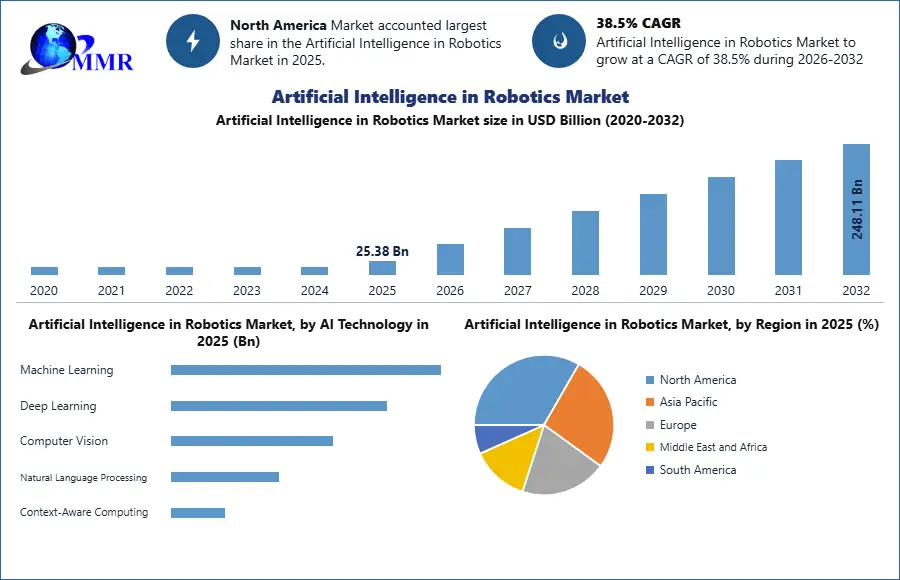
The Artificial Intelligence in Robotics Market size was valued at USD 25.38 Billion in 2025 and the total Artificial Intelligence in Robotics revenue is expected to grow at a CAGR of 38.5% from 2026 to 2032, reaching nearly USD 248.11 Billion.
Overview of Artificial Intelligence (AI) in Robotics
The global Artificial Intelligence (AI) in Robotics Market is witnessing significant growth due to the increasing adoption of intelligent automation technologies across manufacturing, healthcare, logistics, automotive, retail, and defense industries. AI-powered robotics combines machine learning, computer vision, natural language processing, and advanced sensors to enable robots to perform complex tasks with minimal human intervention. The rising implementation of smart factories, Industry 4.0 technologies, autonomous mobile robots (AMRs), collaborative robots (cobots), and robotic process automation solutions is accelerating market expansion globally. Businesses are increasingly investing in AI-enabled robots to improve productivity, operational efficiency, precision, and workplace safety while reducing labor costs. In healthcare, AI robotics is transforming robotic surgery, rehabilitation, and patient assistance applications. The rapid growth of e-commerce and warehouse automation is also driving demand for intelligent robotic systems. Furthermore, advancements in cloud computing, edge AI, and 5G connectivity are enhancing robotic capabilities, creating strong growth opportunities for the Artificial Intelligence (AI) in Robotics Market worldwide.
 To know about the Research Methodology :- Request Free Sample Report
Artificial Intelligence (AI) in Robotics Market Dynamics:
Production depends on demand.
Every stage of the production process is monitored by sensors as AI-enabled robotics is implemented. Production is handled based on demand and capacity, and it can be adjusted as needed. Sensors feed data to AI-based software, which then manages production depending on the software's analysis. This helps to avoid losses caused by both over-and under-production. As a result, AI-industrial robotics can effectively balance demand and supply.
After robotics, AI is the next stage in increasing productivity and lowering production costs. Poor demand and capacity planning, dangerous workplaces (in which workers are exposed to key dangerous products used in manufacturing), inefficiency, lengthier and more expensive manufacturing, and so on are the main factors of industries' logical evolution. Artificial Intelligence is critical for the industry's survival and improvement. Robots play a critical part in the production, packing, and transportation of products with minimal human intervention.
Pros:
Long-term cost-effectiveness
Errors are reduced
Risk reduction
Cons:
A lack of creativity
Job losses are a possibility.
High start-up costs
In the manufacturing industry, AI industrial robots are being used widely.
AI is one of the most widely accepted technologies in a variety of industries, including manufacturing. AI industrial robots are gaining traction in the manufacturing sector. The production process has already been changed by industrial automation, and AI-enabled robots are enhancing that impact with more efficient and seamless procedures.
The usage of AI-based robots simplifies the process of detecting and resolving faults. Machine maintenance that is done correctly saves time and ultimately boosts the process's output. Robots can check their accuracy and performance using AI industrial robotics technology. To avoid costly downtime, the robots warn when repair is required. As a result, human resources are also considerably reduced.
The use of AI industrial robotics aids in the precision and uniformity of product manufacturing. Robots can labor for long periods without becoming tired and can operate in hazardous settings. They help to save labor and inventory costs while allowing for quick reaction to design changes. As a result, AI-enabled industrial robots can greatly boost the value of output.
Artificial Intelligence (AI) in Robotics Market Segmentation:
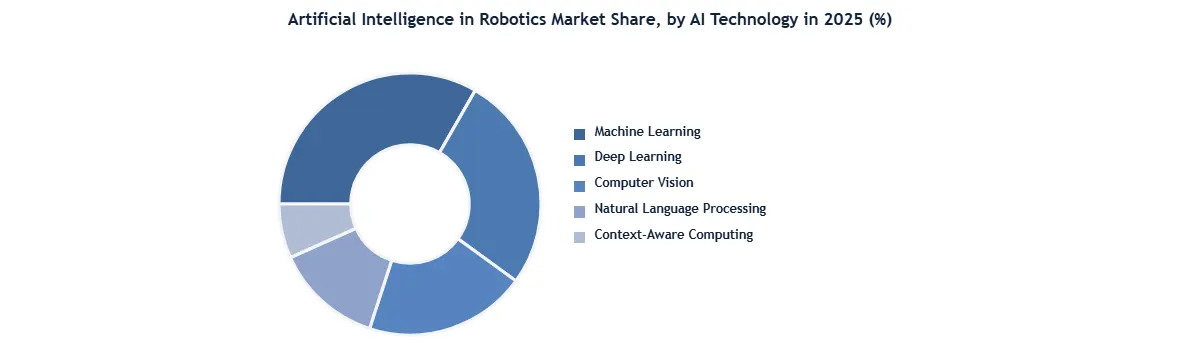
Based On Machine Type :The Machine Learning segment dominates the Artificial Intelligence (AI) in Robotics Market due to its widespread use in industrial automation, predictive analytics, autonomous decision-making, and intelligent robotic operations. Machine learning algorithms enable robots to analyze large volumes of real-time data, identify patterns, improve task accuracy, and continuously enhance performance through self-learning capabilities. Industries such as manufacturing, logistics, automotive, healthcare, and e-commerce are increasingly deploying machine learning-enabled robots for warehouse automation, quality inspection, predictive maintenance, and robotic process automation applications. The growing demand for smart factories and Industry 4.0 technologies is further accelerating segment growth.
Meanwhile, the Computer Vision segment is witnessing rapid expansion owing to increasing adoption of AI-powered image recognition, facial recognition, object detection, and navigation systems in autonomous robots and surveillance robots. Deep Learning technology is also gaining strong traction due to its ability to support advanced neural networks and intelligent robotic decision-making. In addition, Natural Language Processing and Context-Aware Computing are expanding steadily with rising demand for human-robot interaction, virtual assistants, and intelligent service robots across healthcare, retail, and customer service industries.
Artificial Intelligence (AI) in Robotics Market Regional Insights:
North America dominates the global Artificial Intelligence (AI) in Robotics Market due to the strong presence of advanced AI technology providers, robotics manufacturers, cloud computing companies, and industrial automation leaders across the United States and Canada. The region accounts for the largest market share because industries such as healthcare, automotive, logistics, aerospace, defense, and e-commerce are rapidly adopting AI-powered robots, autonomous mobile robots (AMRs), collaborative robots (cobots), and robotic process automation solutions. The United States remains the leading contributor owing to rising investments in smart factories, warehouse automation, robotic surgery systems, and AI research programs. Additionally, high research and development spending, strong digital infrastructure, and increasing deployment of intelligent robotic systems continue to support market expansion.
Meanwhile, Asia-Pacific is emerging as the fastest-growing regional segment due to rapid industrialization and increasing automation adoption across China, Japan, South Korea, and India. China dominates the regional market because of extensive industrial robot deployment and strong government support for AI innovation. Japan and South Korea also contribute significantly through advanced robotics manufacturing capabilities. Europe holds a substantial market share driven by Industry 4.0 adoption, automotive automation, and increasing use of AI-enabled industrial robotics across Germany, France, and the United Kingdom.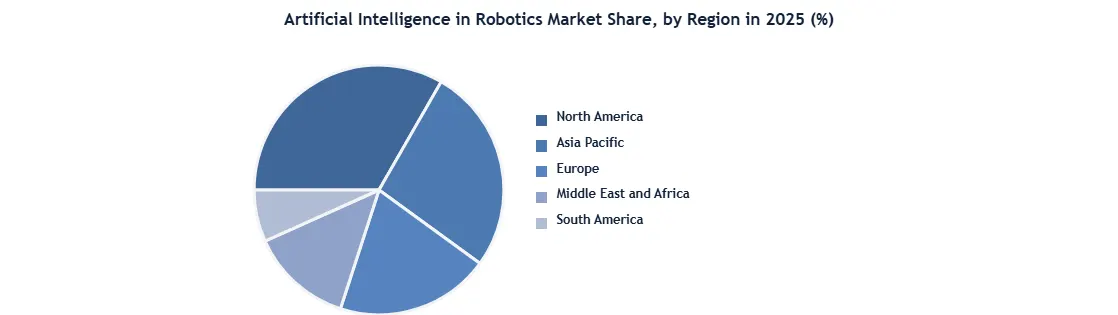
Artificial Intelligence (AI) in Robotics Market Recent Industry Developments (2025–2026)
| Date | Company | Development | Impact |
|---|---|---|---|
| 16 March 2026 | FANUC Corporation | Announced a major strategic collaboration with NVIDIA to integrate Physical AI and Omniverse libraries across its entire industrial robot portfolio. | The integration enables real-time digital twins and voice-commanded Python code generation, significantly reducing commissioning time for factory automation. |
| 26 January 2026 | ABB Ltd. | Unveiled Autonomous Versatile Robotics (AVR™) solutions at SLAS 2026, featuring AI-powered collaborative robots for laboratory automation. | This development scales AI-ready workflows in life sciences, allowing for higher throughput and seamless multi-vendor connectivity in complex research environments. |
| 05 January 2026 | NVIDIA Corporation | Released NVIDIA Cosmos and GR00T N1.6 open models specifically designed for humanoid robot learning and reasoning. | These Vision-Language-Action (VLA) models provide the foundation for generalist robots to execute complex physical tasks with human-like contextual understanding. |
| 20 October 2025 | Rockwell Automation | Successfully completed the operational integration of Clearpath Robotics and its OTTO Motors division to provide unified AI-driven production logistics. | The move accelerates the deployment of Autonomous Mobile Robots (AMRs) in smart factories, optimizing end-to-end autonomous material handling. |
| 15 September 2025 | Yaskawa Electric Corporation | Launched the SFA method in collaboration with Toyota to replicate the intricate skills of master workers through AI-driven robotic motion. | This initiative preserves specialized manufacturing expertise and enhances global competitiveness through high-speed, autonomous improvement cycles. |
| 14 July 2025 | Google LLC | Announced a significant update to Robotics Transformer 2 (RT-2), incorporating Generative AI to allow robots to generalize tasks beyond their training data. | The update enables robots to interpret high-level linguistic instructions, facilitating more flexible warehouse automation and human-robot interaction. |
Global Artificial Intelligence (AI) in Robotics Market Scope: Inquire before buying
| Artificial Intelligence (AI) in Robotics Market | |||
|---|---|---|---|
| Report Coverage | Details | ||
| Base Year: | 2025 | Forecast Period: | 2026-2032 |
| Historical Data: | 2020 to 2025 | Market Size in 2025: | 25.38 USD Billion |
| Forecast Period 2026-2032 CAGR: | 38.5% | Market Size in 2032: | 248.09 USD Billion |
| Segments Covered: | by Robot Type | Industrial Robots Service Robots |
|
| by AI Technology | Machine Learning Deep Learning Computer Vision Natural Language Processing Context-Aware Computing |
||
| by Industry Vertical | Manufacturing Logistics & Warehousing Agriculture Defense & Security Hospitality Construction |
||
| by Application | Assembly Line Automation Material Handling Quality Inspection Surgical Assistance Warehouse Automation Personal Assistance |
||
| by End-User Industry | Automotive Retail & E-commerce Healthcare Food & Beverage Other End-user Industries |
||
Artificial Intelligence (AI) in Robotics Market, by Region
North America (United States, Canada and Mexico)
Europe (UK, France, Germany, Italy, Spain, Sweden, Austria, Turkey, Russia and Rest of Europe)
Asia Pacific (China, India, Japan, South Korea, Australia, ASEAN and Rest of APAC)
Middle East and Africa (South Africa, GCC, Egypt, Nigeria and Rest of ME&A)
South America (Brazil, Argentina, Columbia and Rest of South America)
Artificial Intelligence (AI) in Robotics Market Key Players
- NVIDIA Corporation
- ABB Ltd.
- FANUC Corporation
- Yaskawa Electric Corporation
- KUKA AG
- Siemens AG
- Microsoft Corporation
- Intel Corporation
- International Business Machines (IBM) Corporation
- Google LLC
- Teradyne, Inc.
- Omron Corporation
- Kawasaki Heavy Industries, Ltd.
- Intuitive Surgical, Inc.
- Boston Dynamics, Inc.
- Locus Robotics
- CloudMinds Technology Inc.
- Neurala, Inc.
- Veo Robotics, Inc.
- Vicarious AI
- Brain Corporation
- Miso Robotics
- Agility Robotics
- Gecko Robotics
- UBTECH Robotics Corp.