
Artificial Intelligence (AI) Defence Market by Offering, by Technology, by Application, by Platform and Regional Insights 2034
Overview
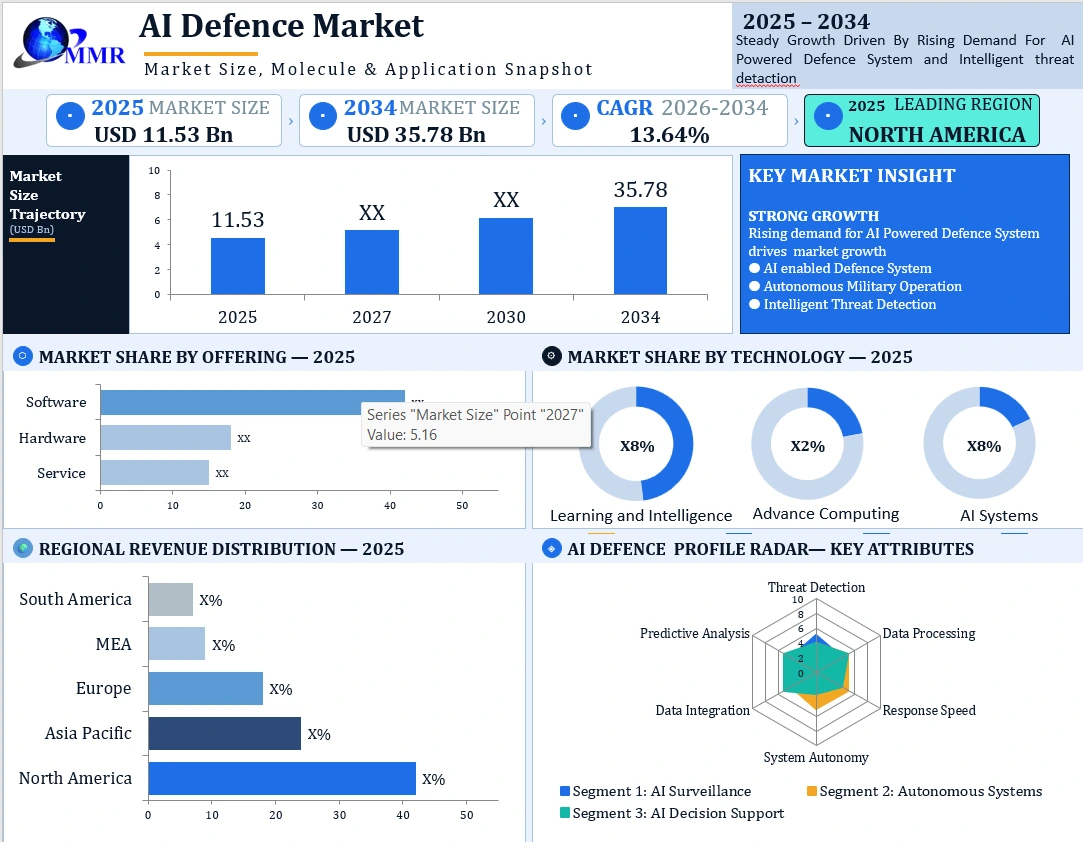
Global Artificial Intelligence (AI) Defence Market size is expected to reach US$ 35.78 Bn in year 2034, at a CAGR of 13.4% during the forecast period.
Artificial Intelligence (AI) Defence Market Overview
The global Artificial Intelligence (AI) Defence Market is valued at USD 11.53 billion in 2025 and is projected to reach USD 35.78 billion by 2034, registering a CAGR of 13.4% during the forecast period (2026–2034). The market is driven by the increasing adoption of AI-enabled intelligence, surveillance, threat detection, autonomous systems, and military decision-support technologies.
The Global Artificial Intelligence (AI) Defence Market is expanding as defence organisations increasingly integrate artificial intelligence into military operations, intelligence analysis, surveillance, cybersecurity, and autonomous systems. AI technologies enable armed forces to process large volumes of data, identify potential threats, improve situational awareness, and support faster decision-making. The growing focus on defence modernisation, national security, and operational efficiency strengthens demand for AI-enabled military capabilities across airborne, land-based, naval, and space platforms.
The market benefits from advancements in machine learning, deep learning, computer vision, predictive analytics, and high-performance computing. Defence agencies and technology providers invest in autonomous unmanned systems, AI-powered target recognition, intelligent command-and-control platforms, and real-time threat monitoring. However, high implementation costs, data security concerns, integration with legacy defence infrastructure, and requirements for reliable and responsible AI deployment continue to influence market adoption. North America maintains a leading position, while Asia-Pacific offers significant growth opportunities through military modernisation and investments in indigenous defence technologies. Increasing government funding, strategic partnerships, and the development of secure AI infrastructure are expected to support the long-term growth of the Global Artificial Intelligence (AI) Defence Market.
Artificial Intelligence (AI) Defence Market Size and Share Analysis
To know about the Research Methodology:-Request Free Sample Report
Global Artificial Intelligence (AI) Defence Market Dynamics
Market Drivers
Rising demand for AI-powered military intelligence drives market growth: Defence forces increasingly adopt artificial intelligence to process satellite imagery, radar signals, surveillance footage, and battlefield information. AI-based intelligence, surveillance, and reconnaissance (ISR) systems help military personnel identify potential threats, monitor changing conditions, and make faster operational decisions. Global military expenditure reaches USD 2.887 trillion in 2025, increasing by 2.9% in real terms, supporting continued investment in advanced defence capabilities.
Growing adoption of autonomous defence systems accelerates demand: Military organisations increasingly use AI-enabled drones, autonomous vehicles, and robotic platforms for reconnaissance, surveillance, logistics, and operations in high-risk environments. These systems process sensor data and support navigation, object recognition, and mission coordination, reducing the need for continuous manual control. Investment in autonomous platforms and multi-system coordination creates opportunities for AI software developers, defence electronics manufacturers, and system integrators.
Market Restraints
High implementation costs restrict adoption: AI-based defence systems require advanced computing hardware, secure data infrastructure, specialised software, sensor integration, and continuous testing. Defence organisations also invest in cybersecurity, system validation, and personnel training before deploying AI in operational environments. These requirements increase implementation costs and create challenges for countries with limited defence budgets, particularly when programmes require long procurement cycles.
Data security and reliability concerns limit deployment: AI defence systems depend on accurate, reliable, and secure data. Incomplete datasets, adversarial manipulation, algorithmic errors, and cyberattacks can affect system performance and military decision-making. Defence organisations require rigorous testing, secure computing environments, and human oversight to reduce operational risks. These requirements increase validation time and can delay the transition from pilot projects to large-scale deployment.
Market Opportunities
Integration of generative AI and advanced analytics creates new opportunities: Defence organisations increasingly explore generative AI, natural language processing, and predictive analytics for intelligence analysis, mission planning, logistics, technical documentation, and decision support. These applications help personnel process large volumes of information and identify relevant insights more efficiently. The expansion of secure, classified AI infrastructure creates opportunities for cloud providers, software companies, and defence technology firms.
Increasing investment in domestic defence AI creates growth opportunities: Countries increasingly seek domestic AI capabilities to reduce dependence on foreign technology providers and strengthen control over sensitive military data. This creates opportunities for local software developers, semiconductor suppliers, defence research institutions, and startups developing autonomous platforms and intelligence systems. The shift toward technological self-reliance also encourages partnerships between established defence contractors and commercial AI companies.
Market Challenges
Complex integration with existing defence infrastructure creates challenges: AI solutions must operate alongside legacy radar systems, communication networks, command-and-control platforms, and military databases. Differences in data formats, communication standards, and system architectures complicate integration and information sharing. Defence providers must ensure interoperability, low-latency data processing, and reliable operation across multiple military domains, increasing development time and technical complexity.
Shortages of specialised talent and responsible-AI requirements challenge deployment: Defence organisations require specialists in machine learning, cybersecurity, data engineering, robotics, and military systems integration. Competition for these professionals increases recruitment and training requirements. At the same time, concerns about autonomous weapons, accountability, and compliance with international humanitarian law create additional requirements for governance, testing, and human supervision.
Global Artificial Intelligence (AI) Defence Market, Segment Analysis:
Based on Offering, the Global Artificial Intelligence (AI) Defence Market is segmented into software, hardware, and services. Software supports military intelligence analysis, autonomous operations, threat detection, and decision-making through AI algorithms and data analytics platforms. Hardware includes processors, sensors, computing devices, and specialised systems that enable AI applications in defence environments. Services cover system integration, consulting, maintenance, technical support, and AI model development, helping defence organisations implement and maintain AI-enabled capabilities.
Based on Technology, the market is segmented into learning and intelligence, advanced computing, and AI systems. Learning and intelligence technologies use machine learning, deep learning, and pattern recognition to analyse military data, identify potential threats, and improve predictive capabilities. Advanced computing provides the processing capacity required to handle large datasets, complex simulations, and time-sensitive military applications. AI systems integrate algorithms, software, sensors, and computing infrastructure to support autonomous platforms, intelligence gathering, surveillance, and operational decision-making.
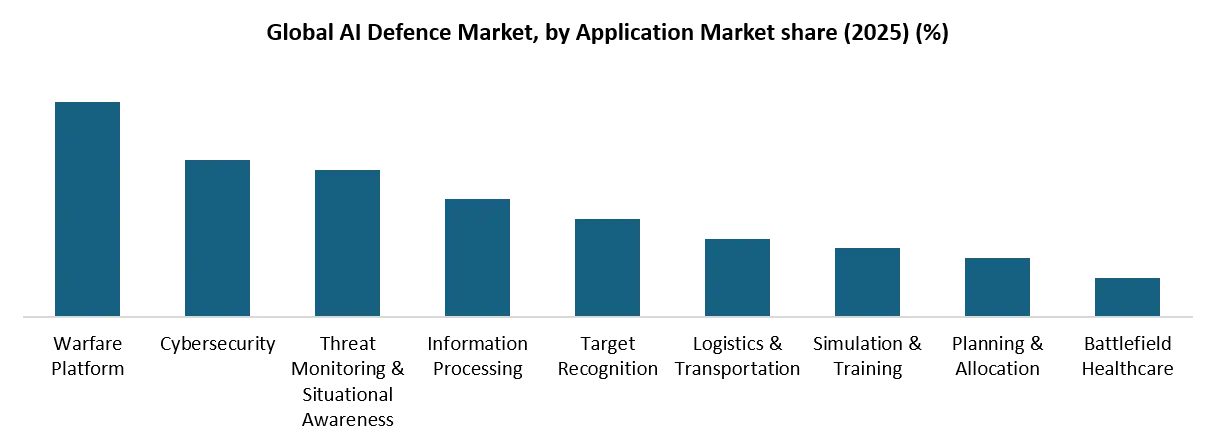
Based on Application, the market is segmented into warfare platform, cybersecurity, logistics and transportation, target recognition, battlefield healthcare, simulation and training, threat monitoring and situational awareness, information processing, and planning and allocation. Warfare platforms use AI to support autonomous navigation, mission coordination, and operational analysis. Cybersecurity applications identify suspicious activity, detect network intrusions, and protect sensitive defence infrastructure. Logistics and transportation applications optimise inventory management, equipment maintenance, supply chains, and military transportation.
Target recognition systems analyse imagery and sensor data to identify objects and potential threats. Battlefield healthcare applications support casualty assessment, medical resource allocation, and emergency response. Simulation and training platforms create realistic military scenarios for personnel preparation and operational planning. Threat monitoring and situational awareness solutions combine radar, satellite, and surveillance data to provide timely information about changing battlefield conditions. Information processing systems organise large volumes of military intelligence, while planning and allocation applications help commanders coordinate personnel, equipment, and mission resources.
 Based on Platform, the market is segmented into airborne, land-based, naval, and space platforms. Airborne platforms include AI-enabled aircraft, unmanned aerial vehicles, and airborne surveillance systems that support reconnaissance, navigation, and threat detection. Land-based platforms incorporate autonomous ground vehicles, robotic systems, command-and-control infrastructure, and AI-enabled surveillance equipment for ground operations.
Naval platforms use AI for maritime surveillance, autonomous vessel navigation, threat identification, and fleet coordination. Space platforms integrate AI into satellite imagery analysis, space-based surveillance, communications, and missile-warning systems. Increasing integration of AI across these platforms supports faster information processing, improved operational coordination, and enhanced situational awareness across defence environments.
Global Artificial Intelligence (AI) Defence Market Regional Insights
North America dominates the Global Artificial Intelligence (AI) Defence Market, driven by high defence expenditure, advanced military technology, and strong investments in artificial intelligence for defence applications. The United States leads regional adoption through the development of AI-powered defence systems, autonomous military platforms, cybersecurity solutions, and intelligence, surveillance, and reconnaissance (ISR) technologies. The presence of leading defence contractors, AI software developers, and advanced research institutions strengthens the regional market. Increasing investments in military AI, predictive analytics, and automated threat detection support the adoption of next-generation defence technologies across North America.
Asia-Pacific represents a significant growth opportunity in the AI defence market, supported by military modernisation, rising security concerns, and increasing investment in indigenous defence technology. China, India, Japan, South Korea, and Australia strengthen their military capabilities through AI-enabled surveillance, autonomous weapons platforms, battlefield intelligence, and advanced command-and-control systems. Government initiatives promoting domestic defence manufacturing and AI research further support market expansion. The growing adoption of unmanned aerial vehicles (UAVs), intelligent border-monitoring systems, and AI-powered military analytics positions Asia-Pacific as an important region for future growth in the global military artificial intelligence market.
Europe strengthens its position in the Global Artificial Intelligence (AI) Defence Market through defence modernisation, collaborative research, and investments in advanced military technologies. The United Kingdom, France, and Germany increasingly incorporate artificial intelligence into military surveillance, cybersecurity, autonomous systems, target recognition, and battlefield decision-support applications. NATO cooperation and cross-border defence initiatives encourage interoperability and the development of AI-enabled military capabilities. The increasing focus on defence readiness, secure data infrastructure, and autonomous military technology supports demand for AI defence solutions across the European market.
The Middle East and Africa AI defence market develops as governments prioritise national security, border protection, counter-drone systems, and military modernisation. Countries in the Middle East invest in AI-powered surveillance, intelligence analysis, missile-warning capabilities, and integrated air-defence technologies. The adoption of autonomous military systems and real-time threat monitoring strengthens demand for advanced defence solutions. In Africa, AI-enabled border surveillance, security analytics, and intelligence-processing technologies create opportunities for defence technology providers, although budget constraints and limited digital infrastructure affect adoption in some countries.
The South America Artificial Intelligence (AI) Defence Market develops as governments focus on strengthening national security, border surveillance, cybersecurity, and military modernisation. Brazil leads regional defence technology development, supported by investments in military infrastructure, aerospace capabilities, and indigenous defence manufacturing. Countries across the region increasingly explore AI-powered surveillance systems, unmanned aerial vehicles (UAVs), intelligence analysis, predictive maintenance, and military logistics solutions. The growing need for efficient threat monitoring and advanced defence capabilities creates opportunities for artificial intelligence in military applications. However, limited defence budgets, infrastructure constraints, and competing public spending priorities influence the adoption of AI-enabled defence systems across South America.
North America maintains a leading position in the Global Artificial Intelligence (AI) Defence Market through advanced defence infrastructure, substantial military investment, and established AI technology providers. Asia-Pacific presents strong growth potential as countries increase military modernisation spending and develop indigenous artificial intelligence capabilities. Meanwhile, Europe strengthens demand through defence collaboration and technology development, while the Middle East, Africa, and South America create additional opportunities in surveillance, cybersecurity, and intelligent defence systems.
Global Artificial Intelligence (AI) Defence Market Competitive Landscape
The global Artificial Intelligence (AI) Defence Market is characterized by competition among established defence contractors, aerospace manufacturers, technology companies, and specialized AI developers. Market participants focus on integrating artificial intelligence into military intelligence, surveillance and reconnaissance (ISR), autonomous defence systems, cybersecurity, target recognition, predictive maintenance, and battlefield decision-support platforms. Companies strengthen their market positions through research and development, strategic partnerships, defence contracts, and the integration of AI with existing military infrastructure.
North American companies maintain a strong presence through advanced defence technology development and military modernization programs. European companies focus on AI-enabled combat systems, electronic warfare, autonomous platforms, and defence analytics, while Asia-Pacific companies expand capabilities in robotics, surveillance, and autonomous military systems. Specialized AI firms also contribute through software platforms, sensor data analysis, and real-time operational intelligence. Competition increasingly depends on system reliability, cybersecurity, interoperability, data processing capabilities, and compliance with defence requirements.
Traditional defence contractors such as Lockheed Martin, Northrop Grumman, RTX, BAE Systems, and General Dynamics integrate AI into aircraft, radar systems, intelligence platforms, and command-and-control technologies. Technology-focused companies such as Palantir, Anduril Industries, Shield AI, and Helsing compete through AI software, autonomous systems, sensor integration, and real-time battlefield data analysis. Meanwhile, technology providers including Microsoft, Google, Amazon Web Services, NVIDIA, and IBM contribute computing infrastructure, cloud services, and AI capabilities that support defence applications.
The competitive landscape also includes companies from Europe and Asia-Pacific, such as Thales, Leonardo, Saab, Elbit Systems, Israel Aerospace Industries, and other regional defence technology developers. These companies develop AI-enabled surveillance, threat detection, electronic warfare, and autonomous platform technologies. Strategic collaborations between defence manufacturers and software developers are becoming increasingly important as military organizations seek interoperable, secure, and scalable AI solutions. Overall, the Global AI Defence Market remains competitive, with companies investing in innovation, advanced computing, autonomous capabilities, and defence-specific software to strengthen their market presence.
Global Artificial Intelligence (AI) Defence Market Development
| Date | Company | Development | Impact |
| October 2026 | Intelic | Secured a €30 million contract with the Dutch Defence Ministry for its Nexus AI software, which connects radar, sensors, and image-recognition systems to support drone detection and interception. | Increases demand for AI-powered counter-drone solutions and interoperable air-defence software. |
| July 2026 | Palladyne AI and U.S. Air Force Research Laboratory | Executed a USD 4.2 million contract to develop SwarmOS technology for coordinating autonomous systems across space, air, maritime, and land domains. | Creates opportunities for autonomous mission coordination, multi-domain intelligence, and defence AI software providers. |
| June 2026 | Palladyne AI and U.S. Army | Received contracts to test and operationally validate SwarmOS autonomous swarm technology and the Gremlin-X UAV with Army personnel. | Supports the transition from AI research to field testing and may accelerate future procurement of autonomous military systems. |
| June 2026 | Safran and SatSure | Signed an MoU to combine AI models, satellite imagery, and geospatial intelligence for defence and other applications in India. | Strengthens demand for AI-enabled satellite analytics, intelligence processing, and domestic defence technology partnerships. |
| May 2026 | Oracle and U.S. Department of War | Announced an agreement to deploy Oracle AI capabilities across classified cloud networks for authorised military applications. | Expands demand for secure AI infrastructure, classified cloud computing, and military data-analysis services. |
| May 2026 | Indian Ministry of Defence and Bharat Electronics Limited (BEL) | Signed a ₹1,476 crore contract for five ground-based mobile electronic systems for the Indian Army, with at least 72% indigenous content. | Supports domestic defence electronics manufacturing and creates opportunities for Indian suppliers; the contract is relevant to the broader defence technology market, not exclusively AI. |
Scope of Global Artificial Intelligence (AI) Defence Market: Inquire before buying
| Artificial Intelligence (AI) Defence Market | |||
|---|---|---|---|
| Report Coverage | Details | ||
| Base Year: | 2025 | Forecast Period: | 2026-2034 |
| Historical Data: | 2020 to 2025 | Market Size in 2025: | 11.53 USD Billion |
| Forecast Period 2026-2034 CAGR: | 13.4% | Market Size in 2034: | 35.78 USD Billion |
| Segments Covered: | by Offering | Software Hardware Services |
|
| by Technology | Learning & Intelligence Advanced Computing AI Systems |
||
| by Application | Warfare Platform Cyber Security Logistics And Transportation Target Recognition Battlefield Healthcare Simulation And Training Threat Monitoring And Situational Awareness Information Processing Planning And Allocation |
||
| by Platform | Airborne Land Based Naval Space |
||
Global Artificial Intelligence (AI) Defence Market, by Region
North America (United States, Canada, and Mexico)
Europe (UK, France, Germany, Italy, Spain, Sweden, Austria, and the Rest of Europe)
Asia Pacific (China, South Korea, Japan, India, Australia, ASEAN, Indonesia, Philippines, Malaysia, Vietnam, Thailand, ASEAN, Rest of Asia Pacific)
Middle East & Africa (South Africa, GCC, Nigeria, Rest of ME&A)
South America (Brazil, Argentina, Rest of South America)
Key players operated in the Global Artificial Intelligence (AI) Defence Market includes:
1. Lockheed Martin Corporation
2. Northrop Grumman Corporation
3. BAE Systems plc
4. RTX Corporation
5. L3Harris Technologies, Inc.
6. General Dynamics Corporation
7. Leidos Holdings, Inc.
8. The Boeing Company
9. Thales Group
10. Leonardo S.p.A.
11. Airbus SE
12. Elbit Systems Ltd.
13. Rheinmetall AG
14. Saab AB
15. Rafael Advanced Defense Systems
16. Israel Aerospace Industries (IAI)
17. Kongsberg Defence & Aerospace
18. QinetiQ Group plc
19. Kratos Defense & Security Solutions
20. HENSOLDT AG
21. Palantir Technologies Inc.
22. Anduril Industries
23. Shield AI
24. SparkCognition
25. Helsing
26. Dedrone
27. Skydio
28. Saronic Technologies
29. Intelic
30. IBM Corporation
31. NVIDIA Corporation
32. Microsoft Corporation
33. Amazon Web Services (AWS)
34. Google
35. Oracle Corporation
36. OpenAI
37. Anthropic
38. Mistral AI
39. Booz Allen Hamilton
40. Science Applications International Corporation (SAIC)
Frequently Asked Questions (FAQs)
Q1. What is the global Artificial Intelligence (AI) Defence Market size?
Ans. The global Artificial Intelligence (AI) Defence Market is valued at USD 11.53 billion in 2025.
Q2. What is the projected AI Defence Market size by 2034?
Ans. The global AI Defence Market is projected to reach USD 35.78 billion by 2034.
Q3. What is the CAGR of the global AI Defence Market?
Ans. The market is expected to grow at a CAGR of 13.4% during the forecast period from 2026 to 2034.
Q4. Which region dominates the global AI Defence Market?
Ans. North America dominates the global AI Defence Market, supported by high defence expenditure, advanced military infrastructure, and investments in AI-powered surveillance, autonomous systems, cybersecurity, and military intelligence.
Q5. What are the key factors driving growth in the global AI Defence Market?
Ans. Key growth drivers include increasing defence modernisation, rising security threats, growing adoption of autonomous military systems, demand for real-time intelligence and surveillance, and investments in AI-enabled threat detection and military decision-support technologies.