Global Architectural Services Market Size by Service Type, Deployment type, Organization size, End-User and Region – Segment-Level Market Assessment, Growth Opportunity Analysis, Competitive Mapping & Forecast to 2032

4.7%
CAGR (2026-2032)
419.14 USD Bn.
Forecast Market Size
308
Report Pages
151
Market Tables

Overview

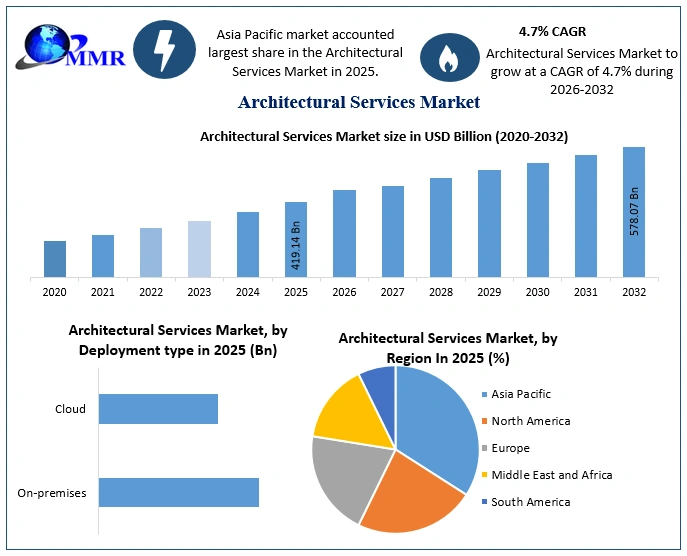
Architectural Services Market size was valued at US$ 419.14 Bn. in 2025 and the total revenue is expected to grow at 4.7 % through 2026 to 2032, reaching nearly US$ 578.07 Bn.

Architectural Services Market Overview:

The Architectural Services Market is expanding alongside global construction activity, urbanization, infrastructure development, and the modernization of residential and commercial buildings. The market includes architectural design services, building planning, urban design, interior architecture, landscape architecture, project consulting, and sustainable building design, with demand increasingly shifting toward integrated and technology-enabled solutions. In the U.S., the architecture profession includes around 116,000 licensed architects and 205,000 employees working in architecture firms. Architectural services support nearly USD 693 billion in construction value and more than 5.6 million jobs across the broader economy. Globally, the long-term outlook for architectural design services and building design services is supported by the continued expansion of the built environment, as the total amount of building floor space requiring worldwide more than double by 2060. This expansion is creating opportunities for architectural firms across residential architecture, commercial architecture, healthcare architecture, institutional buildings, infrastructure projects, and urban development. Demand, however, varies across project categories, with data centers, healthcare facilities, and selected institutional projects showing stronger activity than some traditional office segments.

The global architectural services industry is also undergoing a significant transformation as firms adopting  Building Information Modeling (BIM), artificial intelligence, generative design, digital twins, parametric architecture, 3D visualization, and cloud-based architectural collaboration. These technologies are improving design coordination, project visualization, cost planning, and building performance analysis while enabling more efficient digital architecture services. Sustainability is becoming another major focus of the architectural design market, as buildings account for nearly 19% of energy-related greenhouse-gas emissions and around 40% of global electricity consumption, increasing demand for green architecture, sustainable building design, energy-efficient buildings, low-carbon materials, and climate-resilient architecture. The growing emphasis on decarbonization is also creating opportunities in building renovation, adaptive reuse, energy retrofits, and sustainable urban planning. Ultimately, the architectural services industry is moving toward a multidisciplinary model that combines architectural design with digital technologies, sustainability expertise, building performance optimization, and lifecycle-focused planning.

Architectural Services Market GrowthTo know about the Research Methodology :- Request Free Sample Report

Architectural Services Market Dynamics:

Urbanization, Infrastructure Development, and Building Modernization Supporting Architectural Demand

Growing urban populations, infrastructure investment, and the expansion of residential, healthcare, institutional, and commercial facilities continue to create demand for architectural design services and building planning services. At the same time, the market is becoming increasingly polarized across project types. In the U.S., the nonresidential building construction spending declined 7% during the first five months of 2026 compared with the same period of 2025. However, healthcare and institutional projects remained comparatively resilient, while AI-related data center construction provided significant momentum within the commercial segment. This uneven project environment is influencing architectural firms to diversify their portfolios toward sectors with stronger investment visibility.

Rising Sustainability Requirements Increasing Demand for Green Architectural Services

Sustainability is becoming an increasingly important component of architectural planning and sustainable building design as developers and building owners seek to improve energy performance, reduce carbon emissions, and comply with evolving environmental requirements. Architectural firms are increasingly integrating passive design, energy-efficient building envelopes, renewable energy systems, low-carbon materials, and climate-resilient strategies into projects. The growing emphasis on resilience is also translating into new service opportunities; as 44% of architecture firm leaders had worked on projects incorporating resilient design characteristics during the previous five years.

Cost Pressures and Economic Uncertainty Influencing Project Pipeline

High construction costs, labor shortages, financing conditions, and economic uncertainty are creating challenges for the architectural services industry by delaying or downsizing new projects. The AIA/Deltek Architecture Billings Index remained below the growth threshold in June 2026, at 47.3, indicating continued softness in architecture firm billings. Nevertheless, inquiries for new work increased, suggesting that project planning activity remains active even when clients postpone final investment decisions. This environment is encouraging architectural firms to focus more strongly on cost-efficient design, value engineering, and flexible project delivery.

Architectural Services Market Trends:

  • AI and Generative Design Transforming Architectural Workflows - Artificial intelligence is becoming an increasingly important trend across digital architecture services, supporting concept generation, design iteration, visualization, documentation, and workflow automation. The profession is gradually moving from conventional CAD and BIM-based workflows toward AI-assisted design processes.  The adoption for advanced digital technologies across architectural practices is continuously growing.
  • BIM and Integrated Digital Workflows Becoming Standard Practice - Building Information Modeling (BIM) continues to influence the delivery of architectural services by enabling architects, engineers, contractors, and owners to collaborate around shared digital models. BIM is increasingly being combined with cloud collaboration, digital twins, computational design, and building performance analysis, improving coordination throughout the project lifecycle. The industry is consequently moving toward integrated digital workflows in which architectural design, engineering, construction planning, and facility management are increasingly connected.
  • AI Infrastructure and Data Center Construction Creating New Architectural Opportunities -The rapid expansion of artificial intelligence infrastructure is generating a new source of demand for commercial architectural services. Data center construction has become a major contributor to the U.S. commercial construction outlook, with AIA noting that the sector's projected growth in 2026 is driven almost entirely by surging data center activity. This is creating opportunities for architectural firms with specialized capabilities in high-density computing facilities, energy infrastructure, cooling systems, security, and resilient building design.
  • Adaptive Reuse and Building Renovation Gaining Importance - Architectural firms are increasingly focusing on adaptive reuse architecture, building renovation, and retrofit services as developers seek alternatives to costly new construction and respond to sustainability objectives. Transforming obsolete offices, industrial buildings, and other underutilized structures into residential, hospitality, educational, or mixed-use spaces is creating new opportunities for architects. This trend is particularly relevant in mature urban markets where land constraints and aging building stock make renovation and repurposing economically attractive.
  • Resilient and Climate-Responsive Architecture Expanding - Increasing exposure to extreme heat, flooding, storms, and other climate risks is encouraging demand for climate-resilient architecture and disaster-resistant building design. Architectural firms are incorporating flood mitigation, passive cooling, water management, robust building envelopes, and resilient infrastructure into new projects and renovations. This trend is moving resilience from a specialized design consideration toward a more mainstream component of architectural planning.
  • Sustainability Becoming Integrated With Digital Design - The integration of sustainability and technology is creating a new generation of high-performance architectural design services. AI, BIM, digital twins, and building performance simulation are increasingly being used to evaluate energy consumption, material efficiency, daylighting, carbon impact, and operational performance during the design stage. The 95% of surveyed AECO leaders reported that their organizations were taking steps to become more sustainable, while 39% of AECO respondents are using AI to enable sustainability, highlighting the growing intersection between digital transformation and green architecture.

Architectural Services Market Segment Analysis:

The By Services Type segment is divided into Architectural Advisory Services, Construction and Project Management Services, Engineering Services, Interior Design Services, Urban Planning Services, and Others. Architectural Advisory Services held the largest market share in 2025, supported by their central role in project feasibility assessment, site analysis, conceptual planning, regulatory compliance, and strategic design decisions. The segment benefits from sustained demand for architectural services and architectural design services across residential, commercial, institutional, and infrastructure projects. Construction and Project Management Services also represent a significant portion of the global architectural services market, as clients increasingly seek integrated support for project scheduling, cost management, procurement, and construction coordination. Engineering Services remain essential for complex building projects that require structural, mechanical, electrical, and environmental expertise, while Interior Design Services are benefiting from demand for functional and aesthetically optimized residential, commercial, hospitality, and workplace environments. Urban Planning Services are gaining importance alongside urbanization, smart-city development, and the need for sustainable land-use and infrastructure planning.

Architectural Services Market Share by Services Type In 2025

Construction and Project Management Services are expected to remain a key growth opportunity within the architectural services industry, as architectural firms increasingly expand beyond traditional design into integrated project delivery and end-to-end construction consulting. Meanwhile, Urban Planning Services are benefiting from population growth, infrastructure modernization, transportation development, and smart urban development initiatives. Interior Design Services are evolving in response to changing workplace models and demand for experience-driven commercial spaces, while Engineering Services are increasingly integrated with BIM, computational design, and building performance analysis. The Others category includes landscape architecture, sustainability consulting, heritage conservation, and building performance services, which are gaining relevance as clients prioritize green building design, adaptive reuse, energy efficiency, and climate-resilient architecture.

The By Deployment Type segment is divided into On-premises and Cloud. Cloud deployment held the largest market share in 2025, reflecting the accelerating digital transformation of the architectural services market and the growing adoption of cloud-based architectural software and collaboration platforms. Cloud-based deployment enables architectural firms to centralize project files, facilitate real-time collaboration, support remote design teams, and provide architects, engineers, contractors, and clients with access to project information from multiple locations. The growing use of Building Information Modeling (BIM), digital twins, 3D architectural design, AI-powered design tools, and cloud-based project management is further strengthening demand for cloud solutions. On-premises deployment remains relevant for large architectural firms and organizations requiring greater control over sensitive project data, proprietary designs, and internal IT infrastructure.

Cloud deployment is expected to maintain its strong position as architectural firms increasingly adopt digital architecture services and integrated design workflows. Cloud-based BIM environments support real-time document management, design coordination, remote project reviews, and multidisciplinary collaboration, while scalable cloud infrastructure enables the integration of AI, generative design, and building performance analytics. On-premises solutions will continue to serve firms with stringent data security, regulatory, and infrastructure-control requirements; however, the broader architecture software market is moving toward cloud-centric and hybrid environments that provide greater flexibility, accessibility, and collaboration across the building design and construction lifecycle.

Architectural Services Market Regional Analysis:

Asia Pacific held the largest share of the global architectural services market in 2025, accounting for aroundv 37.4% of global revenue. The region's leadership is closely linked to rapid urbanization, large-scale residential and commercial construction, infrastructure modernization, and government investment in smart cities. China, India, Japan, and Southeast Asian economies are generating substantial demand for architectural design services, urban planning services, engineering services, and construction project management. The region's expanding industrial and manufacturing base is also supporting demand for specialized architectural services for factories, logistics facilities, data centers, and commercial developments. Increasing adoption of Building Information Modeling (BIM), generative AI, and digital architecture is further transforming project delivery across major markets.

North America represents a significant regional market, supported by strong demand for commercial architecture, residential architecture, healthcare facilities, industrial buildings, and infrastructure projects. The U.S.  is representing the primary market. Architectural demand is increasingly influenced by data center construction, healthcare investment, renovation of aging buildings, and sustainable building upgrades. The region also benefits from the presence of globally established architecture and engineering firms, while high adoption of BIM, cloud-based design platforms, AI-assisted workflows, and building performance technologies is supporting the development of digitally enabled architectural services.

Europe remains an important market for architectural services, supported by renovation of aging building stock, urban redevelopment, heritage conservation, and stringent sustainability requirements. Demand is increasingly shifting toward green architecture, energy-efficient building design, adaptive reuse, and building retrofit services as developers and property owners seek to improve energy performance and reduce carbon emissions. The region's established architectural heritage and strong regulatory focus on building efficiency create opportunities for specialized design and consulting services. Major markets such as Germany, the U.K., France, Italy, and the Nordic countries are contributing to demand for sustainable architecture and digitally integrated project delivery.

 Global Architectural Services Market ,Revenue Share by Region (%) in 2025

Global Architectural Services Market ,Revenue Share by Region in 2025

Latin America is an emerging opportunity for the global architectural services industry, with demand supported by urban population growth, housing development, commercial construction, and infrastructure modernization. Brazil and Mexico represent important markets where expanding cities are creating opportunities for residential architecture, urban planning, and infrastructure-related design services. However, economic volatility, financing constraints, and uneven construction investment can influence project pipelines across the region.

Middle East & Africa is witnessing increasing demand for architectural design and urban planning services, particularly in the Gulf countries. Large-scale tourism, hospitality, residential, mixed-use, and infrastructure developments in Saudi Arabia and the UAE are generating opportunities for international and regional architecture firms. Mega-development programs and smart-city initiatives are also increasing demand for specialized design capabilities, while Africa presents longer-term opportunities through urbanization, housing requirements, and infrastructure development.

Architectural Services Market Recent Developments:

Date Recent Development
21 Jan 2025 Gensler was selected to design Nevada's first comprehensive standalone children's hospital, strengthening its presence in specialized healthcare architecture and medical design.
27 Jan 2025 Stantec was selected to provide architecture, medical planning, landscape architecture, and sustainability consulting for a US$212 million academic health sciences and clinical facility for Florida International University and Baptist Health South Florida.
27 Jan 2025 Arcadis announced a design-build joint venture with Gilbane Building Company for the expansion of the Albany NanoTech Complex, including a 50,000-square-foot ISO 5 cleanroom and supporting infrastructure, highlighting growing architectural demand from advanced technology facilities.
3 Feb 2025 Arcadis was ranked the second-largest architecture firm globally in the 2025 World Architecture 100, reflecting its expanded architecture and urbanism capabilities following the integration of IBI Group and CallisonRTKL.
4 Mar 2025 Stantec announced a definitive agreement to acquire Page, a 1,400-person architecture and engineering firm, strengthening its capabilities in advanced manufacturing, data centers, healthcare, and cleanroom design.
20 Mar 2025 Arcadis announced the acquisition of WSP Infrastructure Engineering GmbH in Germany, adding approximately 160 employees and strengthening its rail infrastructure, structural engineering, and design capabilities in the German market.
8 Apr 2025 Stantec completed the acquisition of Ryan Hanley, a 150-person engineering and environmental consultancy in Ireland, expanding its multidisciplinary capabilities and regional presence.
31 Jul 2025 Stantec completed the acquisition of Page, increasing its U.S. Buildings practice by approximately 35% and strengthening its position in architecture and engineering, particularly across data centers, advanced manufacturing, healthcare, and cleanroom facilities.

Architectural Services Market Competitive Landscape:

The Architectural Services Market is highly competitive and fragmented, with competition spanning global architecture and engineering firms, multidisciplinary professional services companies, and specialized architectural practices. Competitive positioning is increasingly influenced by design expertise, global project portfolios, sustainability capabilities, digital design technologies, BIM proficiency, and the ability to deliver integrated architecture, engineering, and project management services. Large firms are expanding their geographic presence and multidisciplinary capabilities, while specialized firms are differentiating themselves through expertise in sectors such as healthcare, data centers, infrastructure, hospitality, and sustainable building design. The growing adoption of AI, generative design, digital twins, and cloud-based collaboration is also becoming an important factor in improving design efficiency and project delivery.

Key players include Gensler, AECOM, Jacobs, Perkins&Will, HKS, Inc., HDR, Inc., Skidmore, Owings & Merrill (SOM), Foster + Partners, Kohn Pedersen Fox (KPF), Stantec, Arcadis, and NBBJ. Gensler maintains a strong global presence across architecture and design, while AECOM, Jacobs, Stantec, and Arcadis leverage multidisciplinary architecture, engineering, infrastructure, and consulting capabilities. Perkins&Will, HKS, HDR, and NBBJ have established positions across specialized building sectors, while SOM, Foster + Partners, and KPF are recognized for complex architectural and large-scale urban projects. Competition is increasingly shifting toward firms capable of combining architectural design, sustainable building solutions, digital technologies, and end-to-end project advisory services.

Architectural Services Market Scope: Inquiry Before Buying

Architectural Services Market
Report Coverage Details
Base Year: 2025 Forecast Period: 2026-2032
Historical Data: 2020 to 2025 Market Size in 2025: US $ 419.14 Bn.
Forecast Period 2026 to 2032 CAGR: 4.7 % Market Size in 2032: US $ 578.07 Bn.
Segments Covered: By Services Type Architectural Advisory Services
Construction and Project Management Services
Engineering Services
Interior Design Services
Urban Planning Services
Others
By End-User Education
Government
Healthcare
Residential
Industrial
Retail
Others
By Deployment type On-premises
Cloud
By Organization size Large Enterprises
SMEs

Architectural Services Market, by Region

Asia Pacific (China, South Korea, Japan, India, Australia, Indonesia, Malaysia, Vietnam, Taiwan, Bangladesh, Pakistan and Rest of APAC)
Europe (UK, France, Germany, Italy, Spain, Sweden, Austria and Rest of Europe)
North America (United States, Canada and Mexico)
Middle East and Africa (South Africa, GCC, Egypt, Nigeria and Rest of ME&A)
South America (Brazil, Argentina Rest of South America)

Architectural Services Market Key Players

North America

  1. AECOM – United States
  2. Gensler – United States
  3. HKS, Inc. – United States
  4. PCL Constructors Inc. – Canada
  5. HDR, Inc. – United States
  6. HOK – United States
  7. Jacobs Solutions Inc. – United States
  8. Perkins&Will – United States
  9. Perkins Eastman – United States
  10. Stantec Inc. – Canada
  11. CannonDesign – United States

Europe

  1. Foster + Partners – United Kingdom
  2. Arcadis N.V. – Netherlands
  3. Arup Group Ltd. – United Kingdom
  4. Scott Brownrigg – United Kingdom

Asia Pacific

  1. Aedas – Hong Kong
  2. DP Architects Pte Ltd. – Singapore
  3. NIKKEN SEKKEI LTD – Japan
  4. Surbana Jurong – Singapore

Others

Frequently Asked Questions:

1] What segments are covered in Architectural Services Market report?
Ans. The segments covered in Architectural Services Market report are based on Services Types, deployment type, organization size and End-User.

2] Which region is expected to hold the highest share in the Architectural Services Market?
Ans. Asia Pacific is expected to hold the highest share in the Architectural Services Market.

3] What is the market size of Architectural Services Market by 2032?
Ans. The market size of Architectural Services Market is expected to reach US $ 578.07 Bn. by 2032.

4] Who are the top key players in the Architectural Services Market?
Ans. AECOM, Aedas, DP Architects Pte Ltd, Foster + Partners, Gensler, HKS Inc. and PCL Constructors Inc. are the top key players in the global Architectural Services Market.

5] What was the market size of Architectural Services Market in 2025?
Ans. The market size of Architectural Services Market in 2025 was US $ 419.14 Bn.

Table of Contents

1. Architectural Services Market Introduction 1.1. Study Assumption and Market Definition 1.2. Scope of the Study 1.3. Executive Summary 2. Global Architectural Services Market: Competitive Landscape 2.1. MMR Competition Matrix 2.2. Competitive Landscape 2.3. Key Players Benchmarking 2.3.1. Company Name 2.3.2. Business Segment 2.3.3. End-user Segment 2.3.4. Revenue (2025) 2.3.5. Company Locations 2.4. Leading Architectural Services Market Companies, by market capitalization 2.5. Market Structure 2.5.1. Market Leaders 2.5.2. Market Followers 2.5.3. Emerging Players 2.6. Mergers and Acquisitions Details 3. Architectural Services Market: Dynamics 3.1. Architectural Services Market Trends by Region 3.1.1. North America Architectural Services Market Trends 3.1.2. Europe Architectural Services Market Trends 3.1.3. Asia Pacific Architectural Services Market Trends 3.1.4. Middle East and Africa Architectural Services Market Trends 3.1.5. South America Architectural Services Market Trends 3.2. Architectural Services Market Dynamics by Region 3.2.1. North America 3.2.1.1. North America Architectural Services Market Drivers 3.2.1.2. North America Architectural Services Market Restraints 3.2.1.3. North America Architectural Services Market Opportunities 3.2.1.4. North America Architectural Services Market Challenges 3.2.2. Europe 3.2.2.1. Europe Architectural Services Market Drivers 3.2.2.2. Europe Architectural Services Market Restraints 3.2.2.3. Europe Architectural Services Market Opportunities 3.2.2.4. Europe Architectural Services Market Challenges 3.2.3. Asia Pacific 3.2.3.1. Asia Pacific Architectural Services Market Drivers 3.2.3.2. Asia Pacific Architectural Services Market Restraints 3.2.3.3. Asia Pacific Architectural Services Market Opportunities 3.2.3.4. Asia Pacific Architectural Services Market Challenges 3.2.4. Middle East and Africa 3.2.4.1. Middle East and Africa Architectural Services Market Drivers 3.2.4.2. Middle East and Africa Architectural Services Market Restraints 3.2.4.3. Middle East and Africa Architectural Services Market Opportunities 3.2.4.4. Middle East and Africa Architectural Services Market Challenges 3.2.5. South America 3.2.5.1. South America Architectural Services Market Drivers 3.2.5.2. South America Architectural Services Market Restraints 3.2.5.3. South America Architectural Services Market Opportunities 3.2.5.4. South America Architectural Services Market Challenges 3.3. PORTER's Five Forces Analysis 3.4. PESTLE Analysis 3.5. Technology Roadmap 3.6. Regulatory Landscape by Region 3.6.1. North America 3.6.2. Europe 3.6.3. Asia Pacific 3.6.4. Middle East and Africa 3.6.5. South America 3.7. Key Opinion Leader Analysis For Architectural Services Industry 3.8. Analysis of Government Schemes and Initiatives For Architectural Services Industry 3.9. Architectural Services Market Trade Analysis 3.10. The Global Pandemic Impact on Architectural Services Market 4. Architectural Services Market: Global Market Size and Forecast by Segmentation (in USD Billion) 2025-2032 4.1. Architectural Services Market Size and Forecast, by Services Type (2025-2032) 4.1.1. Architectural Advisory Services 4.1.2. Construction and Project Management Services 4.1.3. Engineering Services 4.1.4. Interior Design Services 4.1.5. Urban Planning Services 4.1.6. Others 4.2. Architectural Services Market Size and Forecast, by End-User (2025-2032) 4.2.1. Education 4.2.2. Government 4.2.3. Healthcare 4.2.4. Residential 4.2.5. Industrial 4.2.6. Retail 4.2.7. Others 4.3. Architectural Services Market Size and Forecast, by Deployment type (2025-2032) 4.3.1. On-premises 4.3.2. Cloud 4.4. Architectural Services Market Size and Forecast, by Organization size (2025-2032) 4.4.1. Large Enterprises 4.4.2. SMEs 4.5. Architectural Services Market Size and Forecast, by Region (2025-2032) 4.5.1. North America 4.5.2. Europe 4.5.3. Asia Pacific 4.5.4. Middle East and Africa 4.5.5. South America 5. North America Architectural Services Market Size and Forecast by Segmentation (in USD Billion) 2025-2032 5.1. North America Architectural Services Market Size and Forecast, by Services Type (2025-2032) 5.1.1. Architectural Advisory Services 5.1.2. Construction and Project Management Services 5.1.3. Engineering Services 5.1.4. Interior Design Services 5.1.5. Urban Planning Services 5.1.6. Others 5.2. North America Architectural Services Market Size and Forecast, by End-User (2025-2032) 5.2.1. Education 5.2.2. Government 5.2.3. Healthcare 5.2.4. Residential 5.2.5. Industrial 5.2.6. Retail 5.2.7. Others 5.3. North America Architectural Services Market Size and Forecast, by Deployment type (2025-2032) 5.3.1. On-premises 5.3.2. Cloud 5.4. North America Architectural Services Market Size and Forecast, by Organization size (2025-2032) 5.4.1. Large Enterprises 5.4.2. SMEs 5.5. North America Architectural Services Market Size and Forecast, by Country (2025-2032) 5.5.1. United States 5.5.1.1. United States Architectural Services Market Size and Forecast, by Services Type (2025-2032) 5.5.1.1.1. Architectural Advisory Services 5.5.1.1.2. Construction and Project Management Services 5.5.1.1.3. Engineering Services 5.5.1.1.4. Interior Design Services 5.5.1.1.5. Urban Planning Services 5.5.1.1.6. Others 5.5.1.2. United States Architectural Services Market Size and Forecast, by End-User (2025-2032) 5.5.1.2.1. Education 5.5.1.2.2. Government 5.5.1.2.3. Healthcare 5.5.1.2.4. Residential 5.5.1.2.5. Industrial 5.5.1.2.6. Retail 5.5.1.2.7. Others 5.5.1.3. United States Architectural Services Market Size and Forecast, by Deployment type (2025-2032) 5.5.1.3.1. On-premises 5.5.1.3.2. Cloud 5.5.1.4. United States Architectural Services Market Size and Forecast, by Organization size (2025-2032) 5.5.1.4.1. Large Enterprises 5.5.1.4.2. SMEs 5.5.2. Canada 5.5.2.1. Canada Architectural Services Market Size and Forecast, by Services Type (2025-2032) 5.5.2.1.1. Architectural Advisory Services 5.5.2.1.2. Construction and Project Management Services 5.5.2.1.3. Engineering Services 5.5.2.1.4. Interior Design Services 5.5.2.1.5. Urban Planning Services 5.5.2.1.6. Others 5.5.2.2. Canada Architectural Services Market Size and Forecast, by End-User (2025-2032) 5.5.2.2.1. Education 5.5.2.2.2. Government 5.5.2.2.3. Healthcare 5.5.2.2.4. Residential 5.5.2.2.5. Industrial 5.5.2.2.6. Retail 5.5.2.2.7. Others 5.5.2.3. Canada Architectural Services Market Size and Forecast, by Deployment type (2025-2032) 5.5.2.3.1. On-premises 5.5.2.3.2. Cloud 5.5.2.4. Canada Architectural Services Market Size and Forecast, by Organization size (2025-2032) 5.5.2.4.1. Large Enterprises 5.5.2.4.2. SMEs 5.5.3. Mexico 5.5.3.1. Mexico Architectural Services Market Size and Forecast, by Services Type (2025-2032) 5.5.3.1.1. Architectural Advisory Services 5.5.3.1.2. Construction and Project Management Services 5.5.3.1.3. Engineering Services 5.5.3.1.4. Interior Design Services 5.5.3.1.5. Urban Planning Services 5.5.3.1.6. Others 5.5.3.2. Mexico Architectural Services Market Size and Forecast, by End-User (2025-2032) 5.5.3.2.1. Education 5.5.3.2.2. Government 5.5.3.2.3. Healthcare 5.5.3.2.4. Residential 5.5.3.2.5. Industrial 5.5.3.2.6. Retail 5.5.3.2.7. Others 5.5.3.3. Mexico Architectural Services Market Size and Forecast, by Deployment type (2025-2032) 5.5.3.3.1. On-premises 5.5.3.3.2. Cloud 5.5.3.4. Mexico Architectural Services Market Size and Forecast, by Organization size (2025-2032) 5.5.3.4.1. Large Enterprises 5.5.3.4.2. SMEs 6. Europe Architectural Services Market Size and Forecast by Segmentation (in USD Billion) 2025-2032 6.1. Europe Architectural Services Market Size and Forecast, by Services Type (2025-2032) 6.2. Europe Architectural Services Market Size and Forecast, by End-User (2025-2032) 6.3. Europe Architectural Services Market Size and Forecast, by Deployment type (2025-2032) 6.4. Europe Architectural Services Market Size and Forecast, by Organization size (2025-2032) 6.5. Europe Architectural Services Market Size and Forecast, by Country (2025-2032) 6.5.1. United Kingdom 6.5.1.1. United Kingdom Architectural Services Market Size and Forecast, by Services Type (2025-2032) 6.5.1.2. United Kingdom Architectural Services Market Size and Forecast, by End-User (2025-2032) 6.5.1.3. United Kingdom Architectural Services Market Size and Forecast, by Deployment type (2025-2032) 6.5.1.4. United Kingdom Architectural Services Market Size and Forecast, by Organization size (2025-2032) 6.5.2. France 6.5.2.1. France Architectural Services Market Size and Forecast, by Services Type (2025-2032) 6.5.2.2. France Architectural Services Market Size and Forecast, by End-User (2025-2032) 6.5.2.3. France Architectural Services Market Size and Forecast, by Deployment type (2025-2032) 6.5.2.4. France Architectural Services Market Size and Forecast, by Organization size (2025-2032) 6.5.3. Germany 6.5.3.1. Germany Architectural Services Market Size and Forecast, by Services Type (2025-2032) 6.5.3.2. Germany Architectural Services Market Size and Forecast, by End-User (2025-2032) 6.5.3.3. Germany Architectural Services Market Size and Forecast, by Deployment type (2025-2032) 6.5.3.4. Germany Architectural Services Market Size and Forecast, by Organization size (2025-2032) 6.5.4. Italy 6.5.4.1. Italy Architectural Services Market Size and Forecast, by Services Type (2025-2032) 6.5.4.2. Italy Architectural Services Market Size and Forecast, by End-User (2025-2032) 6.5.4.3. Italy Architectural Services Market Size and Forecast, by Deployment type (2025-2032) 6.5.4.4. Italy Architectural Services Market Size and Forecast, by Organization size (2025-2032) 6.5.5. Spain 6.5.5.1. Spain Architectural Services Market Size and Forecast, by Services Type (2025-2032) 6.5.5.2. Spain Architectural Services Market Size and Forecast, by End-User (2025-2032) 6.5.5.3. Spain Architectural Services Market Size and Forecast, by Deployment type (2025-2032) 6.5.5.4. Spain Architectural Services Market Size and Forecast, by Organization size (2025-2032) 6.5.6. Sweden 6.5.6.1. Sweden Architectural Services Market Size and Forecast, by Services Type (2025-2032) 6.5.6.2. Sweden Architectural Services Market Size and Forecast, by End-User (2025-2032) 6.5.6.3. Sweden Architectural Services Market Size and Forecast, by Deployment type (2025-2032) 6.5.6.4. Sweden Architectural Services Market Size and Forecast, by Organization size (2025-2032) 6.5.7. Austria 6.5.7.1. Austria Architectural Services Market Size and Forecast, by Services Type (2025-2032) 6.5.7.2. Austria Architectural Services Market Size and Forecast, by End-User (2025-2032) 6.5.7.3. Austria Architectural Services Market Size and Forecast, by Deployment type (2025-2032) 6.5.7.4. Austria Architectural Services Market Size and Forecast, by Organization size (2025-2032) 6.5.8. Rest of Europe 6.5.8.1. Rest of Europe Architectural Services Market Size and Forecast, by Services Type (2025-2032) 6.5.8.2. Rest of Europe Architectural Services Market Size and Forecast, by End-User (2025-2032) 6.5.8.3. Rest of Europe Architectural Services Market Size and Forecast, by Deployment type (2025-2032) 6.5.8.4. Rest of Europe Architectural Services Market Size and Forecast, by Organization size (2025-2032) 7. Asia Pacific Architectural Services Market Size and Forecast by Segmentation (in USD Billion) 2025-2032 7.1. Asia Pacific Architectural Services Market Size and Forecast, by Services Type (2025-2032) 7.2. Asia Pacific Architectural Services Market Size and Forecast, by End-User (2025-2032) 7.3. Asia Pacific Architectural Services Market Size and Forecast, by Deployment type (2025-2032) 7.4. Asia Pacific Architectural Services Market Size and Forecast, by Organization size (2025-2032) 7.5. Asia Pacific Architectural Services Market Size and Forecast, by Country (2025-2032) 7.5.1. China 7.5.1.1. China Architectural Services Market Size and Forecast, by Services Type (2025-2032) 7.5.1.2. China Architectural Services Market Size and Forecast, by End-User (2025-2032) 7.5.1.3. China Architectural Services Market Size and Forecast, by Deployment type (2025-2032) 7.5.1.4. China Architectural Services Market Size and Forecast, by Organization size (2025-2032) 7.5.2. S Korea 7.5.2.1. S Korea Architectural Services Market Size and Forecast, by Services Type (2025-2032) 7.5.2.2. S Korea Architectural Services Market Size and Forecast, by End-User (2025-2032) 7.5.2.3. S Korea Architectural Services Market Size and Forecast, by Deployment type (2025-2032) 7.5.2.4. S Korea Architectural Services Market Size and Forecast, by Organization size (2025-2032) 7.5.3. Japan 7.5.3.1. Japan Architectural Services Market Size and Forecast, by Services Type (2025-2032) 7.5.3.2. Japan Architectural Services Market Size and Forecast, by End-User (2025-2032) 7.5.3.3. Japan Architectural Services Market Size and Forecast, by Deployment type (2025-2032) 7.5.3.4. Japan Architectural Services Market Size and Forecast, by Organization size (2025-2032) 7.5.4. India 7.5.4.1. India Architectural Services Market Size and Forecast, by Services Type (2025-2032) 7.5.4.2. India Architectural Services Market Size and Forecast, by End-User (2025-2032) 7.5.4.3. India Architectural Services Market Size and Forecast, by Deployment type (2025-2032) 7.5.4.4. India Architectural Services Market Size and Forecast, by Organization size (2025-2032) 7.5.5. Australia 7.5.5.1. Australia Architectural Services Market Size and Forecast, by Services Type (2025-2032) 7.5.5.2. Australia Architectural Services Market Size and Forecast, by End-User (2025-2032) 7.5.5.3. Australia Architectural Services Market Size and Forecast, by Deployment type (2025-2032) 7.5.5.4. Australia Architectural Services Market Size and Forecast, by Organization size (2025-2032) 7.5.6. Indonesia 7.5.6.1. Indonesia Architectural Services Market Size and Forecast, by Services Type (2025-2032) 7.5.6.2. Indonesia Architectural Services Market Size and Forecast, by End-User (2025-2032) 7.5.6.3. Indonesia Architectural Services Market Size and Forecast, by Deployment type (2025-2032) 7.5.6.4. Indonesia Architectural Services Market Size and Forecast, by Organization size (2025-2032) 7.5.7. Malaysia 7.5.7.1. Malaysia Architectural Services Market Size and Forecast, by Services Type (2025-2032) 7.5.7.2. Malaysia Architectural Services Market Size and Forecast, by End-User (2025-2032) 7.5.7.3. Malaysia Architectural Services Market Size and Forecast, by Deployment type (2025-2032) 7.5.7.4. Malaysia Architectural Services Market Size and Forecast, by Organization size (2025-2032) 7.5.8. Vietnam 7.5.8.1. Vietnam Architectural Services Market Size and Forecast, by Services Type (2025-2032) 7.5.8.2. Vietnam Architectural Services Market Size and Forecast, by End-User (2025-2032) 7.5.8.3. Vietnam Architectural Services Market Size and Forecast, by Deployment type (2025-2032) 7.5.8.4. Vietnam Architectural Services Market Size and Forecast, by Organization size (2025-2032) 7.5.9. Taiwan 7.5.9.1. Taiwan Architectural Services Market Size and Forecast, by Services Type (2025-2032) 7.5.9.2. Taiwan Architectural Services Market Size and Forecast, by End-User (2025-2032) 7.5.9.3. Taiwan Architectural Services Market Size and Forecast, by Deployment type (2025-2032) 7.5.9.4. Taiwan Architectural Services Market Size and Forecast, by Organization size (2025-2032) 7.5.10. Rest of Asia Pacific 7.5.10.1. Rest of Asia Pacific Architectural Services Market Size and Forecast, by Services Type (2025-2032) 7.5.10.2. Rest of Asia Pacific Architectural Services Market Size and Forecast, by End-User (2025-2032) 7.5.10.3. Rest of Asia Pacific Architectural Services Market Size and Forecast, by Deployment type (2025-2032) 7.5.10.4. Rest of Asia Pacific Architectural Services Market Size and Forecast, by Organization size (2025-2032) 8. Middle East and Africa Architectural Services Market Size and Forecast by Segmentation (in USD Billion) 2025-2032 8.1. Middle East and Africa Architectural Services Market Size and Forecast, by Services Type (2025-2032) 8.2. Middle East and Africa Architectural Services Market Size and Forecast, by End-User (2025-2032) 8.3. Middle East and Africa Architectural Services Market Size and Forecast, by Deployment type (2025-2032) 8.4. Middle East and Africa Architectural Services Market Size and Forecast, by Organization size (2025-2032) 8.5. Middle East and Africa Architectural Services Market Size and Forecast, by Country (2025-2032) 8.5.1. South Africa 8.5.1.1. South Africa Architectural Services Market Size and Forecast, by Services Type (2025-2032) 8.5.1.2. South Africa Architectural Services Market Size and Forecast, by End-User (2025-2032) 8.5.1.3. South Africa Architectural Services Market Size and Forecast, by Deployment type (2025-2032) 8.5.1.4. South Africa Architectural Services Market Size and Forecast, by Organization size (2025-2032) 8.5.2. GCC 8.5.2.1. GCC Architectural Services Market Size and Forecast, by Services Type (2025-2032) 8.5.2.2. GCC Architectural Services Market Size and Forecast, by End-User (2025-2032) 8.5.2.3. GCC Architectural Services Market Size and Forecast, by Deployment type (2025-2032) 8.5.2.4. GCC Architectural Services Market Size and Forecast, by Organization size (2025-2032) 8.5.3. Nigeria 8.5.3.1. Nigeria Architectural Services Market Size and Forecast, by Services Type (2025-2032) 8.5.3.2. Nigeria Architectural Services Market Size and Forecast, by End-User (2025-2032) 8.5.3.3. Nigeria Architectural Services Market Size and Forecast, by Deployment type (2025-2032) 8.5.3.4. Nigeria Architectural Services Market Size and Forecast, by Organization size (2025-2032) 8.5.4. Rest of ME&A 8.5.4.1. Rest of ME&A Architectural Services Market Size and Forecast, by Services Type (2025-2032) 8.5.4.2. Rest of ME&A Architectural Services Market Size and Forecast, by End-User (2025-2032) 8.5.4.3. Rest of ME&A Architectural Services Market Size and Forecast, by Deployment type (2025-2032) 8.5.4.4. Rest of ME&A Architectural Services Market Size and Forecast, by Organization size (2025-2032) 9. South America Architectural Services Market Size and Forecast by Segmentation (in USD Billion) 2025-2032 9.1. South America Architectural Services Market Size and Forecast, by Services Type (2025-2032) 9.2. South America Architectural Services Market Size and Forecast, by End-User (2025-2032) 9.3. South America Architectural Services Market Size and Forecast, by Deployment type (2025-2032) 9.4. South America Architectural Services Market Size and Forecast, by Organization size (2025-2032) 9.5. South America Architectural Services Market Size and Forecast, by Country (2025-2032) 9.5.1. Brazil 9.5.1.1. Brazil Architectural Services Market Size and Forecast, by Services Type (2025-2032) 9.5.1.2. Brazil Architectural Services Market Size and Forecast, by End-User (2025-2032) 9.5.1.3. Brazil Architectural Services Market Size and Forecast, by Deployment type (2025-2032) 9.5.1.4. Brazil Architectural Services Market Size and Forecast, by Organization size (2025-2032) 9.5.2. Argentina 9.5.2.1. Argentina Architectural Services Market Size and Forecast, by Services Type (2025-2032) 9.5.2.2. Argentina Architectural Services Market Size and Forecast, by End-User (2025-2032) 9.5.2.3. Argentina Architectural Services Market Size and Forecast, by Deployment type (2025-2032) 9.5.2.4. Argentina Architectural Services Market Size and Forecast, by Organization size (2025-2032) 9.5.3. Rest Of South America 9.5.3.1. Rest Of South America Architectural Services Market Size and Forecast, by Services Type (2025-2032) 9.5.3.2. Rest Of South America Architectural Services Market Size and Forecast, by End-User (2025-2032) 9.5.3.3. Rest Of South America Architectural Services Market Size and Forecast, by Deployment type (2025-2032) 9.5.3.4. Rest Of South America Architectural Services Market Size and Forecast, by Organization size (2025-2032) 10. Company Profile: Key Players 10.1. AECOM 10.1.1. Company Overview 10.1.2. Business Portfolio 10.1.3. Financial Overview 10.1.4. SWOT Analysis 10.1.5. Strategic Analysis 10.1.6. Scale of Operation (small, medium, and large) 10.1.7. Details on Partnership 10.1.8. Regulatory Accreditations and Certifications Received by Them 10.1.9. Awards Received by the Firm 10.1.10. Recent Developments 10.2. Aedas 10.3. DP Architects Pte Ltd 10.4. Foster + Partners 10.5. Gensler 10.6. HKS Inc. 10.7. PCL Constructors Inc. 10.8. HDR 10.9. HOK 10.10. IBI Group 10.11. Jacobs Engineering Group 10.12. NIKKEN SEKKEI LTD 10.13. PERKINS&WILL 10.14. Perkins Eastman 10.15. Stantec 10.16. CannonDesign 11. Key Findings 12. Industry Recommendations 13. Architectural Services Market: Research Methodology 14. Terms and Glossary

Custom Market Research Services

We Will Customise The Research For You, In Case The Report Listed Above Does Not Meet With Your Requirements