Apiculture Market by Product, Type and Region – Global Market Size Estimation, Industry-Wide Analysis, Competitive Landscape Assessment & Long-Term Forecast to 2032

3%
CAGR (2026-2032)
10.35 USD Bn.
Forecast Market Size
301
Report Pages
150
Market Tables

Overview

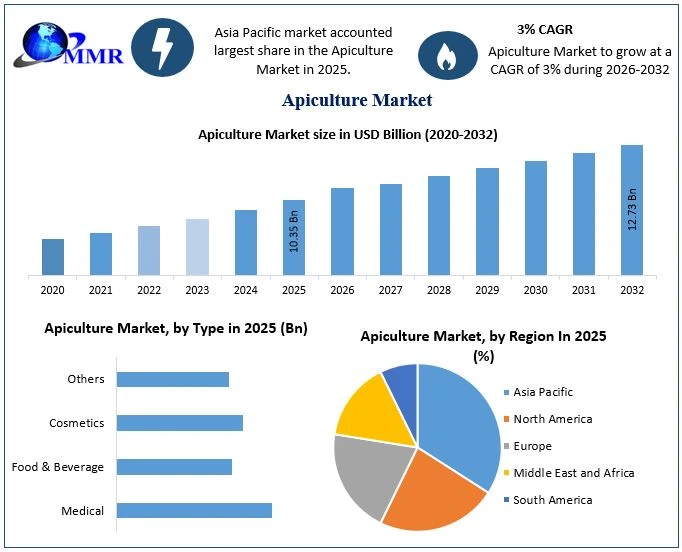
The Apiculture Market size was valued at USD 10.35 Billion in 2025 and the total Apiculture revenue is expected to grow at a CAGR of 3% from 2026 to 2032, reaching nearly USD 12.73 Billion.
Global Apiculture Market Overview:

The global Apiculture market is experiencing steady growth, driven by increasing demand for honey, beeswax, royal jelly, propolis, bee pollen, and other bee-derived products across the food & beverage, pharmaceutical, cosmetics, and nutraceutical industries. Apiculture, also known as beekeeping, plays a vital role in supporting agricultural productivity through pollination services while contributing to biodiversity and ecosystem sustainability. Rising consumer preference for natural, organic, and clean-label products, coupled with growing awareness of the health benefits associated with honey and other bee products, is significantly boosting market demand. Additionally, the expanding use of honey as a natural sweetener in functional foods, beverages, and dietary supplements is further supporting market growth. Increasing government initiatives to promote sustainable beekeeping practices and protect pollinator populations are also contributing to the development of the global apiculture industry.

Furthermore, the growing adoption of modern beekeeping technologies, including smart hive monitoring systems, IoT-enabled sensors, and precision apiculture solutions, is improving hive management, productivity, and disease control. Rising demand for pollination services from fruit, vegetable, oilseed, and horticultural crop producers is creating additional revenue opportunities for commercial beekeepers. The pharmaceutical and personal care industries are increasingly utilizing bee-derived ingredients such as propolis, royal jelly, and beeswax in medicinal formulations, skincare products, and cosmetic applications due to their antimicrobial, antioxidant, and anti-inflammatory properties. Moreover, the rapid expansion of e-commerce platforms and direct-to-consumer sales channels has enhanced the accessibility of premium and organic bee products worldwide. Supported by advancements in sustainable apiculture practices, technological innovation, and growing consumer awareness of natural health products, the global Apiculture market is expected to witness sustained growth throughout the forecast period.

Apiculture Market GrowthTo know about the Research Methodology :- Request Free Sample Report

Apiculture Market Dynamics:

Rising consumer demand for natural honey and bee-derived health products is driving the market growth

The increasing consumer preference for natural, organic, and clean-label products is a major factor driving the global Apiculture market. Honey is widely recognized for its antioxidant, antimicrobial, and anti-inflammatory properties, making it a popular ingredient in functional foods, dietary supplements, and traditional medicine. Growing health consciousness, coupled with rising demand for natural sweeteners as alternatives to refined sugar, is accelerating honey consumption worldwide. Additionally, expanding applications of bee-derived products such as beeswax, royal jelly, propolis, and bee pollen in the food & beverage, pharmaceutical, cosmetics, and personal care industries are further supporting market growth. The increasing importance of pollination services in improving agricultural productivity and crop yields also contributes significantly to the expansion of the apiculture industry.

Honey adulteration, declining bee populations, and climate change are restraining the market growth

The Apiculture market faces significant challenges due to the increasing incidence of honey adulteration, which affects consumer confidence and product authenticity. Additionally, declining bee populations caused by habitat loss, pesticide exposure, climate change, pests, and diseases such as Varroa mite infestations are negatively impacting honey production and pollination services. Fluctuating weather conditions, rising production costs, and limited access to advanced beekeeping equipment further constrain the profitability of commercial beekeeping operations. These factors collectively pose challenges to the sustainable growth of the global apiculture market.

Government initiatives and technological advancements in beekeeping are creating growth opportunities for the market

Supportive government programs promoting sustainable beekeeping, pollinator conservation, and rural livelihood development are creating significant growth opportunities for the Apiculture market. Increasing investments in smart hive monitoring systems, IoT-enabled beekeeping technologies, precision apiculture, and disease management solutions are improving hive productivity and colony health. Furthermore, rising consumer demand for organic honey, premium bee products, and immunity-supporting natural ingredients is encouraging manufacturers and beekeepers to diversify their product offerings. Expanding applications of bee-derived ingredients in pharmaceuticals, nutraceuticals, and cosmetics, along with the growth of e-commerce platforms, are expected to further enhance market opportunities during the forecast period.

Environmental challenges and counterfeit products are challenging the market growth

Environmental degradation, biodiversity loss, and the widespread use of agricultural pesticides continue to threaten bee health and reduce pollination efficiency, creating long-term challenges for the Apiculture market. In addition, the presence of counterfeit and low-quality honey products in global markets intensifies competition and undermines consumer trust in authentic bee-derived products. Maintaining product traceability, ensuring quality certification, and complying with stringent food safety and international trade regulations require continuous investment from market participants. Addressing these environmental and quality-related challenges remains essential for achieving sustainable growth in the global apiculture industry.

Apiculture Market Trends:

  • Growing demand for organic honey and premium bee-derived products is emerging as a key market trend - Consumers are increasingly preferring organic, raw, and minimally processed honey due to growing awareness of its nutritional value and health benefits. This trend is driving demand for premium bee-derived products such as royal jelly, propolis, bee pollen, and beeswax across the food & beverage, nutraceutical, pharmaceutical, and personal care industries. Manufacturers are also introducing value-added products with organic certifications, geographical indications, and traceability features to meet evolving consumer preferences and strengthen brand differentiation.
  • Smart beekeeping technologies are transforming modern apiculture practices - The adoption of precision apiculture technologies is increasing as commercial beekeepers seek to improve hive productivity and colony health. Smart hive monitoring systems, Internet of Things (IoT)-enabled sensors, artificial intelligence (AI)-based analytics, GPS tracking, and remote monitoring solutions are helping beekeepers monitor hive temperature, humidity, bee activity, and disease outbreaks in real time. These technological advancements are enhancing operational efficiency, reducing colony losses, and supporting sustainable beekeeping practices.
  • Expanding applications of bee-derived ingredients are driving product innovation - Bee-derived products are witnessing increasing utilization beyond traditional honey consumption. Propolis, beeswax, royal jelly, and bee pollen are gaining popularity in pharmaceutical formulations, functional foods, dietary supplements, cosmetics, and skincare products due to their antimicrobial, antioxidant, and anti-inflammatory properties. Rising consumer demand for natural and clean-label ingredients is encouraging manufacturers to develop innovative products that cater to health-conscious consumers and premium wellness markets.
  • Sustainability and pollinator conservation initiatives are reshaping the apiculture industry - Growing concerns regarding declining bee populations and biodiversity loss are encouraging governments, agricultural organizations, and industry stakeholders to invest in sustainable beekeeping and pollinator conservation programs. Manufacturers and commercial beekeepers are increasingly adopting environmentally friendly practices, reducing pesticide exposure, and promoting habitat restoration to protect bee colonies. At the same time, consumers are showing greater preference for sustainably sourced and ethically produced honey, prompting companies to enhance supply chain transparency, quality certification, and traceability across the apiculture value chain.
Apiculture Market Segment Analysis:

By Product,

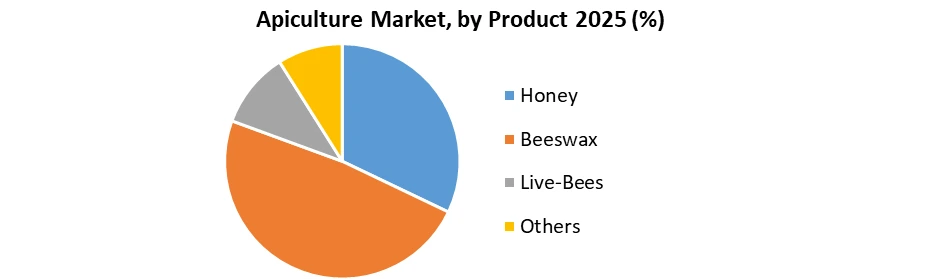
The Honey segment is expected to dominate the global Apiculture market during the 2025–2032 forecast period owing to its widespread consumption as a natural sweetener and its extensive applications across the food & beverage, pharmaceutical, nutraceutical, and personal care industries. Growing consumer preference for organic and clean-label food products, coupled with increasing awareness of honey's antioxidant, antimicrobial, and immune-boosting properties, continues to drive demand worldwide. The rising use of honey in functional foods, dietary supplements, bakery products, beverages, and traditional medicine further strengthens the segment's market leadership. Beeswax also accounts for a significant market share due to its extensive use in cosmetics, skincare products, pharmaceuticals, candle manufacturing, and food processing applications.

Apiculture Market by product

Meanwhile, the Live Bees segment is expected to witness robust growth during the forecast period, driven by the increasing demand for commercial pollination services in agriculture, horticulture, and greenhouse farming. Rising awareness of the role of bees in improving crop yields and supporting sustainable farming practices is encouraging investments in commercial beekeeping and colony expansion. Additionally, the Others segment, which includes products such as royal jelly, propolis, bee pollen, and bee venom, is gaining traction due to their growing applications in nutraceuticals, functional foods, pharmaceuticals, and premium personal care products. The expanding use of these value-added bee-derived products is expected to contribute significantly to overall market growth.

By Type,

The Food & Beverage segment is expected to dominate the global Apiculture market throughout the forecast period owing to the increasing consumption of honey and other bee-derived products as natural sweeteners and functional ingredients. Rising consumer demand for healthy, organic, and minimally processed foods, along with the growing popularity of functional beverages, bakery products, confectionery, and dietary supplements, continues to fuel market growth. The shift toward clean-label products and sugar alternatives is further driving the adoption of honey across the global food industry. Medical applications also represent a substantial market share, supported by the increasing use of honey, propolis, royal jelly, and bee venom in wound care, cough remedies, nutritional therapies, and traditional medicine due to their antimicrobial, antioxidant, and anti-inflammatory properties.

The Cosmetics segment is expected to witness significant growth as manufacturers increasingly incorporate honey, beeswax, royal jelly, and propolis into skincare, haircare, lip care, and anti-aging formulations. Rising consumer preference for natural, sustainable, and chemical-free cosmetic ingredients is accelerating the adoption of bee-derived products across the beauty and personal care industry. Additionally, the Others segment, which includes agricultural pollination services, industrial applications, and research activities, is projected to experience steady growth due to increasing awareness of the ecological and economic importance of bees in improving agricultural productivity and supporting biodiversity conservation.

Apiculture Market Regional Insights:

Europe dominates the Apiculture market driven by strong beekeeping traditions and high demand for premium honey

Europe holds the largest share of the global Apiculture market, supported by its well-established beekeeping industry, high per capita honey consumption, and strong demand for organic and premium bee-derived products. Countries such as Germany, Spain, France, Italy, Greece, and Poland are among the leading producers and consumers of honey and beeswax. Favorable government initiatives promoting sustainable beekeeping, pollinator conservation, and organic farming, along with stringent quality standards for honey production, continue to support regional market growth. The increasing use of bee-derived ingredients in the food & beverage, pharmaceutical, and cosmetics industries further strengthens Europe's market position.

Asia-Pacific is expected to witness the fastest growth owing to expanding honey production and rising health awareness

Asia-Pacific is projected to register the highest CAGR during the forecast period due to increasing honey production, rising consumer awareness of natural health products, and expanding applications of bee-derived products across multiple industries. China, India, Australia, Japan, and Vietnam are major contributors to regional market growth, benefiting from favorable climatic conditions, growing commercial beekeeping activities, and increasing government support for apiculture. Rising demand for functional foods, dietary supplements, traditional medicines, and natural cosmetics is further accelerating the consumption of honey, beeswax, propolis, and royal jelly across the region.

North America maintains a significant market share supported by growing demand for natural sweeteners and pollination services

North America represents a substantial market for apiculture owing to increasing consumer preference for organic honey, clean-label food products, and natural health supplements. The United States and Canada are witnessing growing demand for premium honey, beeswax-based personal care products, and pharmaceutical applications of bee-derived ingredients. Additionally, the region has a well-developed commercial beekeeping industry that provides essential pollination services for fruit, vegetable, and nut production. Increasing investments in smart beekeeping technologies and pollinator conservation programs are further supporting market expansion.

Latin America and the Middle East & Africa are emerging markets driven by expanding commercial beekeeping and agricultural development

Latin America and the Middle East & Africa are expected to experience steady growth during the forecast period, supported by increasing commercial beekeeping activities, favorable climatic conditions, and rising demand for honey and other bee-derived products. Countries such as Brazil, Argentina, Mexico, Turkey, South Africa, and the UAE are expanding honey production to meet growing domestic and export demand. Government initiatives promoting rural livelihoods, sustainable agriculture, and pollinator conservation, coupled with increasing awareness of the health benefits of natural bee products, are expected to create significant growth opportunities for the Apiculture market across these regions.

Competitive Landscape - Global Apiculture Market

The global Apiculture market is moderately fragmented, with international honey producers, commercial beekeeping enterprises, cooperatives, and manufacturers of bee-derived products competing through product quality, organic certifications, sustainable sourcing, and portfolio diversification. Market participants are increasingly investing in modern beekeeping technologies, smart hive monitoring systems, and sustainable apiculture practices to improve hive productivity and product quality. Strategic initiatives such as acquisitions, partnerships, geographic expansion, and product innovation are enabling companies to strengthen their market presence and meet the growing demand for natural, organic, and premium bee-derived products across the food & beverage, pharmaceutical, nutraceutical, and cosmetics industries.

Company Key Strategies
Capilano Honey Ltd. Focuses on premium honey production, sustainable sourcing, product innovation, and expanding international distribution networks.
Comvita Limited Emphasizes Manuka honey products, scientific research, premium branding, and expansion in the health and wellness sector.
Dabur India Ltd. Strengthens its market position through product diversification, extensive retail distribution, and investments in quality assurance and honey traceability.
Barkman Honey LLC Focuses on private-label manufacturing, premium honey offerings, and sustainable beekeeping practices.
Bee Maid Honey Limited Expands through cooperative-based honey production, product quality enhancement, and strong domestic distribution.
GloryBee Inc. Invests in ethically sourced bee products, organic certifications, and sustainable supply chain initiatives.
Dutch Gold Honey Inc. Focuses on value-added honey products, customized packaging, and expansion across food service and retail channels.
Nature Nate's Honey Co. Strengthens brand presence through raw and organic honey products, quality testing, and consumer-focused marketing strategies.
New Zealand Honey Co. Expands its premium Manuka honey portfolio through international exports and scientific product validation.
Steens Honey Focuses on minimally processed premium honey, sustainable production practices, and direct-to-consumer sales channels.

Apiculture Market Recent Developments:

  • May 2025: Comvita Limited expanded its premium Manuka honey portfolio by introducing new wellness-focused products to meet the growing global demand for natural health supplements.
  • March 2025: Nature Nate's Honey Co. strengthened its retail presence by expanding the distribution of its raw and organic honey products across major supermarket chains in North America.
  • January 2025: Dabur India Ltd. enhanced its honey traceability and quality assurance initiatives by adopting advanced product authentication and testing technologies.
  • October 2024: Capilano Honey Ltd. introduced sustainably sourced premium honey products with eco-friendly packaging to strengthen its position in international markets.
  • August 2024: New Zealand Honey Co. expanded its Manuka honey exports through strategic partnerships and increased production capacity to address rising global demand for premium bee-derived products.

Apiculture Market Scope: Inquire before buying

Apiculture Market
Report Coverage Details
Base Year: 2025 Forecast Period: 2026-2032
Historical Data: 2020 to 2025 Market Size in 2025: USD 10.35 Bn.
Forecast Period 2026 to 2032 CAGR: 3% Market Size in 2032: USD 12.73 Bn.
Segments Covered: By Product Honey
Beeswax
Live-Bees
Others
By Type Medical
Food & Beverage
Cosmetics
Others

Apiculture Market, by Region

North America (United States, Canada and Mexico)
Europe (UK, France, Germany, Italy, Spain, Sweden, Austria and Rest of Europe)
Asia Pacific (China, South Korea, Japan, India, Australia, Indonesia, Malaysia, Vietnam, Taiwan, Bangladesh, Pakistan and Rest of APAC)
Middle East and Africa (South Africa, GCC, Egypt, Nigeria and Rest of ME&A)
South America (Brazil, Argentina Rest of South America)

Apiculture Market, Key Players

1. Betterbee
2. Bartink
3. Beehive Botanicals
4. Seldom Foods Apiculture
5. Millers’s Honey Company
6. Shandong Bokang Apiculture
7. Dabur India Ltd.
8. Arnold Honeybee
9. Chengdu Feng’s Apiculture
10. EURL Atlantic Apiculture
11. Thomas Apiculture
12. Sarl Luberonn Beekeeping
13. Honeybee Enterprises
14. Tiwana Bee Farm
15. Mann Lake

Frequently Asked Questions:

1. Which region has the largest share in Global market?
Ans: Asia Pacific region holds the highest share in 2025.

2. What was the Global Apiculture Market size in 2025?
Ans: The Global Apiculture Market size was USD 10.35 Billion in 2025.

3. What is scope of the Global market report?
Ans: Global market report helps with the PESTEL, PORTER, Recommendations for Investors & Leaders, and market estimation of the forecast period.

4. Who are the key players in Global market?
Ans: The important key players in the Global market are – Betterbee, Bartink, Beehive Botanicals, Seldom Foods Apiculture, Millers’s Honey Company, Shandong Bokang Apiculture, Dabur India Ltd., Arnold Honeybee, Chengdu Feng’s Apiculture, EURL Atlantic Apiculture, Thomas Apiculture, Sarl Luberonn Beekeeping, Honeybee Enterprises, Tiwana Bee Farm, and Mann Lake.

Table of Contents

1. Apiculture Market Introduction 1.1. Study Assumption and Market Definition 1.2. Scope of the Study 1.3. Executive Summary 2. Global Apiculture Market: Competitive Landscape 2.1. MMR Competition Matrix 2.2. Competitive Landscape 2.3. Key Players Benchmarking 2.3.1. Company Name 2.3.2. Business Segment 2.3.3. End-user Segment 2.3.4. Revenue (2025) 2.3.5. Company Locations 2.4. Leading Apiculture Market Companies, by market capitalization 2.5. Market Structure 2.5.1. Market Leaders 2.5.2. Market Followers 2.5.3. Emerging Players 2.6. Mergers and Acquisitions Details 3. Apiculture Market: Dynamics 3.1. Apiculture Market Trends by Region 3.1.1. North America Apiculture Market Trends 3.1.2. Europe Apiculture Market Trends 3.1.3. Asia Pacific Apiculture Market Trends 3.1.4. Middle East and Africa Apiculture Market Trends 3.1.5. South America Apiculture Market Trends 3.2. Apiculture Market Dynamics by Region 3.2.1. North America 3.2.1.1. North America Apiculture Market Drivers 3.2.1.2. North America Apiculture Market Restraints 3.2.1.3. North America Apiculture Market Opportunities 3.2.1.4. North America Apiculture Market Challenges 3.2.2. Europe 3.2.2.1. Europe Apiculture Market Drivers 3.2.2.2. Europe Apiculture Market Restraints 3.2.2.3. Europe Apiculture Market Opportunities 3.2.2.4. Europe Apiculture Market Challenges 3.2.3. Asia Pacific 3.2.3.1. Asia Pacific Apiculture Market Drivers 3.2.3.2. Asia Pacific Apiculture Market Restraints 3.2.3.3. Asia Pacific Apiculture Market Opportunities 3.2.3.4. Asia Pacific Apiculture Market Challenges 3.2.4. Middle East and Africa 3.2.4.1. Middle East and Africa Apiculture Market Drivers 3.2.4.2. Middle East and Africa Apiculture Market Restraints 3.2.4.3. Middle East and Africa Apiculture Market Opportunities 3.2.4.4. Middle East and Africa Apiculture Market Challenges 3.2.5. South America 3.2.5.1. South America Apiculture Market Drivers 3.2.5.2. South America Apiculture Market Restraints 3.2.5.3. South America Apiculture Market Opportunities 3.2.5.4. South America Apiculture Market Challenges 3.3. PORTER's Five Forces Analysis 3.4. PESTLE Analysis 3.5. Technology Roadmap 3.6. Regulatory Landscape by Region 3.6.1. North America 3.6.2. Europe 3.6.3. Asia Pacific 3.6.4. Middle East and Africa 3.6.5. South America 3.7. Key Opinion Leader Analysis For Apiculture Industry 3.8. Analysis of Government Schemes and Initiatives For Apiculture Industry 3.9. Apiculture Market Trade Analysis 3.10. The Global Pandemic Impact on Apiculture Market 4. Apiculture Market: Global Market Size and Forecast by Segmentation (in USD Billion) 2025-2032 4.1. Apiculture Market Size and Forecast, by Product (2025-2032) 4.1.1. Honey 4.1.2. Beeswax 4.1.3. Live-Bees 4.1.4. Others 4.2. Apiculture Market Size and Forecast, by Type (2025-2032) 4.2.1. Medical 4.2.2. Food & Beverage 4.2.3. Cosmetics 4.2.4. Others 4.3. Apiculture Market Size and Forecast, by Region (2025-2032) 4.3.1. North America 4.3.2. Europe 4.3.3. Asia Pacific 4.3.4. Middle East and Africa 4.3.5. South America 5. North America Apiculture Market Size and Forecast by Segmentation (in USD Billion) 2025-2032 5.1. North America Apiculture Market Size and Forecast, by Product (2025-2032) 5.1.1. Honey 5.1.2. Beeswax 5.1.3. Live-Bees 5.1.4. Others 5.2. North America Apiculture Market Size and Forecast, by Type (2025-2032) 5.2.1. Medical 5.2.2. Food & Beverage 5.2.3. Cosmetics 5.2.4. Others 5.3. North America Apiculture Market Size and Forecast, by Country (2025-2032) 5.3.1. United States 5.3.1.1. United States Apiculture Market Size and Forecast, by Product (2025-2032) 5.3.1.1.1. Honey 5.3.1.1.2. Beeswax 5.3.1.1.3. Live-Bees 5.3.1.1.4. Others 5.3.1.2. United States Apiculture Market Size and Forecast, by Type (2025-2032) 5.3.1.2.1. Medical 5.3.1.2.2. Food & Beverage 5.3.1.2.3. Cosmetics 5.3.1.2.4. Others 5.3.2. Canada 5.3.2.1. Canada Apiculture Market Size and Forecast, by Product (2025-2032) 5.3.2.1.1. Honey 5.3.2.1.2. Beeswax 5.3.2.1.3. Live-Bees 5.3.2.1.4. Others 5.3.2.2. Canada Apiculture Market Size and Forecast, by Type (2025-2032) 5.3.2.2.1. Medical 5.3.2.2.2. Food & Beverage 5.3.2.2.3. Cosmetics 5.3.2.2.4. Others 5.3.3. Mexico 5.3.3.1. Mexico Apiculture Market Size and Forecast, by Product (2025-2032) 5.3.3.1.1. Honey 5.3.3.1.2. Beeswax 5.3.3.1.3. Live-Bees 5.3.3.1.4. Others 5.3.3.2. Mexico Apiculture Market Size and Forecast, by Type (2025-2032) 5.3.3.2.1. Medical 5.3.3.2.2. Food & Beverage 5.3.3.2.3. Cosmetics 5.3.3.2.4. Others 6. Europe Apiculture Market Size and Forecast by Segmentation (in USD Billion) 2025-2032 6.1. Europe Apiculture Market Size and Forecast, by Product (2025-2032) 6.2. Europe Apiculture Market Size and Forecast, by Type (2025-2032) 6.3. Europe Apiculture Market Size and Forecast, by Country (2025-2032) 6.3.1. United Kingdom 6.3.1.1. United Kingdom Apiculture Market Size and Forecast, by Product (2025-2032) 6.3.1.2. United Kingdom Apiculture Market Size and Forecast, by Type (2025-2032) 6.3.2. France 6.3.2.1. France Apiculture Market Size and Forecast, by Product (2025-2032) 6.3.2.2. France Apiculture Market Size and Forecast, by Type (2025-2032) 6.3.3. Germany 6.3.3.1. Germany Apiculture Market Size and Forecast, by Product (2025-2032) 6.3.3.2. Germany Apiculture Market Size and Forecast, by Type (2025-2032) 6.3.4. Italy 6.3.4.1. Italy Apiculture Market Size and Forecast, by Product (2025-2032) 6.3.4.2. Italy Apiculture Market Size and Forecast, by Type (2025-2032) 6.3.5. Spain 6.3.5.1. Spain Apiculture Market Size and Forecast, by Product (2025-2032) 6.3.5.2. Spain Apiculture Market Size and Forecast, by Type (2025-2032) 6.3.6. Sweden 6.3.6.1. Sweden Apiculture Market Size and Forecast, by Product (2025-2032) 6.3.6.2. Sweden Apiculture Market Size and Forecast, by Type (2025-2032) 6.3.7. Austria 6.3.7.1. Austria Apiculture Market Size and Forecast, by Product (2025-2032) 6.3.7.2. Austria Apiculture Market Size and Forecast, by Type (2025-2032) 6.3.8. Rest of Europe 6.3.8.1. Rest of Europe Apiculture Market Size and Forecast, by Product (2025-2032) 6.3.8.2. Rest of Europe Apiculture Market Size and Forecast, by Type (2025-2032) 7. Asia Pacific Apiculture Market Size and Forecast by Segmentation (in USD Billion) 2025-2032 7.1. Asia Pacific Apiculture Market Size and Forecast, by Product (2025-2032) 7.2. Asia Pacific Apiculture Market Size and Forecast, by Type (2025-2032) 7.3. Asia Pacific Apiculture Market Size and Forecast, by Country (2025-2032) 7.3.1. China 7.3.1.1. China Apiculture Market Size and Forecast, by Product (2025-2032) 7.3.1.2. China Apiculture Market Size and Forecast, by Type (2025-2032) 7.3.2. S Korea 7.3.2.1. S Korea Apiculture Market Size and Forecast, by Product (2025-2032) 7.3.2.2. S Korea Apiculture Market Size and Forecast, by Type (2025-2032) 7.3.3. Japan 7.3.3.1. Japan Apiculture Market Size and Forecast, by Product (2025-2032) 7.3.3.2. Japan Apiculture Market Size and Forecast, by Type (2025-2032) 7.3.4. India 7.3.4.1. India Apiculture Market Size and Forecast, by Product (2025-2032) 7.3.4.2. India Apiculture Market Size and Forecast, by Type (2025-2032) 7.3.5. Australia 7.3.5.1. Australia Apiculture Market Size and Forecast, by Product (2025-2032) 7.3.5.2. Australia Apiculture Market Size and Forecast, by Type (2025-2032) 7.3.6. Indonesia 7.3.6.1. Indonesia Apiculture Market Size and Forecast, by Product (2025-2032) 7.3.6.2. Indonesia Apiculture Market Size and Forecast, by Type (2025-2032) 7.3.7. Malaysia 7.3.7.1. Malaysia Apiculture Market Size and Forecast, by Product (2025-2032) 7.3.7.2. Malaysia Apiculture Market Size and Forecast, by Type (2025-2032) 7.3.8. Vietnam 7.3.8.1. Vietnam Apiculture Market Size and Forecast, by Product (2025-2032) 7.3.8.2. Vietnam Apiculture Market Size and Forecast, by Type (2025-2032) 7.3.9. Taiwan 7.3.9.1. Taiwan Apiculture Market Size and Forecast, by Product (2025-2032) 7.3.9.2. Taiwan Apiculture Market Size and Forecast, by Type (2025-2032) 7.3.10. Rest of Asia Pacific 7.3.10.1. Rest of Asia Pacific Apiculture Market Size and Forecast, by Product (2025-2032) 7.3.10.2. Rest of Asia Pacific Apiculture Market Size and Forecast, by Type (2025-2032) 8. Middle East and Africa Apiculture Market Size and Forecast by Segmentation (in USD Billion) 2025-2032 8.1. Middle East and Africa Apiculture Market Size and Forecast, by Product (2025-2032) 8.2. Middle East and Africa Apiculture Market Size and Forecast, by Type (2025-2032) 8.3. Middle East and Africa Apiculture Market Size and Forecast, by Country (2025-2032) 8.3.1. South Africa 8.3.1.1. South Africa Apiculture Market Size and Forecast, by Product (2025-2032) 8.3.1.2. South Africa Apiculture Market Size and Forecast, by Type (2025-2032) 8.3.2. GCC 8.3.2.1. GCC Apiculture Market Size and Forecast, by Product (2025-2032) 8.3.2.2. GCC Apiculture Market Size and Forecast, by Type (2025-2032) 8.3.3. Nigeria 8.3.3.1. Nigeria Apiculture Market Size and Forecast, by Product (2025-2032) 8.3.3.2. Nigeria Apiculture Market Size and Forecast, by Type (2025-2032) 8.3.4. Rest of ME&A 8.3.4.1. Rest of ME&A Apiculture Market Size and Forecast, by Product (2025-2032) 8.3.4.2. Rest of ME&A Apiculture Market Size and Forecast, by Type (2025-2032) 9. South America Apiculture Market Size and Forecast by Segmentation (in USD Billion) 2025-2032 9.1. South America Apiculture Market Size and Forecast, by Product (2025-2032) 9.2. South America Apiculture Market Size and Forecast, by Type (2025-2032) 9.3. South America Apiculture Market Size and Forecast, by Country (2025-2032) 9.3.1. Brazil 9.3.1.1. Brazil Apiculture Market Size and Forecast, by Product (2025-2032) 9.3.1.2. Brazil Apiculture Market Size and Forecast, by Type (2025-2032) 9.3.2. Argentina 9.3.2.1. Argentina Apiculture Market Size and Forecast, by Product (2025-2032) 9.3.2.2. Argentina Apiculture Market Size and Forecast, by Type (2025-2032) 9.3.3. Rest Of South America 9.3.3.1. Rest Of South America Apiculture Market Size and Forecast, by Product (2025-2032) 9.3.3.2. Rest Of South America Apiculture Market Size and Forecast, by Type (2025-2032) 10. Company Profile: Key Players 10.1. Betterbee 10.1.1. Company Overview 10.1.2. Business Portfolio 10.1.3. Financial Overview 10.1.4. SWOT Analysis 10.1.5. Strategic Analysis 10.1.6. Scale of Operation (small, medium, and large) 10.1.7. Details on Partnership 10.1.8. Regulatory Accreditations and Certifications Received by Them 10.1.9. Awards Received by the Firm 10.1.10. Recent Developments 10.2. Bartink 10.3. Beehive Botanicals 10.4. Seldom Foods Apiculture 10.5. Millers’s Honey Company 10.6. Shandong Bokang Apiculture 10.7. Dabur India Ltd. 10.8. Arnold Honeybee 10.9. Chengdu Feng’s Apiculture 10.10. EURL Atlantic Apiculture 10.11. Thomas Apiculture 10.12. Sarl Luberonn Beekeeping 10.13. Honeybee Enterprises 10.14. Tiwana Bee Farm 10.15. Mann Lake 11. Key Findings 12. Industry Recommendations 13. Apiculture Market: Research Methodology 14. Terms and Glossary

Custom Market Research Services

We Will Customise The Research For You, In Case The Report Listed Above Does Not Meet With Your Requirements