Apiculture Market by Product, Type and Region – Global Market Size Estimation, Industry-Wide Analysis, Competitive Landscape Assessment & Long-Term Forecast to 2032

3%
CAGR (2026-2032)
10.35 USD Bn.
Forecast Market Size
301
Report Pages
150
Market Tables

Overview

The Apiculture Market size was valued at USD 10.35 Billion in 2025 and the total Apiculture revenue is expected to grow at a CAGR of 3% from 2026 to 2032, reaching nearly USD 12.73 Billion.
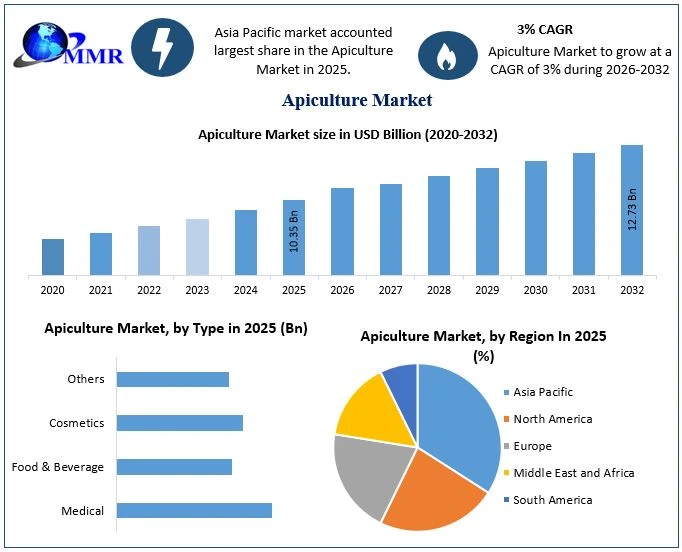
The global Apiculture market report is a comprehensive analysis of the industry, market, and key players. The report has covered the market by demand and supply-side by segments. The global Apiculture report also provides trends by market segments, technology, and investment with a competitive landscape.2025 is considered as a base year to forecast the market from 2026 to 2032. 2025’s market size is estimated on real numbers and outputs of the key players and major players across the globe. Past five years' trends are considered while forecasting the market through 2032. 2025 is a year of exception and analyzed especially with the impact of lockdown by region.

Apiculture Market GrowthTo know about the Research Methodology :- Request Free Sample Report

Apiculture Market Dynamics:

Driving factors for the apiculture market are increasing awareness and consumption of honey on daily basis, Consumers prefer honey and use it for weight loss, reduce fever. Due to its various health benefits such as the rich source of antioxidants, which reduces the risk of heart attacks, strokes, helps maintain blood pressure, heal wounds, good for digestive issues. The growing establishment of new colonies & beekeeping enterprises for honey production is responsible for apiculture market growth. Increasing the use of honey as an alternative to sugar or artificial sweetener in industries is driving the apiculture market.

Increasing adulteration of honey & decreasing the number of beehives & beekeepers are responsible for the restraint of the apiculture market. Also increasing the price of honey and weak improved apiculture equipment are another restraint for the market.

Increasing Government support across the globe & rising consumer’s inclination towards apiculture market products is the opportunity. Rising on R&D and introducing new products in the market can increase market share. The demand for immunity-boosting products is rising due to coronavirus disease and honey gives protection from fever so the market of apiculture will constantly growing. There is an opportunity for the apiculture market in pharmaceutical industries because it can be used for medical to protect from several diseases such as cancer, stress.

Apiculture Market Overview:

The Apiculture Market size was valued at USD 10.35 Billion in 2025 and the total Apiculture revenue is expected to grow at a CAGR of 3% from 2026 to 2032, reaching nearly USD 12.73 Billion.

Apiculture is known as honey gatherer, bee keeping is the care & management of honey bees for the production of honey and wax. Apiculture is important for agriculture because it provides honey & bee wax which are important for food and industries like cosmetics, medical. The increasing awareness of apiculture products is projected to grow faster in the coming years. Apiculture provides pollination which is important for the food growing process, plant reproduction such as honey bees.

Apiculture Market Key trends:

Increasing demand of organic honey in the developed region like Europe, US, Japan and rising consumers of healthy & natural products are driving the apiculture market growth. The rising consumption of honey across the globe in end-use industries is responsible for growth in the apiculture market. Drug-containing honey is the key trend of the apiculture market. The rising use of honey in the pharmaceutical, cosmetic industries will propel the apiculture market. Rapidly growing food & beverage industry & rising awareness of health-conscious consumers creating a positive image for apiculture market.

Apiculture Market Segment Analysis:

The global apiculture market is segmented in main two type by Product, by Application.

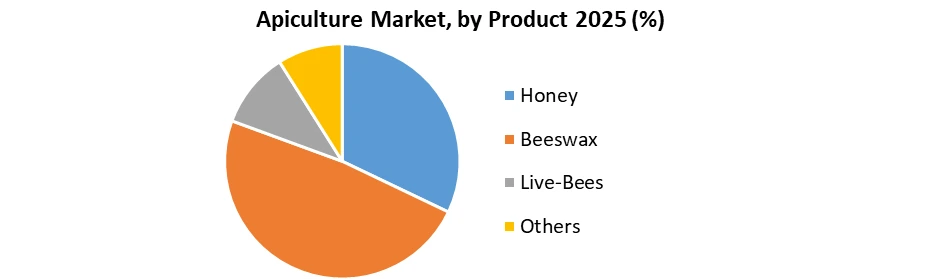
Based on the Product, the global apiculture market is sub-segmented into four type’s honey, beeswax, live bees, and others. The honey segment holds the highest market share of the global apiculture market product segment owing to the increasing demand for honey as a natural sweetener worldwide. Honey is also used for medicines due to its antibacterial, antiseptic, anti-fungal immunity booster health properties. Increasing demand for the high amount of nutritional food products is responsible for honey market growth. In 2023, Europe holds the largest honey market share segment of 30% in the world. The global honey market size was valued at 7.0 Billion in 2023 and it is expected to reach 14.5 Billion by 2030.

Based on the Application, the apiculture market is sub-segmented into four types medical, food & beverages, cosmetics, others. Food & Beverage segment is dominating the global apiculture market owing to rising usage of honey as a source of sweetening and flavoring agent, increasing consumer preference towards natural, organic, low-calorie, low-fat products. It can be used for beverages processed foods like jams, jerries, so food & beverage manufacturers are looking for alternatives to sugar for sweetener needs for foods & beverage products. The food & beverage segment is expected to reach 4.5 Billion during the forecast period. USA, China, Japan, Europe holds the highest market share in the global food & beverage segment and are expected to grow at a CAGR of 3.0 % and reach 3.5 Billion by the end of the analysis period.

Apiculture Market by product

The Top Honey producing countries in 2023 are

The objective of the report is to present a comprehensive analysis of the global Apiculture market to the stakeholders in the industry. The past and current status of the industry with the forecasted market size and trends are presented in the report with the analysis of complicated data in simple language. The report covers all the aspects of the industry with a dedicated study of key players that include market leaders, followers, and new entrants.

PORTER, PESTEL analysis with the potential impact of micro-economic factors of the market have been presented in the report. External as well as internal factors that are supposed to affect the business positively or negatively have been analysed, which will give a clear futuristic view of the industry to the decision-makers.

The report also helps in understanding the global market dynamics, structure by analyzing the market segments and project the global Apiculture market size. Clear representation of competitive analysis of key players by product, price, financial position, product portfolio, growth strategies, and regional presence in the global Apiculture market make the report investor’s guide.

Apiculture Market Recent Developments

Date Company / Organization Development Impact
15 May 2026 Mann Lake Ltd. The company announced the acquisition of Apis Biologix to bring its pioneering bee nutrition science fully in-house. The transaction accelerates the development of next-generation feeding solutions such as Bio-Activator and BIO-Metabolic-Fuel to combat challenging seasonal colony conditions across North America.
14 May 2026 BASF and NOD Apiary Products Ltd. The companies established a strategic collaboration focused on funding and technical expertise to advance honey bee health. The alliance incorporates BASF's certified compostable polymers into NOD's Formic Pro™ strips, delivering a safe and controlled release of formic acid vapor to target hive mites sustainably.
14 May 2026 Comvita New Zealand The global leader in manuka honey secured a cornerstone investment from Fraser and Neave, Limited (F&N), giving F&N a 19.99% stake via a capital raise. This partnership strengthens Comvita's financial recapitalization and expands its route-to-market distribution and premium brand penetration across Southeast Asia.
07 May 2026 Ministry of Agriculture, Guyana The Ministry officially launched a major commercial apiculture project in Region Nine, distributing roughly 340 commercial bee hives and specialized protective gear. The initiative expands regional honey yield capabilities toward a national projection increase of 2,000 to 5,000 additional gallons by the end of 2026.

Apiculture Market Regional Insights:

Asia Pacific region holds the highest market share of 25% in the global apiculture market owing to the increasing demand of honey in the region, China & India are major countries for growing the demand of honey, consumers are becoming aware regarding health benefits associated with product. China is expected to grow at a CAGR of 4.0% during the forecast period and expected to reach USD 2.5 Billion by 2030. While the US is projected to reach USD2.1 Billion in the year 2023. Among the other important regional markets such as Japan, Canada grow at a CAGR of 2.5% during the forecast period. The top honey importing countries in 2023are- USA, Germany, Japan, France, UK.

Apiculture Market Scope: Inquire before buying

Apiculture Market
Report Coverage Details
Base Year: 2025 Forecast Period: 2026-2032
Historical Data: 2020 to 2025 Market Size in 2025: USD 10.35 Bn.
Forecast Period 2026 to 2032 CAGR: 3% Market Size in 2032: USD 12.73 Bn.
Segments Covered: by Product Honey
Beeswax
Live-Bees
Others
by Type Medical
Food & Beverage
Cosmetics
Others

Apiculture Market, by Region

North America (United States, Canada and Mexico)
Europe (UK, France, Germany, Italy, Spain, Sweden, Austria and Rest of Europe)
Asia Pacific (China, South Korea, Japan, India, Australia, Indonesia, Malaysia, Vietnam, Taiwan, Bangladesh, Pakistan and Rest of APAC)
Middle East and Africa (South Africa, GCC, Egypt, Nigeria and Rest of ME&A)
South America (Brazil, Argentina Rest of South America)

Apiculture Market, Key Players

1. Betterbee
2. Bartink
3. Beehive Botanicals
4. Seldom Foods Apiculture
5. Millers’s Honey Company
6. Shandong Bokang Apiculture
7. Dabur India Ltd.
8. Arnold Honeybee
9. Chengdu Feng’s Apiculture
10. EURL Atlantic Apiculture
11. Thomas Apiculture
12. Sarl Luberonn Beekeeping
13. Honeybee Enterprises
14. Tiwana Bee Farm
15. Mann Lake

Frequently Asked Questions:

1. Which region has the largest share in Global market?
Ans: Asia Pacific region holds the highest share in 2025.

2. What was the Global Apiculture Market size in 2025?
Ans: The Global Apiculture Market size was USD 10.35 Billion in 2025.

3. What is scope of the Global market report?
Ans: Global market report helps with the PESTEL, PORTER, Recommendations for Investors & Leaders, and market estimation of the forecast period.

4. Who are the key players in Global market?
Ans: The important key players in the Global market are – Betterbee, Bartink, Beehive Botanicals, Seldom Foods Apiculture, Millers’s Honey Company, Shandong Bokang Apiculture, Dabur India Ltd., Arnold Honeybee, Chengdu Feng’s Apiculture, EURL Atlantic Apiculture, Thomas Apiculture, Sarl Luberonn Beekeeping, Honeybee Enterprises, Tiwana Bee Farm, and Mann Lake.

Table of Contents

1. Apiculture Market Introduction 1.1. Study Assumption and Market Definition 1.2. Scope of the Study 1.3. Executive Summary 2. Global Apiculture Market: Competitive Landscape 2.1. MMR Competition Matrix 2.2. Competitive Landscape 2.3. Key Players Benchmarking 2.3.1. Company Name 2.3.2. Business Segment 2.3.3. End-user Segment 2.3.4. Revenue (2025) 2.3.5. Company Locations 2.4. Leading Apiculture Market Companies, by market capitalization 2.5. Market Structure 2.5.1. Market Leaders 2.5.2. Market Followers 2.5.3. Emerging Players 2.6. Mergers and Acquisitions Details 3. Apiculture Market: Dynamics 3.1. Apiculture Market Trends by Region 3.1.1. North America Apiculture Market Trends 3.1.2. Europe Apiculture Market Trends 3.1.3. Asia Pacific Apiculture Market Trends 3.1.4. Middle East and Africa Apiculture Market Trends 3.1.5. South America Apiculture Market Trends 3.2. Apiculture Market Dynamics by Region 3.2.1. North America 3.2.1.1. North America Apiculture Market Drivers 3.2.1.2. North America Apiculture Market Restraints 3.2.1.3. North America Apiculture Market Opportunities 3.2.1.4. North America Apiculture Market Challenges 3.2.2. Europe 3.2.2.1. Europe Apiculture Market Drivers 3.2.2.2. Europe Apiculture Market Restraints 3.2.2.3. Europe Apiculture Market Opportunities 3.2.2.4. Europe Apiculture Market Challenges 3.2.3. Asia Pacific 3.2.3.1. Asia Pacific Apiculture Market Drivers 3.2.3.2. Asia Pacific Apiculture Market Restraints 3.2.3.3. Asia Pacific Apiculture Market Opportunities 3.2.3.4. Asia Pacific Apiculture Market Challenges 3.2.4. Middle East and Africa 3.2.4.1. Middle East and Africa Apiculture Market Drivers 3.2.4.2. Middle East and Africa Apiculture Market Restraints 3.2.4.3. Middle East and Africa Apiculture Market Opportunities 3.2.4.4. Middle East and Africa Apiculture Market Challenges 3.2.5. South America 3.2.5.1. South America Apiculture Market Drivers 3.2.5.2. South America Apiculture Market Restraints 3.2.5.3. South America Apiculture Market Opportunities 3.2.5.4. South America Apiculture Market Challenges 3.3. PORTER's Five Forces Analysis 3.4. PESTLE Analysis 3.5. Technology Roadmap 3.6. Regulatory Landscape by Region 3.6.1. North America 3.6.2. Europe 3.6.3. Asia Pacific 3.6.4. Middle East and Africa 3.6.5. South America 3.7. Key Opinion Leader Analysis For Apiculture Industry 3.8. Analysis of Government Schemes and Initiatives For Apiculture Industry 3.9. Apiculture Market Trade Analysis 3.10. The Global Pandemic Impact on Apiculture Market 4. Apiculture Market: Global Market Size and Forecast by Segmentation (in USD Billion) 2025-2032 4.1. Apiculture Market Size and Forecast, by Product (2025-2032) 4.1.1. Honey 4.1.2. Beeswax 4.1.3. Live-Bees 4.1.4. Others 4.2. Apiculture Market Size and Forecast, by Type (2025-2032) 4.2.1. Medical 4.2.2. Food & Beverage 4.2.3. Cosmetics 4.2.4. Others 4.3. Apiculture Market Size and Forecast, by Region (2025-2032) 4.3.1. North America 4.3.2. Europe 4.3.3. Asia Pacific 4.3.4. Middle East and Africa 4.3.5. South America 5. North America Apiculture Market Size and Forecast by Segmentation (in USD Billion) 2025-2032 5.1. North America Apiculture Market Size and Forecast, by Product (2025-2032) 5.1.1. Honey 5.1.2. Beeswax 5.1.3. Live-Bees 5.1.4. Others 5.2. North America Apiculture Market Size and Forecast, by Type (2025-2032) 5.2.1. Medical 5.2.2. Food & Beverage 5.2.3. Cosmetics 5.2.4. Others 5.3. North America Apiculture Market Size and Forecast, by Country (2025-2032) 5.3.1. United States 5.3.1.1. United States Apiculture Market Size and Forecast, by Product (2025-2032) 5.3.1.1.1. Honey 5.3.1.1.2. Beeswax 5.3.1.1.3. Live-Bees 5.3.1.1.4. Others 5.3.1.2. United States Apiculture Market Size and Forecast, by Type (2025-2032) 5.3.1.2.1. Medical 5.3.1.2.2. Food & Beverage 5.3.1.2.3. Cosmetics 5.3.1.2.4. Others 5.3.2. Canada 5.3.2.1. Canada Apiculture Market Size and Forecast, by Product (2025-2032) 5.3.2.1.1. Honey 5.3.2.1.2. Beeswax 5.3.2.1.3. Live-Bees 5.3.2.1.4. Others 5.3.2.2. Canada Apiculture Market Size and Forecast, by Type (2025-2032) 5.3.2.2.1. Medical 5.3.2.2.2. Food & Beverage 5.3.2.2.3. Cosmetics 5.3.2.2.4. Others 5.3.3. Mexico 5.3.3.1. Mexico Apiculture Market Size and Forecast, by Product (2025-2032) 5.3.3.1.1. Honey 5.3.3.1.2. Beeswax 5.3.3.1.3. Live-Bees 5.3.3.1.4. Others 5.3.3.2. Mexico Apiculture Market Size and Forecast, by Type (2025-2032) 5.3.3.2.1. Medical 5.3.3.2.2. Food & Beverage 5.3.3.2.3. Cosmetics 5.3.3.2.4. Others 6. Europe Apiculture Market Size and Forecast by Segmentation (in USD Billion) 2025-2032 6.1. Europe Apiculture Market Size and Forecast, by Product (2025-2032) 6.2. Europe Apiculture Market Size and Forecast, by Type (2025-2032) 6.3. Europe Apiculture Market Size and Forecast, by Country (2025-2032) 6.3.1. United Kingdom 6.3.1.1. United Kingdom Apiculture Market Size and Forecast, by Product (2025-2032) 6.3.1.2. United Kingdom Apiculture Market Size and Forecast, by Type (2025-2032) 6.3.2. France 6.3.2.1. France Apiculture Market Size and Forecast, by Product (2025-2032) 6.3.2.2. France Apiculture Market Size and Forecast, by Type (2025-2032) 6.3.3. Germany 6.3.3.1. Germany Apiculture Market Size and Forecast, by Product (2025-2032) 6.3.3.2. Germany Apiculture Market Size and Forecast, by Type (2025-2032) 6.3.4. Italy 6.3.4.1. Italy Apiculture Market Size and Forecast, by Product (2025-2032) 6.3.4.2. Italy Apiculture Market Size and Forecast, by Type (2025-2032) 6.3.5. Spain 6.3.5.1. Spain Apiculture Market Size and Forecast, by Product (2025-2032) 6.3.5.2. Spain Apiculture Market Size and Forecast, by Type (2025-2032) 6.3.6. Sweden 6.3.6.1. Sweden Apiculture Market Size and Forecast, by Product (2025-2032) 6.3.6.2. Sweden Apiculture Market Size and Forecast, by Type (2025-2032) 6.3.7. Austria 6.3.7.1. Austria Apiculture Market Size and Forecast, by Product (2025-2032) 6.3.7.2. Austria Apiculture Market Size and Forecast, by Type (2025-2032) 6.3.8. Rest of Europe 6.3.8.1. Rest of Europe Apiculture Market Size and Forecast, by Product (2025-2032) 6.3.8.2. Rest of Europe Apiculture Market Size and Forecast, by Type (2025-2032) 7. Asia Pacific Apiculture Market Size and Forecast by Segmentation (in USD Billion) 2025-2032 7.1. Asia Pacific Apiculture Market Size and Forecast, by Product (2025-2032) 7.2. Asia Pacific Apiculture Market Size and Forecast, by Type (2025-2032) 7.3. Asia Pacific Apiculture Market Size and Forecast, by Country (2025-2032) 7.3.1. China 7.3.1.1. China Apiculture Market Size and Forecast, by Product (2025-2032) 7.3.1.2. China Apiculture Market Size and Forecast, by Type (2025-2032) 7.3.2. S Korea 7.3.2.1. S Korea Apiculture Market Size and Forecast, by Product (2025-2032) 7.3.2.2. S Korea Apiculture Market Size and Forecast, by Type (2025-2032) 7.3.3. Japan 7.3.3.1. Japan Apiculture Market Size and Forecast, by Product (2025-2032) 7.3.3.2. Japan Apiculture Market Size and Forecast, by Type (2025-2032) 7.3.4. India 7.3.4.1. India Apiculture Market Size and Forecast, by Product (2025-2032) 7.3.4.2. India Apiculture Market Size and Forecast, by Type (2025-2032) 7.3.5. Australia 7.3.5.1. Australia Apiculture Market Size and Forecast, by Product (2025-2032) 7.3.5.2. Australia Apiculture Market Size and Forecast, by Type (2025-2032) 7.3.6. Indonesia 7.3.6.1. Indonesia Apiculture Market Size and Forecast, by Product (2025-2032) 7.3.6.2. Indonesia Apiculture Market Size and Forecast, by Type (2025-2032) 7.3.7. Malaysia 7.3.7.1. Malaysia Apiculture Market Size and Forecast, by Product (2025-2032) 7.3.7.2. Malaysia Apiculture Market Size and Forecast, by Type (2025-2032) 7.3.8. Vietnam 7.3.8.1. Vietnam Apiculture Market Size and Forecast, by Product (2025-2032) 7.3.8.2. Vietnam Apiculture Market Size and Forecast, by Type (2025-2032) 7.3.9. Taiwan 7.3.9.1. Taiwan Apiculture Market Size and Forecast, by Product (2025-2032) 7.3.9.2. Taiwan Apiculture Market Size and Forecast, by Type (2025-2032) 7.3.10. Rest of Asia Pacific 7.3.10.1. Rest of Asia Pacific Apiculture Market Size and Forecast, by Product (2025-2032) 7.3.10.2. Rest of Asia Pacific Apiculture Market Size and Forecast, by Type (2025-2032) 8. Middle East and Africa Apiculture Market Size and Forecast by Segmentation (in USD Billion) 2025-2032 8.1. Middle East and Africa Apiculture Market Size and Forecast, by Product (2025-2032) 8.2. Middle East and Africa Apiculture Market Size and Forecast, by Type (2025-2032) 8.3. Middle East and Africa Apiculture Market Size and Forecast, by Country (2025-2032) 8.3.1. South Africa 8.3.1.1. South Africa Apiculture Market Size and Forecast, by Product (2025-2032) 8.3.1.2. South Africa Apiculture Market Size and Forecast, by Type (2025-2032) 8.3.2. GCC 8.3.2.1. GCC Apiculture Market Size and Forecast, by Product (2025-2032) 8.3.2.2. GCC Apiculture Market Size and Forecast, by Type (2025-2032) 8.3.3. Nigeria 8.3.3.1. Nigeria Apiculture Market Size and Forecast, by Product (2025-2032) 8.3.3.2. Nigeria Apiculture Market Size and Forecast, by Type (2025-2032) 8.3.4. Rest of ME&A 8.3.4.1. Rest of ME&A Apiculture Market Size and Forecast, by Product (2025-2032) 8.3.4.2. Rest of ME&A Apiculture Market Size and Forecast, by Type (2025-2032) 9. South America Apiculture Market Size and Forecast by Segmentation (in USD Billion) 2025-2032 9.1. South America Apiculture Market Size and Forecast, by Product (2025-2032) 9.2. South America Apiculture Market Size and Forecast, by Type (2025-2032) 9.3. South America Apiculture Market Size and Forecast, by Country (2025-2032) 9.3.1. Brazil 9.3.1.1. Brazil Apiculture Market Size and Forecast, by Product (2025-2032) 9.3.1.2. Brazil Apiculture Market Size and Forecast, by Type (2025-2032) 9.3.2. Argentina 9.3.2.1. Argentina Apiculture Market Size and Forecast, by Product (2025-2032) 9.3.2.2. Argentina Apiculture Market Size and Forecast, by Type (2025-2032) 9.3.3. Rest Of South America 9.3.3.1. Rest Of South America Apiculture Market Size and Forecast, by Product (2025-2032) 9.3.3.2. Rest Of South America Apiculture Market Size and Forecast, by Type (2025-2032) 10. Company Profile: Key Players 10.1. Betterbee 10.1.1. Company Overview 10.1.2. Business Portfolio 10.1.3. Financial Overview 10.1.4. SWOT Analysis 10.1.5. Strategic Analysis 10.1.6. Scale of Operation (small, medium, and large) 10.1.7. Details on Partnership 10.1.8. Regulatory Accreditations and Certifications Received by Them 10.1.9. Awards Received by the Firm 10.1.10. Recent Developments 10.2. Bartink 10.3. Beehive Botanicals 10.4. Seldom Foods Apiculture 10.5. Millers’s Honey Company 10.6. Shandong Bokang Apiculture 10.7. Dabur India Ltd. 10.8. Arnold Honeybee 10.9. Chengdu Feng’s Apiculture 10.10. EURL Atlantic Apiculture 10.11. Thomas Apiculture 10.12. Sarl Luberonn Beekeeping 10.13. Honeybee Enterprises 10.14. Tiwana Bee Farm 10.15. Mann Lake 11. Key Findings 12. Industry Recommendations 13. Apiculture Market: Research Methodology 14. Terms and Glossary

Custom Market Research Services

We Will Customise The Research For You, In Case The Report Listed Above Does Not Meet With Your Requirements