
Anxiety Disorder and Depression Treatment Market – Industry Structure Evaluation, Demand Drivers Analysis, Regional Growth Analysis and Identification, Competitive Positioning Review & Global Market Size Forecast to 2032
Overview
Anxiety Disorder and Depression Treatment Market was valued at USD 21.51 Bn in 2025 and is expected to reach USD 30.07 Bn by 2032, growing at a CAGR of 4.9% during the forecast period.
Anxiety Disorder and Depression Treatment Market Overview
Anxiety and depression are two of the most common mental health issues worldwide and affect millions of people. Over the years, the evolution of treatments has been significant, from psychotherapy and early generation antidepressants, to pharmacotherapies, digital therapeutics, and neuromodulation. Today, treatments based on personalized medicine, made possible by smartphone apps powered by AI, and non-invasive or minimally invasive forms of brain stimulation with fewer side effects. The size of the global anxiety and depression treatment market is poised for significant growth, with the increase in overall wellness, including mental health awareness, stress levels, and the population experiencing mental health issues due to the lingering psychological effects of the coronavirus pandemic.
In North America and Europe, the healthcare infrastructure is well-established, supporting advancements from diagnosis to next-generation antidepressants, cognitive behavioural therapy (CBT), and transcranial magnetic stimulation (TMS), all of which are expected to drive demand. Similarly, the Asia-Pacific region is experiencing rapid growth in these markets, partly due to urbanization, increasing workplace stress, and the gradual reduction of stigma surrounding mental health in countries such as China, Japan, and India.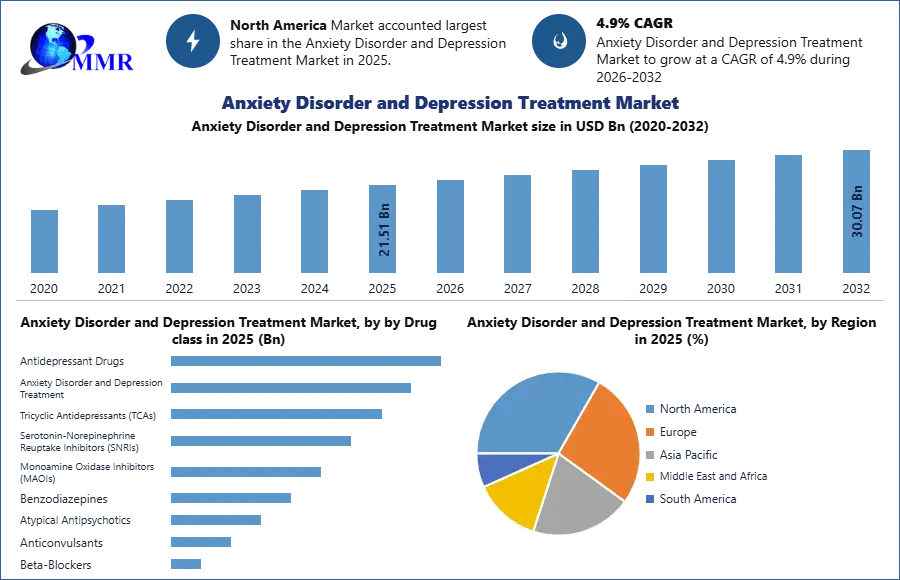 To know about the Research Methodology:-Request Free Sample Report
Anxiety Disorder and Depression Treatment Market Dynamics:
Anxiety Disorder and Depression Treatment Market Drivers and Restraints
Increasing prevalence of mental health issues and disorders like anxiety disorder and depression, followed by rising demand for antidepressants due to minimal side effects associated with these medications and growing awareness levels amongst the consumers, are the factors fuelling the growth of the global market during the forecast period. The growing population with mental issues like Alzheimer's, trauma is also acting as a driving factor for the global market. The high cost associated with the use of these devices and therapies, including anaesthesia and hospital stay, has hampered the growth of the global market.
| Exact Date | Company | Development | Impact |
|---|---|---|---|
| 04 March 2026 | Axsome Therapeutics, Inc. | Axsome Therapeutics officially kicked off the CLARITY Phase 3 trial evaluating solriamfetol for the treatment of Major Depressive Disorder (MDD) with excessive daytime sleepiness. | The study aims to address specific residual symptoms of depression, potentially expanding the clinical utility of their DNRI and TAAR1 agonist platform. |
| 30 January 2026 | Flow Neuroscience | The FDA granted regulatory clearance for a first-of-its-kind at-home, non-drug brain stimulation device for adults with moderate to severe Major Depressive Disorder (MDD). | This tDCS wearable headset expands access to neuromodulation-based care, offering a prescription-only alternative for patients seeking treatments beyond traditional pharmaceuticals. |
| 06 November 2025 | Johnson & Johnson | Johnson & Johnson received FDA approval for Caplyta (lumateperone) as an adjunctive therapy to oral antidepressants for the treatment of Major Depressive Disorder (MDD) in adults. | This approval, following the $14.6 billion acquisition of Intra-Cellular Therapies, positions the drug to target a $5 billion annual sales milestone by serving 22 million Americans with clinical depression. |
| 08 September 2025 | Cybin Inc. | Cybin completed enrollment in its Phase 2 study of CYB004, a proprietary deuterated DMT program targeting Generalized Anxiety Disorder (GAD). | The milestone advances a next-generation psychedelic therapeutic aimed at providing rapid-onset and durable relief for the 300 million people worldwide affected by anxiety. |
| 25 August 2025 | AbbVie / Gilgamesh Pharmaceuticals | AbbVie entered into a definitive agreement to acquire Gilgamesh Pharmaceuticals’ bretisilocin (GM-2505), a novel Phase 2 psychedelic compound for Major Depressive Disorder. | The $1.2 billion deal underscores a major industry shift toward short-acting serotonin receptor agonists to enhance psychiatric care for treatment-resistant patients. |
| 21 January 2025 | Johnson & Johnson | The FDA approved Spravato (esketamine) CIII nasal spray as the first monotherapy for adults with Treatment-Resistant Depression (TRD). | By removing the requirement for concurrent oral antidepressants, this label expansion provides greater clinical flexibility and simplifies the treatment pathway for hard-to-treat depression. |
Anxiety Disorder and Depression Treatment Market Segment Analysis:
In 2025, the Antidepressant Drugs segment continues to dominate the market, with high demand for Tricyclic Antidepressants (TCAs) and Serotonin-Norepinephrine Reuptake Inhibitors (SNRIs) due to their established efficacy in treating depression and anxiety disorders. Benzodiazepines maintain significant usage for short-term management of acute anxiety episodes, while Atypical Antipsychotics and Anticonvulsants are increasingly prescribed for treatment-resistant cases. Beta-Blockers are primarily used for symptom management in specific anxiety-related conditions. Overall, antidepressants remain the backbone of pharmacological intervention, while newer classes address niche or complex patient needs.
Cognitive Behavioral Therapy (CBT) and Psychotherapy continue to be the most widely adopted non-pharmacological treatments in 2025, supported by their long-term effectiveness and minimal side effects. Electroconvulsive Therapy (ECT) and Deep Brain Stimulation (DBS) are reserved for severe or treatment-resistant cases, showing steady but limited adoption. Emerging therapies such as Transcranial Magnetic Stimulation (TMS) and Cranial Electrotherapy Stimulation (CES) are witnessing gradual uptake due to growing awareness, technological advances, and increasing availability in clinical settings.
Major Depressive Disorder remains the largest application segment in 2025, driven by rising prevalence and increased diagnosis rates. Anxiety-related disorders, including Phobias and Obsessive Compulsive Disorder, also contribute substantially to market demand. Post-traumatic Stress Disorder (PTSD) treatment is growing steadily, particularly in regions with high mental health awareness. Overall, the market is shaped by both high-prevalence conditions and the increasing adoption of holistic treatment approaches combining pharmacological and therapeutic interventions.
| Anxiety Disorder and Depression Treatment Market | |||
|---|---|---|---|
| Report Coverage | Details | ||
| Base Year: | 2025 | Forecast Period: | 2026-2032 |
| Historical Data: | 2020 to 2025 | Market Size in 2025: | 21.51 USD Bn |
| Forecast Period 2026-2032 CAGR: | 4.9% | Market Size in 2032: | 30.07 USD Bn |
| Segments Covered: | by Drug class | Antidepressant Drugs Anxiety Disorder and Depression Treatment Tricyclic Antidepressants (TCAs) Serotonin-Norepinephrine Reuptake Inhibitors (SNRIs) Monoamine Oxidase Inhibitors (MAOIs) Benzodiazepines Atypical Antipsychotics, Anticonvulsants Beta-Blockers Benzodiazepines |
|
| by Therapies | Electroconvulsive Therapy (ECT), Cognitive Behavior Therapy (CBT) Psychotherapy Deep Brain Stimulation Transcranial Magnetic Stimulation (TMS) Cranial electrotherapy stimulation (CES) |
||
| by Application | Phobia Major Depressive Disorder Obsessive Compulsive Disorder Post–traumatic stress Disorder Others |
||
Anxiety Disorder and Depression Treatment Market Regional Insights
North America leads the global Anxiety Disorder and Depression Treatment Market in 2025, driven by advanced healthcare infrastructure, high mental health awareness, and strong adoption of both pharmacological and therapy-based interventions. Europe holds a significant share due to well-established healthcare systems and government initiatives promoting mental health. Asia Pacific shows robust growth, fueled by increasing mental health awareness, expanding pharmaceutical manufacturing, and improving access to treatment in countries such as India, Japan, and China. Middle East & Africa and South America exhibit moderate growth, influenced by emerging healthcare investments and gradual improvements in mental health services.
Anxiety Disorder and Depression Treatment Market Competitive Landscape
The treatment space for anxiety and depression is rapidly growing and is characterized by intense competition between the two pharmaceutical leaders (Pfizer and Eli Lilly). Pfizer continues to expand its breadth of branded antidepressants (e.g., Zoloft), heavily invests in fast-acting therapies for mental health disorders, and continues to pursue a growing set of digital health partnerships to improve treatment adherence.
Eli Lilly is deploying its new depression products (e.g., Zepbound, which targets treatment-resistant depression) and has a deep pipeline, including neuropsychiatric drugs, on the move. Eli Lilly has a unique array of activities providing a direct-to-patient telehealth service. Both companies are similarly trying to integrate substantially more AI into drug development and clinical trials, with Eli Lilly making substantial progress with psychedelic-adjacent compounds, and Pfizer primarily focusing on novel SSRI formulations. Pfizer and Eli Lilly's competition consists of three main aspects: the efficacy of new mechanisms (i.e., Lilly's NMDA-targeting and Pfizer's SNDRI), the integration of their new digital ecosystem with different stakeholders, and meeting competitor managed care formulary positions, which Lilly currently leads, with its flagship products, enjoying 30% more insurance coverage.
Anxiety Disorder and Depression Treatment Market Key Trends
| Category | Key Trend | Example Product/Innovation | Market Impact |
| Digital Therapeutics | AI-powered mental health platforms are gaining adoption | Woebot (AI chatbot for CBT) | 30% better patient engagement vs traditional therapy; 25% CAGR growth expected (2023-2030) |
| Rapid-Acting Medications | Next-gen antidepressants with faster onset | Johnson & Johnson's Spravato (esketamine) | Reduces depressive symptoms within 24 hours for 65% of patients; $1.2B market by 2025 |
| Neuromodulation Advances | Non-invasive brain stimulation therapies | NeuroStar TMS Therapy | FDA-approved for treatment-resistant depression; 40% adoption growth in clinics |
| Psychedelic-Assisted Therapy | Breakthrough status for novel treatments | Compass Pathways' psilocybin therapy | Potential to treat 50% of resistant cases; projected $3B market by 2030 |
| Personalized Medicine | Genetic testing to optimize treatment selection | GeneSight Psychotropic test | Improves response rates by 50%; used in 35% of U.S. psychiatric practices |
| Telepsychiatry Expansion | Virtual therapy is becoming mainstream | BetterHelp online counselling | 40% YoY growth post-pandemic; covers 85% of U.S. health plans |
Anxiety Disorder and Depression Treatment Market Scope: Inquire before buying
Anxiety Disorder and Depression Treatment Market, by Region
North America (United States, Canada and Mexico)
Europe (United Kingdom, France, Germany, Italy, Spain, Sweden, Russia, Rest of Europe)
Asia Pacific (China, Japan, South Korea, India, Australia, Malaysia, Thailand, Vietnam, Indonesia, Philippines, Rest of APAC)
Middle East and Africa (South Africa, GCC, Nigeria, Egypt, Turkey, Rest of MEA)
South America (Brazil, Argentina, Colombia, Chile, Peru, Rest of South America)
Key Players /Competitor Profiles Covered in the Anxiety Disorder and Depression Treatment Market Report from a Strategic Perspective.
- Eli Lilly and Company
- Forest Laboratories Inc.
- Merck and Co. Inc.
- Pfizer Inc.
- Johnson and Johnson
- Bristol-Myers Squibb Company
- Mylan NV
- Amneal Pharmaceuticals Inc.
- AstraZeneca PLC
- GlaxoSmithKline plc
- H Lundbeck A/S
- Novartis AG
- Sumitomo Dainippon Pharma Co. Ltd.
- Sanofi-Aventis
- Glenmark Life Sciences Limited
- Lupin Limited
- Sun Pharmaceutical Industries Ltd.
- Intas Pharmaceuticals Ltd.
- Takeda Pharmaceutical Company Limited
- Teva Pharmaceutical Industries Ltd.
- Otsuka Pharmaceutical Co. Ltd.
- Eisai Co. Ltd.
- Aurobindo Pharma Limited
- Mitsubishi Tanabe Pharma Corporation
- Boehringer Ingelheim GmbH