
Dengue Testing Market – Industry Structure Evaluation, Demand Drivers Analysis, Regional Growth Analysis and Identification, Competitive Positioning Review & Global Market Size Forecast to 2034
Overview
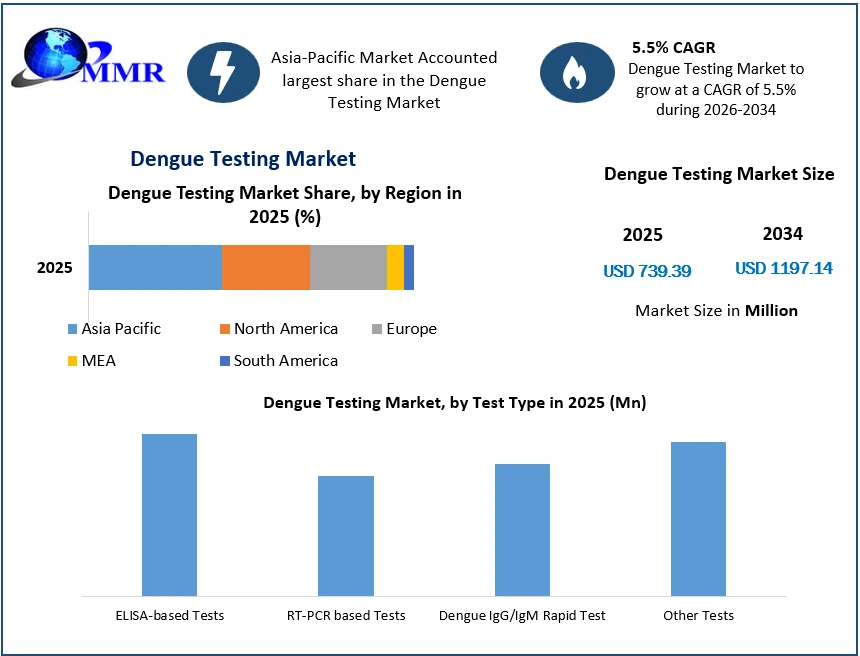
Dengue Testing Market size is expected to reach nearly USD 1197.14 Mn. by 2034 with the CAGR of 5.5% during the forecast period.
Dengue Testing Market Overview:
The global Dengue Testing Market is witnessing steady growth due to the rising incidence of dengue fever across tropical and subtropical regions, increasing government surveillance programs, and growing awareness regarding early diagnosis and disease management. Dengue testing comprises laboratory-based and point-of-care diagnostic methods, including RT-PCR assays, ELISA-based tests, NS1 antigen detection tests, and IgM/IgG rapid diagnostic kits, which enable timely identification of dengue virus infections. These diagnostic solutions are extensively utilized in hospitals, diagnostic laboratories, public health laboratories, research institutes, and community healthcare settings. The increasing frequency of dengue outbreaks driven by rapid urbanization, climate change, international travel, and expanding mosquito habitats has intensified the demand for accurate and rapid diagnostic technologies. Furthermore, continuous advancements in molecular diagnostics, multiplex PCR platforms, automated immunoassays, and highly sensitive rapid diagnostic tests are improving diagnostic accuracy while reducing turnaround time, supporting the expansion of the global Dengue Testing Market.
The market is expected to experience significant growth over the forecast period as healthcare systems increasingly adopt decentralized testing, digital healthcare solutions, and AI-enabled diagnostic platforms to strengthen infectious disease surveillance. Investments in public health infrastructure, expanding laboratory networks in emerging economies, and the integration of connected diagnostic devices with disease reporting systems are creating new growth opportunities for market participants. Additionally, increasing research on multiplex infectious disease testing, portable molecular diagnostic devices, and smartphone-enabled point-of-care testing is transforming dengue diagnosis in resource-limited settings. While affordability constraints, limited laboratory infrastructure in low-income countries, and variability in diagnostic performance during different stages of infection remain challenges, ongoing innovation, favorable government initiatives, and greater emphasis on outbreak preparedness are expected to sustain long-term market growth, making dengue testing an integral component of global infectious disease control strategies.
Dengue Testing Market Snapshot
To know about the Research Methodology :- Request Free Sample Report
Dengue Testing Market Dynamics:
Rising prevalence of dengue outbreaks and expanding surveillance programs are accelerating market growth
The increasing incidence of dengue infections across Asia Pacific, Latin America, and parts of Africa is significantly driving demand for reliable diagnostic solutions. Rapid urbanization, climate change, population mobility, and the expansion of mosquito breeding habitats have increased the frequency and intensity of dengue outbreaks, prompting governments to strengthen disease surveillance and early diagnosis initiatives. Public health agencies are investing in laboratory infrastructure, mass screening campaigns, and integrated vector-borne disease monitoring systems to improve outbreak response. Simultaneously, hospitals and diagnostic laboratories are expanding the adoption of NS1 antigen assays, ELISA-based tests, and RT-PCR platforms to ensure timely detection and clinical intervention. Continuous improvements in diagnostic sensitivity, laboratory automation, and molecular testing technologies are further supporting the growth of the Global Dengue Testing Market.
Growing adoption of decentralized diagnostics and multiplex testing is creating new market opportunities
Healthcare providers are increasingly shifting toward point-of-care (POC) diagnostics that enable rapid testing in community clinics, emergency departments, rural healthcare facilities, and outbreak zones. The development of portable molecular diagnostic systems, AI-assisted result interpretation, and smartphone-enabled reporting platforms is improving accessibility while reducing turnaround times. Additionally, manufacturers are introducing multiplex diagnostic panels capable of simultaneously detecting dengue, Zika, and Chikungunya, allowing clinicians to differentiate between co-circulating mosquito-borne diseases using a single test. Expanding investments in home-based testing, digital health integration, and infectious disease preparedness programs are expected to create significant opportunities for diagnostic manufacturers over the forecast period.
High diagnostic costs and limited laboratory infrastructure continue to limit wider adoption
Despite technological advancements, the adoption of advanced dengue diagnostic solutions remains constrained in many low- and middle-income countries. Molecular tests such as RT-PCR require specialized laboratory equipment, skilled personnel, and stringent quality control measures, increasing operational costs. Many endemic regions continue to rely on conventional rapid diagnostic tests because of budget limitations and inadequate healthcare infrastructure. Furthermore, inconsistent reimbursement policies, limited access to accredited laboratories, and supply chain disruptions affecting diagnostic reagents and consumables can delay testing availability during seasonal outbreaks. These challenges reduce testing capacity in resource-constrained settings and hinder the widespread implementation of advanced diagnostic technologies.
Variability in diagnostic accuracy across different stages of infection remains a major industry challenge
Accurate dengue diagnosis remains challenging because the clinical presentation often overlaps with other mosquito-borne and viral infections, including Zika and Chikungunya. The performance of diagnostic methods depends heavily on the stage of infection, requiring appropriate selection of NS1 antigen tests, molecular assays, or antibody-based tests according to symptom onset. False-negative or false-positive results may occur when inappropriate testing methods are used outside their optimal detection window, potentially delaying treatment and outbreak control measures. In addition, maintaining standardized testing protocols, ensuring quality assurance across laboratories, and obtaining regulatory approvals for next-generation diagnostic technologies remain ongoing challenges for manufacturers seeking to expand globally.
Dengue Testing Market Trends:
- Expansion of rapid point-of-care diagnostic testing - Healthcare systems are increasingly adopting portable point-of-care dengue diagnostic kits that deliver results within minutes, enabling faster clinical decision-making in hospitals, community clinics, and remote healthcare settings. The growing emphasis on decentralized healthcare is accelerating demand for compact and user-friendly testing platforms.
- Growing adoption of multiplex molecular diagnostic platforms - Manufacturers are developing multiplex PCR assays capable of simultaneously detecting dengue, Zika, Chikungunya, and other arboviral infections. These platforms improve diagnostic efficiency, reduce laboratory workload, and support comprehensive infectious disease surveillance in endemic regions.
- Integration of AI and digital health technologies into diagnostics - Artificial intelligence and digital connectivity are being incorporated into dengue testing workflows to improve result interpretation, reduce operator variability, and enable real-time reporting to public health surveillance systems. Mobile-enabled diagnostic platforms are further enhancing outbreak monitoring and epidemiological analysis.
- Increasing development of home-based dengue testing solutions - Diagnostic manufacturers are introducing self-testing kits and simplified rapid antigen assays designed for home use, improving accessibility and enabling earlier diagnosis, particularly in regions with limited laboratory access. These innovations are expanding consumer participation in disease monitoring.
- Advancements in highly sensitive NS1 antigen and molecular assays - Continuous improvements in NS1 antigen detection, digital PCR, and RT-PCR technologies are enhancing diagnostic sensitivity and specificity, enabling earlier detection of dengue infections and supporting more effective patient management during outbreaks.
- Strengthening government investments in infectious disease surveillance - Governments and international health organizations are expanding investments in laboratory infrastructure, national surveillance programs, and vector-borne disease monitoring networks. These initiatives are increasing procurement of advanced dengue diagnostic kits while supporting long-term market expansion through improved outbreak preparedness.
Dengue Testing Market Segment Analysis:
Based on Test Type, the market is divided into ELISA-based Tests, RT-PCR based Tests, Dengue IgG/IgM Rapid Test, and Other Tests. ELISA-based Tests dominated the global Dengue Testing Market in 2025 owing to their high diagnostic accuracy, cost-effectiveness, and widespread use in hospitals, diagnostic laboratories, and public health surveillance programs. ELISA assays are extensively employed for detecting dengue-specific antibodies and NS1 antigens, making them suitable for large-scale screening during outbreaks. Continuous improvements in immunoassay technologies, increasing laboratory automation, and expanding government-sponsored dengue surveillance initiatives have further strengthened the adoption of ELISA-based testing across endemic regions.
RT-PCR based Tests are expected to witness the fastest growth during the forecast period due to their superior sensitivity, early-stage detection capabilities, and ability to accurately identify dengue viral RNA before antibody production. Growing investments in molecular diagnostics, expanding laboratory infrastructure, and increasing demand for highly accurate confirmatory testing are accelerating their adoption. Meanwhile, Dengue IgG/IgM Rapid Tests continue to gain traction in point-of-care settings because of their rapid turnaround time and ease of use, particularly in resource-limited regions, while Other Tests, including NS1 rapid antigen assays and emerging multiplex diagnostic platforms, are increasingly being adopted to enhance comprehensive infectious disease diagnosis.
Based on End-Users, the market is divided into Hospitals, Diagnostic Centers, and Others. Hospitals accounted for the largest market share in 2025 due to the high volume of dengue patient admissions, availability of advanced diagnostic infrastructure, and increasing implementation of laboratory-based molecular and immunological testing. Hospitals serve as the primary centers for emergency diagnosis, disease confirmation, and patient management during seasonal outbreaks, supported by favorable government healthcare initiatives and continuous investments in infectious disease diagnostics.
Diagnostic Centers are projected to register the fastest growth throughout the forecast period, driven by increasing demand for specialized laboratory services, expanding private diagnostic networks, and greater adoption of automated molecular testing technologies. Rising health awareness, preventive screening initiatives, and growing accessibility to advanced diagnostic facilities are further contributing to segment growth. The Others segment, which includes public health laboratories, academic research institutes, blood banks, and community healthcare centers, also plays an important role in epidemiological surveillance, outbreak monitoring, and infectious disease research, supporting the overall expansion of the Global Dengue Testing Market.
Dengue Testing Market Regional Insights:
Asia Pacific dominated the Global Dengue Testing Market in 2025 and is expected to maintain its leading position throughout the forecast period due to the high prevalence of dengue fever across countries such as India, Indonesia, Thailand, the Philippines, Vietnam, and Malaysia. Favorable climatic conditions, rapid urbanization, population growth, and the widespread presence of Aedes mosquitoes contribute to frequent dengue outbreaks, resulting in substantial demand for diagnostic testing. Governments across the region are strengthening disease surveillance programs, expanding public healthcare infrastructure, and investing in laboratory modernization and early disease detection initiatives. Increasing adoption of RT-PCR and ELISA-based diagnostic technologies, growing awareness of early diagnosis, and support from organizations such as the World Health Organization (WHO) are further accelerating market growth. The presence of expanding diagnostic laboratory networks and increasing healthcare expenditure also reinforces Asia Pacific's market leadership.

North America is expected to witness the fastest growth during the forecast period, supported by increasing travel-related dengue cases, rising awareness of vector-borne diseases, and growing investments in advanced molecular diagnostics and infectious disease surveillance. Europe continues to expand its dengue testing capabilities through enhanced public health monitoring, improved laboratory infrastructure, and research collaborations focused on emerging infectious diseases. Latin America, particularly Brazil, Mexico, Colombia, and Peru, remains a significant market owing to recurring dengue epidemics, government-led vector control programs, and widespread deployment of rapid diagnostic tests. Meanwhile, the Middle East & Africa is experiencing steady growth due to improving healthcare infrastructure, increasing diagnostic accessibility, expanding disease surveillance initiatives, and greater investment in laboratory capacity to address the growing burden of mosquito-borne diseases.
Dengue Testing Market Recent Industry Developments:
| Date | Recent Development |
| 06 Jun 2025 | bioMérieux received expanded regulatory recognition for selected infectious disease molecular diagnostic solutions, strengthening its portfolio for vector-borne disease testing and laboratory diagnostics. |
| 12 Mar 2025 | Abbott Laboratories expanded the availability of rapid infectious disease diagnostic solutions across emerging healthcare markets, supporting faster detection of mosquito-borne diseases, including dengue. |
| 18 Sep 2024 | F. Hoffmann-La Roche Ltd. enhanced its molecular diagnostics portfolio by introducing advanced PCR workflow improvements designed to increase testing efficiency for infectious diseases. |
| 15 Jul 2024 | SD Biosensor Inc. expanded the commercialization of rapid diagnostic testing products across Asia Pacific and Latin America to improve access to infectious disease diagnostics in dengue-endemic regions. |
| 22 Feb 2024 | QIAGEN N.V. introduced new molecular assay enhancements for infectious disease detection, reinforcing its syndromic and vector-borne disease testing capabilities through improved PCR-based workflows. |
Dengue Testing Market Competitive Landscape:
The Global Dengue Testing Market is moderately competitive, with leading diagnostic companies focusing on expanding their infectious disease testing portfolios through product innovation, strategic collaborations, regulatory approvals, and investments in molecular diagnostics. Market participants are strengthening their positions by developing highly sensitive RT-PCR assays, ELISA-based immunoassays, rapid antigen and antibody tests, and multiplex diagnostic platforms capable of detecting multiple vector-borne diseases simultaneously. Companies are also investing in automated laboratory systems, point-of-care testing technologies, digital health integration, and AI-enabled diagnostic solutions to improve testing accuracy and reduce turnaround times. Strategic partnerships with healthcare providers, public health agencies, and research institutions, along with capacity expansion in emerging economies, continue to support market growth. Additionally, manufacturers are prioritizing quality assurance, regulatory compliance, and sustainable production practices to enhance their global competitiveness.
Major players including F. Hoffmann-La Roche Ltd., Abbott Laboratories, bioMérieux SA, Thermo Fisher Scientific Inc., Danaher Corporation (Cepheid and Beckman Coulter), Bio-Rad Laboratories, Siemens Healthineers AG, QIAGEN N.V., SD Biosensor Inc., and InBios International Inc. are continuously strengthening their market presence through new product launches, technological advancements, and geographic expansion. These companies are focusing on developing rapid, highly accurate, and user-friendly dengue diagnostic solutions while expanding molecular testing capabilities and multiplex infectious disease panels. Their emphasis on research and development, strategic acquisitions, collaborations with government health agencies, and expansion of manufacturing and distribution networks enables them to address the increasing global demand for early and accurate dengue diagnosis.
Dengue Testing Market Scope: Inquire before buying
| Dengue Testing Market | |||
|---|---|---|---|
| Report Coverage | Details | ||
| Base Year: | 2025 | Forecast Period: | 2026-2034 |
| Historical Data: | 2020 to 2025 | Market Size in 2025: | USD 739.39 Mn. |
| Forecast Period 2026 to 2034 CAGR: | 5.5% | Market Size in 2034: | USD 1197.14 Mn. |
| Segments Covered: | By Test Type | ELISA-based Tests RT-PCR based Tests Dengue IgG/IgM Rapid Test Other Tests |
|
| By End-Users | Hospitals Diagnostic Centers Others |
||
Dengue Testing Market, by Region
North America (United States, Canada and Mexico)
Europe (UK, France, Germany, Italy, Spain, Sweden, Austria, Turkey, Russia and Rest of Europe)
Asia Pacific (China, India, Japan, South Korea, Australia, ASEAN and Rest of APAC)
Middle East and Africa (South Africa, GCC, Egypt, Nigeria and Rest of ME&A)
South America (Brazil, Argentina, Columbia and Rest of South America)
Dengue Testing Market, Key Players are
North America
- Abbott Laboratories (Illinois, United States)
- Thermo Fisher Scientific Inc. (Massachusetts, United States)
- Bio-Rad Laboratories, Inc. (California, United States)
- Danaher Corporation (Washington, D.C., United States)
- OraSure Technologies, Inc. (Pennsylvania, United States)
- InBios International, Inc. (Washington, United States)
Europe
- F. Hoffmann-La Roche Ltd. (Basel, Switzerland)
- QIAGEN N.V. (Venlo, Netherlands)
- bioMérieux SA (Marcy-l'Étoile, France)
- Siemens Healthineers AG (Erlangen, Germany)
- EKF Diagnostics Holdings plc (Cardiff, United Kingdom)
Asia Pacific
- SD Biosensor, Inc. (Suwon, South Korea)
- Seegene Inc. (Seoul, South Korea)
- Sysmex Corporation (Kobe, Japan)
- Sansure Biotech Inc. (Changsha, China)
- J. Mitra & Co. Pvt. Ltd. (New Delhi, India)
- Molbio Diagnostics Pvt. Ltd. (Goa, India)
Others
Frequently Asked Questions:
1. Which region has the largest share in Global Dengue Testing Market?
Ans: Asia Pacific region held the highest share in 2025.
2. What is the growth rate of Global Dengue Testing Market?
Ans: The Global Dengue Testing Market is growing at a CAGR of 5.5% during forecasting period 2026-2034.
3. What is scope of the Global Dengue Testing market report?
Ans: Global Dengue Testing Market report helps with the PESTEL, PORTER, COVID-19 Impact analysis, Recommendations for Investors & Leaders, and market estimation of the forecast period.
4. Who are the key players in Global Dengue Testing market?
Ans: The important key players in the Global Dengue Testing Market are – Thermo Fisher Scientific Inc., Roche Molecular Systems Inc., Abbott Laboratories, Abnova Corporation, InBios International, Inc., NovaTec Immundiagnostica GmbH, Euroimmun AG (Sub. PerkinElmer), Quest Diagnostics, Certest Biotec S.L., OriGene Technologies, Arkray Inc., Ceres Nanosciences Inc., Corgenix Medical Corp, FK-Biotecnologia SA, QuantuMDx Group Ltd., Sansure Biotech Inc., and Quidel Corp
5. What is the study period of this market?
Ans: The Global Dengue Testing Market is studied from 2025 to 2034.