
Anti-Obesity Prescription Drugs Market – Industry Structure Evaluation, Demand Drivers Analysis, Regional Growth Analysis and Identification, Competitive Positioning Review & Global Market Size Forecast to 2034
Overview
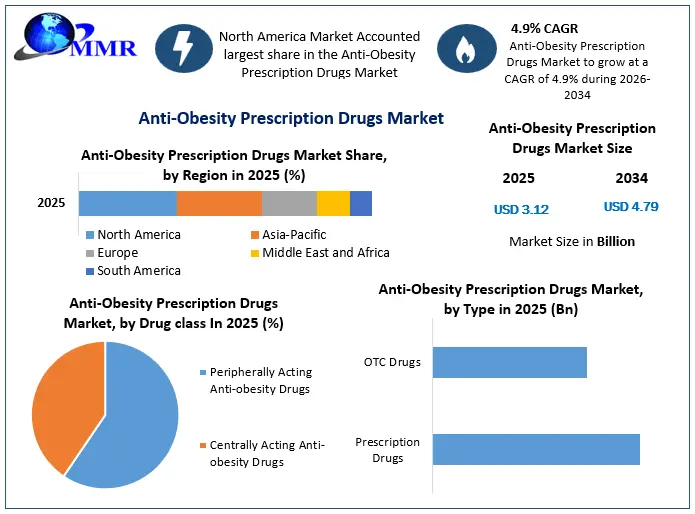
Anti-Obesity Prescription Drugs Market was valued at USD 3.12 Bn. in 2025 and the total Global Anti-Obesity Prescription Drugs Market revenue is Expected to grow at a CAGR of 4.9% from 2026 to 2032 reaching nearly USD 4.79 Bn. by 2034.
According to past study 650 Mn individuals in 1965 had corpulent body and recent study data shows the obesity has tripled in 2023, giving a number of 1.6 Bn individuals who are suffering from overweight problems. A corpulent individual is at a higher risk of developing chronic diseases like endometrial cancer, breast cancer, colon cancer, type 2 diabetes, cardiovascular diseases, and musculoskeletal disorders.
Anti-Obesity Prescription Drugs Market Snapshot
 To know about the Research Methodology :- Request Free Sample Report
The drug which inhibit fat absorption, energy intake, enhance energy expenditure and stimulate fat mobilization are known as Anti-Obesity Drugs. The FDA has approved five different types of Anti-Obesity Prescription Drugs lorcaserin (Belviq), orlistat (Xenical), phentermine-topiramate (Qsymia), naltrexone-bupropion (Contrave), and liraglutide (Saxenda).Global Anti-Obesity Prescription Drugs Market Drivers and RestrainsThe report study has analyzed revenue impact of COVID -19 pandemic on the sales revenue of market leaders, market followers and market disrupters in the report and same is reflected in our analysis.
According to, Disease Control & Prevention Centers show that 68.8% of the United State population is obese. The increasing incidence of the condition is followed by growing awareness of the same. Because of, the increasing awareness of anxiety that customers shift to anti-obesity drugs is rising at a prominent step. Obesity can be credited as an incurable chronic disease that increases the risk of cardiovascular diseases like diabetes, hypertension, and strokes. Sometimes, lifestyle intervention fails to impart potential results and a huge proportion of patients obvert their customary standards to enhance positive clinical outcome with the consumption of prescribed weight loss drugs.
Advanced technique of skin patch delivery that permits for the administration of anti-obesity prescription drugs with low risk of side effects. Furthermore, the development of Nano Soy-Phytosome based thermo gels as the interesting formulations of anti-obesity is a key novelty in the market. Herbal supplements are the recent trend in the anti-obesity prescription drugs market. These trends are expected to boost opportunities for the growth of sellers in the global anti-obesity drugs market. The top Food and Drug Administration (FDA) approved anti-obesity drugs are Contrave, Belviq, Xenical, Saxenda and Qsymia. In United State, Xenical was the largest selling drug in the market until 2012, because of the character for unpleasant gastrointestinal side effects showed by Xenical. Though, recently approved Saxenda by Novo Nordisk Pharma is gaining large interest between obese individuals and is growing at a unanimous rate.
Manufacturers in the Anti-Obesity Prescription Drugs are focusing on competitive pricing as the strategy to capture significant market share. Moreover, strategic mergers and acquisitions and technological innovations are also the key focus areas of the manufacturers.
Anti-Obesity Prescription Drugs Market Segment Analysis
Based on the Drug type the Anti-Obesity Prescription Drugs Market is segmented into Contrave, Belviq, Xenical, Saxenda and Qsymia. Saxenda segment dominated the market in 2025 and is expected to hold largest share during the forecast period. Saxenda, a GLP-1 receptor agonist, gained strong adoption due to its high efficacy in weight management, ability to improve metabolic health, and proven clinical outcomes compared to other drugs. Rising obesity prevalence, physician preference for GLP-1 therapies, and favorable reimbursement policies further boosted demand. Its dual benefits of weight reduction and diabetes risk management made it the most widely prescribed option.
Based on the Application the Market is Segmented into Hospitals Pharmacies, Retail Pharmacies and E-commerce. Hospital Pharmacies dominated the market in 2025 and is expected to hold largest share during the forecast period. Hospitals serve as the primary channel for prescribing and dispensing anti-obesity and weight management drugs, as they are directly linked with physician consultations and patient monitoring. The strong trust factor, immediate availability of prescribed medications, and integration with treatment plans give hospital pharmacies an advantage over retail and e-commerce channels, making them the largest contributor to overall market revenue.
Anti-Obesity Prescription Drugs Market Regional Insights
In terms of regional analysis North America is expected to emerge as a leading region in the global anti-obesity prescription drugs market during the forecast period. Because of the awareness of obesity among the population and the risks associated with the health situation have resulted in the anti-obesity prescription drugs market describing flourished growth in the region over the years. The Asia Pacific market for anti-obesity prescription drugs is anticipated to drive in the coming years, thanks to the rise in obese population. The European Medicines Agency (EMA), retreated the utilization of a series of anti-obesity drugs attributed to prohibited proportion of threat to benefit ratio, in 2000. Anti-obesity prescriptive drug like Rimonabant was available in more than 55 countries Afterward, in the year 2009 Rimonabant was withdrawn from the European anti-obesity prescription drugs market due to serious psychiatric side effects. In recent times, numerous development have been tested and examined, but only orlistat and sibutramine have been permitted for long-term use.
The objective of the report is to present comprehensive analysis of Global Market including all the stakeholders of the industry. The past and current status of the industry with forecasted market size and trends are presented in the report with the analysis of complicated data in simple language. The report covers all the aspects of industry with dedicated study of key players that includes market leaders, followers and new entrants by region.
PORTER, SVOR, PESTEL analysis with the potential impact of micro-economic factors by region on the market have been presented in the report. External as well as internal factors that are supposed to affect the business positively or negatively have been analyzed, which will give clear futuristic view of the industry to the decision makers.
The report also helps in understanding Global Market dynamics, structure by analyzing the market segments, and project the Global Market size. Clear representation of competitive analysis of key players by Type, price, financial position, product portfolio, growth strategies, and regional presence in the Global Market make the report investor’s guide.
Anti-Obesity Prescription Drugs Market Recent Industry Developments
| Date | Company | Development | Impact |
|---|---|---|---|
| 11 March 2025 | F. Hoffmann-La Roche Ltd | Roche entered an exclusive multi-billion dollar collaboration and licensing agreement with Zealand Pharma to co-develop and co-commercialize petrelintide, a long-acting amylin analog intended for chronic weight management. | The deal is valued up to USD 5.3 billion and grants Roche exclusive commercialization rights globally outside of the U.S. and Europe. |
| 31 March 2025 | U.S. Food and Drug Administration (FDA) | The US FDA officially released its new draft guidance for obesity medications, formally reclassifying obesity as a "chronic disease" rather than a mere health risk. | This regulatory shift streamlines clinical evaluation standards and mandates that Phase 3 registration trials incorporate standardized lifestyle-modification programs. |
| 22 October 2025 | AstraZeneca plc | AstraZeneca finalized its strategic acquisition of Swiss biotechnology company SixPeaks Bio AG to accelerate its pipeline of next-generation metabolic therapeutics. | The deal is valued at up to USD 300 million and adds bispecific antibodies targeting muscle-preservation pathways during weight loss to AstraZeneca's metabolic clinical portfolio. |
| 01 April 2026 | Eli Lilly and Company | Eli Lilly achieved a major clinical milestone by securing US FDA approval for orforglipron, an oral small-molecule non-peptide GLP-1 receptor agonist indicated for obesity and overweight management. | This approval introduces the first oral small-molecule GLP-1 therapy into a clinical market historically dominated by injectable peptide biologics, reducing injection barriers. |
| 29 April 2026 | Zealand Pharma A/S | Zealand Pharma and partner Roche secured official program endorsement to advance their long-acting amylin analog, petrelintide, into global Phase 3 clinical trials following positive Phase 2 outcome readouts. | The Phase 3 program evaluates once-weekly subcutaneous dosing for chronic weight management, positioning the asset as a major non-GLP-1 mechanism alternative. |
Anti-Obesity Prescription Drugs Market Scope: Inquire before buying
| Anti-Obesity Prescription Drugs Market | |||
|---|---|---|---|
| Report Coverage | Details | ||
| Base Year: | 2025 | Forecast Period: | 2026-2034 |
| Historical Data: | 2020 to 2025 | Market Size in 2025: | USD 3.12 Bn. |
| Forecast Period 2026 to 2034 CAGR: | 4.9% | Market Size in 2034: | USD 4.79 Bn. |
| Segments Covered: | by Drug Type | Contrave Belviq Xenical Saxenda Qsymia |
|
| by Type | Prescription Drugs OTC Drugs |
||
| by Drug class | Peripherally Acting Anti-obesity Drugs Centrally Acting Anti-obesity Drugs |
||
| by Sales channel | Direct Channel Distribution Channel |
||
| by Application | Hospitals Pharmacies Retail Pharmacies E-commerce |
||
Anti-Obesity Prescription Drugs Market, by Region
North America (United States, Canada and Mexico)
Europe (UK, France, Germany, Italy, Spain, Sweden, Austria and Rest of Europe)
Asia Pacific (China, South Korea, Japan, India, Australia, Indonesia, Malaysia, Vietnam, Taiwan, Bangladesh, Pakistan and Rest of APAC)
Middle East and Africa (South Africa, GCC, Egypt, Nigeria and Rest of ME&A)
South America (Brazil, Argentina Rest of South America)
Anti-Obesity Prescription Drugs Market, Key Players
1. GLP-1 Receptor Agonists & Incretin-Based Therapies
These companies develop drugs that mimic gut hormones to regulate appetite, food intake, blood sugar levels, and body weight.
Europe
1. Novo Nordisk A/S – Denmark
North America
1. Eli Lilly and Company – United States
Asia Pacific
1. Hanmi Pharmaceutical Co., Ltd. – South Korea
2. Obesity-Focused Pharmaceutical Developers
These companies have dedicated obesity and metabolic disease drug development programs.
North America
1. Eli Lilly and Company – United States
2. Amgen Inc. – United States
3. Viking Therapeutics, Inc. – United States
4. Structure Therapeutics Inc. – United States
Europe
1. Novo Nordisk A/S – Denmark
2. AstraZeneca PLC – United Kingdom
Asia Pacific
1. Hanmi Pharmaceutical Co., Ltd. – South Korea
3. Metabolic Disease & Cardiometabolic Therapy Companies
These companies develop therapies targeting obesity-related metabolic disorders including diabetes, cardiovascular disease, and metabolic syndrome.
North America
1. Eli Lilly and Company – United States
2. Pfizer Inc. – United States
3. Amgen Inc. – United States
Europe
1. Novo Nordisk A/S – Denmark
2. AstraZeneca PLC – United Kingdom
3. Roche Holding AG – Switzerland
Asia Pacific
1. Daiichi Sankyo Company, Limited – Japan
4. Appetite Regulation & Weight Management Drug Developers
These companies focus on therapies that suppress appetite, improve satiety, or regulate energy balance.
North America
1. Currax Pharmaceuticals LLC – United States
2. Vivus LLC – United States
3. Amgen Inc. – United States
4. Viking Therapeutics, Inc. – United States
Europe
1. Novo Nordisk A/S – Denmark
Asia Pacific
1. Hanmi Pharmaceutical Co., Ltd. – South Korea
5. Next-Generation Obesity Drug Innovators
These companies are developing emerging therapies such as dual agonists, triple agonists, oral obesity drugs, and novel metabolic treatments.
North America
1. Viking Therapeutics, Inc. – United States
2. Structure Therapeutics Inc. – United States
3. Altimmune, Inc. – United States
4. Amgen Inc. – United States
Europe
1. Novo Nordisk A/S – Denmark
2. Roche Holding AG – Switzerland
Asia Pacific
1. Hanmi Pharmaceutical Co., Ltd. – South Korea
Frequently Asked Questions:
1.Which region has the largest share in Global Anti-Obesity Prescription Drugs Market?
Ans: North America region held the highest share in 2025.
2.What is the growth rate of Global Anti-Obesity Prescription Drugs Market?
Ans: The global market is growing at a CAGR of 4.9% during forecasting period 2026-2034.
3.What is scope of the Global Anti-Obesity Prescription Drugs market report?
Ans: Global market report helps with the PESTEL, PORTER, COVID-19 Impact analysis, Recommendations for Investors & Leaders, and market estimation of the forecast period.
4.Who are the key players in Global market?
Ans: The important key players in the global market are – Phentermine and Topiramate, VIVUS, Inc, F Hoffmann La Roche, Liraglutide, Norgine bv, Bupropion and Naltrexone, Orlistat, Novo Nordisk, Lorcaserin, GlaxoSmith Kline, Eisai Co, Ltd, Boehringer Ingelheim, Merck & Co, Pfizer, Rhythm Pharmaceuticals, Zafgan, Takeda Pharmaceuticals, Novo Nordisk, Bristol-Myers Squibb Co., and Shionogi USA Inc.
5. What is the study period of this market?
Ans: The Global Market is studied from 2025 to 2034.