Alumina Trihydrate Market Size by Type, Application, End-Use Industry, Region, Industry-Wide Analysis, Competitive Landscape Assessment & Long-Term Forecast to 2034

4.84%
CAGR (2026-2034)
1.80 USD Bn.
Forecast Market Size
326
Report Pages
120
Market Tables

Overview

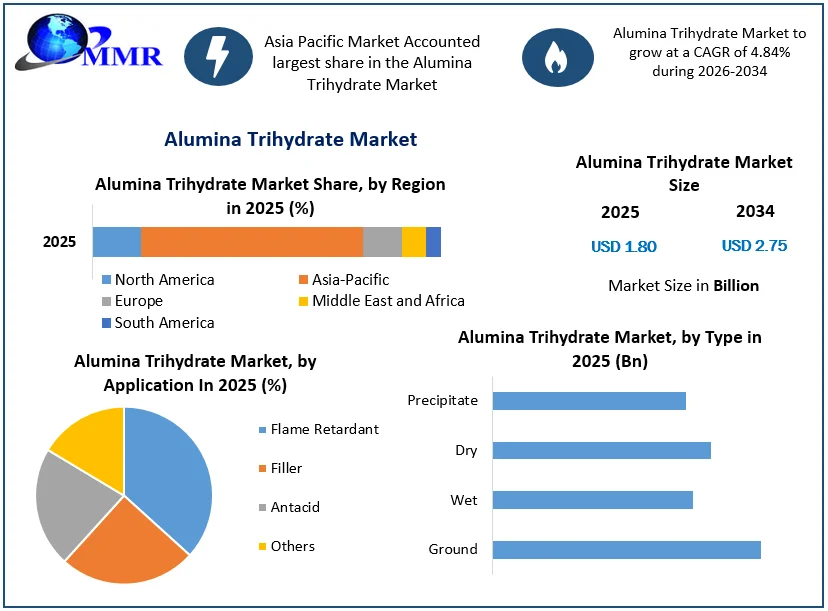
Alumina Trihydrate Market size was valued at USD 1.80 Bn. in 2025 and the total Global Alumina Trihydrate revenue is expected to grow by 4.84% from 2026 to 2034, reaching nearly USD 2.75 Bn.

Alumina Trihydrate Market Overview:

Alumina Trihydrate (ATH) is a white, odorless, non-toxic inorganic compound primarily obtained from bauxite ore through the Bayer process. It is the most common form of aluminum hydroxide and is widely used as a flame retardant, filler, and chemical intermediate. Alumina Trihydrate (ATH) market is growing due to rising demand for halogen-free flame retardants amid stricter fire safety regulations. Rapid infrastructure expansion in emerging economies, such as India’s USD 1.4 trillion National Infrastructure Pipeline and China’s sustained investment in construction and electrical safety, continues to elevate demand. The market is also being driven by factors such as expanding urban infrastructure, growth in polymer and plastic production, and greater investment in water treatment and insulation applications.

Asia Pacific is dominate the Alumina Trihydrate (ATH) Market in 2025, due to rapid industrialization, infrastructure development, and strong demand from end-use sectors like construction and polymers. The Alumina Trihydrate (ATH) market key players are Huber Engineered Materials, Nabaltec AG, Alteo, Aluminum Corporation of China Limited (Chalco), and Sumitomo Chemical Co., Ltd.

In 2025, global ATH trade saw a 24% year-on-year increase, with over 900 recorded import shipments. Major importers include the UAE and Saudi Arabia, while India and the U.S. are among the top exporters. End users of the Alumina Trihydrate (ATH) market include the construction, electrical and electronics, automotive, polymer and plastic, water treatment, and pharmaceutical and cosmetic industries, where ATH is widely applied as a flame retardant, filler, and chemical additive.

Alumina Trihydrate Market Growth and Share Analysis
Alumina Trihydrate Market Size

To know about the Research Methodology:-Request Free Sample Report

Alumina Trihydrate Market Dynamics:

The increased demand for non-halogenated flame retardants over halogenated ones across numerous industries can be attributable to the quick rise of the alumina trihydrate market. The demand for flame retardants like alumina trihydrate is increasing as the number of fires rises. Alumina trihydrate is the most frequently used flame retardant in the world, with applications in engineering plastics, paints and coatings, rubber, paper, and other materials.

The increasing use of engineering plastic in a variety of industries, including construction, automotive, and electronics, is boosting alumina trihydrate demand. During the forecast period, the use of plastic in the automotive industry to reduce overall vehicle weight is expected to drive the market for alumina trihydrate.

The market's most important players are actively spending in research and development. To achieve a competitive advantage, they are working on both organic and inorganic growth methods such as product launches and approvals, mergers and acquisitions, advanced product development, alliances, and collaborations.

The need for flame retardants is rising due to the increased use of engineering plastics in the electronics, building, and automobile industries around the world. As a result of its low cost and lack of toxicity, automobile and electronic manufacturers use alumina trihydrate as a flame retardant in their products. Despite the fact that freshly created alumina trihydrates are meant to replace and overcome restrictions, alumina trihydrate sales are expected to increase.

The need for cost-effective and energy-efficient solutions has driven technological advancements and breakthroughs in recent years. Paints & coatings, polymer & plastic, cosmetics, adhesives, sealants, and personal care, among others, have all seen significant growth in the chemical industry in recent years. The chemical industry's growth will continue to be critical to the alumina trihydrate market's development.

Alumina Trihydrate Market Segment Analysis:

The Alumina Trihydrate Market is segmented by Application, and End-Use Industry.

Based on the End-Use Industry, the market is segmented into Plastics, Papers, Paints and Coatings, Adhesives, Chemicals, Pharmaceuticals Industry, and Others. Plastics End-Use Industry segment is expected to hold the largest market share of xx% by 2034. Plastic composites used in an average automobile account for 10–15 percent of its total weight, and the chemical industry has been accelerating its shift to advancements that tend to have multiple uses, such as the use of plastic in automotive and transport plastic composites used in an average automobile account for 10–15 percent of its total weight. Because plastics are lighter than metals, they reduce the overall weight of the vehicle, making it more efficient.

Because heat generation in automobiles is a high-risk element for fire, it is critical to have high-quality flame retardant characteristics in practically every part of the vehicle's plastic. The need for alumina trihydrate as a flame retardant in automobile polymers is expected to be driven by these factors. Governments around the world are expected to drive the increased demand for alumina trihydrate by enacting laws and regulations regulating automobile safety.

Alumina trihydrate is also preferred by some other end-use industries. Alumina trihydrate, for example, is cost effective and favoured by manufacturers since it can reduce total manufacturing costs by roughly 25%, which is increasing its popularity as a titanium dioxide substitute.

Based on the Application, the market is segmented into Flame Retardant, Filler, Antacid, and Others. Flame Retardant segment is expected to grow rapidly at a CAGR of xx% during the forecast period 2026-2034. Flame retardants help to prevent or delay the spread of fire, which is a vital layer of fire protection. The combustion process is inhibited or suppressed by flame retardants. They reduce the amount of heat emitted by a fire as well as the risk of a fire spreading.

Alumina Trihydrate Market Regional Insights:

Asia Pacific region is expected to dominate the Alumina Trihydrate Market during the forecast period 2026-2034. Asia Pacific region is expected to hold the largest market share of xx% by 2034. The use of alumina trihydrate is increasing in the region as the demand for plastics and the building and construction industries grow in nations like China, India, and Japan. The market is expected to grow due to the presence of large chemical production businesses and growing government supports.

North America region is expected to grow rapidly at a CAGR of 7.1% during the forecast period 2026-2034. Due to high demand for the commodity from the construction industry, the United States is a key user of alumina trihydrate. Because of the constantly developing construction industry in this region, North America is another key region in the alumina trihydrate market. The government's increasing investment in infrastructure projects, such as the renovation of the World Trade Centre, is boosting market growth even more.

Europe region is expected to grow rapidly at a CAGR of 6.5% during the forecast period 2026-2034. The increased demand for paints and coatings in the automotive industry in Europe is expected to drive the alumina trihydrate market. Furthermore, the market is expected to grow due to a flourishing construction sector and increased investment in the refurbishment of homes and commercial buildings over the forecast period.

The objective of the report is to present a comprehensive analysis of the Global Alumina Trihydrate Market to the stakeholders in the industry. The past and current status of the industry with the forecasted market size and trends are presented in the report with the analysis of complicated data in simple language. The report covers all the aspects of the industry with a dedicated study of key players that include market leaders, followers, and new entrants.

PORTER, PESTEL analysis with the potential impact of micro-economic factors of the market has been presented in the report. External as well as internal factors that are supposed to affect the business positively or negatively have been analyzed, which will give a clear futuristic view of the industry to the decision-makers.

The reports also help in understanding the Global Alumina Trihydrate Market dynamic and structure by analyzing the market segments and projecting the Global Alumina Trihydrate Market size. Clear representation of competitive analysis of key players by Distribution Channel, price, financial position, product portfolio, growth strategies, and regional presence in the Alumina Trihydrate Market make the report an investor’s guide.

Alumina Trihydrate Market: Competitive Landscape

Alumina Trihydrate (ATH) market key players are Huber Engineered Materials, Nabaltec AG, Alteo, Aluminum Corporation of China Limited (Chalco), and Sumitomo Chemical Co., Ltd. These companies are driven by their strong production capabilities, application-focused innovations, and established global supply networks. These companies are among the key global participants, marked by consistent R&D investment, product diversification, emphasis on halogen-free flame retardants, and expansion across high-demand industrial sectors like construction, electrical insulation, and automotive. Additionally, Huber, Nabaltec, Alteo, Chalco, and KC Corporation are recognized as leading players accelerating market growth through advanced processing technologies, commitment to sustainable materials, and tailored product solutions for specific flame retardant and filler applications.

Huber Engineered Materials is the leading company in the global ATH market, driven by its broad range of non-halogenated flame retardants and strong ties with polymer and cable industries. In 2025, its ATH-related revenue reached an estimated USD 3 billion, fueled by demand in the electrical, construction, and automotive sectors. The competitive landscape is being reshaped by eco-friendly formulations, technical-grade specialization, and strategic manufacturing expansions, with these firms at the forefront of global ATH market transformation.

Key Trends in Alumina Trihydrate Market:

• Rising Demand for Flame Retardants:
ATH is favored as a non-toxic flame retardant, especially in plastics, wires, cables, and building materials. Regulatory pressures worldwide are encouraging the shift from halogenated to halogen-free retardants, boosting ATH demand.

• Technological Advancements & Sustainability:
Manufacturers are innovating to produce ATH with better thermal stability and environmentally friendly production methods. This is helping ATH find new uses in sectors like pharmaceuticals, water purification, and specialty coatings.

• Regional Market Expansion:
Asia Pacific dominates due to fast urbanization and infrastructure growth in countries like China and India. Meanwhile, North America and Europe are growing steadily, driven by strict fire safety rules and green building trends.

Recent Devlopments in Alumina Trihydrate Market:

Date Company Development Impact
15 January 2025 Huber Engineered Materials Huber Engineered Materials announced a major capacity expansion at its high-purity fine alumina trihydrate (ATH) manufacturing facility in North America. This development significantly increases the global supply of flame retardant additives to meet growing demand in the EV battery and cable insulation markets.
28 March 2025 Nabaltec AG Nabaltec launched its new APYRAL® eco line, featuring ultra-fine surface-modified alumina trihydrate flame retardants tailored for high-temperature thermoplastics. The product line enhances thermal stability and smoke suppression, giving polymer compounding manufacturers eco-friendly alternatives to halogenated additives.
12 June 2025 Albemarle Corporation Albemarle partnered with leading Asian polymer processors to commercialize a novel grade of sub-micron alumina trihydrate filler. The collaboration improves dispersion efficiency and flame retardancy in thin-wall electronics and printed circuit board applications.
19 September 2025 Sumitomo Chemical Co., Ltd. Sumitomo Chemical completed the upgrade of its low-carbon alumina trihydrate production line, incorporating 100% renewable energy for processing. This initiative cuts the product’s embedded carbon footprint by 35%, establishing a strong advantage in sustainable construction and automotive supply chains.
10 February 2026 ALEO Minerals ALEO Minerals signed a multi-year distribution agreement to supply specialty fine-ground alumina trihydrate across European polymer compounding hubs. The agreement strengthens regional supply chain resilience and supports compliance with stringent EU flame retardant safety regulations.

Alumina Trihydrate Market Scope: Inquire before buying

Alumina Trihydrate Market
Report Coverage Details
Base Year: 2025 Forecast Period: 2026-2034
Historical Data: 2020 to 2025 Market Size in 2025: USD 1.80 Bn.
Forecast Period 2026 to 2034 CAGR: 4.84% Market Size in 2034: USD 2.75 Bn.
Segments Covered: by Type Ground
Wet
Dry
Precipitate
by Application Flame Retardant
Filler
Antacid
Others
by End-Use Industry Plastics
Papers
Paints and Coatings
Adhesives
Chemicals
Pharmaceuticals Industry
Others

Alumina Trihydrate Market, by Region

North America (United States, Canada and Mexico)
Europe (UK, France, Germany, Italy, Spain, Sweden, Austria, Turkey, Russia and Rest of Europe)
Asia Pacific (China, India, Japan, South Korea, Australia, ASEAN and Rest of APAC)
Middle East and Africa (South Africa, GCC, Egypt, Nigeria and Rest of ME&A)
South America (Brazil, Argentina, Columbia and Rest of South America)

Alumina Trihydrate Market Key Players :

The Global Alumina Trihydrate refers to the worldwide commercial trade, production, and consumption of alumina trihydrate (ATH) also known as Aluminum Hydroxide.

Company Name Headquarters Core Competencies
Albemarle Corporation Charlotte, North Carolina, USA Specialty chemicals, flame retardants, and alumina-based materials
Huber Engineered Materials Atlanta, Georgia, USA Alumina trihydrate (ATH), flame retardants, and industrial minerals
The R.J. Marshall Company Southfield, Michigan, USA Mineral fillers, ATH products, and industrial additives
Southern Ionics Incorporated West Point, Mississippi, USA High-purity alumina, ATH, and specialty alumina products
Spectrum Chemical Mfg. Corp. Gardena, California, USA Laboratory chemicals, pharmaceutical-grade alumina chemicals, and specialty materials
AluChem Inc. Cincinnati, Ohio, USA Calcined alumina, ATH, and specialty alumina products
Nabaltec AG Schwandorf, Germany Alumina trihydrate, flame retardants, and functional fillers
LKAB Minerals AB Luleå, Sweden Industrial minerals, ATH, and flame-retardant fillers
Sibelco Antwerp, Belgium Industrial minerals, specialty fillers, and alumina products
Alteo Gardanne, France Specialty aluminas, ATH, and high-performance alumina materials
Dadco Group London, United Kingdom Alumina chemicals and specialty industrial minerals
Alcoa Corporation Pittsburgh, Pennsylvania, USA Alumina refining, bauxite mining, and aluminum products
Sumitomo Chemical Co., Ltd. Tokyo, Japan Specialty chemicals and advanced alumina materials
Aluminum Corporation of China Limited (CHALCO) Beijing, China Alumina production, aluminum refining, and mining
Jinan Chenxu Chemical Co., Ltd. Jinan, China Alumina trihydrate, aluminum hydroxide, and chemical additives
Hayashi Kasei Co., Ltd. Osaka, Japan Specialty alumina products and industrial chemicals
Alumina Chemicals & Castables Kolkata, India Alumina chemicals, refractory materials, and castables
Hydro Alunorte Barcarena, Pará, Brazil Alumina refining and bauxite processing
Saudi Arabian Mining Company (Ma'aden) Riyadh, Saudi Arabia Bauxite mining, alumina refining, and aluminum production
Iran Alumina Company Jajarm, Iran Alumina refining and aluminum raw materials
Egyptalum Nag Hammadi, Egypt Aluminum smelting and alumina-based products
Resonac Corporation Tokyo, Japan Advanced materials, specialty alumina, and functional chemicals
Rio Tinto London, United Kingdom Bauxite mining, alumina refining, and aluminum production

Frequently Asked Questions:

1] Which region is expected to hold the highest share in the Alumina Trihydrate Market?
Ans. Asia Pacific region is expected to hold the highest share in the Alumina Trihydrate Market.

2] Who are the top key players in the Alumina Trihydrate Market?
Ans. The Alumina Trihydrate (ATH) market key players are Huber Engineered Materials, Nabaltec AG, Alteo, Aluminum Corporation of China Limited (Chalco), and Sumitomo Chemical Co., Ltd.

3] Which segment is expected to hold the largest market share in the Alumina Trihydrate Market by 2034?
Ans. The Plastics End-Use Industry segment is expected to hold the largest market share in the Alumina Trihydrate Market by 2034.

4] What is the market size of the Alumina Trihydrate Market by 2034?
Ans. The market size of the Alumina Trihydrate Market is expected to reach USD 2.75 Bn. by 2034.

5] What was the market size of the Alumina Trihydrate Market in 2025?
Ans. The market size of the Alumina Trihydrate Market was worth USD 1.80 Bn. in 2025.

Table of Contents

1. Alumina Trihydrate Market Introduction 1.1. Study Assumption and Market Definition 1.2. Scope of the Study 1.3. Executive Summary 2. Global Alumina Trihydrate Market: Competitive Landscape 2.1. MMR Competition Matrix 2.2. Competitive Landscape 2.3. Key Players Benchmarking 2.3.1. Company Name 2.3.2. Business Segment 2.3.3. End-user Segment 2.3.4. Revenue (2025) 2.3.5. Company Locations 2.4. Leading Alumina Trihydrate Market Companies, by market capitalization 2.5. Market Structure 2.5.1. Market Leaders 2.5.2. Market Followers 2.5.3. Emerging Players 2.6. Mergers and Acquisitions Details 3. Alumina Trihydrate Market: Dynamics 3.1. Alumina Trihydrate Market Trends by Region 3.1.1. North America Alumina Trihydrate Market Trends 3.1.2. Europe Alumina Trihydrate Market Trends 3.1.3. Asia Pacific Alumina Trihydrate Market Trends 3.1.4. Middle East and Africa Alumina Trihydrate Market Trends 3.1.5. South America Alumina Trihydrate Market Trends 3.2. Alumina Trihydrate Market Dynamics by Region 3.2.1. North America 3.2.1.1. North America Alumina Trihydrate Market Drivers 3.2.1.2. North America Alumina Trihydrate Market Restraints 3.2.1.3. North America Alumina Trihydrate Market Opportunities 3.2.1.4. North America Alumina Trihydrate Market Challenges 3.2.2. Europe 3.2.2.1. Europe Alumina Trihydrate Market Drivers 3.2.2.2. Europe Alumina Trihydrate Market Restraints 3.2.2.3. Europe Alumina Trihydrate Market Opportunities 3.2.2.4. Europe Alumina Trihydrate Market Challenges 3.2.3. Asia Pacific 3.2.3.1. Asia Pacific Alumina Trihydrate Market Drivers 3.2.3.2. Asia Pacific Alumina Trihydrate Market Restraints 3.2.3.3. Asia Pacific Alumina Trihydrate Market Opportunities 3.2.3.4. Asia Pacific Alumina Trihydrate Market Challenges 3.2.4. Middle East and Africa 3.2.4.1. Middle East and Africa Alumina Trihydrate Market Drivers 3.2.4.2. Middle East and Africa Alumina Trihydrate Market Restraints 3.2.4.3. Middle East and Africa Alumina Trihydrate Market Opportunities 3.2.4.4. Middle East and Africa Alumina Trihydrate Market Challenges 3.2.5. South America 3.2.5.1. South America Alumina Trihydrate Market Drivers 3.2.5.2. South America Alumina Trihydrate Market Restraints 3.2.5.3. South America Alumina Trihydrate Market Opportunities 3.2.5.4. South America Alumina Trihydrate Market Challenges 3.3. PORTER's Five Forces Analysis 3.4. PESTLE Analysis 3.5. Technology Roadmap 3.6. Regulatory Landscape by Region 3.6.1. North America 3.6.2. Europe 3.6.3. Asia Pacific 3.6.4. Middle East and Africa 3.6.5. South America 3.7. Key Opinion Leader Analysis For Alumina Trihydrate Industry 3.8. Analysis of Government Schemes and Initiatives For Alumina Trihydrate Industry 3.9. Alumina Trihydrate Market Trade Analysis 3.10. The Global Pandemic Impact on Alumina Trihydrate Market 4. Alumina Trihydrate Market: Global Market Size and Forecast by Segmentation (in USD Billion) 2025-2034 4.1. Alumina Trihydrate Market Size and Forecast, by Type (2025-2034) 4.1.1. Ground 4.1.2. Wet 4.1.3. Dry 4.1.4. Precipitate 4.2. Alumina Trihydrate Market Size and Forecast, by Application (2025-2034) 4.2.1. Flame Retardant 4.2.2. Filler 4.2.3. Antacid 4.2.4. Others 4.3. Alumina Trihydrate Market Size and Forecast, by End-Use Industry (2025-2034) 4.3.1. Plastics 4.3.2. Papers 4.3.3. Paints and Coatings 4.3.4. Adhesives 4.3.5. Chemicals 4.3.6. Pharmaceuticals Industry 4.3.7. Others 4.4. Alumina Trihydrate Market Size and Forecast, by Region (2025-2034) 4.4.1. North America 4.4.2. Europe 4.4.3. Asia Pacific 4.4.4. Middle East and Africa 4.4.5. South America 5. North America Alumina Trihydrate Market Size and Forecast by Segmentation (in USD Billion) 2025-2034 5.1. North America Alumina Trihydrate Market Size and Forecast, by Type (2025-2034) 5.1.1. Ground 5.1.2. Wet 5.1.3. Dry 5.1.4. Precipitate 5.2. North America Alumina Trihydrate Market Size and Forecast, by Application (2025-2034) 5.2.1. Flame Retardant 5.2.2. Filler 5.2.3. Antacid 5.2.4. Others 5.3. North America Alumina Trihydrate Market Size and Forecast, by End-Use Industry (2025-2034) 5.3.1. Plastics 5.3.2. Papers 5.3.3. Paints and Coatings 5.3.4. Adhesives 5.3.5. Chemicals 5.3.6. Pharmaceuticals Industry 5.3.7. Others 5.4. North America Alumina Trihydrate Market Size and Forecast, by Country (2025-2034) 5.4.1. United States 5.4.1.1. United States Alumina Trihydrate Market Size and Forecast, by Type (2025-2034) 5.4.1.1.1. Ground 5.4.1.1.2. Wet 5.4.1.1.3. Dry 5.4.1.1.4. Precipitate 5.4.1.2. United States Alumina Trihydrate Market Size and Forecast, by Application (2025-2034) 5.4.1.2.1. Flame Retardant 5.4.1.2.2. Filler 5.4.1.2.3. Antacid 5.4.1.2.4. Others 5.4.1.3. United States Alumina Trihydrate Market Size and Forecast, by End-Use Industry (2025-2034) 5.4.1.3.1. Plastics 5.4.1.3.2. Papers 5.4.1.3.3. Paints and Coatings 5.4.1.3.4. Adhesives 5.4.1.3.5. Chemicals 5.4.1.3.6. Pharmaceuticals Industry 5.4.1.3.7. Others 5.4.2. Canada 5.4.2.1. Canada Alumina Trihydrate Market Size and Forecast, by Type (2025-2034) 5.4.2.1.1. Ground 5.4.2.1.2. Wet 5.4.2.1.3. Dry 5.4.2.1.4. Precipitate 5.4.2.2. Canada Alumina Trihydrate Market Size and Forecast, by Application (2025-2034) 5.4.2.2.1. Flame Retardant 5.4.2.2.2. Filler 5.4.2.2.3. Antacid 5.4.2.2.4. Others 5.4.2.3. Canada Alumina Trihydrate Market Size and Forecast, by End-Use Industry (2025-2034) 5.4.2.3.1. Plastics 5.4.2.3.2. Papers 5.4.2.3.3. Paints and Coatings 5.4.2.3.4. Adhesives 5.4.2.3.5. Chemicals 5.4.2.3.6. Pharmaceuticals Industry 5.4.2.3.7. Others 5.4.3. Mexico 5.4.3.1. Mexico Alumina Trihydrate Market Size and Forecast, by Type (2025-2034) 5.4.3.1.1. Ground 5.4.3.1.2. Wet 5.4.3.1.3. Dry 5.4.3.1.4. Precipitate 5.4.3.2. Mexico Alumina Trihydrate Market Size and Forecast, by Application (2025-2034) 5.4.3.2.1. Flame Retardant 5.4.3.2.2. Filler 5.4.3.2.3. Antacid 5.4.3.2.4. Others 5.4.3.3. Mexico Alumina Trihydrate Market Size and Forecast, by End-Use Industry (2025-2034) 5.4.3.3.1. Plastics 5.4.3.3.2. Papers 5.4.3.3.3. Paints and Coatings 5.4.3.3.4. Adhesives 5.4.3.3.5. Chemicals 5.4.3.3.6. Pharmaceuticals Industry 5.4.3.3.7. Others 6. Europe Alumina Trihydrate Market Size and Forecast by Segmentation (in USD Billion) 2025-2034 6.1. Europe Alumina Trihydrate Market Size and Forecast, by Type (2025-2034) 6.2. Europe Alumina Trihydrate Market Size and Forecast, by Application (2025-2034) 6.3. Europe Alumina Trihydrate Market Size and Forecast, by End-Use Industry (2025-2034) 6.4. Europe Alumina Trihydrate Market Size and Forecast, by Country (2025-2034) 6.4.1. United Kingdom 6.4.1.1. United Kingdom Alumina Trihydrate Market Size and Forecast, by Type (2025-2034) 6.4.1.2. United Kingdom Alumina Trihydrate Market Size and Forecast, by Application (2025-2034) 6.4.1.3. United Kingdom Alumina Trihydrate Market Size and Forecast, by End-Use Industry (2025-2034) 6.4.2. France 6.4.2.1. France Alumina Trihydrate Market Size and Forecast, by Type (2025-2034) 6.4.2.2. France Alumina Trihydrate Market Size and Forecast, by Application (2025-2034) 6.4.2.3. France Alumina Trihydrate Market Size and Forecast, by End-Use Industry (2025-2034) 6.4.3. Germany 6.4.3.1. Germany Alumina Trihydrate Market Size and Forecast, by Type (2025-2034) 6.4.3.2. Germany Alumina Trihydrate Market Size and Forecast, by Application (2025-2034) 6.4.3.3. Germany Alumina Trihydrate Market Size and Forecast, by End-Use Industry (2025-2034) 6.4.4. Italy 6.4.4.1. Italy Alumina Trihydrate Market Size and Forecast, by Type (2025-2034) 6.4.4.2. Italy Alumina Trihydrate Market Size and Forecast, by Application (2025-2034) 6.4.4.3. Italy Alumina Trihydrate Market Size and Forecast, by End-Use Industry (2025-2034) 6.4.5. Spain 6.4.5.1. Spain Alumina Trihydrate Market Size and Forecast, by Type (2025-2034) 6.4.5.2. Spain Alumina Trihydrate Market Size and Forecast, by Application (2025-2034) 6.4.5.3. Spain Alumina Trihydrate Market Size and Forecast, by End-Use Industry (2025-2034) 6.4.6. Sweden 6.4.6.1. Sweden Alumina Trihydrate Market Size and Forecast, by Type (2025-2034) 6.4.6.2. Sweden Alumina Trihydrate Market Size and Forecast, by Application (2025-2034) 6.4.6.3. Sweden Alumina Trihydrate Market Size and Forecast, by End-Use Industry (2025-2034) 6.4.7. Austria 6.4.7.1. Austria Alumina Trihydrate Market Size and Forecast, by Type (2025-2034) 6.4.7.2. Austria Alumina Trihydrate Market Size and Forecast, by Application (2025-2034) 6.4.7.3. Austria Alumina Trihydrate Market Size and Forecast, by End-Use Industry (2025-2034) 6.4.8. Rest of Europe 6.4.8.1. Rest of Europe Alumina Trihydrate Market Size and Forecast, by Type (2025-2034) 6.4.8.2. Rest of Europe Alumina Trihydrate Market Size and Forecast, by Application (2025-2034) 6.4.8.3. Rest of Europe Alumina Trihydrate Market Size and Forecast, by End-Use Industry (2025-2034) 7. Asia Pacific Alumina Trihydrate Market Size and Forecast by Segmentation (in USD Billion) 2025-2034 7.1. Asia Pacific Alumina Trihydrate Market Size and Forecast, by Type (2025-2034) 7.2. Asia Pacific Alumina Trihydrate Market Size and Forecast, by Application (2025-2034) 7.3. Asia Pacific Alumina Trihydrate Market Size and Forecast, by End-Use Industry (2025-2034) 7.4. Asia Pacific Alumina Trihydrate Market Size and Forecast, by Country (2025-2034) 7.4.1. China 7.4.1.1. China Alumina Trihydrate Market Size and Forecast, by Type (2025-2034) 7.4.1.2. China Alumina Trihydrate Market Size and Forecast, by Application (2025-2034) 7.4.1.3. China Alumina Trihydrate Market Size and Forecast, by End-Use Industry (2025-2034) 7.4.2. S Korea 7.4.2.1. S Korea Alumina Trihydrate Market Size and Forecast, by Type (2025-2034) 7.4.2.2. S Korea Alumina Trihydrate Market Size and Forecast, by Application (2025-2034) 7.4.2.3. S Korea Alumina Trihydrate Market Size and Forecast, by End-Use Industry (2025-2034) 7.4.3. Japan 7.4.3.1. Japan Alumina Trihydrate Market Size and Forecast, by Type (2025-2034) 7.4.3.2. Japan Alumina Trihydrate Market Size and Forecast, by Application (2025-2034) 7.4.3.3. Japan Alumina Trihydrate Market Size and Forecast, by End-Use Industry (2025-2034) 7.4.4. India 7.4.4.1. India Alumina Trihydrate Market Size and Forecast, by Type (2025-2034) 7.4.4.2. India Alumina Trihydrate Market Size and Forecast, by Application (2025-2034) 7.4.4.3. India Alumina Trihydrate Market Size and Forecast, by End-Use Industry (2025-2034) 7.4.5. Australia 7.4.5.1. Australia Alumina Trihydrate Market Size and Forecast, by Type (2025-2034) 7.4.5.2. Australia Alumina Trihydrate Market Size and Forecast, by Application (2025-2034) 7.4.5.3. Australia Alumina Trihydrate Market Size and Forecast, by End-Use Industry (2025-2034) 7.4.6. Indonesia 7.4.6.1. Indonesia Alumina Trihydrate Market Size and Forecast, by Type (2025-2034) 7.4.6.2. Indonesia Alumina Trihydrate Market Size and Forecast, by Application (2025-2034) 7.4.6.3. Indonesia Alumina Trihydrate Market Size and Forecast, by End-Use Industry (2025-2034) 7.4.7. Malaysia 7.4.7.1. Malaysia Alumina Trihydrate Market Size and Forecast, by Type (2025-2034) 7.4.7.2. Malaysia Alumina Trihydrate Market Size and Forecast, by Application (2025-2034) 7.4.7.3. Malaysia Alumina Trihydrate Market Size and Forecast, by End-Use Industry (2025-2034) 7.4.8. Vietnam 7.4.8.1. Vietnam Alumina Trihydrate Market Size and Forecast, by Type (2025-2034) 7.4.8.2. Vietnam Alumina Trihydrate Market Size and Forecast, by Application (2025-2034) 7.4.8.3. Vietnam Alumina Trihydrate Market Size and Forecast, by End-Use Industry (2025-2034) 7.4.9. Taiwan 7.4.9.1. Taiwan Alumina Trihydrate Market Size and Forecast, by Type (2025-2034) 7.4.9.2. Taiwan Alumina Trihydrate Market Size and Forecast, by Application (2025-2034) 7.4.9.3. Taiwan Alumina Trihydrate Market Size and Forecast, by End-Use Industry (2025-2034) 7.4.10. Rest of Asia Pacific 7.4.10.1. Rest of Asia Pacific Alumina Trihydrate Market Size and Forecast, by Type (2025-2034) 7.4.10.2. Rest of Asia Pacific Alumina Trihydrate Market Size and Forecast, by Application (2025-2034) 7.4.10.3. Rest of Asia Pacific Alumina Trihydrate Market Size and Forecast, by End-Use Industry (2025-2034) 8. Middle East and Africa Alumina Trihydrate Market Size and Forecast by Segmentation (in USD Billion) 2025-2034 8.1. Middle East and Africa Alumina Trihydrate Market Size and Forecast, by Type (2025-2034) 8.2. Middle East and Africa Alumina Trihydrate Market Size and Forecast, by Application (2025-2034) 8.3. Middle East and Africa Alumina Trihydrate Market Size and Forecast, by End-Use Industry (2025-2034) 8.4. Middle East and Africa Alumina Trihydrate Market Size and Forecast, by Country (2025-2034) 8.4.1. South Africa 8.4.1.1. South Africa Alumina Trihydrate Market Size and Forecast, by Type (2025-2034) 8.4.1.2. South Africa Alumina Trihydrate Market Size and Forecast, by Application (2025-2034) 8.4.1.3. South Africa Alumina Trihydrate Market Size and Forecast, by End-Use Industry (2025-2034) 8.4.2. GCC 8.4.2.1. GCC Alumina Trihydrate Market Size and Forecast, by Type (2025-2034) 8.4.2.2. GCC Alumina Trihydrate Market Size and Forecast, by Application (2025-2034) 8.4.2.3. GCC Alumina Trihydrate Market Size and Forecast, by End-Use Industry (2025-2034) 8.4.3. Nigeria 8.4.3.1. Nigeria Alumina Trihydrate Market Size and Forecast, by Type (2025-2034) 8.4.3.2. Nigeria Alumina Trihydrate Market Size and Forecast, by Application (2025-2034) 8.4.3.3. Nigeria Alumina Trihydrate Market Size and Forecast, by End-Use Industry (2025-2034) 8.4.4. Rest of ME&A 8.4.4.1. Rest of ME&A Alumina Trihydrate Market Size and Forecast, by Type (2025-2034) 8.4.4.2. Rest of ME&A Alumina Trihydrate Market Size and Forecast, by Application (2025-2034) 8.4.4.3. Rest of ME&A Alumina Trihydrate Market Size and Forecast, by End-Use Industry (2025-2034) 9. South America Alumina Trihydrate Market Size and Forecast by Segmentation (in USD Billion) 2025-2034 9.1. South America Alumina Trihydrate Market Size and Forecast, by Type (2025-2034) 9.2. South America Alumina Trihydrate Market Size and Forecast, by Application (2025-2034) 9.3. South America Alumina Trihydrate Market Size and Forecast, by End-Use Industry (2025-2034) 9.4. South America Alumina Trihydrate Market Size and Forecast, by Country (2025-2034) 9.4.1. Brazil 9.4.1.1. Brazil Alumina Trihydrate Market Size and Forecast, by Type (2025-2034) 9.4.1.2. Brazil Alumina Trihydrate Market Size and Forecast, by Application (2025-2034) 9.4.1.3. Brazil Alumina Trihydrate Market Size and Forecast, by End-Use Industry (2025-2034) 9.4.2. Argentina 9.4.2.1. Argentina Alumina Trihydrate Market Size and Forecast, by Type (2025-2034) 9.4.2.2. Argentina Alumina Trihydrate Market Size and Forecast, by Application (2025-2034) 9.4.2.3. Argentina Alumina Trihydrate Market Size and Forecast, by End-Use Industry (2025-2034) 9.4.3. Rest Of South America 9.4.3.1. Rest Of South America Alumina Trihydrate Market Size and Forecast, by Type (2025-2034) 9.4.3.2. Rest Of South America Alumina Trihydrate Market Size and Forecast, by Application (2025-2034) 9.4.3.3. Rest Of South America Alumina Trihydrate Market Size and Forecast, by End-Use Industry (2025-2034) 10. Company Profile: Key Players 10.1. Albemarle Corporation 10.1.1. Company Overview 10.1.2. Business Portfolio 10.1.3. Financial Overview 10.1.4. SWOT Analysis 10.1.5. Strategic Analysis 10.1.6. Scale of Operation (small, medium, and large) 10.1.7. Details on Partnership 10.1.8. Regulatory Accreditations and Certifications Received by Them 10.1.9. Awards Received by the Firm 10.1.10. Recent Developments 10.2. Huber Engineered Materials 10.3. The R.J. Marshall Company 10.4. Southern Ionics Incorporated 10.5. Spectrum Chemical Mfg. Corp. 10.6. AluChem Inc. 10.7. Nabaltec AG 10.8. LKAB Minerals AB 10.9. Sibelco 10.10. Alteo 10.11. Dadco Group 10.12. Alcoa Corporation 10.13. Sumitomo Chemical Co. 10.14. Ltd. 10.15. Aluminum Corporation of China Limited (CHALCO) 10.16. Jinan Chenxu Chemical Co. 10.17. Hayashi Kasei Co. 10.18. Alumina Chemicals & Castables 10.19. Hydro Alunorte 10.20. Saudi Arabian Mining Company (Ma'aden) 10.21. Iran Alumina Company 10.22. Egyptalum 10.23. Resonac Corporation 10.24. Rio Tinto 11. Key Findings 12. Industry Recommendations 13. Alumina Trihydrate Market: Research Methodology 14. Terms and Glossary

Custom Market Research Services

We Will Customise The Research For You, In Case The Report Listed Above Does Not Meet With Your Requirements