
Agrochemicals Market by Pesticide Type, Fertilizer Type, Crop Type and Region – Global Market Size Estimation, Industry-Wide Analysis, Competitive Landscape Assessment & Long-Term Forecast to 2034
Overview
The Global Agrochemicals Market size was valued at USD 245.15 Billion in 2025 and the total Agrochemicals revenue is expected to grow at a CAGR of 4.2 % from 2026 to 2034, reaching nearly USD 355.01 Billion by 2034.
Global Agrochemicals Market Overview
Agrochemicals are products used by farmers to protect crops, improve plant growth, and increase farm productivity. They include fertilizers, herbicides, insecticides, fungicides, and plant growth regulators. In simple terms, these products help crops get the nutrients they need and protect them from weeds, insects, and diseases. They are widely used across cereals, grains, fruits, vegetables, oilseeds, and other commercial crops. Organizations such as the Food and Agriculture Organization (FAO) closely track the use of fertilizers and pesticides because they remain important inputs in modern agriculture.
The Global Agrochemicals Market is growing as farmers try to produce more food from limited farmland while dealing with pests, crop diseases, changing weather conditions, and pressure on yields. Demand is also being supported by precision farming, better crop-protection products, and growing interest in more efficient and sustainable agricultural practices. FAO data shows that pesticide and fertilizer use remains significant worldwide, highlighting the continued dependence of modern farming on agricultural inputs. Large companies such as Bayer are also investing in seeds, herbicides, fungicides, and crop-protection technologies to serve changing farming needs.
The Maximize Market Research Global Agrochemicals Market Report will help clients understand how the market is changing and where future opportunities may develop. It will cover market trends, product demand, crop applications, fertilizer and pesticide use, regional growth, pricing, regulations, supply-chain developments, competition, and technology trends. The report will also examine herbicides, insecticides, fungicides, fertilizers, biological crop protection, precision agriculture, and sustainable farming solutions, helping manufacturers, distributors, investors, and agricultural companies make better decisions on market entry, product planning, expansion, and long-term strategy.
Agrochemicals Market Size, Share and Growth Analysis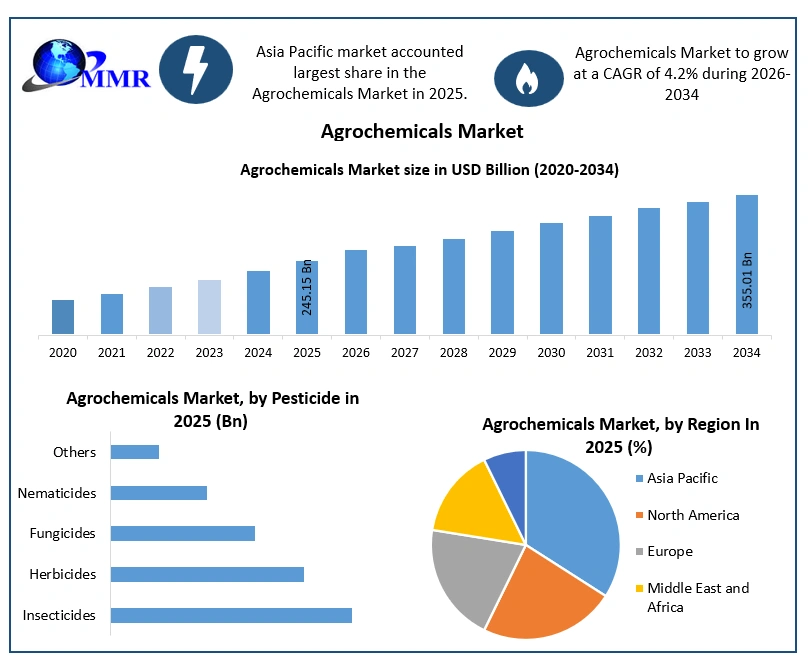
To know about the Research Methodology :- Request Free Sample Report
Agrochemicals Market Trends:
| Trend | Market Impact / Supporting Data |
| Growing Use of Crop Protection Products | Global agricultural pesticide use reached 3.92 million tonnes of active ingredients in 2024, up 5% from 2023, showing the continuing importance of crop protection in modern farming. |
| Fertilizer Demand Remains Strong | Global agricultural use of inorganic fertilizers reached 197 million tonnes of nutrients in 2024, underlining the large role fertilizers continue to play in maintaining crop productivity. |
| Precision and Efficient Agrochemical Use | Average global fertilizer use stood at about 122 kg per hectare of cropland in 2024, encouraging farmers and agrochemical companies to focus on more precise nutrient application and improved efficiency. |
| Expansion of International Agrochemical Trade | Global pesticide export volumes increased 53% between 2015 and 2024, showing how strongly crop-protection products are connected to international agricultural supply chains. |
| Shift Toward More Sustainable Farming Inputs | Pesticide use in 2024 was 18% higher than a decade earlier, while regulators and farmers are placing greater attention on biological crop protection, safer formulations, and reduced environmental impact. |
Agrochemicals Market Dynamics:
The imperative to enhance agricultural efficiency and protect crops drives demand for agrochemicals worldwide.
The imperative to enhance agricultural efficiency and safeguard crops against pests, weeds, and diseases stands as a pivotal driver for the global agrochemicals market. 40% of global crop yields succumb to pests and diseases annually, with weeds alone slashing yields by nearly 34%. Agrochemical solutions such as herbicides, fungicides, and insecticides emerge as indispensable tools in curbing these losses and shielding crops. Climate change exacerbates crop stresses like drought, heat, cold, and salinity, further imperiling yields. Agrochemicals offer a means to bolster crop resilience in the face of such climatic challenges. Regions with tropical climates face heightened risks of insect infestations, fungal infections, and rampant weed proliferation, fueling demand for pesticides and other crop protection agents.
Moreover, unsustainable agricultural practices like reduced crop rotations and continuous cropping degrade soil health and foster the emergence of resistant pests and weeds, intensifying the necessity for diverse agrochemical interventions and advanced fertilizers. As agriculture increasingly shifts towards high-value horticultural crops, which demand heightened plant protection, the need for agrochemicals remains unabated. Therefore, the persistent quest to enhance agricultural productivity and shield crops against evolving threats from pests, diseases, and weeds serves as a paramount driver propelling growth in the global agrochemicals market.
Increasing stringency of regulatory requirements
Stringent regulatory laws, especially in Europe, are challenging to agrochemicals market with the further development of new, innovative technologies like gene-editing in plants, and the use of some types of crop protection agents like glyphosate. The number of glyphosate-related cases for a major agrochemical company crossed 11,000, impacting its stock price performance. A ban on a prevalent crop protection chemical like glyphosate could potentially remove up to 40% of the revenues for a few companies—most agrochemical companies being highly dependent upon glyphosate to drive their revenues and margins.
Government farm subsidy reduction with expectations of government subsidy cuts in the United States, farmers are likely to have less of a safety net in case of any weather-related disaster, pay more crop insurance premiums from their own pockets, and have less financial incentive to buy new and more effective crop protection products and seeds which affects to agrochemicals market.
Capturing value from increasing interest in sustainable agricultural practices and precision farming:
Sustainable agricultural practices include components like Integrated Pest Management (IPM), which involves proactive monitoring of pest populations, and preventing them from growing to unprecedented, damaging levels without causing irreversible soil toxicity or environmental harm all are included in the Agrochemicals Market. It comprises an integrated approach wherein the use of nonchemical tools and digital technologies is encouraged. Rigid focus on minimizing the use of agrochemicals, and greater adoption of IPM practices lead to long-term demand agrochemical market and a decline in major classes of crop protection chemicals including herbicides.
However, because of IPM’s focus on natural pest control mechanisms, the demand for biologicals increases to a great extent and commands higher premiums than conventional crop protection chemicals.For well-established innovators whose business models remain asset-heavy, leveraging the power of Machine Learning and Artificial Intelligence (AI) might help Agrochemicals Market a great deal. For instance, instead of testing the efficacy of seeds in a field, Bayer CropScience has made use of simulations and big data to test the same in a computer. This has reportedly shaved off one to two years’ worth of R&D efforts, improved the time-to-Agrochemicals Market for new seeds, and reduced its R&D expenditure.
Agrochemicals Market Segment Analysis:
Based on Crop Type, in 2025, the cereal and grains segment emerged as the dominant force in the market, commanding a substantial revenue share exceeding 47.0%. Agrochemicals play a pivotal role in the development of fruits and vegetables, ensuring their safety, quality, and cost-effectiveness. Pesticides support farmers in cultivating fruit and vegetable crops while fertilizers provide essential nutrients, nitrogen, phosphorus, and potassium (NPK), fostering optimal Agrochemicals Market growth. Asia Pacific stands as the primary consumer of cereal and grain products globally, boasting a significant portion of the world's cultivated land dedicated to grains and cereals. The widespread adoption of fertilizers has become imperative in grain cultivation to meet the escalating demand. This demand is primarily fueled by the increasing consumption of cereals and grains such as rice, wheat, rye, corn, oats, sorghum, and barley. Agrochemical utilization is particularly pronounced in the cultivation of staple crops like rice, wheat, and other cereals and grains.
Agrochemicals Market Recent Analysis
| Date | Company | Development | Impact |
| 28 May 2025 | BASF India Limited | BASF India Limited introduced two new agrochemical formulations, Valexio insecticide and Mibelya fungicide, targeted at rice crop protection. | The dual launch addresses persistent pest pressures while boosting overall crop yield and disease control efficiency for rice cultivators. |
| 19 June 2025 | Syngenta | Syngenta unveiled a novel herbicide molecule named Metproxybicyclone designed to provide broad-spectrum weed management across major crops. | This active ingredient offers a new mode of action to help growers manage herbicide-resistant weed populations effectively. |
| 16 July 2025 | Bayer AG | Bayer expanded its global commercial partnership with M2i to supply pheromone-based biological crop protection products worldwide. | The collaboration accelerates the commercialization of biological alternatives, enhancing sustainable integrated pest management (IPM) practices. |
| 10 August 2025 | UPL Ltd. | UPL officially launched Brucia, a next-generation selective herbicide specifically formulated to safeguard maize crops against stubborn weeds. | The product improves overall maize productivity and field management efficiency by offering long-lasting residual weed control. |
| 24 August 2025 | Insecticides (India) Limited | Insecticides (India) Limited partnered with Corteva Agriscience to launch SPARCLE, a broad-spectrum insecticide formulated for rice crops. | This commercial alliance expands access to advanced crop protection tools, minimizing stem borer damage and safeguarding crop yield. |
Agrochemicals Market Regional Insights
Asia Pacific Leads the Agrochemicals Market as Large Farming Economies Drive Crop Protection and Fertilizer Demand
Asia Pacific remains a major center for the Global Agrochemicals Market, supported by the scale of agriculture in China, India, Japan, Southeast Asia, and Australia. Demand for fertilizers, herbicides, insecticides, fungicides, seed-treatment products, and biological crop protection continues as farmers work to improve yields and protect crops from pests, diseases, weeds, and changing weather conditions. The OECD-FAO outlook highlights Asia Pacific as a key agricultural region through 2034, while FAO data shows that Asia continues to account for substantial fertilizer use even as countries such as China focus on using nutrients more efficiently.
North America Remains a Strong Agrochemicals Market Supported by Commercial Farming and Precision Agriculture
North America benefits from highly commercialized agriculture, large-scale cultivation of corn, soybean, wheat, fruits, and vegetables, and widespread use of crop protection chemicals and fertilizers. Farmers in the United States, Canada, and Mexico are increasingly combining agrochemicals with precision agriculture, digital farm management, targeted spraying, and more efficient nutrient application. FAO reported that the Americas imported 2.31 million tonnes of formulated pesticides in 2024, valued at USD 14.0 billion, underlining the scale of crop-protection activity across the region.
Europe Moves Toward Safer and More Sustainable Agrochemical Use
Europe remains an important Agrochemicals Market, but growth is increasingly shaped by environmental regulation, pesticide reduction goals, sustainable agriculture, and more efficient fertilizer use. Farmers across Germany, France, Italy, Spain, the United Kingdom, and other European countries continue to rely on herbicides, fungicides, insecticides, fertilizers, and specialty crop inputs, while manufacturers are developing lower-impact formulations and biological alternatives. FAO data shows that fertilizer use in Europe declined by 4% between 2015 and 2024, reflecting the region’s broader push toward more efficient input use.
South America Expands on Large-Scale Crop Production and Export Agriculture
South America is an important growth region for agrochemicals because of its large soybean, corn, sugarcane, coffee, fruit, and other commercial crop industries. Brazil and Argentina remain major agricultural producers, creating steady demand for herbicides, fungicides, insecticides, fertilizers, and crop nutrition products. Expanding export-oriented agriculture, pest and disease pressure, and the need to maintain high crop yields are encouraging farmers to adopt more advanced crop protection technologies and integrated pest-management practices.
Middle East & Africa Offer Long-Term Opportunities Through Agricultural Development and Food-Security Investment
The Middle East & Africa Agrochemicals Market is developing as governments and agricultural businesses invest in food security, irrigation, crop productivity, and local farming capacity. Demand is growing for fertilizers, pesticides, specialty nutrients, and crop-protection solutions across South Africa, GCC countries, Egypt, Nigeria, and other markets. FAO data shows that Africa accounted for only 6% of global pesticide use between 2015 and 2024, suggesting considerable room for agricultural-input adoption as farming systems modernize and productivity improves.
Agrochemicals Market Competitive Landscape
The Global Agrochemicals Market is highly competitive, with major companies competing through crop protection innovation, new active ingredients, biological products, advanced formulations, digital agriculture, and stronger regional distribution networks. Bayer, Syngenta, BASF, Corteva Agriscience, FMC Corporation, UPL, ADAMA, and Nufarm are among the prominent companies shaping the market. BASF identifies Bayer, Corteva, FMC, Syngenta, and UPL among its main competitors in agricultural solutions, reflecting the concentration of competition among large global crop-protection players.
Competition is increasingly moving beyond traditional herbicides, insecticides, and fungicides. Companies are investing in biological crop protection, seed treatments, precision agriculture, digital farming tools, new modes of action, and integrated crop-management solutions. In September 2026, Bayer said it had more than 15 novel crop-protection modes of action in its research pipeline and was pursuing a plan to introduce 10 blockbuster agricultural innovations over 10 years, showing how strongly R&D and product differentiation are influencing the industry.
BASF is following a similar innovation-led strategy, combining seeds, traits, crop protection products, biological solutions, advanced formulations, and digitally enabled agronomic tools. Its Agricultural Solutions pipeline has an incremental peak sales potential of more than €7.5 billion for products and solutions expected to launch by 2035, highlighting the scale of investment being directed toward next-generation agricultural technologies.
Corteva is also focusing on differentiated crop protection and balanced regional portfolios. At its 2026 Investor Day, the company reported 144 new crop-protection products introduced in 2025 and emphasized differentiated technologies, biological products, and crop-specific market strategies. This reflects a wider shift in the Agrochemicals Market toward products that offer better performance, improved resistance management, safer application, and stronger value for farmers.
Overall, the competitive landscape is being shaped by product innovation, regulatory approvals, biological agrochemicals, sustainable formulations, precision farming, R&D investment, regional expansion, pricing, supply-chain strength, and farmer-focused solutions. Companies that can combine effective crop protection with digital tools, sustainability, reliable distribution, and new chemistry are likely to strengthen their position as farming becomes more technology-driven and environmentally conscious.
Agrochemicals Market Scope: Inquiry Before Buying
| Agrochemicals Market | |||
|---|---|---|---|
| Report Coverage | Details | ||
| Base Year: | 2025 | Forecast Period: | 2026-2034 |
| Historical Data: | 2020 to 2025 | Market Size in 2025: | US $ 245.15 Bn. |
| Forecast Period 2026 to 2034 CAGR: | 4.2% | Market Size in 2034: | US $ 355.01 Bn. |
| Segments Covered: | by Pesticide Type | Insecticides Herbicides Fungicides Nematicides Others |
|
| by Fertilizer Type | Nitrogenous Fertilizer Phosphatic Fertilizer Potassic Fertilizer |
||
| by Crop Type | Cereal & Grains Oilseeds & Pulses Fruits & Vegetables Others |
||
Global Agrochemicals Market by Region
North America (United States, Canada, and Mexico)
Europe (UK, France, Germany, Italy, Spain, Sweden, Russia and Rest of Europe)
Asia Pacific (China, India, Japan, South Korea, Australia, ASEAN and Rest of APAC)
Middle East and Africa (South Africa, GCC, and Rest of ME&A)
South America (Brazil, Argentina, and Rest of South America)
Agrochemicals Market Key Players:
1. OCP GROUP (United States)
2. Nutrien Ltd. (United States)
3. FMC Corporation (United States)
4. DuPont de Nemours, Inc. (United States)
5. Marrone Bio Innovations, Inc. (United States)
6. Corteva Agriscience(United States)
7. Bayer AG (Germany)
8. Syngenta Group (Switzerland)
9. BASF SE (Germany)
10. Yara International ASA (Norway)
11. ADAMA Ltd. (Israel)
12. Israel Chemicals Ltd. (Israel)
13. UPL Limited(Mumbai, India)
14. Sumitomo Chemical Co., Ltd. (Japan)
15. Nufarm Limited (Australia)
16. Mitsubishi Chemical Corporation (Japan)
17. ChemChina (Syngenta Group) (Beijing, China)
18. Ihara Chemical Industry Co., Ltd. (Japan)
Frequently Ask Questions:
1. What makes the Asia Pacific a Lucrative Market for Agrochemicals Market?
Ans. Textiles, sugar, animal husbandry, and vegetable oil manufacture are among the emerging agro-based businesses that are driving this growth.
2. What are the top players operating in the Agrochemicals Market?
Ans. ADAMA LTD, BAYER, BASF SE, SYNGENTA AG, UPL, COMPASS MINERALS, EUROCHEM GROUP, and OCP GROUP.
3. What is the key driving factor for the growth of the Agrochemicals Market?
Ans. The requirement to maintain agricultural integrity is expected to play a significant role in increasing sales in the global agrochemicals market.
4. What is the market size of the Global Agrochemicals Market by 2034?
Ans. The Agrochemicals Market size was valued at USD 355.01 Bn. In 2025 the total Agrochemicals Market revenue is growing by 4.2 % from 2026 to 2034, reaching nearly USD 245.15 Bn.