
Freight Forwarding Market by Mode of Transport, Application, Customer Type, Service and Region – Global Market Size Estimation, Industry-Wide Analysis, Competitive Landscape Assessment & Long-Term Forecast to 2032
Overview
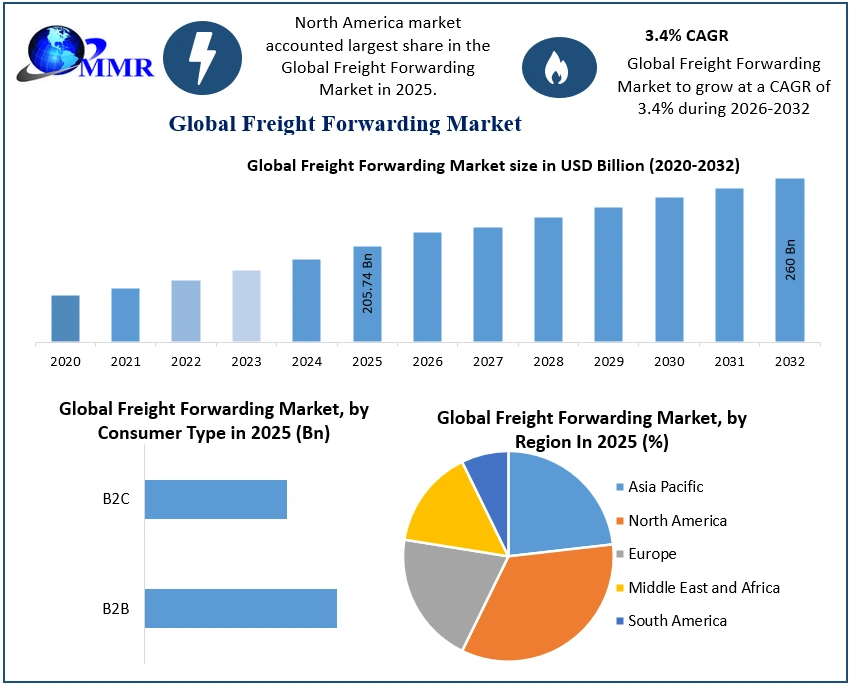
The Freight Forwarding Market size was valued at USD 205.74 Billion in 2025 and the total Freight Forwarding revenue is expected to grow at a CAGR of 3.4% from 2025 to 2032, reaching nearly USD 260 Billion by 2032.
Freight Forwarding Market Overview:
The coordination and shipment of commodities from one location to another via a single or numerous carriers via air, maritime, rail, or roadway is known as freight forwarding. Freight forwarding principles are based on the efficient and cost-effective transportation of commodities that are kept in good condition during their journey. Freight forwarders become specialists at managing the logistics required to ensure that items arrive on schedule to achieve this. Having the correct tools at your disposal is essential for successful trading and transportation in today's marketplaces.
On behalf of shippers, freight forwarding includes strategic logistics strategy and execution for the international transportation of commodities. A freight forwarder's responsibilities include freight rate negotiations, container tracking, customs documentation, and freight consolidation.
To know about the Research Methodology :- Request Free Sample Report
Freight Forwarding Market Dynamics:
Drivers of Freight Forwarding Market:
1. Increase in the trade agreements between nations: The trade agreements between countries increases the import and export of goods and services between the countries, which results in driving the Freight Forwarding Market growth. The new free trade deal will erase 90% of tariffs between 15 East Asian and Pacific countries.
The partnership called Regional Comprehensive Economic Partnership (RCEP) brings together 15 East Asian and Pacific countries. Trade between 15 members was worth around US$ 2.3 trillion, and the agreement's tariff concessions may raise exports by US$ 42 billion, inside the newly created alliance.
2. Use of artificial intelligence (AI): When it comes to logistics and supply chain management, artificial intelligence is rapidly evolving. The AI in the logistics and supply chain market is expected to reach US$ 14 Bn by 2029 by growing at a CAGR of 20% through the forecast period. Artificial intelligence (AI) integration has emerged as a crucial topic that is gaining traction in the freight forwarding market. Through automation and real-time data, artificial intelligence helps to save expenses, save time, increase production, and improve accuracy.
For overland shipments within the Asia Pacific area, Kuehne Nagel, a Swiss logistics company, launched the AI-enabled freight forwarding platform eTrucknow.com. Shippers can utilize eTrucknow to compare options. After the customer submits the shipment details, and AI-enabled engine optimizes and automates the cost comparison process by evaluating numerous data points and giving the customer the most cost-economic service.
3. Rising international trade by air freight and ocean freight: The international trade by Ocean freight is expected to grow at a CAGR of 4.5% through the forecast period. The new trade agreements between the countries are generating more trade. Air freight forwarding has seen 14.9% YoY growth in 2022 and is expected to grow at a CAGR of 5.4% throughout the forecast period. Pharmaceuticals and cross-border e-commerce sectors are expected to drive market growth through the forecast period.
4. Growing acceptance of e-commerce: E-commerce holds 15% market share in Air freight trade volume. 18% of air cargo revenue is due to e-commerce and this is expected to reach 22% by end of 2022. The air cargo market has received the benefits of particularly high demand from the e-commerce sector, which has proven to be a significant source of cargo volume for airlines.
The E-commerce logistics market was valued at €441.47 Bn in 2021 and it is expected to grow at a CAGR of 11.65% through the forecast period. The total value of online retail sales increased by 27.6% to US$ 4.280 trillion in 2021. China led the way with 52.1 % of sales at $2,799 billion, followed by South Korea with 28.9 % and the United Kingdom with 28.3 percent, and the United States with 15.0 %.
Challenges in Freight Forwarding Market: The rise of nearshoring manufacturing operations throughout the world, which is expected to result in a lack of acceptance of trade activities, is expected to hinder the freight forwarding market's growth through the forecast period. However, the rise in reshoring and nearshoring manufacturing is expected to limit the freight forwarding market's growth. Despite the difficulties, the growing trend of international freight transportation will help to cushion the boom of the freight forwarding business through the next years.
Freight Forwarding Market Segment Analysis:
Based on Mode of Transport, Ocean freight forwarding mode dominated the segment with 43% share in 2025. It is expected to grow at a CAGR of around 4.5% through the forecast period. The maritime freight forwarding market is booming, due to strong internet penetration, rising cost of living, infrastructural developments (new ports, containers, and ships), and services best suited for the e-commerce market. The demand for ocean freight forwarding has increased since rising in air freight charges. Kuehne + Nagel International the leading company generated around US$ 28 Bn through its operations in 2025.
Based on the Application, the Freight Forwarding Market is segmented into Industrial and Manufacturing, Healthcare, Automobiles, Electronics, Military, Oil and Gas, Food and Beverages, and Others. Trade in Pharmaceuticals was increased during the COVID, and it accounts for around 2.2% of the market share in total trading goods. It is valued at around US$ 616 Bn in 2021 and medical instruments hold the market share of 0.78% and are valued at US$ 216 Bn in total traded goods.
The most-traded goods are cars, Germany holds around 19.3% of the market share and is the largest exporter of cars in the world. Valued around US$ 122.3 Bn worth export has been done by Germany through cars in 2021. Japan is the second-largest exporter of cars with a market share of 12.8% and a value of s around US$ 80.9 Bn of cars has been exported by Japan in 2021.
Regional Insights:
The North America region dominated the market with a 32% share in 2025. The 30 trade partners of the United States represent 88% of US exports and 87% of US imports. North America dominates the market because of the strong economy of the US. With only 4.5% of the world's population, the United States contributes one-fifth of its GDP. Out of 10 brands, the most of brands belong to the US. The US is having the highest trading partners.
Asia-Pacific is the fastest-growing area in the freight and logistics market. This is due to the growing logistics in ASEAN countries, as well as the presence of big economies such as China and India. Also, the region's strong government backing for the logistics sector contributes to the market growth.
With US$ 112 Bn in trade, the United States was India's most important trading partner in 2021. The United States is followed by China. Trade between India and China was US$ 110 Bn. The fast-growing economies offer growth opportunities, thus top companies are focusing on mergers and acquisitions to increase their presence in these markets. For example, in March 2021, Kuehne Nagel (K+N), a German-based third-party logistics (3PL) services provider, paid US$ 1.5 billion for China-based freight forwarder Apex International Corporation.
The objective of the report is to present a comprehensive analysis of the Freight Forwarding Market to the stakeholders in the industry. The past and current status of the industry with the forecasted market size and trends are presented in the report with the analysis of complicated data in simple language. The report covers all the aspects of the industry with a dedicated study of key players that include market leaders, followers, and new entrants.
PORTER, PESTEL analysis with the potential impact of micro-economic factors of the market have been presented in the report. External as well as internal factors that are supposed to affect the business positively or negatively have been analyzed, which will give a clear futuristic view of the industry to the decision-makers.
The reports also help in understanding the Freight Forwarding Market dynamic, structure by analyzing the market segments and projecting the Freight Forwarding Market size. Clear representation of competitive analysis of key players by Product type, price, financial position, product portfolio, growth strategies, and regional presence in the Freight Forwarding Market make the report investor’s guide.
Freight Forwarding Market Scope: Inquiry Before Buying
| Freight Forwarding Market | |||
|---|---|---|---|
| Report Coverage | Details | ||
| Base Year: | 2025 | Forecast Period: | 2026-2032 |
| Historical Data: | 2020 to 2025 | Market Size in 2025: | USD 205.74 Bn. |
| Forecast Period 2026 to 2032 CAGR: | 3.4% | Market Size in 2032: | USD 260 Bn. |
| Segments Covered: | by Mode of Transport | Air Ocean Rail Road |
|
| by Application | Industrial and Manufacturing Retail Healthcare Media and Entertainment Military Oil and Gas Food and Beverages Others |
||
| by Customer Type | B2B B2C |
||
| by Service | Transportation and Warehousing Packaging and Documentation Insurance Value-Added Services |
||
Freight Forwarding Market, by Region
North America (United States, Canada and Mexico)
Europe (UK, France, Germany, Italy, Spain, Sweden, Austria and Rest of Europe)
Asia Pacific (China, South Korea, Japan, India, Australia, Indonesia, Malaysia, Vietnam, Taiwan, Bangladesh, Pakistan and Rest of APAC)
Middle East and Africa (South Africa, GCC, Egypt, Nigeria and Rest of ME&A)
South America (Brazil, Argentina Rest of South America)
Freight Forwarding Market, Key Players
1. Agility
2. Bolloré Logistics
3. CEVA Logistics
4. Sinotrans India Private Limited
5. DB Schenker
6. DHL Global Forwarding
7. Imerco
8. Dachser
9. DSV Panalpina A/S
10. Expeditors International
11. Hellmann Worldwide Logistics
12. Kuehne + Nagel International AG
13. MGF (Manitoulin Global Forwarding)
14. Nippon Express Co.
15. UPS Supply Chain Solutions
Frequently Asked Questions:
1] What segments are covered in the Global Freight Forwarding Market report?
Ans. The segments covered in the Freight Forwarding Market report are based on Mode of Transport, Customer Type, Application, and Service.
2] Which region is expected to hold the highest share in the Global Freight Forwarding Market?
Ans. The North America region is expected to hold the highest share in the Freight Forwarding Market.
3] What is the market size of the Global Freight Forwarding Market by 2032?
Ans. The market size of the Freight Forwarding Market by 2032 is expected to reach USD 260 Bn.
4] What is the forecast period for the Global Freight Forwarding Market?
Ans. The forecast period for the Freight Forwarding Market is 2026-2032.
5] What was the Global Freight Forwarding Market size in 2025?
Ans: The Global Freight Forwarding Market size was USD 205.74 Billion in 2025.