
Food Safety Testing Market – Global Market Size, Strategic Growth Drivers, Risk Assessment Framework, Regulatory Landscape Review, Competitive Intensity Mapping & Long-Term Industry Outlook to 2032
Overview
The Food Safety Testing Market size was valued at USD 27.28 Billion in 2025 and the total Food Safety Testing revenue is expected to grow at a CAGR of 8.34% from 2026 to 2032, reaching nearly USD 47.79 Billion.
Food Safety Testing Market Overview
The Global Food Safety Testing Market is a crucial component of the food safety ecosystem of food testing, which gives consumers reliance that the food is safe to ingest. Foods contaminated with physical, chemical, and microbial hazards from farm to fork, including production, processing, distribution, and storage pose a public health risk.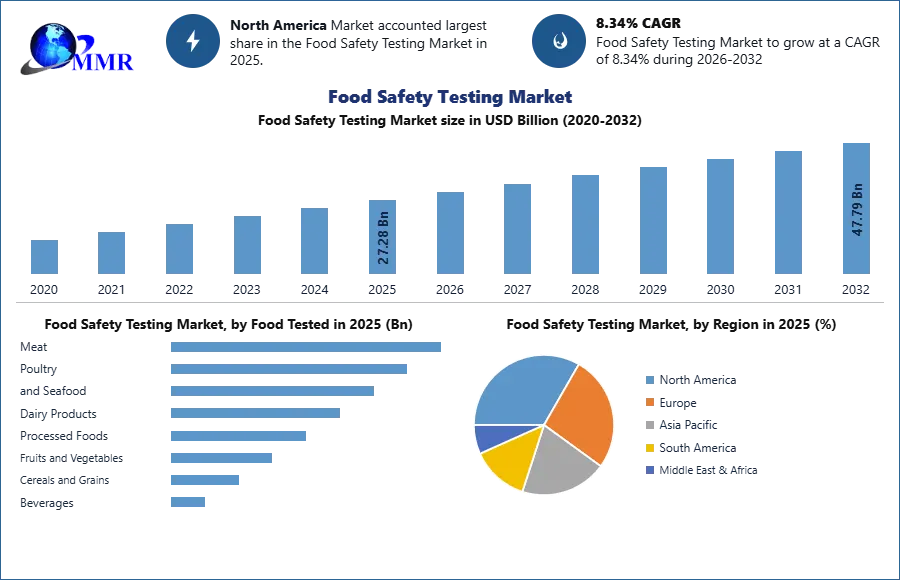 To know about the Research Methodology :- Request Free Sample Report
The substantial element stimulating the Food Safety Testing Market is the increasing occurrence of food-borne infections, adulterations in food, and risks to public health stimulating the government to apply stringent rules. As foodborne infections keep hindering productivity and pose a burden on public health, government agencies all over the globe foster food safety testing. The expansion of the global food supply chain necessitates comprehensive testing to ensure the safety of products crossing borders.
Growing awareness among consumers regarding food safety issues and a demand for transparent information drive the need for robust testing. Different regions have varying regulatory standards, making compliance complex for businesses operating in multiple markets. While technological advancements enhance testing capabilities, adopting technologies can be slow. The food safety testing market includes a range of companies like Eurofins Scientific SE., SGS Group, and NSF International offering testing services, equipment, and solutions that drive the food safety testing market. The Food Testing Market is pivoting and leading to grow as an essential part of human health and food and nutrition security.
Food Safety Testing Market Dynamics
Factors Driving Growth of Food Safety Testing Market
The increasing awareness about safe and healthy food is the major driver for the Food Safety Testing Market. Customers are becoming mindful of nutritional choices and opting the products that are organic, non-GMO, and contribute to overall health. With the rising consciousness about various allergens and other dietary limitations, consumers are looking for products with specific dietary needs. The inclination towards products labelled with minimal additives, preservatives, and artificial agents and seeking food testing services to ensure the products are free from GMOs and other harmful pollutants are driving the Food Safety Testing Market. Integration of rapid technology such as PCR, LC-MS/MS, and immunoassay provide swift and precise results. As a result, it is beneficial for the detection of heavy metals, pathogens, and other contaminants. The Government and Regulatory bodies around the world are applying strict food safety regulations to guarantee the safety of food. As the food manufacturers need to comply with the rules and regulations the demand for the Food Safety Testing Market is burgeoning.
Challenges Faced by Small and Medium Enterprises
The food testing market faces a major challenge due to the high cost associated with the equipment and technology. Small and medium-sized enterprises (SEMEs) find it difficult to allocate resources for these advanced technology solutions, impacting their ability to conduct food testing. Addressing this challenge is crucial to ensure accessibility and uniform standards in food safety testing.
Shortage of Skilled Professionals
The food testing market encounters a notable hurdle as a major challenge is finding and retaining skilled individuals with expertise to operate the equipment, interpret the results, and stay updated with the advancement. The absence of skilled professionals affects food testing efficiency and poses a blockage for companies. As a result, the shortage of skilled professionals is a major challenge for companies looking to expand their services.
Impact of Technological Advancements and Innovative Tools in the Global Market
Technological advancements are developing rapidly in the food safety arena. Nanobiotechnology, Remote Senescing, Automation, and artificial intelligence in the food industry have started to garner attention by offering applications and benefits in nutrition and safety by providing better tools for detecting traceability and contaminants. Scientific innovation, digitalization, and technological advancements can pace faster international trade, be cost-effective, with greater market access, and increase food safety. Countries most affected by foodborne illness where analytical tools will be beneficial along with developing technical expertise to facilitate the understanding of new technology can be an opportunity for the Food Safety Testing Market.
Food Safety Testing Market Segment Analysis
Based on Food Tested, the Meat, Poultry, and Seafood segment dominated the market in 2025 due to the high risk of microbial contamination and strict regulatory monitoring across global food supply chains. Increasing consumer preference for high-protein diets and rising awareness regarding foodborne diseases significantly strengthened the demand for safety testing in this segment. In addition, regulatory agencies require continuous testing of meat and seafood products to ensure quality parameters such as freshness, texture, and microbial safety, further driving testing adoption across production and processing facilities. The processed foods segment also showed strong growth, supported by rising urbanization, busy lifestyles, and increasing consumption of ready-to-eat products, which require strict quality and contamination monitoring.
Based on Contaminants Targeted, the market is segmented into Pathogens, Chemical Contaminants, and Allergens. Among these, pathogen testing dominated the market in 2025 due to the high prevalence of foodborne illnesses caused by bacteria such as Salmonella, E. coli, and Listeria. Food manufacturers and regulatory authorities increasingly adopted pathogen detection testing to ensure product safety and comply with international food safety regulations.
Based on Technology, the market is segmented into Polymerase Chain Reaction (PCR), Immunoassay Technologies, and Chromatography & Spectroscopy. Among these, PCR technology dominated the market in 2025 due to its high sensitivity, accuracy, and rapid detection capability for microbial contamination. PCR-based testing enables laboratories to identify pathogens quickly and efficiently, which is critical for preventing contaminated food products from entering the supply chain.
Based on Testing Type, the market is segmented into Microbiological Testing, Chemical Testing, Allergen Testing, and GMO Testing. Among these, microbiological testing held the largest share in 2025 as it is widely used to detect harmful microorganisms responsible for food contamination and foodborne diseases.
Based on End-User, the market is segmented into Food Manufacturers, Food Testing Laboratories, Government Agencies, and Retailers. Among these, food manufacturers dominated the market in 2025 as they conduct routine testing to ensure compliance with food safety standards, maintain product quality, and meet regulatory requirements before products reach consumers.
Food Safety Testing Market Regional Insights
North America dominated the Food Safety Testing Market in 2025, supported by the presence of strict food safety regulations, advanced testing infrastructure, and strong regulatory oversight from authorities such as the U.S. Food and Drug Administration (FDA) and the U.S. Department of Agriculture (USDA). The region has a highly developed food processing industry and well-established laboratory networks, which increased the adoption of advanced food safety testing technologies. In addition, high consumer awareness regarding food quality and contamination risks further strengthened the demand for food safety testing across the region.
Food Safety Testing Market Competitive Landscapes
The global Food Safety Testing Market remains highly competitive due to the strong presence of numerous international and regional players. Leading companies continue to focus on developing advanced testing technologies, expanding laboratory networks, and implementing strategic partnerships and acquisitions to strengthen their market position. Increasing demand for rapid, reliable, and cost-effective testing solutions across food categories such as processed foods, meat products, and fruits and vegetables is driving continuous innovation in testing methods and product development.
Food Safety Testing Market Recent Development (2025–2026):
| Exact Date | Company | Development | Impact |
|---|---|---|---|
| 10 December 2025 | Intertek | Acquired a new specialized facility in Cambridge, UK, to significantly expand its pharmaceutical and food safety testing capacity. | This expansion strengthens Intertek’s ability to support multinational food brands with harmonized compliance services and rapid diagnostic deployment. |
| 15 October 2025 | SGS SA | Released SafeGuardS 160/25 guidelines to help global food contact material (FCM) manufacturers comply with India’s proposed ban on Bisphenol A (BPA) and PFAS. | The advisory provides critical migration testing protocols and regulatory documentation review to ensure market access under new FSSAI safety standards. |
| 21 May 2025 | Eurofins Scientific | Acquired Analytical Laboratories (USA) to enhance its North American footprint in pesticide residue and food safety testing. | The acquisition increases laboratory throughput for high-demand crop residue analysis and expands Eurofins' specialized service capabilities for local agribusinesses. |
| 04 March 2025 | Bio-Rad Laboratories | Launched the XP-Design Assay Salmonella Serotyping Solution, a real-time PCR assay for fast detection of Salmonella serotypes. | This solution reduces pathogen identification time from days to hours, enabling food manufacturers to perform rapid product recalls and prevent widespread outbreaks. |
| 06 January 2025 | Mérieux NutriSciences | Completed the acquisition of Bureau Veritas' food testing activities in the U.S. and Canada, integrating 12 laboratories and 400 employees. | The transaction consolidates Mérieux's position as a global TIC leader, broadening its reach in chemical and microbiological analysis for the processed food industry. |
Food Safety Testing Market Scope: Inquiry Before Buying
| Food Safety Testing Market | |||
|---|---|---|---|
| Report Coverage | Details | ||
| Base Year: | 2025 | Forecast Period: | 2026-2032 |
| Historical Data: | 2020 to 2025 | Market Size in 2025: | 27.28 USD Billion |
| Forecast Period 2026-2032 CAGR: | 8.34% | Market Size in 2032: | 47.79 USD Billion |
| Segments Covered: | by Food Tested | Meat, Poultry, and Seafood Dairy Products Processed Foods Fruits and Vegetables Cereals and Grains Beverages |
|
| by Contaminants Targeted | Pathogens Chemical Contaminants Allergens Genetically Modified Organisms (GMOs) Toxins |
||
| by Technology | Polymerase Chain Reaction (PCR) Immunoassay Technologies Chromatography and Spectroscopy Rapid Testing Biosensors |
||
| by Testing Type | Microbiological Testing Chemical Testing Allergen Testing GMO Testing |
||
| by End-User | Food Manufacturers Food Testing Laboratories Government Agencies Retailers |
||
Food Safety Testing Market, by Region
North America (United States, Canada, and Mexico)
Europe (UK, France, Germany, Italy, Spain, Sweden, Austria, and Rest of Europe)
Asia Pacific (China, South Korea, Japan, India, Australia, Indonesia, Malaysia, Vietnam, Taiwan, Bangladesh, Pakistan and Rest of APAC)
South America (Brazil, Argentina, and Rest of South America)
Middle East and Africa (South Africa, GCC, Egypt, Nigeria, and Rest of ME&A)
Food Safety Testing Market Key Players:
- SGS SA
- Eurofins Scientific SE
- Intertek Group plc
- Bureau Veritas SA
- ALS Limited
- TÜV SÜD AG
- AsureQuality Limited
- Bio-Rad Laboratories Inc.
- Thermo Fisher Scientific Inc.
- Mérieux NutriSciences
- Neogen Corporation
- NSF International
- Agilent Technologies, Inc.
- QIAGEN
- Microbac Laboratories Inc.
- Shimadzu Corporation
- PerkinElmer Inc.
- 3M Food Safety
- FoodChain ID
- Romer Labs Division Holding GmbH
- TÜV Nord Group
- Symbio Laboratories
- Charles River Laboratories International Inc.
- Danaher Corporation
- Charm Sciences Inc.