Flue Gas Analyzer Market Size by Installation Type, Technology, Gas Component, Application and Region – Segment-Level Market Assessment, Growth Opportunity Analysis, Competitive Mapping & Forecast to 2032

6.49%
CAGR (2026-2032)
1.11 USD Bn.
Market Size
306
Report Pages
140
Market Tables

Overview

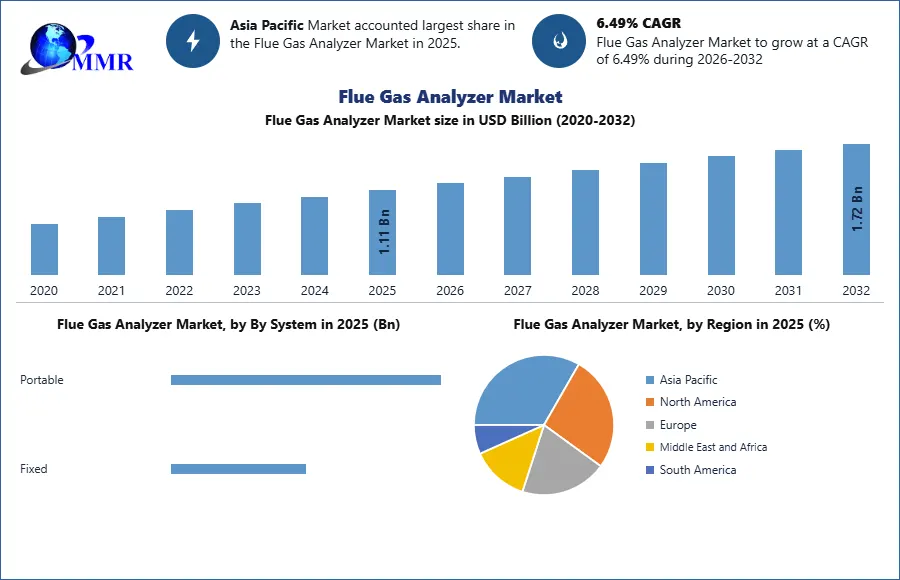
The Flue Gas Analyzer Market size was valued at USD 1.11 Billion in 2025 and the total Flue Gas Analyzer revenue is expected to grow at a CAGR of 6.49% from 2026 to 2032, reaching nearly USD 1.72 Billion.
Flue Gas Analyzer Market

To know about the Research Methodology :- Request Free Sample Report

A flue gas analyzer is an analytical device that measures the concentration of different emitted gases from flue into the atmosphere. Flue gases contain gases such as carbon monoxide, oxides of nitrogen, sulfur oxides, carbon dioxide, and nitrogen oxides which are exhausted from boilers, fireplace, and furnaces. Moreover, flue gas analyzers are also known as portable devices used to measure the air quality in buildings and rooms.

Rising concerns regarding environmental protection, stringent environmental and legal regulations, various technological advancements and increase in awareness in the commercial and industrial properties, an increase in health and safety concerns are some of the major factors driving the growth of flue gas analyzer market. However, high cost and technical complications of flue gas analyzers are restraining the flue gas analyzer market growth.

Flue Gas Analyzer Market Dynamics:

The Flue Gas Analyzer Market is primarily driven by increasing stringent environmental regulations and emission control mandates across industrial sectors such as power generation, oil & gas, cement, and chemicals. Governments worldwide are enforcing strict limits on pollutants like NOx, SO₂, and CO₂, compelling industries to adopt advanced monitoring systems for compliance and operational optimization. Additionally, rising awareness regarding air quality, workplace safety, and environmental sustainability is accelerating the adoption of both portable and inline flue gas analyzers. Technological advancements, including IoT-enabled monitoring, real-time data analytics, and improved sensor accuracy, are further enhancing product efficiency and expanding application areas. However, the market faces restraints such as high initial investment costs, technical complexity, and the requirement for skilled personnel to operate and maintain advanced systems. On the opportunity side, rapid industrialization in emerging economies (Asia-Pacific, Middle East), growing adoption in maritime emission monitoring, and increasing focus on energy efficiency and decarbonization initiatives are expected to create strong growth potential. Overall, the market dynamics reflect a transition toward smart, connected, and compliance-driven emission monitoring solutions, positioning flue gas analyzers as essential tools in modern industrial environmental management.

Flue Gas Analyzer Market Regional Analysis:

The Asia-Pacific region dominates in terms of growth and overall market contribution, accounting for a substantial share , driven by rapid industrialization, urbanization, and expansion of power generation capacity in countries like China, India, and Japan. Increasing energy demand, large-scale infrastructure development, and tightening government regulations on air pollution are significantly boosting the adoption of flue gas analyzers across industrial sectors. Meanwhile, Latin America and the Middle East & Africa are emerging markets, witnessing gradual growth due to rising environmental awareness, industrial expansion, and increasing investments in energy and manufacturing sectors.

Further key findings from the report:

• Waste incineration segment among the applications accounted for the highest share of flue gas market in. As Incinerations emission monitoring needs to be carried out with high accuracy demand for flue gas analyzer is expected to continue to remain high during the forecast period.
• Inline flue gas analyzer is expected to hold a larger market share of flow gas market between 2026 and 2032 owing to its features such as weatherproof and explosion-proof enclosures. Since inline flue gas analyzers can be used for continuous emission monitoring it is widely used in many industries
• From the gas component segment, the market for NOX gas components segment is to grow at significant higher CAGR during the forecast period
• Geographically, APAC is expected to dominate the flue gas analyzer market by 2032. Power generation plants, oil & gas, waste incineration applications would contribute to the growth of the market in this region. Rapid industrialization and urbanization in APAC countries such as China and India, a rise in demand for stringent air pollution regulations are the key factors driving the flue gas analyzer market in this region

Flue Gas Analyzer Market Key Highlights:

• Analyzes competitive developments such as contracts, joint ventures, mergers & acquisitions, collaborations, product launches & developments, and research and development (R&D) in the market
• The objective of the report is to provide a detailed analysis of the market on the basis of installation type, technology, a gas component, application, and geography
• Complete quantitative analysis of the industry from 2026 to 2032 to enable the stakeholders to capitalize on the prevailing market opportunities
• In-depth analysis of the industry on the basis of market segments, market dynamics, market size, competition & companies involved value chain
• Analysis of the market with respect to individual growth trends, prospects, and contribution to the total market
• Segment wise business performance detailed in the report will be worthwhile for the organizations willing to enhance its business
• Provides detailed information regarding the major factors influencing the growth of the market (drivers, restraints, opportunities, and challenges)
• This report would help stakeholders understand their competitors better and gain more insights to enhance their position in the business

Recent Industry Developments (2025–2026)

Exact Date Company Development Impact
15 January 2026 ABB Launched the Advance Optima AO2000 series update featuring integrated cloud-based predictive maintenance and automated calibration. Reduces operational downtime by 30% for power generation plants through real-time sensor health monitoring.
04 November 2025 Testo SE & Co. KGaA Released the testo 300 NEXT GEN portable analyzer with enhanced hydrogen-ready (H2) sensors for industrial boiler testing. Addresses the decarbonization trend by enabling accurate measurement in facilities transitioning to hydrogen-blend fuels.
22 February 2026 SICK AG Commissioned a new high-precision manufacturing facility in the APAC region to double the production of In-situ laser analyzers. Strengthens regional supply chain resilience and reduces lead times for major cement and metal industrial projects in Asia.
12 September 2025 Emerson Electric Co. Announced a strategic collaboration with a leading software firm to integrate AI-driven combustion optimization into Rosemount flue gas systems. Improves fuel efficiency by 5-8% for oil and gas refineries by providing real-time tuning recommendations based on flue gas data.
08 January 2026 Horiba Introduced the ENDA-7000 series multi-gas analyzer capable of measuring NOx, SO2, CO, and O2 simultaneously with zero-drift technology. Enables compliance with ultra-low emission standards in waste incineration plants without the need for frequent manual recalibration.

Flue Gas Analyzer Market Research Methodology:

Bloomberg, Hoovers, Factiva are some of the sites that are being referred to gain insights about market. Experts from top manufacturing companies along with other stakeholders have been considered. This is done to validate and collect critical information for evaluating trends related to this market during the forecast period. Top-down and bottom-up approaches have been used to estimate the global and regional size of this market. Data triangulation techniques along with other comparative analysis are also used to calculate the exact size of the market globally.

 Flue Gas Analyzer Market Scope: Inquire before buying

 Flue Gas Analyzer Market
Report Coverage Details
Base Year: 2025 Forecast Period: 2026-2032
Historical Data: 2020 to 2025 Market Size in 2025: 1.11 USD Billion
Forecast Period 2026-2032 CAGR: 6.49% Market Size in 2032: 1.72 USD Billion
Segments Covered: By System Portable
Fixed
By Technology Electrochemical
Non Dispersive Infrared
    Dual Beam
    Single Beam
Paramagnetic
Photoacoustic
Zirconia Sensor
Others
By Measured Gas Oxygen (O₂)
Carbon Monoxide (CO)
Carbon Dioxide (CO₂)
Nitrogen Oxides (NOx)
Sulfur Dioxide (SO₂)
Others
by Bay Sales Channel Aftermarket
OEM
By Application Emission Monitoring
Environmental Compliance
Process Optimization
By End-Use Industry Power Generation
Oil & Gas
Cement Plants
Chemicals
Pulp & Paper
Metals
Waste Incineration
Others


Flue Gas Analyzer Market, by Region:

North America (United States, Canada and Mexico)
Europe (UK, France, Germany, Italy, Spain, Sweden, Austria, Turkey, Russia and Rest of Europe)
Asia Pacific (China, India, Japan, South Korea, Australia, ASEAN and Rest of APAC)
Middle East and Africa (South Africa, GCC, Egypt, Nigeria and Rest of ME&A)
South America (Brazil, Argentina, Columbia and Rest of South America)

Key Players / Competitors Profiles Covered in Brief in Global Flue Gas Analyzer Market Report in Strategic Perspective:

  1. ABB Automation company
  2. Emerson Electric Co.
  3. Ametek Inc.
  4. Teledyne Analytical Instruments
  5. Horiba
  6. Nova Analytical Systems
  7. Testo SE & Co. KGaA
  8. Envea (formerly Environnement SA)
  9. Sick AG
  10. Wohler Technik GmbH
  11. California Analytical Instruments
  12. Kane International Limited
  13. Siemens AG
  14. Dragerwerk AG & Co. KGaA
  15. Vasthi Engineers
  16. Tekran Instruments Corp
  17. Endee Engineers
  18. Opsis AB
  19. Servomex (Spectris plc)
  20. Robert Bosch GmbH
  21. Fuji Electric Co., Ltd.
  22. Yokogawa Electric Corporation
  23. Shimadzu Corporation
  24. Thermo Fisher Scientific Inc.
  25. Kimo Instruments (Sauermann Group)

Table of Contents

1. Flue Gas Analyzer Market: Market Introduction 1.1. Executive Summary 1.2. Market Size (2025) & Forecast (2026-2032), 1.3. Market Size (Value in USD Million and Volume in 000'Units) and Market Share (%) - By Segments, Regions and Country 2. Competitive Landscape 2.1. MMR Competition Matrix 2.2. Competitive Analysis of key players 2.3. Key Players Benchmarking 2.3.1 Company Name 2.3.2 Headquarter 2.3.3 Product Portfolio 2.3.4 Technology Adoption 2.3.5 Calibration Frequency & Stability 2.3.6 Serviceability & Maintainability 2.3.7 Compliance & Certification Support 2.3.8 Warranty & After-Sales Support 2.3.9 Pricing Strategy 2.3.10 Distribution Network Strength 2.3.11 Lifecycle Support Duration 2.3.12 Market Share (%) 2025 2.3.13 Revenue, 2025 2.3.14 R&D Investment 2.3.15 Global Reach 2.4. Market Structure 2.4.1 Market Leaders 2.4.2 Market Followers 2.4.3 Emerging Players 2.5. Mergers and Acquisitions Details 2.6. Market Share & Revenue Benchmarking (2025) 2.6.1 Company-wise global revenue share (2025) 2.6.2 Regional market share comparison 2.6.3 Industry vertical dominance analysis 2.7. Product Portfolio & Technology Benchmarking 2.7.1 Technology adoption comparison (Electrochemical, NDIR, Zirconia, etc.) 2.7.2 Multi-gas vs single-gas specialization 2.7.3 Portable vs stationary product coverage 2.7.4 Hazardous area certification capability comparison 2.8. Pricing Strategy & Margin Benchmarking 2.8.1 ASP comparison by company and system type 2.8.2 Gross margin benchmarking (estimated range analysis) 2.8.3 Premium pricing justification analysis 2.8.4 Discounting intensity in tender-driven markets 2.9. Distribution Channel & Go-To-Market Benchmarking 2.9.1 Direct sales vs distributor-driven model comparison 2.9.2 EPC and system integrator partnerships strength 2.9.3 Regional service hub density comparison 2.9.4 Aftermarket revenue penetration ratio 3. Flue Gas Analyzer Market Dynamics 3.1. Flue Gas Analyzer Market Trends 3.2. Flue Gas Analyzer Market Dynamics 3.2.1 Drivers 3.2.2 Restraints 3.2.3 Opportunities 3.2.4 Challenges 3.3. PORTER’s Five Forces Analysis 3.4. PESTLE Analysis 4. Regulatory & Compliance Landscape Analysis 4.1 Global emission standards comparative analysis (EPA, EU IED, CPCB, China MEE) 4.2 Country-level CEMS mandate assessment 4.3 Industrial boiler & combustion compliance framework evaluation 4.4 Compliance-driven analyzer demand forecasting model 4.5 Carbon reporting & ESG disclosure impact assessment 4.6 Penalty structure and non-compliance risk evaluation 5. Technology Benchmarking & Performance Evaluation 5.1 Comparative performance analysis of electrochemical vs zirconia vs paramagnetic vs NDIR 5.2 Accuracy, sensitivity & response time benchmarking matrix 5.3 Technology-wise calibration frequency comparison 5.4 Sensor lifespan & replacement cost modeling 5.5 Industry-wise technology adoption trends analysis 5.6 Performance benchmarking under extreme industrial conditions 6. Pricing & Cost Structure Analysis (2025) 6.1 Historical ASP trend analysis by System type (2020–2025) 6.2 Technology-wise pricing comparison study 6.3 Regional price differential benchmarking 6.4 Installation & commissioning cost breakdown analysis 6.5 Total cost of ownership (TCO) financial modeling 6.6 Spare parts and sensor cost contribution analysis 7. Industry-Specific Demand Assessment 7.1 Power generation fuel-wise demand segmentation (coal, gas, biomass) 7.2 Cement industry emission monitoring growth trends 7.3 Oil & gas refining compliance-driven demand analysis 7.4 Waste-to-energy monitoring capacity expansion trends 7.5 Hydrogen and alternative fuel combustion impact assessment 7.6 Retrofit vs greenfield installation demand split analysis 8. Supply Chain & Component Ecosystem Analysis 8.1 Strategic component supplier landscape mapping 8.2 Raw material dependency & semiconductor risk assessment 8.3 Global manufacturing footprint analysis 8.4 Import-export trade flow evaluation 8.5 Lead time variability & inventory cycle analysis 9. Replacement & Lifecycle Analysis 9.1 Analyzer operational lifespan benchmarking 9.2 Technology-wise sensor degradation pattern analysis 9.3 Industry-level replacement cycle assessment 9.4 Refurbishment vs new installation economic comparison 9.5 Configuration-based lifecycle cost evaluation 10. CEMS vs Combustion Monitoring Market Assessment 10.1 Revenue contribution split analysis (CEMS vs standalone analyzers) 10.2 Regulatory-driven installation trend evaluation 10.3 Monitoring-type retrofit vs new plant demand comparison 10.4 Industry-wise adoption penetration analysis 10.5 Compliance-driven upgrade cycle modeling 10.6 Monitoring-type growth forecast scenario analysis 11. Distribution & Go-To-Market Analysis 11.1 Direct vs distributor-led revenue contribution analysis 11.2 EPC contractor & system integrator influence mapping 11.3 Regional distribution structure benchmarking 11.4 Channel margin & pricing control assessment 11.5 Competitive go-to-market strategy evaluation 12. Certification & Hazardous Area Compliance 12.1 ATEX, IECEx & explosion-proof certification requirement analysis 12.2 Hazardous area classification impact assessment (Zone 0/1/2) 12.3 Industry-specific compliance standard benchmarking 12.4 Certification cost impact modeling on pricing 12.5 Regional regulatory approval process comparison 12.6 Compliance-driven competitive positioning analysis 13. Digital Integration & Smart Monitoring Trends 13.1 IoT-enabled analyzer adoption rate analysis 13.2 Cloud-based emission monitoring integration trends 13.3 Remote diagnostics & predictive maintenance penetration study 13.4 AI-driven combustion optimization solution assessment 13.5 SCADA/DCS integration capability benchmarking 13.6 Connected system cybersecurity risk evaluation 14. Industrial Decarbonization & Net-Zero Impact Analysis 14.1 Net-zero commitment impact modeling on monitoring investments 14.2 Fuel-transition (coal-to-gas) demand impact analysis 14.3 Biomass & alternative fuel combustion monitoring assessment 14.4 Carbon capture (CCUS) monitoring opportunity evaluation 14.5 ESG-linked emission intensity tracking integration analysis 15. Customer Purchasing Behavior & Decision Criteria Analysis 15.1 Strategic procurement decision factor assessment 15.2 Industry-wise price sensitivity evaluation 15.3 Multi-gas vs single-gas purchase preference analysis 15.4 Tender-based vs direct procurement comparison study 15.5 Brand switching barrier assessment 15.6 Regulatory deadline-driven buying cycle analysis 16. Service & Calibration Ecosystem Analysis 16.1 OEM vs third-party service penetration benchmarking 16.2 AMC adoption rate analysis 16.3 Spare parts & sensor replacement revenue modeling 16.4 Calibration outsourcing trend assessment 16.5 Remote service & predictive maintenance penetration analysis 16.6 Regional service margin benchmarking study 17. Emerging Application Expansion 17.1 Marine emission monitoring regulatory growth assessment 17.2 Hydrogen combustion monitoring demand outlook 17.3 Waste-to-energy & biomass capacity expansion analysis 17.4 Mid-scale boiler compliance opportunity evaluation 17.5 Data center generator monitoring demand trends 17.6 Municipal & hazardous waste incineration growth assessment 18. Global Flue Gas Analyzer Market :Size and Forecast By Segmentation (By Value in USD Billion and Volume in 000'Units) (2025-2032) 18.1. Global Flue Gas Analyzer Market Size and Forecast, By System 18.1.1 Portable 18.1.2 Fixed 18.2. Global Flue Gas Analyzer Market Size and Forecast, By Technology 18.2.1 Electrochemical 18.2.2 Non Dispersive Infrared 18.2.3 Dual Beam 18.2.4 Single Beam 18.2.5 Paramagnetic 18.2.6 Photoacoustic 18.2.7 Zirconia Sensor 18.2.8 Others 18.3. Global Flue Gas Analyzer Market Size and Forecast, By Measured Gas 18.3.1 Oxygen (O₂) 18.3.2 Carbon Monoxide (CO) 18.3.3 Carbon Dioxide (CO₂) 18.3.4 Nitrogen Oxides (NOx) 18.3.5 Sulfur Dioxide (SO₂) 18.3.6 Others 18.4. Global Flue Gas Analyzer Market Size and Forecast, By Sales Channel 18.4.1 Aftermarket 18.4.2 OEM 18.5. Global Flue Gas Analyzer Market Size and Forecast, By Application 18.5.1 Emission Monitoring 18.5.2 Environmental Compliance 18.5.3 Process Optimization 18.6. Global Flue Gas Analyzer Market Size and Forecast, By End-use 18.6.1 Power Generation 18.6.2 Oil & Gas 18.6.3 Cement Plants 18.6.4 Chemicals 18.6.5 Pulp & Paper 18.6.6 Metals 18.6.7 Waste Incineration 18.6.8 Others 18.7. Global Flue Gas Analyzer Market Size and Forecast, By Region 18.7.1 North America 18.7.2 United States 18.7.3 Canada 18.7.4 Mexico 18.7.5 Europe 18.7.6 United Kingdom 18.7.7 France 18.7.8 Germany 18.7.9 Italy 18.7.10 Spain 18.7.11 Sweden 18.7.12 Russia 18.7.13 Rest of Europe 18.7.14 Asia Pacific 18.7.15 China 18.7.16 S. Korea 18.7.17 India 18.7.18 Japan 18.7.19 Australia 18.7.20 Indonesia 18.7.21 Malaysia 18.7.22 Philippines 18.7.23 Thailand 18.7.24 Vietnam 18.7.25 Rest of Asia Pacific 18.7.26 Middle East and Africa 18.7.27 South Africa 18.7.28 GCC 18.7.29 Israel 18.7.30 Egypt 18.7.31 Nigeria 18.7.32 Liberia 18.7.33 United Arab Emirates (UAE) 18.7.34 Rest of ME&A 18.7.35 South America 18.7.36 Brazil 18.7.37 Argentina 18.7.38 Colombia 18.7.39 Chile 18.7.40 Rest Of South America 19. Company Profile: Key Players 19.01. ABB 19.01.1 Overview 19.01.2 Business Portfolio 19.01.3 Financial Overview 19.01.4 SWOT Analysis 19.01.5 Strategic Analysis 19.01.6 Recent Developments 19.02. HORIBA Group 19.03. Emerson Electric Co. 19.04. AMETEK, Inc. 19.05. Testo SE & Co. KGaA 19.06. Teledyne Analytical Instruments 19.07. Thermo Fisher Scientific Inc. 19.08. Yokogawa India Ltd. 19.09. Servomex Group Ltd. 19.10. Nova Analytical Systems 19.11. Fuji Electric Co., Ltd. 19.12. ENVEA & California Analytical Instruments, Inc. 19.13. IMRUSA 19.14. Siemens AG 19.15. Eurotron Instruments 19.16. Codel International Ltd. 19.17. MSA Safety Incorporated 19.18. Kane International Limited 19.19. MRU Instruments, Inc. 19.20. Kimo Instruments 19.21. Wöhler Technik GmbH 19.22. Wuhan Cubic Instruments Ltd. 19.23. Vasthi Instruments Pvt. Ltd. 19.23.1 Others 20. Key Findings 21. Strategic Outlook & Future Opportunities 22. Global Flue Gas Analyzer Market : Research Methodology

Custom Market Research Services

We Will Customise The Research For You, In Case The Report Listed Above Does Not Meet With Your Requirements