
Faux Fur Clothing Market - Industry Structure Evaluation, Demand Drivers Analysis, Regional Growth Analysis and Identification, Competitive Positioning Review & Global Market Size Forecast to 2032
Overview
Faux Fur Clothing Market size was valued at USD 632.12 Mn. in 2025, and the total revenue is expected to grow by 16.41% from 2026 to 2032, reaching nearly USD 1831.18 Mn.
Faux Fur Clothing Market Overview:
Faux fur clothing or artificial fur clothing is created using fabric materials similar in looks to animal fur. It is similarly soft and warm in comparison to its counterpart. Hence, the product is cheaper, thereby attracting huge demand for the product. The product is sold in various designs and colors to attract the attention of buyers. In addition, the clothing is showcased at several fashion events for promotions. Several manufacturers are developing the product with attractive designs and water-repellent properties to increase product sales. Faux fur jackets are becoming increasingly popular, symbolizing the current state of the fashion industry. The cloth is both inexpensive and warm, increasing demand for it.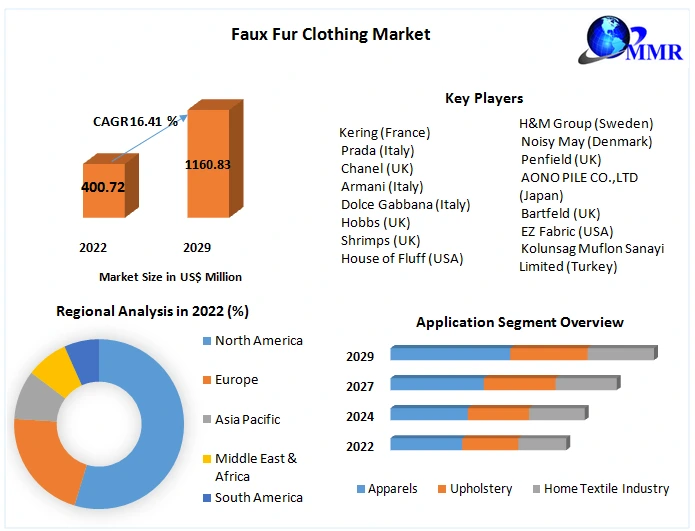 To know about the Research Methodology:-Request Free Sample Report
Faux Fur Clothing Market Dynamics:
The growth of the market is attributed to various factors, such as the demand for luxury clothing, the growing awareness about faux fur clothing, and the disposable income of consumers.
1. An increase in awareness among the people regarding cruelty against animals has led to the adoption of artificially produced fur products.
2. Governments of several countries have banned hunting and the use of animal fur as per the guidelines published by governments regarding animal rights. As per the information provided by The Environment, Food, and Rural Affairs Committee of Government UK's "Fur Trade in the UK" report in 2018, the European Union has imposed a complete ban on the import and export activities of dog and cat fur by the Commission Regulation 1523/2207.
3. Faux Fur clothing is an effective alternative to animal fur and is available at a lower cost, thereby driving the market growth.
4. Growth in disposable income, population, and high consumer spending on fashion are some of the key factors driving the market growth.
5. Fashion companies have introduced the use of recycled waste in the manufacturing of artificial fur, which has averted consumers' attention, resulting in a strong demand for artificial fur in the market.
6. The manufacturing process of faux fur is heavily automated, which has resulted in massive labor cost savings; as a result, many business enterprises are planning to introduce the line of faux fur in their portfolio.
7. Local market players have disrupted the market by using low-quality materials that are not environmentally friendly, resulting in the market's slow growth.
8. Technological advances in the Faux Fur fabric department are expected to create lucrative opportunities in the faux fur market.
Faux Fur Clothing Market Restraints:
1. Faux fur does not provide the same level of insulation as animal fur. Furthermore, artificial fur containing synthetic fibers sheds over time, which can stifle market growth. As a result, the market is growing slowly.
2. Further, the non-biodegradable nature of faux fur clothing is expected to raise problems against the disposal of clothing made with the material, thereby hampering the market growth.
Faux Fur Clothing Market Segment Analysis:
By product type, the market is segregated into vests, jackets, shawls, capelets, scarves, gloves, and others. The Vests & Jackets segment is expected to hold the dominant position in the market during the forecasted period. The growth in the market is attributed to the trend of clothing that is worn in typically colder climates, where coats can also be in snowfall for protection from cold. Further, these clothes are also used as fashion wear, which will further lead to increasing demand.
As per the end-users, the market is segmented into men and women. The women segment is projected to hold a major share during the forecasted period. The growth in the market is attributed to factors like the buying trends among female customers, as they are more conscious about their appearance, and fur clothing provides more elegance and comfort of these clothing. In terms of faux fur clothing, this segment is most interested in garments that have a luxurious and high-end appearance.
Moreover, more variety is available in the market for women as compared to women as the demand is more in their segment. On the other hand, men's faux fur clothing consists of individuals who are typically interested in fashion but not as much as women. In terms of faux fur clothing, the men's end-user segment is most interested in garments that have a practical and functional appearance.
Based on the application, the market is fragmented into apparel, upholstery & home textile industries. High Consumer spending in the fashion industry has been steadily increasing. Furthermore, social media awareness of artificial fur has increased market sales of faux fur apparel. Upholstery and home textile industries are expected to grow steadily in the future because of the rising spending on home aesthetics.
Faux Fur Clothing Market Regional Insights:
Regionally the Faux Fur Clothing Market is segmented into North America, Europe, South America, Asia Pacific, and Middle East & Africa.
Asia Pacific region is projected to dominate the market share during the forecast year because of the harsh environmental conditions during winter. The adoption of the coat is increasing because of its low cost and similar warmth offered by the animal fur. An increase in the popularity of fur clothing and the ban on animal furs in several APAC countries have contributed to the growth of the fur market share.
The report's goal is to provide industry stakeholders with a comprehensive analysis of the market. The report analyses complicated data in simple language and presents the past and current state of the industry, as well as forecasted market size and trends. The report examines all aspects of the industry, including a detailed examination of key players such as market leaders, followers, and new entrants.
The report includes a PORTER and PESTEL analysis, as well as the potential impact of market microeconomic factors. External and internal factors that are expected to have a positive or negative impact on the business have been examined, providing a clear future view of the industry.
The report also aids in understanding the market dynamics, structure, and size projections by analyzing market segments. The report is an investor's guide due to its clear representation of competitive analysis of key players in the market by product, price, financial position, product portfolio, growth strategies, and regional presence.
Recent Industry Developments
| Exact Date | Company | Development | Impact |
|---|---|---|---|
| 05 March 2026 | Stella McCartney | The brand debuted its Winter 2026 collection at Paris Fashion Week featuring advanced faux-mink furs and high-end equestrian-inspired synthetic apparel. | This highlights the luxury segment's shift toward high-fidelity, cruelty-free alternatives that mimic rare animal pelts. |
| 02 January 2026 | ASICS | The company formally pledged to terminate the use of all wildlife-derived materials, transitioning to innovative synthetic and recycled alternatives. | This move accelerates the mainstream adoption of faux-materials in the athletic and lifestyle apparel sectors. |
| 09 December 2025 | CFDA | New York Fashion Week (NYFW) announced a comprehensive ban on animal fur for all official runway events starting in September 2026. | The decision creates a massive market void that faux fur manufacturers are expected to fill by the 2026/27 fashion cycle. |
| 28 October 2025 | GUESS USA | The brand launched a maximalist Fall/Winter 2025 collection centered around audacious faux fur jackets and gold-toned boleros. | This launch reinforces the "maximalist" fashion trend, driving demand for high-volume synthetic fur products in the North American market. |
| 09 September 2025 | Jakke | The London-based label relaunched its brand identity with a Fall/Winter 2025 collection featuring faux Mongolian furs and "elevated rebel" designs. | The relaunch signals a competitive revival for specialized faux fur brands focusing on textural innovation and niche design. |
| 15 May 2025 | Shein | The global retail marketplace officially banned fur and exotic skins across its entire platform. | This policy change drastically increases the supply chain demand for mass-market synthetic fur alternatives in the fast-fashion sector. |
Faux Fur Clothing Market Scope: Inquire before buying
| Faux Fur Clothing Market | |||
|---|---|---|---|
| Report Coverage | Details | ||
| Base Year: | 2025 | Forecast Period: | 2026-2032 |
| Historical Data: | 2020 to 2025 | Market Size in 2025: | 632.12 USD Mn |
| Forecast Period 2026-2032 CAGR: | 16.41% | Market Size in 2032: | 1831.18 USD Mn |
| Segments Covered: | by Product Type | Vests Coats Jacket Shawls Capelet Scarf Gloves Others |
|
| by End-User | Men Women Children |
||
| by Distribution Channel | Supermarkets/hypermarkets Specialty Stores Online Channel Departmental Stores Others |
||
Faux Fur Clothing Market, by Region
North America (United States, Canada and Mexico)
Europe (UK, France, Germany, Italy, Spain, Sweden, Austria and Rest of Europe)
Asia Pacific (China, South Korea, Japan, India, Australia, Indonesia, Malaysia, Vietnam, Taiwan, Bangladesh, Pakistan and Rest of APAC)
Middle East and Africa (South Africa, GCC, Egypt, Nigeria and Rest of ME&A)
South America (Brazil, Argentina Rest of South America)
Key Players / Competitors Profiles Covered in Brief in Global Faux Fur Clothing Market Report in Strategic Perspective:
- Lulus Inc.
- Guess?, Inc.
- Patagonia, Inc.
- Forever 21, Inc.
- Noize Apparel Inc.
- Brother Vellies LLC
- Uniqlo Co., Ltd.
- Kolunsag Muflon Sanayi Limited
- Hobbs London
- Shrimps
- H&M Group
- Noisy May
- Bartfeld Limited
- Bershka
- Zara
- Nanushka Inc.
- AllSaints Retail Limited
- ASOS plc
- Kering
- Jakke
- Prada
- Chanel
- Armani
- Dolce & Gabbana
- Stella McCartney