
Enterprise Architecture Tools Market Size by Component, Solution, Services, Deployment and End-Use Industry
Overview
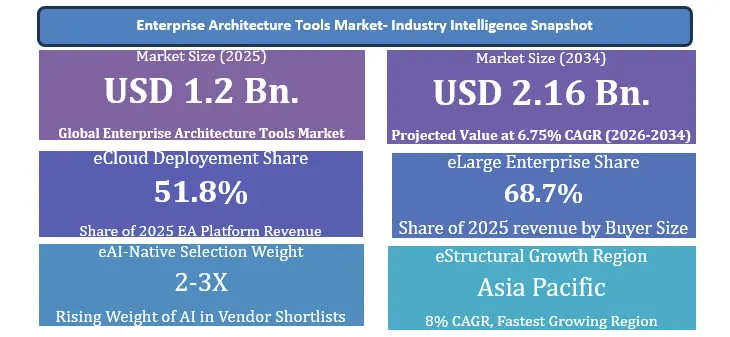
Global Enterprise Architecture Tools Market Size to Reach USD 2.16 Billion by 2034 from USD 1.2 Billion in 2025 at a CAGR of 6.75%, Driven by Cloud Migration, AI Governance, Application Rationalization, and Digital Transformation.
Enterprise architecture (EA) has become a key part of IT planning as large organisations manage a mix of on-premises systems, cloud platforms, SaaS applications, and legacy applications. As these environments become more interconnected, it is becoming harder for architecture teams to maintain an accurate view of applications, technology dependencies, and business systems through manual documentation alone. This is increasing the need for Enterprise Architecture Tools that help organizations assess their technology landscape, support application rationalization, manage technology risks, and plan cloud and digital transformation initiatives.
The Global Enterprise Architecture Tools Market was valued at USD 1.2 Billion in 2025 and is expected to reach USD 2.16 Billion by 2034, registering a CAGR of 6.75% during 2026–2034. Market growth is being supported by the growing complexity of hybrid and multi-cloud environments, application portfolio rationalization, increasing cybersecurity and regulatory requirements, and the need for enterprises to establish stronger visibility over technology investments. As organizations continue to modernise legacy environments while introducing cloud-native applications and AI workloads, the ability to maintain a structured view of the technology estate is becoming an increasingly important component of enterprise IT governance.
Global Enterprise Architecture Tools Market Overview
To know about the Research Methodology :- Request Free Sample Report
The growing adoption of cloud and hybrid IT is also changing how enterprises evaluate EA platforms. Cloud migrations can introduce new applications, infrastructure dependencies, vendors, and technology components within relatively short periods. At the same time, application rationalization programs require organizations to identify redundant, obsolete, or underutilized systems before determining whether they should be retained, modernized, consolidated, or retired. Consequently, Enterprise Architecture Tools are increasingly being evaluated on their ability to provide actionable portfolio intelligence rather than simply maintaining a centralized architecture repository.
The emerging demand area is the use of EA information for technology cost optimization and investment governance. Enterprise architecture teams are increasingly interacting with CIO, CFO, finance, FinOps, cloud-cost, cybersecurity, and transformation functions. Architecture data can support decisions related to cloud expenditure, application duplication, modernization priorities, technology risk, and the financial impact of transformation programs. This is broadening the business case for EA tools beyond traditional compliance and architecture documentation requirements.

Enterprise Architecture Tools Market adoption is expected to remain particularly relevant across BFSI, IT and telecommunications, healthcare, manufacturing, and government organizations, where complex technology estates, regulatory requirements, legacy modernization programs, and large-scale transformation initiatives create a stronger need for structured architecture management. Adoption patterns, however, vary by industry depending on IT complexity, regulatory exposure, cloud maturity, and the scale of transformation investment.
The competitive positioning of vendors in the Global Enterprise Architecture Tools Market is likely to depend increasingly on how effectively platforms demonstrate measurable business outcomes. Capabilities such as identifying redundant applications, reducing technology risk, supporting migration planning, improving audit readiness, optimizing technology expenditure, and accelerating modernization decisions are becoming important differentiators. This represents a broader evolution of EA software from a documentation and governance tool toward an enterprise-wide technology intelligence platform.
Enterprise Architecture Tools Market Trends: Cloud Complexity, AI Governance, and Continuous Technology Intelligence
Cloud and hybrid-IT expansion is changing how enterprises use Enterprise Architecture Tools. Large organizations now manage applications across on-premises infrastructure, multiple cloud environments, and SaaS platforms, making it difficult to maintain an accurate architecture view through spreadsheets and periodic updates. This is increasing demand for automated discovery, application dependency mapping, and tools that can keep architecture information closer to the current IT environment.
As enterprises deploy AI applications and supporting data and cloud infrastructure, architecture teams need visibility into where these technologies are being used and how they connect with existing systems. This is creating demand for EA platforms that support technology classification, dependency analysis, risk assessment, and governance of AI-related workloads.
The quality of underlying IT data is becoming important. EA platforms often depend on information from CMDB, ITSM, ERP, CRM, cloud, and DevOps systems, but these sources are not always complete or consistent. Vendors are therefore focusing more on integrations, automated data collection, and data validation. The competition is increasing from ITSM, cloud-management, and AI-enabled platforms. Buyers are consequently giving more importance to data accuracy, automation, integration capabilities, and practical business outcomes when evaluating Enterprise Architecture Tools.
Enterprise Architecture Tools Market: Mapping the Technology Intelligence Ecosystem
The Enterprise Architecture Tools Market sits between enterprise technology data and the teams responsible for IT architecture, modernization, and technology planning. Data from applications, cloud environments, CMDB, ITSM, ERP, CRM, and DevOps systems provides the underlying view of the technology estate. EA platforms organize this information to map applications and dependencies, assess technology portfolios, and support decisions related to modernization and governance.
The value captured across the ecosystem depends on how effectively this fragmented data is collected, connected, and converted into usable architecture information. Integration capabilities, data accuracy, automated discovery, analytics, and scenario modelling are therefore becoming important areas of differentiation for Enterprise Architecture Tools vendors.
The table below outlines how value is created across the key stages of the EA technology ecosystem.
| Value Chain Stage | Role | Value Capture Characteristics |
| Enterprise Data Sources | CMDB, ITSM, cloud management, ERP, CRM, security, and DevOps systems provide the underlying technology and operational data. | Value depends mainly on data quality, accessibility, and integration readiness. |
| Architecture Repository | Structures applications, technologies, business capabilities, and dependencies into an enterprise architecture view. | Core platform value is linked to modelling capabilities, usability, and integration breadth. |
| Analytics & AI | Supports automated discovery, data classification, dependency analysis, and identification of technology patterns and risks. | Increasing area of vendor differentiation as enterprises seek greater automation. |
| Decision Support | Provides dashboards, portfolio analysis, risk views, and scenario outputs for architecture and IT planning. | Value increases when architecture data can support specific investment and modernization decisions. |
| Transformation Planning | Converts architecture analysis into roadmaps for cloud migration, application modernization, and technology change. | Value is shared across EA platforms, consulting firms, and systems-integration partners. |
| Governance & Monitoring | Supports technology standards, compliance checks, risk monitoring, and ongoing review of the IT landscape. | Creates opportunities for continued platform usage as enterprises maintain and update their architecture environment. |
Continuous Technology Change Is Reshaping Enterprise Architecture Requirements
Enterprise IT environments are changing as organizations migrate applications to the cloud, introduce AI capabilities, modernize legacy systems, and expand SaaS usage. These changes can create new application dependencies and technology relationships, making periodic architecture reviews difficult to maintain across large IT estates. This is increasing the need for Enterprise Architecture Tools that provide better visibility into changes across the technology environment.
The impact is particularly relevant for large organizations managing multiple technology platforms and application portfolios. Architecture teams increasingly need to understand how changes in one application, cloud service, or technology component can affect connected systems, business capabilities, and transformation plans.
This is also creating opportunities for EA vendors to strengthen capabilities around automated discovery, dependency mapping, portfolio analysis, and technology governance. Platforms that can combine information from multiple enterprise systems and present it in a usable architecture view are better positioned to support modernization, risk assessment, and IT investment decisions.
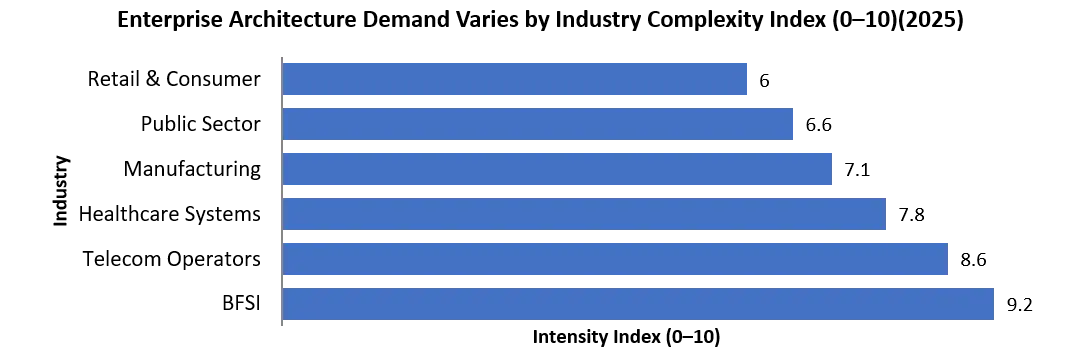
Enterprise Complexity Is Driving Different Levels of EA Adoption
The need for Enterprise Architecture Tools is not uniform across industries. Organizations with larger application portfolios, complex technology dependencies, higher regulatory requirements, and ongoing cloud or modernization programs generally require deeper architecture capabilities. This creates different levels of demand across industry verticals, with architecture intensity closely linked to the complexity of the underlying IT environment.
Enterprise Architecture Tools Market: Data Integration and Platform Connectivity
The performance of Enterprise Architecture Tools depends on the quality and availability of data from systems such as CMDB, ITSM, cloud platforms, ERP, CRM, and security applications. As enterprises use multiple systems to manage their technology environment, EA platforms need reliable integrations to bring application, infrastructure, and dependency information into a common architecture view.
The shift toward automated discovery is reducing reliance on manual data entry and making integration capabilities, data consistency, and update frequency important considerations in EA platform selection. Vendors that can connect a wider range of enterprise systems while maintaining reliable architecture data can provide greater visibility for application rationalization, technology governance, and modernization planning.
| Dependency Point | Why It Matters |
| CMDB, ITSM & Cloud-Management Data | Key dependency point due to inconsistent data quality and limited standardization across enterprise systems |
| Cloud Hyperscalers & Core Enterprise Platforms | AWS, Azure, GCP, ServiceNow, SAP, and Salesforce remain the critical data sources EA platforms integrate against |
| Regional Integration Maturity | North America and Europe are strengthening integration and AI-governance capabilities, supporting broader automated-discovery adoption |
Leading EA vendors are prioritizing automated discovery, broader integration libraries, and continuous data-freshness monitoring as integration resilience becomes a more important competitive factor.
Enterprise Architecture Tools Market: Competitive Positioning and Product Innovation
Competition in the Enterprise Architecture Tools Market is increasingly shaped by integration capabilities, automated discovery, architecture analytics, and the ability to support application and technology decisions. Vendors are moving beyond traditional modelling and documentation by adding capabilities for application rationalization, cloud governance, technology-risk assessment, and transformation planning.
Established providers are expanding their platforms through product development, partnerships, and broader integration capabilities, while newer solutions are targeting automation and AI-assisted architecture analysis. This is creating a more competitive market in which vendors need to demonstrate practical value through better technology visibility, faster analysis, and support for modernization and governance activities.
Competitive Positioning: Platform Reach and Architecture Capability
Leading vendors can be compared across platform breadth and ecosystem reach and architecture and decision-support capability. The positioning below reflects MMR's assessment of product coverage, integration capabilities, automation, architecture functionality, and decision-support features.

Enterprise Architecture Tools Market Regional Outlook and Growth Opportunities
Regional demand for Enterprise Architecture Tools varies with cloud adoption, digital-transformation activity, regulatory requirements, and the complexity of enterprise IT environments. North America has a strong installed base of enterprise software and continues to see demand from cloud migration, application modernization, and technology governance programs. Europe has a stronger emphasis on regulatory requirements, data governance, and managing hybrid technology environments.
Asia Pacific is seeing increasing demand as enterprises expand cloud adoption, digital platforms, and AI-related investments. China, India, Japan, and South Korea are among the key markets where technology modernization is increasing the need for application visibility, dependency mapping, and architecture planning. Regional adoption therefore remains closely linked to the pace of cloud migration, enterprise AI deployment, and modernization of existing IT environments.
Enterprise Architecture Tools Market Investment, M&A and Strategic Capital Landscape
Investment activity in the EA tools market is concentrated in AI-native architecture intelligence, automated discovery, application-portfolio rationalization, technology-risk intelligence, and FinOps-EA integration. Strategic acquisitions, partnerships with cloud and systems-integration partners, and ongoing platform consolidation, including Bizzdesign's acquisitions of MEGA International and Alfabet and SAP's acquisition of LeanIX, are accelerating commercialization across regulated industries, cloud governance, and enterprise-wide digital-transformation programs.
| Deal | Year | Strategic Rationale |
| Bizzdesign acquires Alfabet (from Software AG) | January 2025 | Creates a combined group with ~EUR 110 million revenue, ~2,000 customers, and 600+ employees spanning EA, Strategic Portfolio Management, and GRC |
| Avolution receives growth investment from Whiteoak | December 2024 | Targets accelerated AI module development and Asia-Pacific mid-market expansion |
| Celonis–Ardoq partnership | January 2025 | Combines process-mining telemetry with real-time architecture metadata for cause-and-effect transformation modelling |
Enterprise Architecture Tools Market: Buyer Behavior and Procurement Signals
EA purchasing decisions are increasingly influenced by multiple IT functions rather than the architecture team alone. Enterprise architects, CIO organizations, cloud and FinOps teams, security functions, and technology governance teams may all be involved in evaluating Enterprise Architecture Tools. As a result, buyers are placing greater emphasis on integration with existing IT environments, ease of implementation, data quality, and the ability to demonstrate practical value through specific use cases.
Procurement requirements also vary by the scope of deployment. Organizations evaluating a complete EA platform typically assess architecture management, application portfolio analysis, governance, integration, and transformation capabilities together. In contrast, buyers with a specific requirement such as application rationalization or cloud governance may begin with a focused use case before expanding platform adoption.
• Integration with existing enterprise systems is an important consideration during vendor evaluation.
• CIO, architecture, cloud/FinOps, security, and governance teams can influence EA platform selection depending on the use case.
• Focused use cases such as application rationalization, technology-risk assessment, and cloud governance can provide an entry point for broader EA platform adoption.
Enterprise Architecture Tools Market Scope: Inquire before buying
| Enterprise Architecture Tools Market | |||
|---|---|---|---|
| Report Coverage | Details | ||
| Base Year: | 2025 | Forecast Period: | 2026-2034 |
| Historical Data: | 2020 to 2025 | Market Size in 2025: | USD 1.2 Bn. |
| Forecast Period 2026 to 2034 CAGR: | 6.75% | Market Size in 2034: | USD 2.16 Bn. |
| Segments Covered: | by Component | Solution Services |
|
| by Solution | Infrastructure Architecture Application Architecture Data Architecture Security Architecture Others |
||
| by Services | Managed Services Professional Services |
||
| by Deployment | On-premise Cloud |
||
| by Enterprise Size | Large Enterprises Small & Medium-sized Enterprises (SMEs) |
||
| by End-Use Industry | BFSI Consumer Goods & Retail IT & Telecom Manufacturing Healthcare Government & Public Sector Others |
||
This report provides an assessment of the global Enterprise Architecture Tools Market, covering market size, technology trends, investment activity, competitive positioning, and regional growth patterns across cloud transformation, application-portfolio management, technology-risk governance, and AI-assisted decision intelligence. It draws on MMR's ongoing coverage of enterprise software and cloud-infrastructure markets.
Global Enterprise Architecture Tools Key Players
Tier 1 — Major & Established Platform Vendors
1. SAP LeanIX
2. ServiceNow
3. Bizzdesign
4. Ardoq
5. Avolution
6. Orbus Software
7. Sparx Systems
8. ValueBlue
9. QualiWare
10. UNICOM Systems
11. BOC Group
12. GBTEC
Tier 2 — Adjacent Platform & Process-Intelligence Vendors
13. ins-pi
14. Bee360
15. QPR Software
16. IBM
17. Microsoft
18. Planview
19. Dassault Systèmes
20. iGrafx
21. Celonis
22. SAP Signavio
23. ARIS
24. Camunda
Tier 3 — Regional & Emerging Vendors
25. Prolaborate
26. Enterprise Architecture Solutions (EAS)
27. Capsifi
Company Profiles: Key Players
SAP LeanIX
Headquarters: Bonn, Germany (SAP subsidiary; SAP HQ: Walldorf, Germany) | Ownership: Subsidiary of SAP SE
Company Overview
LeanIX was a privately held enterprise architecture management (EAM) SaaS leader before being acquired by SAP, announced in September 2023 and completed in late 2023, becoming the EA management pillar of SAP's Business Transformation Suite alongside SAP Signavio.
Business & Product Portfolio
LeanIX's platform gives customers a visual representation of IT application architecture to identify unused or obsolete applications and design new application landscapes; it also offers a generative-AI assistant for enterprise architecture management, and continues to serve both SAP and non-SAP landscapes.
Financial Overview
At the time of acquisition, LeanIX had approximately 1,000 customers, with the U.S. market (30% of customers) contributing around 50% of revenue. SAP has not disclosed separate post-acquisition revenue for LeanIX; deal terms were not disclosed.
SWOT Analysis
| Strengths | Weaknesses | Opportunities | Threats |
| Deep SAP ecosystem integration (RISE with SAP, SAP Signavio) and strong U.S. customer concentration | Analysts (Forrester) flagged concerns about continued investment commitment to non-SAP customers post-acquisition | Early mover in generative-AI assistants for EA management provides a differentiation lead | Perceived SAP-centricity could limit appeal to organizations wanting a vendor-neutral EA platform |
Recent Developments
Continues integration into SAP's Business Transformation Suite alongside SAP Signavio and SAP Business Technology Platform, with a stated commitment to continue serving non-SAP landscapes.
ServiceNow
Headquarters: Santa Clara, California, USA | Ownership: Publicly listed (NYSE: NOW)
Company Overview
ServiceNow is a cloud platform company that grew from IT service management (ITSM) into a broad workflow and AI platform spanning IT operations, employee workflows, customer service, and low-code application development; its ITOM/ITSM and architecture-adjacent capabilities give it a platform-native position competing with dedicated EA vendors.
Business & Product Portfolio
ServiceNow's relevant product lines include IT Operations Management (ITOM), Configuration Management Database (CMDB), and Strategic Portfolio Management, which together provide many of the source-system and portfolio-governance capabilities that dedicated EA platforms integrate against.
SWOT Analysis
| Strengths | Weaknesses | Opportunities | Threats |
| Massive scale and blue-chip customer base (85%+ of the Fortune 500); CMDB is a primary data source other EA vendors must integrate against | EA/architecture capability is not ServiceNow's core focus, so depth may lag dedicated EA platforms | Growing AI platform strategy ("AI Control Tower" positioning) creates cross-sell opportunity into architecture and portfolio governance | Market skepticism around potential "seat compression" from generative AI could affect future subscription growth |
Frequently Asked Questions
1. What is the projected market size and growth rate for the Global Enterprise Architecture Tools Market through 2034?
Ans. The Enterprise Architecture Tools Market was valued at USD 1.2 Billion in 2025 and is expected to reach USD 2.16 Billion by 2034, growing at a CAGR of 6.75% during the forecast period (2026–2034).
2. Which region leads the Global Enterprise Architecture Tools Market?
Ans. North America remains the largest regional market, supported by a large installed base and sustained modernization spending, while Asia Pacific is the fastest-growing region, driven by rapid cloud adoption and digital-transformation investment.
3. How does the growing enterprise technology estate support recurring EA demand?
Ans. As enterprises accumulate more cloud services, applications, and AI workloads, the architecture repository becomes more valuable, creating recurring demand through renewals, expansion, additional modules, and workflow embedding.
4. How is architecture intensity per enterprise influencing market opportunities?
Ans. Large, regulated, and multi-cloud organizations generate more architecture objects, dependencies, and governance decisions, particularly in BFSI and IT & telecom, supporting higher platform and services revenue.
5. How are data-dependency challenges affecting the market?
Ans. Dependence on CMDB, ITSM, cloud, ERP, CRM, and security data quality is encouraging deeper integration libraries, automated discovery, and data-freshness management as competitive differentiators.