
Electric Vehicle Charging Infrastructure Market- Industry Structure Evaluation, Demand Drivers Analysis, Regional Growth Analysis and Identification, Competitive Positioning Review & Global Market Size Forecast to 2032
Overview
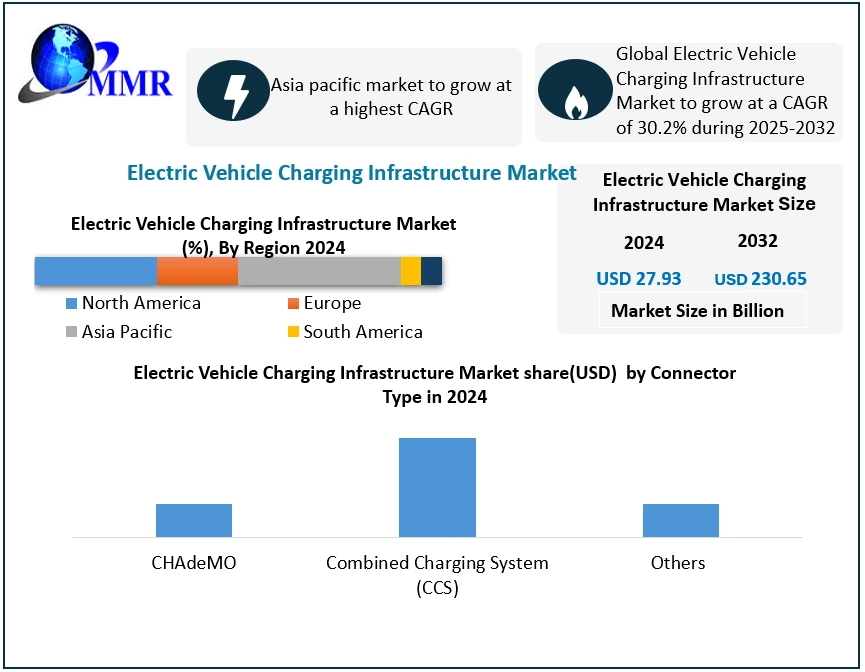
Global Electric Vehicle Charging Infrastructure Market size was valued at USD 27.93 Bn. in 2024, and the total Electric Vehicle Charging Infrastructure Market revenue is expected to grow by 30.2 % from 2025 to 2032, reaching nearly USD 230.65 Bn.
Electric Vehicle Charging Infrastructure Market Overview:
The Electric Vehicle (EV) Charging Infrastructure market encompasses a system and equipment network that enables the charging of electric vehicles, including hardware components (charging stations [alternating current (AC) and direct current (DC)], connectors [CHAdeMO, CCS, Type 2, etc.], etc.) and the software platforms which support them. The market is considered public, private, and includes charging infrastructure at residential, commercial, and publicly accessible charging stations to accommodate no parking or charging needs elsewhere. The report analyzes the market in a detailed perspective across relevant segments, including charger type, connector type, application, and regional footprint, to provide a comprehensive picture of current trends and growth trajectories.
 To know about the Research Methodology:- Request Free Sample Report
The industry is currently booming from three key elements: rapid adoption of electric vehicles and charging infrastructure to support this adoption; increased government involvement and support with subsidies and mandates to encourage adoption and necessary infrastructure; and growing funding and investment in a sustainable mode of transportation. The report states that availability of charging infrastructure is rapidly growing in populated areas while supply constraints still hinder potential growth in less populated or developing areas. As demand continues to grow regionally, regions where EV adoption targets are aggressive like Europe, parts of North America, and the Asia-Pacific.
Asia-Pacific holds a major market share of the current EV charging infrastructure market, while North America also captures a substantial portion, supported by effective government initiatives, rapid technological progress, and increasing adoption of electric vehicles. The report identifies corporations such as ChargePoint, ABB, Tesla, Siemens, Schneider Electric, and BP Pulse as market participants.
In recent years, the constant growth in the adoption of electric vehicles, driven by their efficiency and environmentally friendly features, has spurred the development of charging infrastructure. The energy demand for charging these electric vehicles is expected to surge from 20 billion kilowatt-hours in 2020 to approximately 300 billion kilowatt-hours by2030. Electric vehicles are expected to be increasingly used for intercity travel and long-distance commutes in the coming years in Electric Vehicle Charging Infrastructure Market. However, a significant portion of electric vehicles currently has a limited driving range of less than 150 kilometers, which necessitates efficient charging solutions. Acknowledging this, electric vehicle manufacturers are heavily investing in research and development, particularly focusing on providing fast-charging solutions.
Electric Vehicle Charging Infrastructure Market Dynamics:
The global electric vehicle charging infrastructure market dynamics are thoroughly studied and explained in the MMR report, which helps to understand emerging market trends, drivers, restraints, opportunities, and challenges at the global and regional level for the electric vehicle charging infrastructure market. Some of the driving factors are illustrated below, their detailed explanation is discussed in the report with other supporting.
The number of electric vehicle charging sites is increasing Electric vehicle technology and infrastructure are being pushed forward by the fast-developing electric vehicle charging infrastructure market. Electric vehicles have several advantages, including decreased fuel use and pollution from vehicle engines, which are driving up global demand for them. As a result, demand for electric car charging infrastructure is likely to rise, driving the market growth. As part of government initiative programmers, charging stations are being rapidly constructed, and electric vehicle manufacturers are collaborating on the creation of charging stations in parking lots. Electric car manufacturers are focused on the development of charging stations for electric vehicles that are like gasoline pumps in order to enhance electric vehicle sales. As a result of the increase in the number of electric vehicles charging stations, the electric vehicle charging infrastructure market is growing.
Public charging stations must be developed by governments Governments around the world are expected to heavily subsidize (partially or totally) the building of EV charging infrastructure. Most governments have set lofty goals for the number of chargers they hope to deploy by 2032. France, Germany, and other countries, for example, have proposed special budget allocations for charging infrastructure construction. To fulfil expected demand, we require infrastructure investments of nearly Euro 10 billion in Europe alone. This amount, however, appears feasible given the present electric vehicle charging infrastructure market size and financial sheets of publicly traded EV charging companies. Also, major nations such as the United States have committed to constructing nearly half a million chargers by 2032.
Governments play a crucial role in fostering a conducive ecosystem and driving the increased adoption of electric vehicles by standardizing charging infrastructure. Currently, various countries employ distinct standards for fast charging, leading to a lack of uniformity. Japan utilizes CHAdeMO, Europe, the U.S., and South Korea follow CCS, and China adheres to GB/T. Recognizing the absence of standardization in fast charging methods, the Indian government has mandated the installation of both CHAdeMO and CCS. However, this directive escalated the installation costs for charging stations. Consequently, in 2019, the government revised its guidelines, permitting charging station developers to choose their preferred method. Notably, Tesla, a U.S.-based electric car manufacturer, employs proprietary high-performance superchargers exclusive to Tesla vehicles, thereby limiting compatibility with other electric vehicles. The lack of standardization across countries poses a challenge to the seamless installation of charging stations and could impede the overall growth of the electric vehicle charging infrastructure market.
Emerging Trends for Electric Vehicle Charging Infrastructure Market –
The electric vehicle charging infrastructure market is experiencing dynamic trends driven by the increasing adoption of electric vehicles and the global push towards sustainable transportation solutions. One prominent trend is the rapid expansion of charging networks to address the growing demand for convenient and accessible charging options. Governments, private companies, and utilities worldwide are investing significantly in the installation of charging stations across public spaces, workplaces, homes, and highways. Another key trend is the focus on smart charging solutions, leveraging intelligent backend technology to provide real-time data and manage charging stations based on various factors such as energy output, local electricity consumption, and the number of vehicles being charged. Standardization efforts are underway, but challenges persist in achieving uniformity across different charging standards in various regions. Wireless Power Transfer (WPT) technology is gaining traction, offering a wireless and more efficient means of charging electric vehicles. As the electric vehicle charging infrastructure market continues to grow, these trends collectively contribute to the evolution of a robust and sustainable electric vehicle charging infrastructure ecosystem.
Electric Vehicle Charging Infrastructure Market Segment Analysis:
The market is segmented into Charger Type, Connector Type, and Application.
Based on Charger Type, the market is sub-segmented into the slow charger and Fast charger. In 2024, the fast charger type segment dominated the market, accounting for more than xx % of global sales. The strong demand for rapid chargers in commercial stations was cited as the reason for the increase. Most businesses have installed Level 1 DC fast chargers or Level 2 AC charging stations, which can fully charge an electric vehicle in 4 to 6 hours. In addition, as part of their attempts to promote awareness about their electric cars, automakers are focused on the installation of EV charging stations for their staff. The installation of 100 Level 2 EV charging stations in the parking areas of General Motors Company's Detroit facility, for example, has resulted in a surge in employee demand for the company's Chevrolet Volt electric automobiles.

Based on Connector Type, the market is sub-segmented into CHAdeMO, Combined Charging System (CCS), and others. In 2024, the CHAdeMO connector segment held a considerable market share of over 30%. This is owing to its compatibility with a wide range of EVs (including BMW, GM, and VW, among others) as well as its ease of use. It also allows for more design flexibility in EVs because it only requires a single charging port, whereas CHAdeMO connectors require two charging ports due to their inability to enable AC charging. Furthermore, the current CHAdeMO connectors can produce 62.5 kW of DC and are compliant with the Japan Electric Vehicle Standard (JEVS).
Based on the Application, the electric vehicle charging infrastructure market is sub-segmented into Commercial and Residential. Owing to government initiatives and funding allocation by automotive manufacturers for constructing public EVCI infrastructure, the commercial market accounted for the greatest revenue share of almost 84 % in 2024. Public infrastructure development is required because overnight charging or charging at home would not be sufficient for long-distance travel. Several public transportation agencies are also partnering with automotive manufacturers to develop electric bus charging stations. For example, TRAFIKSELSKABET MOVIA has inked a deal with Siemens for the installation of top-down pantograph electric bus charging stations for electric buses operated by 45 municipalities, including the City of Copenhagen and Region Zealand.

Electric Vehicle Charging Infrastructure Market Regional Analysis:
In 2024, Asia Pacific dominated the global electric vehicle charging infrastructure market, accounting for more than 38% of total sales. Electric vehicle (EV) hotspots include China, Japan, and South Korea, which are investing heavily on charging infrastructure development. For example, in October 2018, the Chinese government stated its plan to invest in EV infrastructure deployment to meet the aim of supporting 5 million electric vehicles on the road by 2021. As part of its effort to encourage environmentally friendly vehicles in the transportation sector, South Korea announced an expenditure of roughly USD 180.3 million to extend EV charging infrastructure across the country. In 2021, the number of electric charging stations in Japan overtook the number of fuel stations, with over 40,000 charging outlets.
In the forthcoming years, Europe is expected to demonstrate a substantial electric vehicle charging infrastructure market share in the electric vehicle charging station segment, driven by the presence of key industry players. This factor is fostering increased consumer adoption of electric vehicles (EVs) and autonomous vehicles throughout the region.
Electric Vehicle Charging Infrastructure Market Competitive Landscapes:
The Electric Vehicle (EV) Charging Infrastructure Market is highly competitive and rapidly changing, primarily due to the multiple collaborations and alliances, the development of new products, several mergers and acquisitions, and worldwide expansion. The report shows that both large electrical equipment manufacturers and small equity-backed EV infrastructure companies are competing to grab a market share. All of this shows that the battle for market share is heating up.
Major players, including ChargePoint, Tesla, ABB, Siemens, Schneider Electric, and EVgo control the marketplace through a mix of charging network, resources to spur research and development (R&D), and partnerships with automakers, energy companies, and government agencies. A great example of this is that Tesla, the automotive manufacturer has built its reputation in large part because of its proprietary Supercharger network, a fast-charging system for Tesla vehicles. ChargePoint has developed a scalable charging solution where users pay by credit card or connect via the cloud for both commercial and residential charging. BP Pulse, Shell Recharge, and Electrify America have deep roots in the energy sector. They are drawing on their energy expertise to tie into renewable energy sources and broaden their fast-charge networks. They are primarily targeting North America and Europe. Notably, emerging players are also beginning to develop fast and interoperable charging technologies. Ionity (Europe) and Tritium (Australia) have become examples of players that have rapidly developed functional ultra-fast charging stations that are interoperable.
The report goes on to say that the rivalry for EV Charging infrastructure innovation is being driven by various technological and service-related advancements. These include but are not limited to smart and microgrid development, mobile phone-based charging management systems, wireless EV charging, and vehicle-to-grid (V2G) functions. Governments are not only regulators they also provide billions of incentivized grants, investments and rebates that directly employ the expanded economies of the EV industry.
Recent key developments in the EV charging infrastructure market
1. July 2025, Michigan (USA) – Huron County Economic Development Corporation: Received an award of $50,050 from the Michigan Department of Environment, Great Lakes and Energy to investigate and expand local EV charging in rural Huron County.
2. July 2025, 14 U.S. States – Federal Government/Conflict:
A federal judge removed a hold on frozen EV charger funding (part of $5 billion BIL program) for 14 states, allowing public charging projects that were stalled to move forward New York alone had $120 million held up.
3. April 2025, Europe (multi-country) – Spark Alliance (Atlante, Ionity, Fastned, Electra): Announced Europe’s largest ever EV charging consortium, bringing together 11,000 charge points and 1,700 stations chain-wide, spread across 25 countries, plus access to ultra-fast up to 400 kW charging.
4. Last month (June 2025), United Kingdom – EDF / Pod Point: EDF formally acquired the UK charging firm Pod Point for slightly more than £10 million; Pod Point features a network of around 258,000 devices, and electrical charging opportunities -- the company has partnerships with Honda, BMW and Jaguar Land Rover.
5. July 2025, Punjab (India) – Ludhiana Municipal Corporation & Private Partner: Announced plans to install 100 EV charging stations across Ludhiana via public law partnership (PPP). Private firm will build and operate the stations in a land-sharing and revenue-share model by the government.
Key trends in the Electric Vehicle (EV) Charging Infrastructure Market:
1.Public and private partnerships (PPP) as a force for infrastructure growth
• The Ludhiana (India) project provides a case study regarding the increasing reliance on PPP models, with government expenditure providing either land or incentive with the EV charging stations being operated and invested in by private companies.
• PPP models allow governments to build and increase infrastructure without putting excessive strain on public expenditure, or public finance, especially in developing countries.
2. As companies consolidate and develop across different geographies, further resource sharing and strategic alliances
• EDF's acquisition of Pod Point, and now Spark Alliance formed are signals that we are seeing a trend toward consolidation and willingness for strategic partnerships.
• Companies are merging, combining resources, and cooperatively providing interoperable and fast-service networks, and are doing this to maximize economies of scale of delivery and deployment
3. Government funding & policy interventions as catalyst for market activity
• On the two occasions in the U.S. (Michigan & the 14-state ruling) it is clear how necessary federal government incentives and regulatory/policy decisions drive deployment.
• We can only speculate to the importance of federal and state level grants and legal decisions to enable large-scale investments for EV infrastructure.
Electric Vehicle Charging Infrastructure Market Scope: Inquire before buying
| Global Electric Vehicle Charging Infrastructure Market | |||
|---|---|---|---|
| Report Coverage | Details | ||
| Base Year: | 2024 | Forecast Period: | 2025-2032 |
| Historical Data: | 2019 to 2024 | Market Size in 2024: | USD 27.93 Bn. |
| Forecast Period 2025 to 2032 CAGR: | 30.2% | Market Size in 2032: | USD 230.65 Bn. |
| Segments Covered: | by Charger Type | Slow Charger Fast Charger |
|
| by Connector Type | CHAdeMO Combined Charging System (CCS) Others |
||
| by Level of Charging | Level 1 Level 2 Level 3 |
||
| by Connectivity | Non-connected Charging Stations Connected Charging Stations |
||
| by Installation | Fixed Portable |
||
| by Application | Commercial Destination Charging Stations Highway Charging Stations Bus Charging Stations Fleet Charging Stations Others Residential Private Houses Apartments/Societies |
||
Electric Vehicle Charging Infrastructure Market by Region
North America (United States, Canada, and Mexico)
Europe (UK, France, Germany, Italy, Spain, Sweden, Austria, and the Rest of Europe)
Asia Pacific (China, South Korea, Japan, India, Australia, Indonesia, Malaysia, Vietnam, Taiwan, Bangladesh, Pakistan, and the Rest of APAC)
Middle East and Africa (South Africa, GCC, Egypt, Nigeria, and the Rest of ME&A)
South America (Brazil, Argentina Rest of South America)
Electric Vehicle Charging Infrastructure Market, Key Players:
North America Electric Vehicle Charging Infrastructure Market:
1. AeroVironment, Inc. - (United States)
2. ChargePoint, Inc. - (United States)
3. SemaConnect, Inc. - (United States)
4. ClipperCreek, Inc. - (United States)
5. Tesla Motors, Inc. - (United States)
6. General Electric Company - (United States)
7. Leviton Manufacturing Co., Inc. - (United States)
8. Huron County Economic Development Corporation (United States)
9. EVgo - (United States)
10. Blink Network - (United States)
11. Greenlots - (United States)
Europe Electric Vehicle Charging Infrastructure Market:
1. ABB Group - (Switzerland)
2. Elektromotive Limited - (United Kingdom)
3. Spark Alliance (United Kingdom)
4. EDF (United Kingdom)
5. Schneider Electric SE - (France)
6. Chargemaster Plc - (United Kingdom)
7. Delphi Automotive LLP - (United Kingdom)
8. Eaton Corporation - (Ireland)
9. Siemens AG - (Germany)
10. Engie - (France)
11. Pod Point Ltd. - (United Kingdom)
12. NewMotion - (Netherlands)
Asia Pacific Electric Vehicle Charging Infrastructure Market:
1. BYD Company - (China)
2. Efacec Electric Mobility - (Portugal)
3. Delta Electronics, Inc. - (Taiwan)
4. TGOOD Global Ltd. - (China)
FAQs:
1) What was the market size of the Market in 2024?
Ans: Electric Vehicle Charging Infrastructure Market was worth USD 27.93 Bn in 2024.
2) What is the market segment of the Market?
Ans: The market segments are based on Charger type, Connector Type, Level of Charging, Connectivity, Installation, and Application.
3) What is the forecast period considered for the Electric Vehicle Charging Infrastructure Market?
Ans: The forecast period for the Market is 2025 to 2032.
4) What is the market size in 2032?
Ans: Electric Vehicle Charging Infrastructure Market is estimated as worth US$ 230.65 Bn.
5) Which region is dominated in Market?
Ans : In 2024, the Asia Pacific region dominated the Market.