Domain Name System (DNS) Firewall Market Size by Deployment Type, Organization Size, Application, End-User, Region, Industry-Wide Analysis, Competitive Landscape Assessment & Long-Term Forecast to 2034

12.86%
CAGR (2026-2034)
201.51 USD Mn.
Forecast Market Size
308
Report Pages
120
Market Tables

Overview

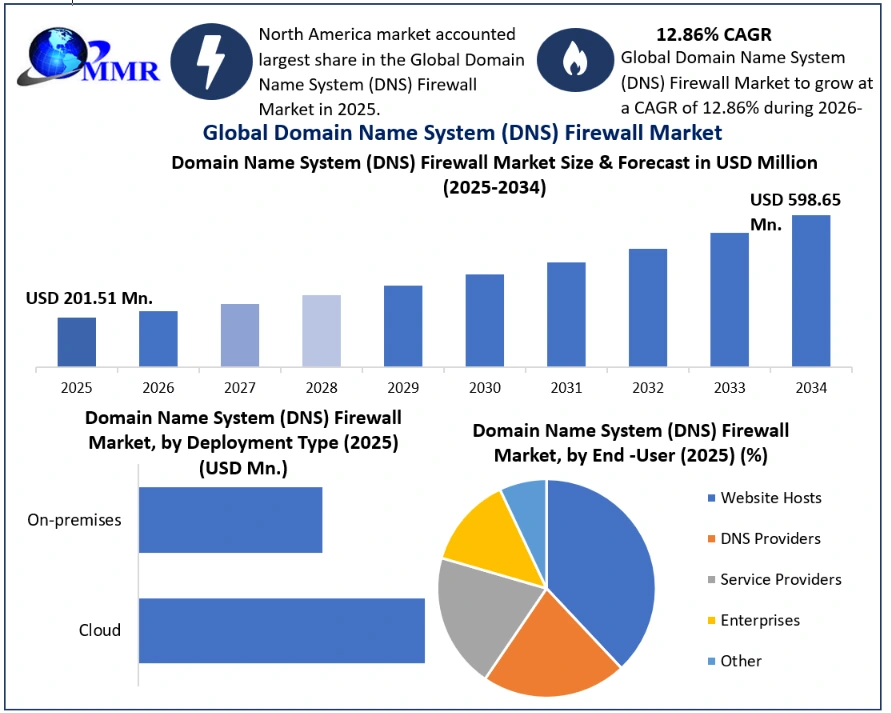
Domain Name System (DNS) Firewall Market is expected to grow at a CAGR of 12.86% during the forecast period. Domain Name System (DNS) Firewall Market is expected to reach USD 598.65 Mn by 2034.

The domain name system also is known as DNS, is the process in which internet domain names are located as well as translated into specific internet protocol or IP addresses. The domain name system helps in mapping the name people generally use for locating a website to the IP address used by a computer for locating a website.

The extreme vulnerability of DNS towards malware, viruses and advanced persistent threat (APT) intrusions are some of the crucial factors that are expected to drive the market. However, it is the IT security budget concerns that act a critical restraining factor for the market growth. Other than this, it is the higher adoption of UTM solutions in enterprises further hinders the Market growth.

Domain Name System (DNS) Firewall Market Growth OutlookDomain Name System (DNS) Firewall Market Growth
To know about the Research Methodology:-Request Free Sample Report

The BFSI end-use application is expected to one of the highest growth rates, as organizations in industries need security for products and services for protecting their assets, offices, employees, customers, branches, and operations. Innovative and improved financial products and facilities are frequently introduced by merchants to improve their business operations and expand the customer base.

Domain Name System (DNS) Firewall Market Dynamics:

Market Drivers

The global Domain Name System (DNS) Firewall market is primarily driven by the escalating frequency of DNS-based cyberattacks, as over 80% of modern cyber threats exploit DNS protocols for command and control (C2) communications, data exfiltration, and malware distribution through tactics like DNS tunneling, phishing, and domain generation algorithms (DGAs). This threat landscape is further reinforced by the rapid proliferation of Zero-Trust Network Architecture (ZTNA) frameworks and regulatory mandates—such as the US CISA Protective DNS initiative and the EU NIS2 directive—which establish DNS-layer filtering as an essential frontline defense. Additionally, the widespread expansion of remote and hybrid workforces necessitates agile, cloud-delivered security solutions capable of enforcing uniform protection across off-network devices without routing all traffic through traditional VPNs, thereby accelerating global market adoption.

Market Restraints & Challenges

The global Domain Name System (DNS) Firewall market faces several key restraints, including the rapid adoption of encrypted DNS protocols like DNS-over-HTTPS (DoH) and DNS-over-TLS (DoT), which encrypt queries and obscure visibility, making traditional enterprise monitoring and policy enforcement more difficult without specialized endpoint configurations. Furthermore, market penetration is hindered by a general lack of awareness among mid-market and SMB organizations that often rely solely on perimeter firewalls while neglecting recursive DNS-layer protection. Additionally, operational challenges arise from the risk of false positives, where overly aggressive threat feeds or misconfigured blocklists inadvertently restrict access to benign business domains, leading to workflow disruptions and policy fatigue.

Market Opportunities

The global Domain Name System (DNS) Firewall market offers significant growth opportunities, driven by the integration of AI and machine learning-powered predictive filtering that enables real-time analysis of domain metadata, structural entropy, and lookalike patterns to proactively mitigate zero-day threats. Additionally, the rapid expansion of edge computing and IoT infrastructure presents a critical avenue for growth, as connected devices lacking endpoint security rely on local gateways and edge resolvers for DNS-level protection. Furthermore, expanding strategic partnerships with Managed Security Service Providers (MSSPs) allows cybersecurity vendors to seamlessly bundle protective DNS solutions into comprehensive SASE and SOC offerings tailored for SMBs and mid-market enterprises.

 Key Market Trends

The global Domain Name System (DNS) Firewall market are highlighted by a widespread convergence with SASE and SSE architectures, driving a shift away from standalone DNS tools toward unified Secure Service Edge platforms that incorporate Secure Web Gateways, CASB, and Zero Trust access controls. Concurrently, organizations are increasingly implementing hybrid resolver architectures, deploying low-latency on-premises resolvers in tandem with cloud-native recursive resolvers to achieve seamless, centralized policy enforcement across complex multi-cloud infrastructure. Furthermore, threat defense is advancing through context-aware threat intelligence integration, where static blocklists are replaced by dynamic telemetry streams that inject real-time DNS logging directly into Extended Detection and Response (XDR) and SIEM platforms for immediate threat correlation.

Domain Name System (DNS) Firewall Market Segment Analysis:

The Global Market is segmented deployment type, organization size, end-user and region. DNS providers will remain one of the fastest growing end-user segment in this market, as the DNS hosts are used for running the DNS servers, further being used and integrated by Internet Service Providers (ISPs), website hosts, and domain name registrars.

The Global Domain Name System (DNS) Firewall Market by deployment type is segmented into Cloud-Based and On-Premises architectures, each serving distinct operational, performance, and security needs across modern enterprises:

Cloud-Based Deployment (Dominant & Fastest-Growing Segment): Cloud-based DNS firewalls hold the majority market share, driven by the rapid adoption of remote/hybrid work models, multi-cloud architectures, and Zero-Trust access frameworks. This deployment model operates via cloud-delivered SaaS/SaaS-like edge resolvers, allowing organizations to redirect recursive DNS queries in real-time through forwarder or DHCP configuration updates without investing in specialized physical hardware. Key drivers for cloud adoption include low administrative overhead, dynamic threat intelligence updates, global scalability, and effortless integration with Secure Service Edge (SSE) and Secure Access Service Edge (SASE) platforms.

On-Premises Deployment (Legacy & Highly Secure Segment): On-premises DNS firewalls continue to represent a vital segment, particularly for critical infrastructure, government agencies, defense organizations, healthcare, and heavily regulated financial institutions. This model involves physical hardware appliances or local virtual appliances deployed directly within an organization’s local data centers or first-hop resolvers. It is preferred by entities operating air-gapped networks or those bound by strict data sovereignty, compliance mandates, and ultra-low latency requirements that prohibit routing internal DNS query telemetry outside the corporate perimeter.

By geography, the Domain Name System (DNS) Firewall Market can be segmented into North America, Europe, Asia Pacific, Middle East, and Latin America. North America is expected to hold the largest market size during the forecast period, as most of the enterprises in this region have deployed DNS firewall because of the presence of diverse internet subscribers, and the increasing deployment of data centres in the region.

The key players of Domain Name System (DNS) Firewall Market include EfficientIP (France), EonScope (US), Cloudflare (US), Infoblox (US), BlueCat (Canada), and Cisco (US).

Domain Name System (DNS) Firewall Market Recent Developments:

Date Company Development Impact
16 June 2026 Palo Alto Networks Palo Alto Networks partnered with Amazon Web Services to launch Advanced DNS Security natively on Amazon Route 53 Resolver DNS Firewall. The collaboration enables AWS enterprise users to enforce real-time predictive DNS threat protection without deploying additional appliance infrastructure.
16 June 2026 EfficientIP Private equity firm Francisco Partners completed the acquisition of EfficientIP to scale its DNS security and DDI solutions global market presence. The investment accelerates R&D for hybrid DNS firewall protection and automated threat response platforms across enterprise cloud environments.
06 August 2026 Infoblox Infoblox completed the acquisition of Kentik to integrate real-time network intelligence into its DNS threat defense and firewall platform. The acquisition enhances DNS-native visibility and AI-driven automated threat containment across enterprise hybrid network architectures.
01 September 2026 Cisco Systems Cisco officially announced the migration roadmap and end-of-sale schedule for Cisco Umbrella SIG and DNS into Cisco Secure Access. The strategic transition consolidates standalone DNS-layer security into a unified Security Service Edge (SSE) architecture.
27 October 2026 DNSFilter DNSFilter commercially launched LUMINATE by DNSFilter™, a unified AI-powered DNS-first security platform. The release integrates behavioral DNS analytics, shadow AI governance, and protective encryption controls into a single DNS firewall architecture.

Scope Of The Domain Name System (DNS) Firewall Market :Inquire before buying

Global Domain Name System (DNS) Firewall Market
Report Coverage Details
Base Year: 2025 Forecast Period: 2026-2034
Historical Data: 2020 to 2025 Market Size in 2025: USD 201.51 Mn.
Forecast Period 2026 to 2034 CAGR: 12.86% Market Size in 2034: USD 598.65 Mn.
Segments Covered: by Deployment Type Cloud
On-premises
by Organization Size Large Enterprise
SMEs
by End-User Website Hosts
DNS Providers
Service Providers
Enterprises

Domain Name System (DNS) Firewall Market, by Region

North America (United States, Canada and Mexico)
Europe (UK, France, Germany, Italy, Spain, Sweden, Austria and Rest of Europe)
Asia Pacific (China, South Korea, Japan, India, Australia, Indonesia, Malaysia, Vietnam, Taiwan, Bangladesh, Pakistan and Rest of APAC)
Middle East and Africa (South Africa, GCC, Egypt, Nigeria and Rest of ME&A)
South America (Brazil, Argentina Rest of South America)

Domain Name System (DNS) Firewall Market Key Players are:

North America
1.Cisco Systems, Inc. (Cisco Umbrella / OpenDNS legacy)
2.Cloudflare, Inc.
3.Infoblox Inc.
4.Akamai Technologies, Inc. (includes Nominum's technology, acquired 2017)
5.VeriSign, Inc.
6.F5, Inc.
7.DNSFilter, Inc.
8.Zorus (DNSFilter, Inc. — acquired 2025)
9.CrowdStrike Holdings, Inc.
10.Palo Alto Networks, Inc.
11.Zscaler, Inc.
12.Fortinet, Inc.
13.Neustar Security Services (GoDaddy Inc. — acquired 2023)
14.GoDaddy Inc.
15.NS1 (International Business Machines Corporation — acquired 2023)
16.Oracle Corporation (Oracle Dyn, formerly Dyn Inc., acquired 2016)
17.Comodo Group, Inc.
18.SafeDNS
19.CleanBrowsing
20.Netskope, Inc.
21.BlueCat Networks, Inc.
22.CIRA (Canadian Internet Registration Authority)
23.eSentire, Inc.
Europe
24. EfficientIP
25. SWITCH (Swiss Education & Research Network)
26. Quad9 Foundation
27. WebTitan (TitanHQ)
28. DNSSense
Asia-Pacific
29. Trend Micro Incorporated
30. NTT Communications Corporation
31. Huawei Technologies Co., Ltd.
South America
32. Check Point Software Technologies Ltd.
Others

Frequently Asked questions

1. What is the market size of the Global Domain Name System (DNS) Firewall Market in 2025?
Ans. The market size Global Market in 2025 was USD 201.51 Million.

2. What are the different segments of the Global Domain Name System (DNS) Firewall Market ?
Ans. The Global Market is divided into Deployment Type, Organization Size, Application and Distribution Channel.

3. What is the study period of this market?
Ans. The Global Market will be studied from 2020 to 2034.

4. Which region is expected to hold the highest Global Market share?
Ans. The North America dominates the market share in the market.

5. What is the Forecast Period of Global Market ?
Ans. The Forecast Period of the market is 2026-2034 in the market.

Table of Contents

1. GLOBAL DOMAIN NAME SYSTEM (DNS) FIREWALL MARKET INTRODUCTION 1.1 Executive Market Landscape and Industry Overview 1.1.1 Global DNS Firewall Market Size (Value USD Million), 2025–2034 1.1.2 Historical DNS Firewall Market Development and Adoption Trends Across Regions 1.1.3 Enterprise DNS Security Adoption and Market Development Trends 1.1.4 Cloud-Based DNS Firewall Adoption Across Global Digital Infrastructure 1.1.5 Increasing DNS-Layer Threats Supporting Firewall Deployment Growth 1.1.6 Global DNS Firewall Market Development Across Developed and Emerging Economies 1.1.7 Five-Year Market Outlook Highlighting DNS Security Growth Opportunities 1.1.8 CAGR Analysis of Global DNS Firewall Market (2025–2034) 1.2 Domain Name System (DNS) Firewall Market Dynamics 1.2.1 Domain Name System (DNS) Firewall Market Trends 1.2.2 Domain Name System (DNS) Firewall Market Dynamics 1.2.3 Drivers 1.2.4 Restraints 1.2.5 Opportunities 1.2.6 Challenges 1.2.7 PORTER’s Five Forces Analysis 1.2.8 PESTLE Analysis 1.3 DNS Firewall Pricing Structure and Value Chain Profitability Assessment 1.3.1 DNS Firewall Software and Service Pricing Structure Analysis 1.3.2 Subscription-Based Pricing Models Across Cloud DNS Firewall Solutions 1.3.3 Enterprise Licensing and Usage-Based DNS Security Pricing Models 1.3.4 Implementation and Integration Costs Across DNS Firewall Deployments 1.3.5 Managed DNS Firewall Service Pricing and Margin Analysis 1.3.6 Threat Intelligence and Advanced Analytics Feature Pricing Impact 1.3.7 Profitability Trends Across DNS Firewall Vendors and Service Providers 1.4 DNS Infrastructure, Technology, and Supplier Ecosystem 1.4.1 Global DNS Infrastructure and Firewall Technology Ecosystem Structure 1.4.2 Recursive Resolver and Authoritative DNS Infrastructure Development Trends 1.4.3 DNS Server Hardware and Software Technology Supplier Landscape 1.4.4 Threat Intelligence Feed Providers Supporting DNS Firewall Solutions 1.4.5 Cloud Infrastructure Providers Supporting DNS Security Deployment 1.4.6 DNS Management Platforms and Security Integration Ecosystem 1.4.7 Supplier Partnerships Supporting Global DNS Firewall Infrastructure Resilience 1.5 DNS Threat Landscape and Security Demand Development 1.5.1 Global DNS-Based Cyberattack Trends and Threat Development Patterns 1.5.2 Malware, Ransomware, and Phishing Attacks Driving DNS Protection Demand 1.5.3 DNS Tunneling and Data Exfiltration Threat Development Trends 1.5.4 Domain Generation Algorithms Supporting Advanced DNS Threat Detection 1.5.5 Command-and-Control Traffic Detection Through DNS Security Platforms 1.5.6 DDoS Attacks Targeting Authoritative DNS Infrastructure 1.5.7 Emerging DNS Threats Influencing Enterprise Security Investment Priorities 1.6 DNS Firewall Architecture and Protection Technology Evolution 1.6.1 Recursive Resolver Firewall Technology Development Trends 1.6.2 Authoritative DNS Firewall Technology and Protection Capabilities 1.6.3 Caching Forwarder Firewall Architecture Development Trends 1.6.4 Policy-Based DNS Filtering and Blocking Technology 1.6.5 DNS Traffic Inspection and Real-Time Threat Detection 1.6.6 DNSSEC Validation and Security Technology Integration 1.6.7 Next-Generation DNS Firewall Architecture Development Opportunities 1.7 DNS Threat Intelligence and Advanced Detection Technologies 1.7.1 Real-Time DNS Threat Intelligence Integration Across Security Platforms 1.7.2 Malicious Domain Detection and Reputation Scoring Technologies 1.7.3 Machine Learning Supporting Advanced DNS Threat Detection 1.7.4 Artificial Intelligence Applications in DNS Security Analytics 1.7.5 Behavioral DNS Traffic Analysis and Anomaly Detection 1.7.6 Threat Feed Aggregation and Automated Security Policy Updates 1.7.7 Future AI-Enabled DNS Firewall Detection Opportunities 1.8 DNS Firewall Cloud, On-Premises, and Hybrid Deployment Dynamics 1.8.1 Cloud-Based DNS Firewall Adoption Across Global Enterprises 1.8.2 On-Premises DNS Firewall Deployment Across Critical Infrastructure 1.8.3 Hybrid DNS Firewall Architecture Development Across Enterprise Networks 1.8.4 Cloud Migration Supporting Scalable DNS Security Infrastructure 1.8.5 Virtual DNS Firewall Appliance Deployment Across Distributed Networks 1.8.6 Edge Computing and DNS Security Architecture Integration 1.8.7 Future Multi-Cloud DNS Firewall Deployment Opportunities 1.9 DNS Firewall Performance, Scalability, and Network Optimization 1.9.1 DNS Query Processing Speed and Firewall Performance Requirements 1.9.2 Low-Latency DNS Resolution Supporting Enterprise Network Performance 1.9.3 High-Volume DNS Query Processing Across Global Networks 1.9.4 Anycast DNS Infrastructure Supporting Global Firewall Availability 1.9.5 DNS Caching Optimization and Response Time Improvements 1.9.6 Scalability Requirements Across Large Enterprise DNS Environments 1.9.7 Performance Optimization Across Cloud and Distributed DNS Architectures 1.10 DNS Firewall Integration With Cybersecurity Platforms 1.10.1 DNS Firewall Integration With Security Operations Center Platforms 1.10.2 SIEM Integration Supporting Centralized DNS Security Monitoring 1.10.3 SOAR Integration Supporting Automated DNS Threat Response 1.10.4 Secure Web Gateway and DNS Firewall Integration 1.10.5 SASE and Zero Trust Security Architecture Integration 1.10.6 Endpoint Security and DNS Threat Protection Integration 1.10.7 Firewall and Network Security Platform Interoperability Trends 1.11 DNS Encryption, Privacy, and Secure Resolution Technologies 1.11.1 DNS over HTTPS Adoption and Firewall Security Implications 1.11.2 DNS over TLS Deployment Across Enterprise Networks 1.11.3 Encrypted DNS Traffic Visibility and Inspection Challenges 1.11.4 DNS Privacy Requirements Influencing Firewall Architecture Development 1.11.5 DNSSEC Adoption Supporting Secure Domain Resolution 1.11.6 Encrypted DNS Policy Enforcement Across Managed Networks 1.11.7 Future Secure DNS Resolution Technology Opportunities 1.12 Managed DNS Firewall and Security Service Development 1.12.1 Global Managed DNS Firewall Services Market Development Trends 1.12.2 Telecom Operator and ISP-Based DNS Security Services 1.12.3 Managed Security Service Provider DNS Firewall Offerings 1.12.4 DNS Monitoring and Incident Response Service Development 1.12.5 Outsourced DNS Security Management Across Enterprise Customers 1.12.6 Service-Level Agreements and Managed DNS Security Contracts 1.12.7 Future DNS Firewall-as-a-Service Business Model Opportunities 1.13 DNS Firewall Monitoring, Analytics, and Incident Response 1.13.1 Real-Time DNS Traffic Monitoring Across Enterprise Networks 1.13.2 DNS Query Logging and Security Event Analysis 1.13.3 Threat Detection and Incident Response Through DNS Analytics 1.13.4 DNS Security Dashboards and Centralized Policy Management 1.13.5 Historical DNS Data Supporting Forensic Security Investigations 1.13.6 Automated Alerts and Threat Response Workflow Development 1.13.7 Predictive DNS Security Analytics and Monitoring Opportunities 1.14 DNS Firewall Investment Trends and Capital Allocation Analysis 1.14.1 Investment Trends Across Global DNS Firewall Technology Providers 1.14.2 Capital Expenditure in DNS Security Infrastructure Expansion 1.14.3 R&D Investment in Advanced DNS Firewall Technologies 1.14.4 Investment in AI-Based DNS Threat Detection Solutions 1.14.5 Strategic Investment in Cloud DNS Security Platforms 1.14.6 Mergers and Acquisitions Across the DNS Security Industry 1.14.7 Future Investment Opportunities Across DNS Firewall Applications 1.15 DNS Firewall Supply Chain, Distribution, and Service Ecosystem 1.15.1 Global DNS Firewall Technology Supply Chain Development 1.15.2 Cloud Infrastructure and Software Supply Dependencies 1.15.3 Threat Intelligence Provider and Security Vendor Relationships 1.15.4 Technology Distributor and Channel Partner Network Development 1.15.5 Managed Service Provider Distribution and Delivery Models 1.15.6 DNS Security Implementation and Integration Partner Ecosystem 1.15.7 Regional Localization of DNS Firewall Service Delivery 1.16 DNS Firewall Enterprise Adoption and Customer Demand Dynamics 1.16.1 Large Enterprise Adoption of DNS Firewall Solutions 1.16.2 Small and Medium Enterprise DNS Security Adoption Trends 1.16.3 Remote Workforce and Distributed Network Security Requirements 1.16.4 Multi-Cloud Enterprise Environments Supporting DNS Firewall Demand 1.16.5 Critical Infrastructure DNS Security Adoption Trends 1.16.6 IT Security Budget Allocation Toward DNS Protection 1.16.7 Future Enterprise DNS Firewall Adoption Opportunities 1.17 DNS Firewall Critical Infrastructure and Industry Applications 1.17.1 DNS Firewall Adoption Across Telecommunications Infrastructure 1.17.2 DNS Security Requirements Across Financial Services Institutions 1.17.3 Government and Defense DNS Infrastructure Protection 1.17.4 Healthcare and Life Sciences DNS Security Applications 1.17.5 Retail and E-Commerce DNS Threat Protection Requirements 1.17.6 Manufacturing and Industrial Network DNS Security Adoption 1.17.7 Energy and Utilities DNS Infrastructure Protection Trends 1.18 DNS Firewall Regulatory Framework, Compliance, and Standards 1.18.1 Global DNS Security Regulations and Compliance Requirements 1.18.2 Data Protection Regulations Influencing DNS Security Deployment 1.18.3 Cybersecurity Frameworks Supporting DNS Firewall Adoption 1.18.4 DNSSEC Standards and Secure DNS Implementation Requirements 1.18.5 Government DNS Security Policies Across Major Markets 1.18.6 Critical Infrastructure Cybersecurity Requirements and DNS Protection 1.18.7 Regional Comparison of DNS Firewall Regulatory Frameworks 1.19 DNS Firewall Lifecycle, Replacement, and Technology Upgrade Dynamics 1.19.1 DNS Firewall Deployment Lifecycle Across Enterprise Environments 1.19.2 Legacy DNS Infrastructure Replacement and Modernization Trends 1.19.3 Software Version Upgrades and Security Feature Adoption 1.19.4 Migration From Traditional DNS Protection to Cloud Platforms 1.19.5 Technology Refresh Cycles Across Enterprise DNS Infrastructure 1.19.6 DNS Firewall Scalability Upgrades Supporting Growing Query Volumes 1.19.7 Long-Term DNS Security Platform Lifecycle Management 1.20 DNS Firewall Digital Transformation and Zero Trust Integration 1.20.1 DNS Firewall Integration Across Digital Transformation Programs 1.20.2 Zero Trust Network Architecture Supporting DNS Security Adoption 1.20.3 SASE Platform Integration With Cloud-Based DNS Firewalls 1.20.4 Secure Access Service Edge and DNS Protection Convergence 1.20.5 Remote Access Security and DNS-Level Policy Enforcement 1.20.6 Digital Infrastructure Modernization Supporting DNS Security 1.20.7 Future DNS Firewall Role Within Zero Trust Architectures 1.21 DNS Firewall Emerging Technologies and Future Innovation 1.21.1 AI-Driven DNS Threat Detection and Automated Response 1.21.2 Machine Learning-Based Domain Reputation and Classification 1.21.3 Behavioral Analytics for Advanced DNS Threat Identification 1.21.4 Quantum-Resistant DNS Security Technology Development 1.21.5 Edge-Based DNS Security and Distributed Protection 1.21.6 Autonomous DNS Firewall Policy Management Technologies 1.21.7 Future Innovation Opportunities Across DNS Firewall Platforms 1.22 DNS Firewall Market Competition, Partnerships, and Ecosystem Development 1.22.1 Strategic Partnerships Across DNS Firewall Technology Providers 1.22.2 Cloud Provider and Cybersecurity Vendor Collaboration Trends 1.22.3 Telecom Operator Partnerships Supporting Managed DNS Security Services 1.22.4 Technology Alliances Supporting Threat Intelligence Integration 1.22.5 OEM and Security Platform Integration Strategies 1.22.6 Channel Partnerships Supporting Global DNS Firewall Market Expansion 1.22.7 Future Ecosystem Development Across DNS Security Technologies 1.23 DNS Firewall Business Models and Service Monetization 1.23.1 Subscription-Based DNS Firewall Revenue Models 1.23.2 Software Licensing and Enterprise Contract Structures 1.23.3 Usage-Based Pricing Across Cloud DNS Firewall Platforms 1.23.4 Managed Security Service Revenue Models 1.23.5 Premium Threat Intelligence and Analytics Monetization 1.23.6 Bundled DNS Security and SASE Service Offerings 1.23.7 Future DNS Firewall Monetization and Recurring Revenue Opportunities 1.24 Regional DNS Firewall Market Development and Future Opportunities 1.24.1 North American DNS Firewall Market Development and Investment Trends 1.24.2 European DNS Security Adoption and Regulatory Development 1.24.3 Asia Pacific DNS Firewall Market Growth and Technology Adoption 1.24.4 Latin American DNS Security Infrastructure Development Trends 1.24.5 Middle East DNS Firewall Deployment and Digital Transformation 1.24.6 African DNS Security Adoption and Infrastructure Development 1.24.7 Regional Comparison of DNS Firewall Growth Opportunities 1.25 Domain Name System (DNS) Firewall Market: Market Size and Forecast by Segmentation (Value USD Million) (2025–2034) 1.25.1 Domain Name System (DNS) Firewall Market Size and Forecast, By Product Type 1.25.1.1 On-Premise 1.25.1.2 Cloud 1.25.1.3 Virtual Appliance 1.25.2 Domain Name System (DNS) Firewall Market Size and Forecast, By Organization Size 1.25.2.1 Large Enterprise 1.25.2.2 SMEs 1.25.3 Domain Name System (DNS) Firewall Market Size and Forecast, By End-User 1.25.3.1 Website Hosts 1.25.3.2 DNS Providers 1.25.3.3 Service Providers 1.25.3.4 Domain Name Registrars 1.25.3.5 Others 1.25.4 Domain Name System (DNS) Firewall Market Size and Forecast, By Region 1.25.4.1 North America 1.25.4.1.1 United States 1.25.4.1.2 Canada 1.25.4.1.3 Mexico 1.25.4.2 Europe 1.25.4.2.1 United Kingdom 1.25.4.2.2 France 1.25.4.2.3 Germany 1.25.4.2.4 Italy 1.25.4.2.5 Switzerland 1.25.4.2.6 Spain 1.25.4.2.7 Sweden 1.25.4.2.8 Russia 1.25.4.2.9 Poland 1.25.4.2.10 Portugal 1.25.4.2.11 Romania 1.25.4.2.12 Rest of Europe 1.25.4.3 Asia Pacific 1.25.4.3.1 China 1.25.4.3.2 South Korea 1.25.4.3.3 Japan 1.25.4.3.4 India 1.25.4.3.5 Australia 1.25.4.3.6 Indonesia 1.25.4.3.7 Philippines 1.25.4.3.8 Malaysia 1.25.4.3.9 Vietnam 1.25.4.3.10 Thailand 1.25.4.3.11 Taiwan 1.25.4.3.12 Combadia 1.25.4.3.13 Rest of Asia Pacific 1.25.4.4 Middle East And Africa 1.25.4.4.1 South Africa 1.25.4.4.2 Turkey 1.25.4.4.3 Saudi Arabia 1.25.4.4.4 UAE 1.25.4.4.5 Qatar 1.25.4.4.6 Egypt 1.25.4.4.7 Nigeria 1.25.4.4.8 Rest of ME&A 1.25.4.5 South America 1.25.4.5.1 Brazil 1.25.4.5.2 Argentina 1.25.4.5.3 Chile 1.25.4.5.4 Colombia 1.25.4.5.5 Rest Of South America 2.COMPETITIVE INTELLIGENCE & INDUSTRIAL ECOSYSTEM 2.1 Competitive Landscape 2.1.1 MMR Competition Matrix 2.1.2 Competitive Positioning of Leading Key Players [Revenue and Market Share (%)] 2.1.3 Key Players Benchmarking 2.1.3.1 Company Name 2.1.3.2 Headquarter 2.1.3.3 Product Portfolio 2.1.3.4 Technology Integration 2.1.3.5 Customer Base 2.1.3.6 Total Company Revenue (2025) 2.1.3.7 Domain Name System (DNS) Firewall Revenue (2025) 2.1.3.8 Certifications 2.1.3.9 Patent 2.1.3.10 Geographic Presence 2.1.4 Market Structure 2.1.4.1 Market Leaders 2.1.4.2 Market Followers 2.1.4.3 Emerging Players 2.1.5 Growth Rate/Y-o-Y (%) of Companies 2.1.6 Profit Margin (%) of Companies 2.1.7 R&D Investments (%) of Companies 2.1.8 Revenue Vs Net Earnings – Financial Health Benchmarking (2025) 2.1.9 Revenue Performance And Financial Analysis (2025) 2.1.10 Mergers and Acquisitions Details 2.1.11 Recent Key Developments 2.2 DNS Firewall Competitive Landscape and Industry Structure 2.2.1 Market Concentration Across Global DNS Firewall Industry 2.2.2 Competitive Positioning Across Major DNS Security Providers 2.2.3 Technology Differentiation Across Leading DNS Firewall Platforms 2.2.4 Cloud and On-Premises Deployment Capability Comparison 2.2.5 Threat Intelligence and Detection Technology Benchmarking 2.2.6 Global DNS Infrastructure and Network Coverage Comparison 2.2.7 Entry Barriers and Challenges for New DNS Firewall Participants 2.3 DNS Firewall Company Market Share and Positioning Analysis (2024–2025) 2.3.1 Revenue-Based Market Share Comparison Across Leading DNS Firewall Companies 2.3.2 Regional Market Positioning Across Major Global Markets 2.3.3 Enterprise and SME Customer Segment Positioning Analysis 2.3.4 Cloud-Based and Hybrid DNS Firewall Platform Positioning 2.3.5 Threat Intelligence and Security Feature Comparison 2.3.6 Managed DNS Security Service Positioning Across Providers 2.3.7 Growth Performance of Emerging DNS Firewall Companies 2.4 Strategic Initiatives and Expansion Strategy Analysis 2.4.1 Cloud DNS Firewall Platform Expansion Across Global Markets 2.4.2 Strategic Partnerships With Telecom and Internet Service Providers 2.4.3 Threat Intelligence Partnership and Technology Integration Strategies 2.4.4 Expansion Into Zero Trust and SASE Security Platforms 2.4.5 Managed DNS Security Service Portfolio Expansion 2.4.6 Regional Data Center and DNS Infrastructure Expansion 2.4.7 Mergers and Acquisitions Supporting DNS Security Market Expansion 2.5 Financial Performance and Profitability Benchmarking 2.5.1 Revenue Growth Trends Across Leading DNS Firewall Providers 2.5.2 Profit Margin Analysis and Cost Structure Comparison 2.5.3 DNS Security Revenue Contribution Across Diversified Technology Companies 2.5.4 R&D Investment and Technology Development Expenditure Trends 2.5.5 Recurring Subscription Revenue and Service Economics Analysis 2.5.6 Managed Security Service Revenue Development Trends 2.5.7 Financial Resilience Across Global DNS Security Providers 2.6 Innovation Leadership and R&D Investment Analysis 2.6.1 Research and Development Investment Across Leading DNS Security Companies 2.6.2 AI-Based DNS Threat Detection Technology Innovation 2.6.3 Machine Learning and Behavioral DNS Analytics Development 2.6.4 DNSSEC and Encrypted DNS Technology Development 2.6.5 Cloud-Native DNS Firewall Architecture Innovation 2.6.6 Zero Trust and SASE Integration Technology Development 2.6.7 Future DNS Firewall Product Pipeline and Innovation Opportunities 2.7 DNS Firewall Partnership and Ecosystem Development Analysis 2.7.1 DNS Firewall Provider and Cloud Platform Partnerships 2.7.2 Telecom Operator and ISP Security Partnership Development 2.7.3 Threat Intelligence Provider and Security Vendor Collaborations 2.7.4 Managed Security Service Provider Partnership Strategies 2.7.5 Enterprise Technology Integration and Channel Partnerships 2.7.6 Government and Critical Infrastructure Security Partnerships 2.7.7 Future Strategic Partnership Opportunities Across DNS Security Ecosystem 2.8 Company Profile: 30+ Key Players 2.8.1 Detailed Profile Considering the Parameters 2.8.1.1 Overview 2.8.1.2 Business Portfolio 2.8.1.3 Financial Overview 2.8.1.4 SWOT Analysis 2.8.1.5 Strategic Analysis 2.8.1.6 Recent Developments 2.8.2 North America 2.8.2.1 Cisco Systems, Inc. (Cisco Umbrella / OpenDNS legacy) 2.8.2.2 Cloudflare, Inc. 2.8.2.3 Infoblox Inc. 2.8.2.4 Akamai Technologies, Inc. (includes Nominum's technology, acquired 2017) 2.8.2.5 VeriSign, Inc. 2.8.2.6 F5, Inc. 2.8.2.7 DNSFilter, Inc. 2.8.2.8 Zorus (DNSFilter, Inc. — acquired 2025) 2.8.2.9 CrowdStrike Holdings, Inc. 2.8.2.10 Palo Alto Networks, Inc. 2.8.2.11 Zscaler, Inc. 2.8.2.12 Fortinet, Inc. 2.8.2.13 Neustar Security Services (GoDaddy Inc. — acquired 2023) 2.8.2.14 GoDaddy Inc. 2.8.2.15 NS1 (International Business Machines Corporation — acquired 2023) 2.8.2.16 Oracle Corporation (Oracle Dyn, formerly Dyn Inc., acquired 2016) 2.8.2.17 Comodo Group, Inc. 2.8.2.18 SafeDNS 2.8.2.19 CleanBrowsing 2.8.2.20 Netskope, Inc. 2.8.2.21 BlueCat Networks, Inc. 2.8.2.22 CIRA (Canadian Internet Registration Authority) 2.8.2.23 eSentire, Inc. 2.8.3 Europe 2.8.3.1 EfficientIP 2.8.3.2 SWITCH (Swiss Education & Research Network) 2.8.3.3 Quad9 Foundation 2.8.3.4 WebTitan (TitanHQ) 2.8.3.5 DNSSense 2.8.4 Asia-Pacific 2.8.4.1 Trend Micro Incorporated 2.8.4.2 NTT Communications Corporation 2.8.4.3 Huawei Technologies Co., Ltd. 2.8.5 South America 2.8.5.1 Check Point Software Technologies Ltd. 2.8.6 Others 3. KEY INSIGHTS, STRATEGIC OUTLOOK & METHODOLOGICAL FRAMEWORK 3.1 Key Findings 3.2 Strategic Moves & Industry Outlook 3.3 Research Methodology

Custom Market Research Services

We Will Customise The Research For You, In Case The Report Listed Above Does Not Meet With Your Requirements