
Digital Badges Market Size – Industry Structure Evaluation, Demand Drivers Analysis, Regional Growth Analysis and Identification, Competitive Positioning Review & Global Market Size Forecast to 2034
Overview
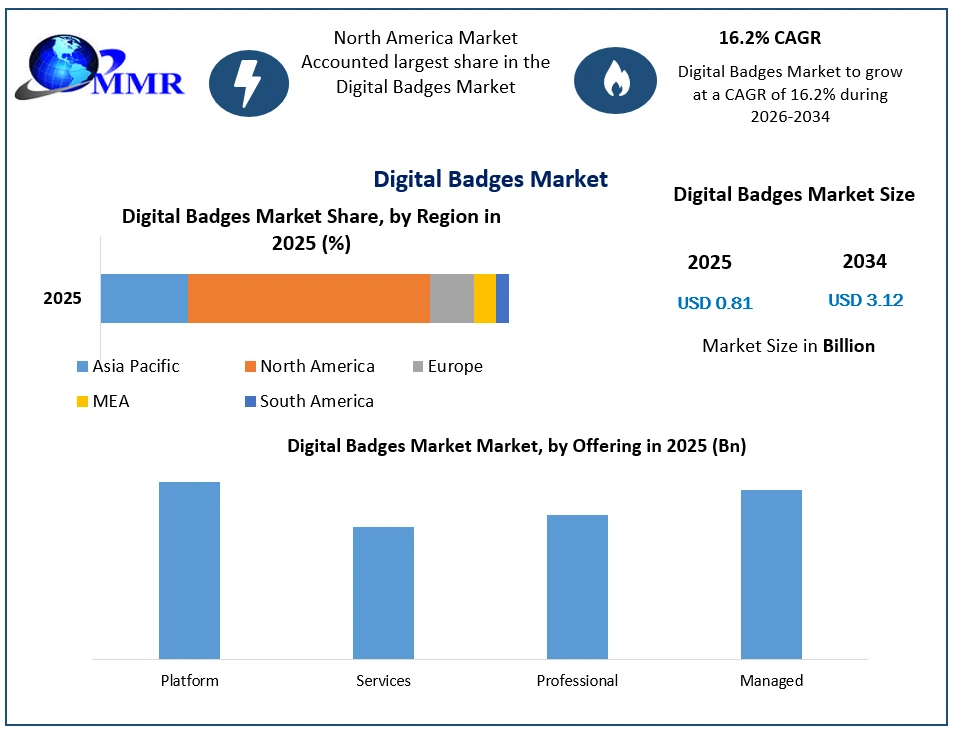
Global Digital Badges Market size was valued at USD 0.81 Bn. in 2025 and is expected to reach USD 3.12 Bn. by 2034, at a CAGR of 16.2%.
The Digital Badges Market refers to the growing industry focused on the creation, distribution, and utilization of digital badges, which are virtual representations of skills, achievements, or accomplishments earned by individuals in various learning or professional environments. These badges, often linked to specific competencies or accomplishments, are gaining traction as a means of validating and showcasing skills in the digital era. The current scenario of the Digital Badges Market reflects a robust and expanding landscape, driven by the increasing adoption of online learning platforms, the growing emphasis on continuous skill development, and the demand for alternative credentialing methods. Key factors fueling the market's growth include the rising need for efficient talent management, the flexibility offered by digital badges in recognizing diverse skills, and the shift towards remote and flexible work arrangements.
Several market players have been playing pivotal roles in shaping the Digital Badges Market. recent developments include the integration of blockchain technology by some key players to enhance the security and authenticity of digital badges, providing a tamper-proof record of individuals' achievements. Companies such as Credly, Badgr, and Accredible have been at the forefront of driving innovation in this space, offering platforms that enable organizations to create, issue, and manage digital badges seamlessly.
Additionally, collaborations between education institutions, industry associations, and technology providers have been instrumental in expanding the reach and acceptance of digital badges. These developments underscore the market's dynamism, with a focus on ensuring the credibility and portability of digital badges across various sectors. As the Digital Badges Market continues to evolve, it is anticipated to play a pivotal role in shaping the future of credentialing, providing individuals with a more granular and verifiable way to showcase their skills and achievements in an increasingly digital and competitive landscape
Digital Badges Market Growth Outlook
To know about the Research Methodology :- Request Free Sample Report
Digital Badges Market Dynamics
The surge in online education platforms, exemplified by platforms like Coursera and edX, has propelled the Digital Badges Market These platforms leverage digital badges to validate and recognize learners' accomplishments, providing verifiable proof of skills acquired in various domains. Growing acceptance of digital badges by employers as credible indicators of specific skills has fuelled market growth. For instance, IBM has embraced digital badges through its IBM Skills Gateway, allowing employees to earn badges for mastering specific technologies, enhancing their employability. Integration of gamification elements in education and professional development, such as points and badges, has become a driving force. Khan Academy utilizes badges to engage learners, making the educational experience more interactive and motivating learners to achieve milestones.
Adoption of innovative learning models, like micro learning and competency-based education, has surged. Digital badges align perfectly with these models, offering a flexible and modular way to recognize and showcase skills. Open University's Open Learn platform utilizes badges to acknowledge completion of short courses. The need for industry-specific certifications and compliance has boosted the demand for digital badges. Microsoft, through its Microsoft Certified badges, provides a clear example of how digital badges are used to validate technical skills and expertise, contributing to career advancement.
The integration of blockchain technology for secure and transparent credentialing has driven market growth. Learning Machine, in collaboration with MIT Media Lab, uses blockchain to issue and verify digital diplomas and certificates, ensuring the integrity of digital badges. Organizations increasingly demand customizable and branded badges to align with their corporate identity. Badgecraft, as an example, offers a platform for creating fully customizable digital badges, allowing organizations to tailor the badges to their unique branding requirements. Supportive government initiatives and policies promoting digital skills development have propelled the Digital Badges Market. For instance, the European Commission's initiative, EUROPASS, includes a digital badge feature to validate and showcase skills and qualifications across Europe.
Seamless integration of digital badges with popular Learning Management Systems, like Canvas and Moodle, has facilitated widespread adoption. Moodle's integration with Credly allows educators to issue and display badges within the Moodle platform, enhancing the learning experience. The increasing emphasis on lifelong learning and continuous skill development has driven individuals to seek digital badges as tangible proof of ongoing education. Mozilla's Open Badges project empowers individuals to collect and display badges from various sources, fostering a culture of continuous learning.
Digital Badges Market Restrains
The Digital Badges Market faces significant challenges that may impact its widespread acceptance and integration into traditional educational and professional systems. One primary obstacle is the absence of standardized criteria for digital badges, leading to potential confusion and inconsistency in their interpretation. Different platforms may employ varying standards for badge issuance, making it challenging for employers or educational institutions to assess the true value of a badge without a universally recognized standard. Perceived credibility concerns further hinder adoption, as skepticism about the rigor associated with digital badges persists due to the lack of universally accepted standards. This skepticism poses a risk of digital badges being perceived as less credible than traditional credentials, impeding their broader acceptance.
Another set of challenges includes the proliferation of digital badges from diverse sources, potentially confusing stakeholders trying to evaluate an individual's skills. Technological barriers, particularly in regions with lower digital literacy rates, may impede accessibility, hindering the adoption of digital badges. Resistance to change from traditional educational and professional systems, security and fraud concerns, limited interoperability between different badging systems, privacy issues, the cost of implementation, and a lack of public awareness further contribute to the hurdles faced by the Digital Badges Market. These challenges collectively underscore the need for concerted efforts to address standardization issues and enhance awareness to ensure the seamless integration of digital badges into various domains.
Digital Badges Market Trends
In the dynamic landscape of the Digital Badges Market is a growing emphasis on Blockchain Integration. As concerns about the security and authenticity of digital badges rise, blockchain technology is increasingly being leveraged to enhance the credibility and integrity of the badging ecosystem. Blockchain's decentralized and tamper-proof nature ensures that once a badge is issued, its information remains secure and cannot be altered, providing a transparent and trustworthy verification process. This trend is significantly influencing market dynamics by addressing concerns related to fraud and security, thereby fostering greater trust among stakeholders in the Digital Badges Market.
Personalized Badge Pathways represent a notable trend, responding to the demand for more customized and adaptive learning experiences. Educational and professional platforms within the Digital Badges industry is increasingly offering personalized badge pathways, tailoring credentialing journeys based on individual skills, preferences, and career aspirations. This trend recognizes the diverse learning styles and goals of users, allowing them to earn badges that align closely with their specific interests and career trajectories. By incorporating a more personalized approach, the Digital Badges Market is catering to the evolving needs of learners and professionals, making the badging experience more relevant and impactful in today's dynamic and competitive environment.
Digital Badges Market Segment Analysis
By Offering, the platform segment of the Digital Badges Market is the most dominant due to increased demand for scalability and flexibility, organizations, from educational institutions to corporations, require solutions that can manage large volumes of badges, cater to diverse user groups, and integrate seamlessly with existing systems. Platforms offer the necessary scalability, flexibility, and customization options to meet these demands effectively. Focus on user experience and ease of use, platforms prioritize user-friendly interfaces and intuitive workflows for both badge issuers and recipients. This simplifies badge creation, issuance, and verification processes, boosting adoption and engagement across various stakeholders.
Evolving feature sets and integrations, leading platform providers are constantly innovating, adding features like gamification elements, analytics dashboards, and integration with social media platforms. These advancements enhance the overall value proposition and user experience, further solidifying the platform segment's dominance. Digital Badges Market While the services segment, encompassing professional services like consulting, implementation, and support, plays a crucial role in assisting organizations with platform adoption and utilization, it primarily complements the platform segment's growth. Managed services, offering ongoing platform management and maintenance, are also gaining traction, but their market share remains smaller compared to platforms.
Digital Badges Market Regional Analysis
North America held the largest Digital Badges Market share in 2025. The region's historical proclivity for early technology adoption has significantly contributed to its leadership in the digital badge landscape. Establishing robust ecosystems and fostering widespread familiarity with digital badges were pivotal in solidifying its position. The presence of key players such as Credly, Acclaim, and Emsi, headquartered in the US, has provided a distinct home-field advantage, further strengthening the market. North American institutions, spanning education, healthcare, and corporate training, were at the forefront of leveraging digital badges, contributing to the market's maturity. Government support, exemplified by initiatives like the Micro-credentials for Workforce Development, has played a crucial role in shaping favorable regulatory frameworks.
Recent developments in the Digital Badges Market showcase the region's commitment to innovation. The integration of digital badge capabilities into Learning Management Systems (LMS) is fostering broader adoption, making the learning experience more dynamic and engaging. Additionally, the market is witnessing a shift towards enhanced security and verification through the adoption of blockchain technology, led by companies like Everchain and Open Badges Alliance. Furthermore, there is a discernible emphasis on personalized learning, with North American institutions utilizing digital badges to track individual learning pathways, tailoring educational experiences to meet the diverse needs of learners.
The Digital Badges Market in the Asia-Pacific (APAC) region has witnessed remarkable dominance driven by a confluence of factors. The burgeoning education sector in countries such as India and China has fueled a substantial demand for skill verification and certification, positioning digital badges as a flexible and convenient solution to address this need. Notably, APAC governments have actively embraced the potential of digital badges, endorsing their use in various education and skill development initiatives.
A pivotal focus on employability within APAC, characterized by a substantial young workforce, has elevated the significance of digital badges. These badges serve as a crucial tool for showcasing skills, enhancing employability, and garnering increased attention from both learners and employers. The region's technological landscape has also played a pivotal role, with the rise of e-learning platforms and widespread mobile technology adoption facilitating the seamless integration and adoption of digital badges. Recent developments in the Digital Badges Market within APAC include the emergence of local badge issuers such as Open Badges Network Asia and EduBits, tailoring their offerings to meet the specific needs of the regional market.
Moreover, there is a discernible trend towards the integration of digital badges in vocational training programs, particularly in countries like India, to acknowledge and validate industry-specific skills. Additionally, the region is witnessing innovative approaches, with the integration of badges into gamified elements and micro-learning platforms, enhancing engagement and fostering skill development. The APAC Digital Badges Market continues to evolve, driven by a dynamic interplay of factors that reflect the region's commitment to embracing and leveraging advancements in credentialing and skill verification technologies.
Digital Badges Market Competitive Landscape
The competitive landscape within the Digital Badges Market is characterized by a dynamic interplay of key players vying for prominence in this rapidly evolving sector. As the demand for skill verification and certification rises, various companies are strategically positioning themselves to capitalize on the burgeoning opportunities within the Digital Badges Market. Established players such as Credly, Acclaim, and Emsi in North America, alongside emerging regional issuers like Open Badges Network Asia and EduBits in the Asia-Pacific region, contribute to the diverse ecosystem. These entities engage in constant innovation, leveraging technological advancements to enhance the functionality and security of digital badges.
The competitive landscape also reflects a focus on aligning with the evolving needs of diverse industries, including education, healthcare, and corporate training. Players within the Digital Badges industry aim to differentiate themselves through seamless integration with Learning Management Systems (LMS), blockchain technology adoption for enhanced security, and creative amalgamations with gamification elements and micro-learning platforms to bolster engagement. The competition extends beyond technological capabilities, with a keen awareness of regulatory frameworks and governmental initiatives to foster a supportive environment for digital badges. Overall, the Digital Badges Market's competitive landscape is marked by strategic maneuvers, technological prowess, and a commitment to staying at the forefront of an industry poised for sustained growth.
Digital Badges Market Recent Development
| Date | Company | Development | Impact |
|---|---|---|---|
| 13 January 2026 | Accredible | Accredible expanded platform capabilities with native support for Open Badge 3.0, W3C Verifiable Credentials (VCs), and the ACE extension to automate standards conversion. | This development significantly enhances interoperability and structured credit portability, streamlining transcript evaluations across higher education and corporate networks. |
| 31 October 2025 | Instructure | Instructure rebranded its Canvas Credentials solution to Parchment Digital Badges to integrate its credentialing ecosystem into the main Parchment Award suite. | The integration consolidates academic records and stackable micro-credentials, boosting platform efficiency and connecting badging directly to labor market demand. |
| 30 September 2025 | Open Badge Factory | Open Badge Factory implemented full support for the Open Badge 3.0 standard alongside evidence attachment viewability across its cloud badging engine. | This upgrade improves credential security and verification transparency for academic institutions and enterprise training providers worldwide. |
| 12 March 2026 | Credly | Credly by Pearson expanded its collaboration with higher education leaders like the University of Phoenix to issue verifiable skills-based badges based on employer-driven learning outcomes. | The collaboration bridges the growing talent shortage gap by allowing learners to easily showcase job-relevant, verified capabilities directly to prospective employers. |
| 01 February 2025 | ServiceNow | ServiceNow released the Credly Spoke integration on the ServiceNow Store to streamline credential verification and management within corporate HR systems. | This release automates the tracking of employee certifications, driving enterprise-wide workforce upskilling and internal mobility visibility. |
Digital Badges Market Scope: Inquire before buying
| Global Digital Badges Market | |||
|---|---|---|---|
| Report Coverage | Details | ||
| Base Year: | 2025 | Forecast Period: | 2026-2034 |
| Historical Data: | 2020 to 2025 | Market Size in 2025: | US $ 0.81 Bn. |
| Forecast Period 2026 to 2034 CAGR: | 16.2% | Market Size in 2034: | US $ 3.12 Bn. |
| Segments Covered: | By Offering | Platform Services Professional Managed |
|
| By End-user | Academic Corporate Large Enterprises Small & Medium Enterprises |
||
Global Digital Badges Market, by Region
North America (United States, Canada and Mexico)
Europe (UK, France, Germany, Italy, Spain, Sweden, Austria and Rest of Europe)
Asia Pacific (China, South Korea, Japan, India, Australia, Indonesia, Malaysia, Vietnam, Taiwan, Bangladesh, Pakistan and Rest of APAC)
Middle East and Africa (South Africa, GCC, Egypt, Nigeria and Rest of ME&A)
South America (Brazil, Argentina Rest of South America)
Digital Badges Market Key players
North America:
1. Credly (United States)
2. Accredible (United Kingdom)
3. Nocti Business Solutions (NBS) (United States)
4. Forall Systems (United States)
5. Learning Times (United States)
6. Youtopia (United States)
7. Discendum (Finland)
8. Badge List (United States)
9. Badgecraft (Latvia)
10. Be Badges (United States)
11. Portfolium (United States)
12. Accreditrust (United States)
13. Concentric Sky (United States)
14. EbizOn (United States)
15. Instructure, Inc. (United States)
16. Badgr (United States)
17. ProExam (United States)
18. Basno (United States)
19. Open Badges Project (United States)
20. Outmatch (United States)
21. Pontoon (United States)
Europe:
1. Macmillan Education (United Kingdom)
2. Moodle (Australia)
3. Macmillan Education (United Kingdom)
4. Bestr (Italy)
5. Concentric Sky Inc. (Ireland)
6. Knowledge Catalyst (United Kingdom)
Asia-Pacific
1. Socrative (United States)
2. EbizON (India):
3. TruScholar (India):
4. Certopus (India)
5. Youtopia (South Korea):
6. Makewaves (Australia)
7. Basno (Singapore)
8. Totara (New Zealand)
Frequently Asked Questions:
1] What is the growth rate of the Global Digital Badges Market?
Ans. The Global Digital Badges Market is growing at a significant rate of 16.2 % during the forecast period.
2] Which region is expected to dominate the Global Digital Badges Market?
Ans. North America held a significant share in the global Digital Badges market, primarily due to advanced healthcare infrastructure, a higher prevalence of respiratory diseases, and a well-established market for medical devices.
3] What is the expected Global Digital Badges Market size by 2034?
Ans. The Digital Badges Market size is expected to reach USD 3.12 Bn by 2034.
4] Which are the top players in the Global Digital Badges Market?
Ans. The major top players in the Global Digital Badges Market are Gilead Sciences Inc, TCR2 Therapeutics Inc, Bluebird Bio Inc, Sorrento Therapeutics, and Fate Therapeutics
5] What are the factors driving the Global Digital Badges Market growth?
Ans. The Global Digital Badges Market growth is primarily propelled by increasing cases of respiratory disorders like COPD, technological advancements improving device efficiency and portability, rising elderly population susceptible to respiratory conditions, and the convenience of at-home oxygen therapy. Additionally,riving market expansion due to the virus's impact on respiratory health worldwide.
6] Which country held the largest Global Digital Badges Market share in 2025?
Ans. The United States held the largest Digital Badges Market share in 2025.