
Data Center Busway Market by Product type, by Conductor material, by Power Rating, by Installation, by Data center type, by Application, by Region and Forecast 2034
Overview
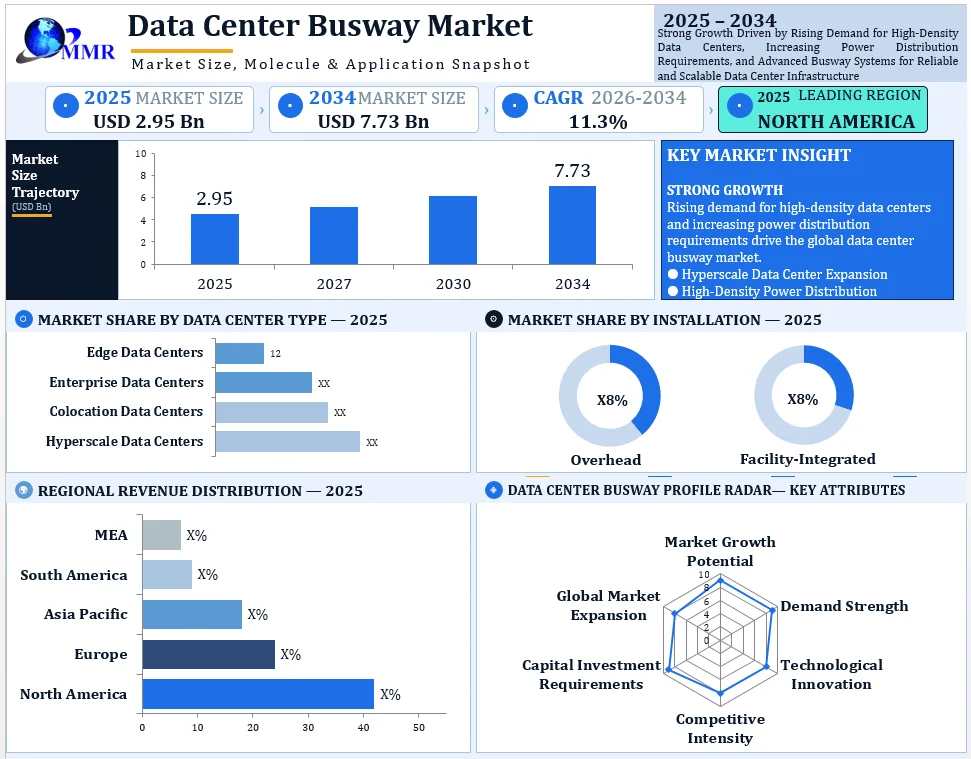
The Global Data Center Busway Market size is valued at USD 2.95 Billion in 2025 and is projected to reach USD 7.73 Billion by 2034, growing at a CAGR of 11.3% during the forecast period.
| USD 2.95 Bn 2025 MARKET SIZE |
USD 7.73 Bn 2034 FORECAST |
11.3% 2026–2034 CAGR |
|---|
Global Data Center Busway Market Overview
Market growth is driven by increasing investments in hyperscale data centers, expansion of artificial intelligence (AI) infrastructure, rising cloud computing adoption, and growing demand for energy-efficient power distribution systems. The adoption of modular busway systems, intelligent power monitoring technologies, and advanced busbar trunking solutions is supporting the development of reliable and scalable data center infrastructure.
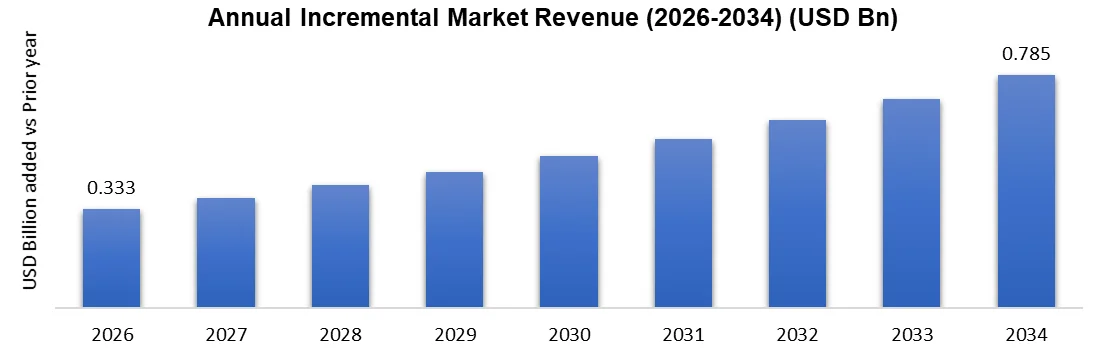
The Data Center Busway Market is expected to generate USD 4.78 Billion in additional revenue between 2025 and 2034, supported by increasing rack power density, data center modernization, and growing adoption of modular electrical distribution systems. Technological advancements in intelligent busway solutions, copper and aluminium conductors, integrated monitoring systems, and configurable tap-off units are strengthening product innovation. Rising global data center electricity consumption, estimated at 485 TWh in 2025 and projected to approach 950 TWh by 2030, further supports long-term market growth opportunities.
The Global Data Center Busway Market Report provides a comprehensive analysis of market size, growth trends, industry dynamics, pricing trends, and future revenue opportunities. The study examines key market segments based on product type, conductor material, power rating, installation type, and data center applications, highlighting emerging demand patterns and growth potential. It also evaluates regional market developments across North America, Europe, Asia-Pacific, the Middle East & Africa, and South America. Furthermore, the report assesses leading market players, competitive positioning, market share, technological advancements, and investment opportunities to provide strategic insights into the industry's growth outlook through 2034.
To know about the Research Methodology :- Request Free Sample Report
Market Dynamics : Principal Growth Drivers
1. Rising AI and High-Performance Computing Infrastructure Demand
The rapid expansion of artificial intelligence (AI), machine learning, and high-performance computing is accelerating demand for advanced data center power distribution systems. Increasing rack power density and high-capacity server deployments are driving the adoption of intelligent busway systems that support reliable electrical distribution, flexible capacity planning, and real-time power monitoring.
2. Expansion of Hyperscale Data Centers and Cloud Infrastructure
Growing investments in hyperscale data centers and cloud computing infrastructure are strengthening Data Center Busway Market growth. Large-scale facilities increasingly require modular electrical distribution networks that support phased capacity expansion, standardized installation, efficient commissioning, and long-term infrastructure scalability.
3. Increasing Adoption of Modular Busway Systems in Colocation Facilities
Rising demand for colocation and multi-tenant data centers is encouraging the deployment of modular and overhead busway systems. These solutions enable flexible power connections, simplified rack reconfiguration, efficient space utilization, and adaptable electrical infrastructure to accommodate changing tenant requirements.
4. Growing Focus on Intelligent Power Monitoring and Operational Reliability
Increasing emphasis on data center uptime, electrical safety, and operational efficiency is supporting demand for smart busway technologies. Integrated metering, load monitoring, and intelligent tap-off units improve power visibility, support proactive maintenance, and strengthen electrical capacity management across modern data center facilities.
Demand engine map | Infrastructure demand pathways
FOUR CONNECTED ENGINES OF BUSWAY DEMAND
|
|
|
||||||
|
|
|
|
||||||
|
|
|
Market Restraints and Deployment Challenges
Capital expenditure remains a primary constraint. A busway installation requires engineered route design, short-circuit verification, support hardware, installation planning and coordination with switchboards, UPS outputs and protective devices. For small or static facilities, initial busway costs may outweigh lifecycle flexibility benefits. Procurement teams therefore compare total installed cost and upgrade requirements rather than treating busway as a universal replacement for cable distribution.
Deployment risk matrix | Project-level constraints and mitigation
| Risk category | Typical pressure point |
Planning response |
|---|---|---|
| Project timing |
Grid, switchgear and transformer delivery | Align busway orders with energization milestones |
| Electrical integration |
Protection settings, thermal duty and clearances |
Complete system-level engineering review |
| Installed cost |
Material prices, supports and labor | Compare lifecycle and phased-expansion costs |
Annual incremental Data Center Busway Market Revenue
Emerging Data Center Busway Market Trends
| Key Market Trends | Industry Developments and Market Analysis |
Impact on Data Center Busway Market Growth |
|---|---|---|
| Modular and Overhead Busway Systems |
Increasing adoption of modular busway systems and overhead power distribution solutions is improving installation flexibility, space utilization, and electrical infrastructure scalability in hyperscale and colocation data centers. Configurable tap-off units support phased capacity expansion and changing rack power requirements. |
Drives demand for flexible, space-efficient busway installations and scalable data center power distribution infrastructure. |
| Intelligent Busway Monitoring and Smart Power Distribution |
Advancements in intelligent busway technology are supporting integrated energy metering, real-time load monitoring, temperature sensing, and alarm management. Integration with Data Center Infrastructure Management (DCIM) and Building Management Systems (BMS) enhances electrical capacity planning and operational visibility. |
Creates growth opportunities for smart busway systems, digital power monitoring solutions, and advanced electrical distribution technologies. |
| Copper and Aluminium Conductor Optimization |
Growing emphasis on energy efficiency and installation economics is encouraging optimization of copper and aluminium busway systems. Manufacturers are improving conductor design, electrical connections, thermal performance, and system durability to meet high-density data center power requirements. |
Supports product innovation, cost optimization, energy-efficient electrical distribution, and competitive product differentiation. |
| Integration with High-Density Computing and Liquid Cooling |
Increasing deployment of AI servers, high-performance computing infrastructure, and liquid-cooled data centers is influencing busway installation layouts. Coordinated planning of overhead power distribution, cooling pipelines, and high-density rack configurations improves infrastructure adaptability. |
Strengthens demand for high-capacity data center busway solutions and customized electrical distribution systems supporting next-generation AI data centers. |
Operating model | From real-time telemetry to maintenance action
INTELLIGENT BUSWAY OPERATING LOOP
|
|
Metered tap-offs |
→ |
Data capture |
→ |
Operations view |
→ |
Field decision |
|
||
|
|
Current | voltage |
|
Energy | temperature |
|
Loads | exceptions |
|
Inspect | rebalance |
|
||
|
|
Feedback |
|
||||||||
Technology and Innovation Landscape
Innovation increasingly combines mechanical modularity with electrical intelligence. Manufacturers are developing busway configurations that accommodate standardized sections, engineered elbows, expansion joints, application-specific tap-off units and integrated communication interfaces. Digital monitoring at selected branch points helps operators identify underused capacity, balance loads where possible and maintain documented power assignments as IT environments change. The strongest products integrate installation practicality with verifiable electrical performance rather than relying only on software features.
A robust specification should consider rated current, rated operational voltage, short-circuit withstand capability, ingress protection, temperature rise, earthing continuity, allowable installation orientation and connection accessibility. For retrofit projects, digital surveys and coordinated building models can reduce routing conflicts before fabrication. These design practices expand the market potential for prefabricated electrical infrastructure while supporting commissioning quality and operational reliability.
Facility-level electrical distribution architecture
|
Utility |
➜ |
Switchgear |
➜ |
Busway |
➜ |
Rack |
Tap-off metering + temperature / load visibility → facility monitoring
Engineering decision flow | Matching system design to facility requirements
POWER DISTRIBUTION SELECTION FLOW | CONCEPTUAL
|
|
|
|
YES → |
Consider modular plug-in track busway |
|
Load |
→ |
Frequent |
╱ |
|
|
|
|
|
NO → |
Evaluate |
Technical qualification scorecard | Buyer evaluation dimensions
| Electrical / operational test |
What must be verified |
Commercial significance |
|---|---|---|
| Rated current and fault withstand |
Nameplate duty, short-circuit rating, joint design |
Application eligibility and safety |
| Metering and data compatibility |
Accuracy, protocol and access to measured data |
Operating visibility and integration |
| Route and tap-off flexibility |
Physical clearance, tap-off positioning and access |
Scalability and change costs |
| Certification and service |
Product approvals, commissioning support and spares |
Qualification and lifecycle risk |
Data Center Busway Market Segmentation Analysis
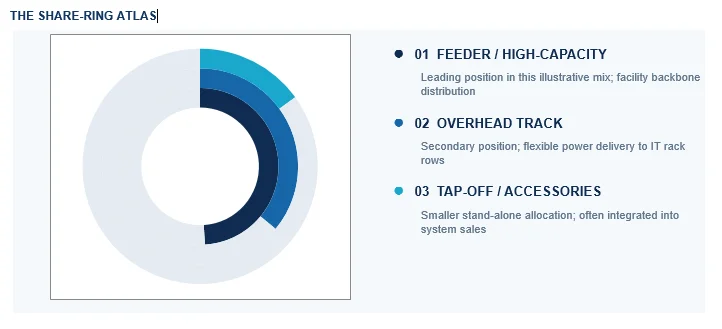
1. By Product Type: Growing Adoption of Overhead Track and High-Capacity Feeder Busway Systems
The Data Center Busway Market, by product type, is segmented into overhead track busway, high-capacity feeder busway or busduct, and tap-off assemblies and accessories. Overhead track busway systems are increasingly adopted in hyperscale and colocation data centers due to their flexible power connections, modular installation, and ability to support changing rack configurations. High-capacity feeder busway systems facilitate large-scale electrical distribution between switchgear, UPS systems, and facility power networks. Increasing investments in AI data centers, intelligent power distribution, and infrastructure modernization are strengthening demand for advanced busway solutions and integrated monitoring accessories.
2. By Conductor Material: Copper and Aluminium Busway Systems Supporting Power Distribution Efficiency
The Data Center Busway Market, by conductor material, is classified into copper busway and aluminium busway systems. Copper busway solutions offer high electrical conductivity and support compact power distribution designs for high-density computing environments. Aluminium busway systems provide opportunities for material cost optimization and reduced conductor weight in appropriately engineered applications. Increasing demand for energy-efficient data center infrastructure is encouraging manufacturers to improve conductor performance, thermal management, joint reliability, and electrical distribution efficiency. Material selection depends on installation requirements, load capacity, lifecycle costs, and overall system design.
THE CONDUCTOR COMPOSITION MOSAIC
|
|
Cu COPPER Al ALUMINIUM
|
Data Center Busway Market segmentation and purchasing relevance
| Segmentation lens | Principal categories | Key selection factor |
|---|---|---|
| Product type | Overhead Track Busway Systems, High-Capacity Feeder Busway (Busduct), Tap-Off Assemblies and Accessories |
Flexibility versus feeder capacity |
| Conductor material | Copper; aluminium | Thermal, weight and installed cost |
| Power rating | Up to 800 A, 801 A – 2,000 A, 2,001 A – 4,000 A, Above 4,000 A |
Rated current and short-circuit duty |
| Installation | Overhead; facility-integrated |
Routing and access clearance |
| Data centre type | Hyperscale; colocation; enterprise; edge |
Expansion needs and density |
| Application | Rack-Row Power Distribution, Main Electrical Feeder Distribution, Data Center Power Infrastructure Upgrades, Data Center Capacity Expansion |
Lifecycle configuration and safety |
Global Data Center Busway Market: Regional Analysis and Growth Opportunities
North America: Hyperscale Data Center Expansion and AI Infrastructure Investments Driving Market Demand
North America remains a prominent region in the Data Center Busway Market, supported by extensive hyperscale infrastructure, cloud computing investments, and rising demand for AI-powered data centers. The United States continues to generate significant opportunities as data center operators expand computing capacity and upgrade electrical distribution networks to accommodate higher rack power densities. US data center electricity consumption reached approximately 176 TWh in 2023, with further growth expected as AI infrastructure expands. Canada is also gaining momentum through investments in sovereign AI computing, cloud infrastructure, and large-scale data center development. These developments are strengthening demand for high-capacity feeder busway, intelligent power distribution systems, and modular overhead busway solutions. Growing emphasis on operational reliability and flexible infrastructure expansion is expected to sustain regional market opportunities through 2034.
Europe: Energy Efficiency Regulations and Digital Infrastructure Modernization Supporting Busway Adoption
Europe represents an important market for energy-efficient data center busway systems, where cloud infrastructure expansion is increasingly accompanied by stringent sustainability requirements. Germany, the United Kingdom, France, and the Netherlands remain established locations for data center development, while Sweden, Finland, and Denmark are attracting interest through renewable energy availability and suitable operating environments. The European Union's proposed Cloud and AI Development Act aims to at least triple EU data center capacity within five to seven years, creating potential opportunities for advanced electrical infrastructure. Meanwhile, energy-performance reporting requirements are encouraging greater attention to electrical monitoring and operational efficiency. These developments support demand for modular busbar trunking systems, copper and aluminium busway solutions, and intelligent power monitoring technologies. However, grid availability, permitting requirements, and installation costs continue to influence regional purchasing decisions.
Asia-Pacific: Rapid Data Center Capacity Expansion Creating Strong Demand for Modular Power Distribution
Asia-Pacific is emerging as a significant growth region in the Global Data Center Busway Market, supported by digital transformation, expanding cloud services, and increasing AI infrastructure investments. China, Japan, South Korea, India, Singapore, and Australia are contributing to regional data center development, although their infrastructure requirements and investment environments differ considerably. India presents a particularly important opportunity, with installed data center power capacity increasing from approximately 375 MW in 2020 to 1.57 GW by August 2026. Major Indian data center hubs, including Mumbai–Navi Mumbai, Chennai, Hyderabad, and Bengaluru, continue to attract infrastructure development. Singapore is pursuing additional capacity through its Green Data Centre Roadmap, which targets at least 300 MW of new capacity in the near term. Increasing demand for compact electrical layouts, scalable rack power distribution, and intelligent busway systems is expected to support market expansion across the region.
Middle East & Africa: Digital Transformation and Hyperscale Investments Strengthening Market Opportunities
The Middle East & Africa Data Center Busway Market is gaining opportunities from growing investments in AI infrastructure, cloud computing, and government-led digital transformation initiatives. Saudi Arabia and the United Arab Emirates are prominent development markets, supported by ambitious digital infrastructure strategies and expanding computing requirements. Saudi Arabia's operational data center capacity increased from approximately 68 MW in 2021 to more than 440 MW in 2025, highlighting the scale of its infrastructure expansion. The UAE is also advancing large-scale AI and government data center projects, creating potential demand for reliable, high-capacity electrical distribution systems. In Africa, South Africa remains an important destination for cloud infrastructure investment, particularly around Johannesburg. These developments are supporting opportunities for modular busway installations, intelligent monitoring systems, and scalable power distribution solutions, although project execution remains dependent on electricity availability and local infrastructure readiness.
South America: Cloud Infrastructure Development and Digital Investment Creating Emerging Growth Opportunities
South America presents developing opportunities for the Data Center Busway Market, driven by increasing cloud adoption, digital services, and investment in modern computing infrastructure. Brazil remains a major regional development market, supported by its expanding data center industry and growing demand for domestic processing capacity. The introduction of Brazil's Redata investment incentive framework in 2026 is expected to encourage additional data center development and associated electrical infrastructure investment. Chile is also strengthening its position through the National Data Center Plan, which promotes sustainable infrastructure expansion and improved investment conditions. Colombia offers selective opportunities through enterprise digitization and regional cloud connectivity. As operators expand capacity and modernize facilities, demand for modular power distribution, overhead busway systems, and efficient electrical infrastructure is expected to increase. Power availability, financing conditions, and local installation capabilities will remain important factors shaping regional growth.
| Region | Demand characteristics |
Busway opportunity |
|---|---|---|
| North America | AI campuses, hyperscale and colocation growth | Large repeatable projects; retrofits |
| Europe | Cloud expansion, reporting, grid constraints | Metered systems; engineering-led sales |
| Asia-Pacific | Rapid capacity additions; dense urban facilities | Scalable row power; local partnerships |
| Middle East | New digital infrastructure and public investment | Phased campus distribution |
| Africa & South America |
Selective metro-level projects | Cost-sensitive modular solutions |
Global Data Center Busway Market: Competitive Landscape and Procurement Dynamics
The Global Data Center Busway Market features a competitive landscape shaped by established electrical equipment manufacturers, specialized busway system suppliers, and integrated data center infrastructure providers. Competition is increasingly driven by product reliability, current-carrying capacity, modular design, and intelligent power distribution capabilities. Manufacturers are expanding their portfolios of overhead track busway systems, high-capacity feeder busway, and metered tap-off assemblies to address growing demand from hyperscale data centers, AI computing facilities, and colocation operators. Product innovation, engineering expertise, certification compliance, and regional service capabilities remain important factors influencing competitive positioning.
Data Center Busway Market procurement dynamics are evolving as operators place greater emphasis on electrical safety, infrastructure scalability, and long-term operating costs. Purchasing decisions involve detailed evaluation of conductor materials, rated current, short-circuit withstand capacity, monitoring compatibility, installation requirements, and compliance with standards such as IEC 61439-6 and UL 857, where applicable. Busway pricing varies according to conductor selection, system capacity, customization, protection devices, and integrated monitoring features. Buyers increasingly assess total installed costs, maintenance requirements, expansion flexibility, and supplier support rather than equipment pricing alone.
The Data Center Busway Market competitive outlook is further influenced by increasing demand for standardized electrical architectures and dependable supply chains. Hyperscale developers prioritize consistent product specifications and timely delivery across multiple construction phases, while colocation operators value configurable power distribution and future capacity expansion. Suppliers offering integrated engineering support, reliable commissioning, replacement-part availability, and intelligent monitoring solutions are positioned to capture opportunities from new data center construction and infrastructure modernization through 2034.
Procurement workflow | From technical specification to operation

Regulatory, Safety and Sustainability Outlook
Electrical safety standards play a critical role in shaping the Data Center Busway Market, influencing product certification, system design, and procurement decisions. IEC 61439-6:2012 establishes requirements for low-voltage busbar trunking systems, while UL 857 addresses applicable service-entrance, feeder, and branch-circuit busways. Manufacturers and data center operators evaluate electrical ratings, short-circuit withstand capacity, temperature-rise performance, and assembly reliability to meet relevant safety requirements. Compliance with applicable standards and local electrical regulations supports product acceptance, installation safety, and long-term operational reliability across global markets.
Growing emphasis on energy efficiency and sustainable data center infrastructure is strengthening demand for intelligent busway systems and energy-efficient power distribution solutions. ISO/IEC 30134-2:2026 defines Power Usage Effectiveness (PUE) as a standardized indicator of overall data center energy performance. Integrated busway monitoring can improve visibility into electrical loads and energy consumption, supporting maintenance planning and infrastructure optimization. However, measurable PUE improvements depend on the performance of the complete facility rather than individual busway components. Increasing attention to electrical losses, conductor selection, and energy monitoring is expected to influence Data Center Busway Market technology development and procurement strategies through 2034.
Data Center Busway Market: Investment Opportunities and Business Strategy
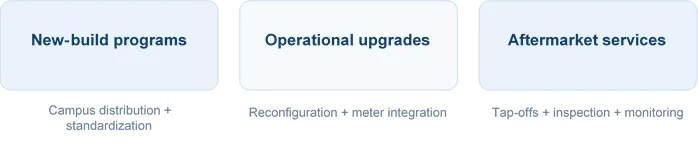
The Global Data Center Busway Market presents significant investment opportunities through the expansion of hyperscale data centers, AI computing infrastructure, colocation facilities, and enterprise data center modernization. Increasing demand for high-capacity electrical distribution and flexible infrastructure is encouraging investment in modular busway systems, intelligent power monitoring, and customized electrical solutions. New data center construction creates opportunities for standardized installations and large-scale equipment procurement, while infrastructure upgrades support demand for engineered configurations, replacement components, and technical services. Suppliers can strengthen their market positioning through product customization, installation partnerships, commissioning support, and lifecycle maintenance services.
The Data Center Busway Market business strategy increasingly emphasizes technical innovation, supply chain reliability, and long-term customer relationships. High-capacity feeder busway systems require verified electrical performance, engineering expertise, and compliance with applicable safety standards, while modular overhead busway solutions focus on installation flexibility and scalable power distribution. Integration of intelligent monitoring technologies creates opportunities for product differentiation through improved energy visibility and electrical capacity management. Manufacturers investing in qualified installation networks, regional service capabilities, efficient material procurement, and reliable project delivery are better positioned to address evolving data center infrastructure requirements and capture emerging growth opportunities through 2034.
Commercial opportunity tracks | Where suppliers can position value
OPPORTUNITY LANDSCAPE | QUALITATIVE MARKET ASSESSMENT
Go-to-market action matrix | Commercial response by buyer group
| Buyer group | Relevant proposition | Supporting capability |
| Hyperscale developer | Standardized feeder and row distribution | Design validation, volume delivery |
| Colocation operator | Upgradeable, monitored distribution | Tap-off options, controls integration |
| Enterprise facility owner | Selective retrofit and continuity | Site survey, phased installation |
| Regional EPC / installer | Qualified, installation-ready product | Training, documentation, local support |
DATA CENTER BUSWAY MARKET / INVESTMENT OUTLOOK
QUALITATIVE OPPORTUNITY–RISK MATRIX
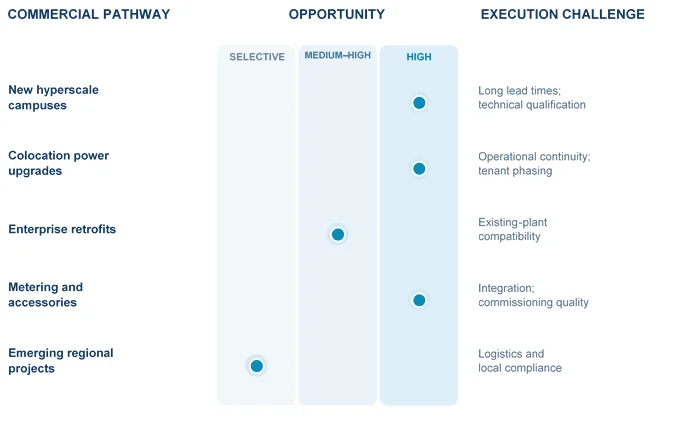
Commercial pathways, opportunity levels and execution considerations
Market Interpretation
New hyperscale campuses, colocation power upgrades and metering solutions offer high qualitative opportunity. Enterprise retrofits are medium–high, while emerging regional projects are selective. Each pathway faces distinct technical, operational or local execution challenges.
Future Outlook and Strategic Conclusion
Through 2034, the Data Center Busway Market is positioned for sustained expansion as electrical distribution becomes a more visible constraint in high-density computing environments. The strongest underlying forces are AI workload growth, hyperscale infrastructure deployment, higher rack power concentration, colocation flexibility and demand for more measurable electrical operations. Advanced monitoring and modular tap-off architectures support product value, while safety verification and dependable service remain fundamental purchasing criteria.
Global Data Center Busway Market Scope: Inquire before buying
| Global Market | |||
|---|---|---|---|
| Report Coverage | Details | ||
| Base Year: | 2025 | Forecast Period: | 2026-2034 |
| Historical Data: | 2020 to 2025 | Market Size in 2025: | 2.95 USD Billion |
| Forecast Period 2026-2034 CAGR: | 11.3% | Market Size in 2034: | 7.73 USD Billion |
| Segments Covered: | by Product type | Overhead Track Busway Systems High-Capacity Feeder Busway (Busduct) Tap-Off Assemblies and Accessories |
|
| by Conductor material | Copper Busway Aluminium Busway |
||
| by Power Rating | Up to 800 A 801 A – 2,000 A 2,001 A – 4,000 A Above 4,000 A |
||
| by Installation | Overhead Busway Installation Facility-integrated Busway Installation |
||
| by Data center type | Hyperscale Data Centers Colocation Data Centers Enterprise Data Centers Edge Data Centers |
||
| by Application | Rack-Row Power Distribution Main Electrical Feeder Distribution Data Center Power Infrastructure Upgrades Data Center Capacity Expansion |
||
Global Data Center Busway Market, by region
North America (United States, Canada, Mexico)
Europe (Germany, United Kingdom, France, Netherlands, Sweden, Italy, Switzerland, Türkiye)
Asia-Pacific (China, India, Japan, South Korea, Singapore, Australia, Malaysia, Indonesia, Vietnam)
Middle East & Africa (Saudi Arabia, United Arab Emirates, South Africa, Egypt)
South America (Brazil, Chile, Colombia, Argentina)
Global Data Center Busway Market, Key Players
1. Schneider Electric SE
2. Siemens AG
3. Legrand SA (including Starline and LINKK Busway Systems)
4. Eaton Corporation plc
5. ABB Ltd.
6. Vertiv Holdings Co.
7. LS Cable & System Ltd.
8. LS Eco Energy Ltd.
9. C&S Electric Limited
10. Godrej Enterprises Group
11. EAE Elektrik A.Ş.
12. Pogliano BusBar S.r.l.
13. Amperio Project (Legrand subsidiary)
14. LINKK Busway Systems (Legrand subsidiary)
15. LSCUS (associated with Gaon Cable / LS Group)
16. Wetown Electric Group Co., Ltd.
17. USA TrackBusway
18. DBTS Industries Sdn. Bhd.
19. Gersan Elektrik Ticaret ve Sanayi A.Ş.
20. Megabarre Europe S.r.l.
21. Graziadio & C. S.p.A.
22. DTM Elektroteknik A.Ş.
23. KYODO KY-TEC Corporation
24. Daqo Group Co., Ltd.
25. DHYN ELEC GROUP Co., Ltd.
26. Power Plug Busduct Sdn. Bhd.
27. Naxso BBT S.r.l.
28. Delta Electronics, Inc.
29. Furutec Electrical Sdn. Bhd.
30. Dynamic Electrical Sdn. Bhd.
Global Data Center Busway Market – Frequently Asked Questions (FAQs)
1. What is the Data Center Busway Market size and growth forecast for 2034?
The global Data Center Busway Market was valued at approximately USD 2.95 Billion in 2025 and is projected to reach nearly USD 7.73 Billion by 2034, growing at a CAGR of 11.3% during the forecast period. Growth is supported by hyperscale data center expansion, AI infrastructure investments, and rising demand for modular power distribution systems.
2. What are the major factors driving the Data Center Busway Market growth?
The major growth drivers include increasing investments in AI-powered data centers, cloud computing infrastructure, hyperscale facilities, and high-density server installations. Growing demand for energy-efficient electrical distribution, intelligent busway monitoring, and flexible power infrastructure is also contributing to market expansion.
3. What are the key segments of the Global Data Center Busway Market?
The Data Center Busway Market is segmented by product type, conductor material, power rating, installation type, data center type, and application. Major product categories include overhead track busway, high-capacity feeder busway, and tap-off assemblies. Copper and aluminium represent the primary conductor materials, while hyperscale, colocation, enterprise, and edge data centers form the major end-user segments.
4. Which regions offer significant growth opportunities in the Data Center Busway Market?
North America, Europe, and Asia-Pacific represent important markets for data center busway systems. The United States leads major hyperscale and AI infrastructure investments, while Germany, the United Kingdom, China, India, Japan, and Singapore are developing additional data center capacity. The Middle East and South America also offer emerging opportunities through cloud infrastructure development and digital transformation initiatives.
5. Who are the key players in the Data Center Busway Market?
Major participants in the Global Data Center Busway Market include Schneider Electric, Siemens, Legrand, Eaton, ABB, Vertiv, LS Cable & System, EAE Elektrik, C&S Electric, and Wetown Electric Group. These companies compete through modular busway technologies, high-capacity electrical distribution solutions, intelligent monitoring capabilities, engineering support, and regional market presence.