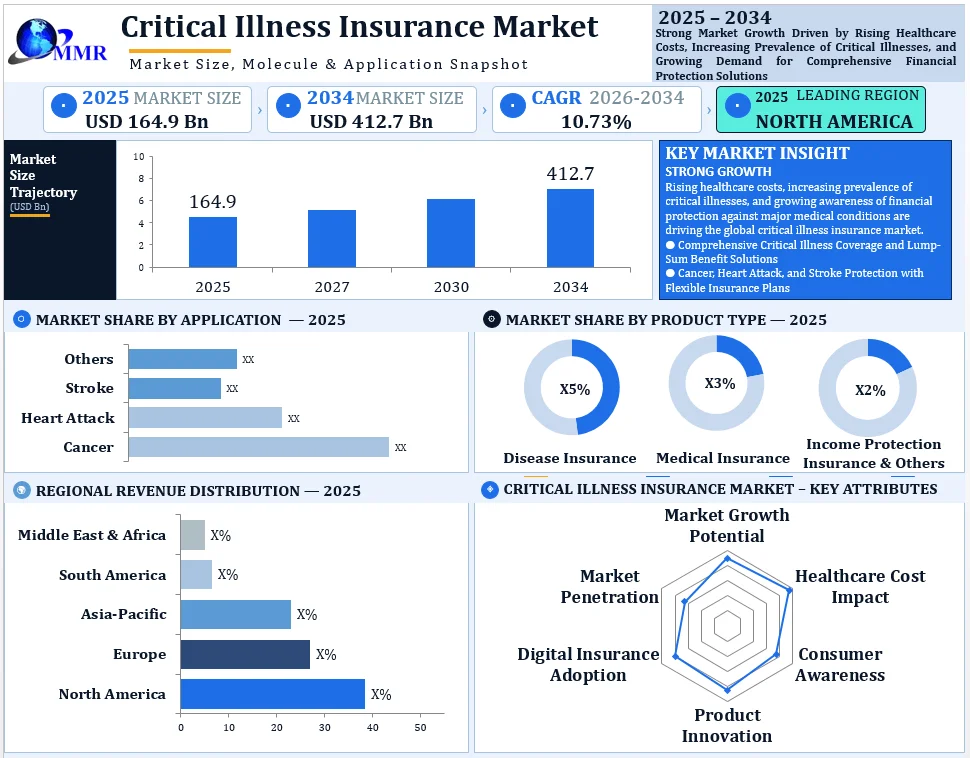
The Global Critical Illness Insurance Market was valued at USD 164.9 billion in 2025 and is projected to reach USD 412.7 billion by 2034, growing at a CAGR of 10.73% during the forecast period (2025–2034).
Critical Illness Insurance Market Overview:
Critical illness insurance provides financial protection for policyholders diagnosed with serious illnesses that could lead to significant medical expenses and long-term care requirements. This type of insurance typically covers a range of severe conditions such as heart attacks, strokes, cancer, kidney failure, and major organ transplants, among others. It is designed to alleviate the financial burden of such life-threatening health issues by providing a lump-sum payout upon diagnosis, which can be used for medical treatments, lifestyle adjustments, or any other expenses that may arise during recovery. The coverage usually depends on the specific ailments listed in the policy, with each insurer having different terms regarding what is covered and the necessary conditions for claims. Critical illness insurance is particularly important for individuals who are at higher risk of developing such diseases or for those without extensive health insurance coverage. It offers peace of mind by ensuring that the policyholder can focus on recovery without the added stress of financial constraints. The market for critical illness insurance has grown significantly in recent years due to rising awareness about the importance of protecting oneself against life-threatening diseases, along with increasing healthcare costs globally. As a result, more consumers are turning to critical illness insurance as a safety net to manage the financial risks associated with severe health conditions. This growth is further driven by insurers offering more flexible, customizable plans to cater to a diverse range of health risks.
Global Critical Illness Insurance Market Size, Growth and Share Analysis
To know about the Research Methodology :- Request Free Sample Report
Global Critical Illness Insurance Market: Key Highlights
• Market Growth: The global critical illness insurance market is valued at USD 164.9 billion in 2025 and is projected to reach USD 412.7 billion by 2034, registering a CAGR of 10.73% during the forecast period.
• Key Growth Drivers: Rising healthcare costs, increasing prevalence of critical illnesses, growing consumer awareness, and demand for financial protection against cancer, heart attacks, and strokes drive market growth.
• Dominant Region: North America dominates the global critical illness insurance market, supported by high healthcare expenditure, established insurance infrastructure, widespread availability of supplementary health coverage, and increasing demand for critical illness protection.
• Emerging Market Trends: Digital insurance platforms, AI-powered underwriting, personalized insurance products, flexible premium options, and multi-claim benefits are transforming the critical illness insurance market and improving customer accessibility.
• Competitive Landscape: The global critical illness insurance market features established players such as Aflac Incorporated, AIA Group Limited, Allianz SE, AXA Group, Aviva plc, Cigna Group, MetLife, Inc., Prudential plc, Sun Life Financial Inc., and Zurich Insurance Group, which focus on product innovation, digital distribution, expanded coverage, and strategic partnerships to strengthen their market positions.
Critical Illness Insurance Market Dynamics:
Global Critical Illness Insurance Market Driver: Rising Healthcare Costs
One of the primary drivers of the global critical illness insurance market is the rising cost of healthcare. Medical expenses associated with life-threatening conditions such as cancer, cardiovascular diseases, and strokes continue to increase, encouraging individuals to seek financial protection against unexpected healthcare costs. According to the World Health Organization (WHO), noncommunicable diseases account for approximately 41 million deaths annually, representing 74% of all deaths worldwide. This substantial disease burden highlights the importance of financial preparedness and supplementary insurance coverage. In North America, particularly in the United States, high treatment costs and out-of-pocket expenses strengthen the demand for critical illness insurance. These policies provide a lump-sum benefit upon the diagnosis of a covered condition, helping policyholders manage treatment expenses, rehabilitation, household bills, and income losses during recovery. As healthcare expenditure increases and the financial consequences of serious illnesses become more significant, critical illness insurance gains importance as a component of personal financial planning, supporting market growth.
Global Critical Illness Insurance Market Restraint: Low Market Penetration
Low market penetration remains a significant restraint in the global critical illness insurance market. Despite the growing need for financial protection against serious illnesses, many consumers remain unfamiliar with standalone critical illness policies or consider them an additional financial burden. According to the World Bank and the World Health Organization, out-of-pocket payments remain a substantial component of healthcare financing in many countries, highlighting the financial vulnerability of individuals who lack adequate protection. However, this financial pressure does not automatically translate into greater insurance adoption, particularly among low- and middle-income households. High premiums, limited disposable income, complex policy conditions, waiting periods, exclusions, and restrictions on pre-existing conditions discourage potential customers. Furthermore, consumers who already possess comprehensive health insurance may perceive critical illness coverage as unnecessary or overlapping with their existing benefits. These factors restrict customer acquisition, particularly in developing economies, and limit market expansion despite the increasing prevalence of serious health conditions.
Global Critical Illness Insurance Market Opportunity: Increased Consumer Awareness and Education
Increasing consumer awareness and financial literacy create significant growth opportunities for the critical illness insurance market. According to the World Health Organization, noncommunicable diseases cause approximately 41 million deaths annually, highlighting the widespread impact of serious health conditions and the importance of financial preparedness. Insurance providers increasingly focus on digital awareness campaigns, financial education initiatives, employer-sponsored insurance programs, and simplified policy information to communicate the benefits of critical illness coverage. The expansion of digital insurance distribution channels also enables providers to reach younger consumers and individuals in underserved markets. Online insurance platforms allow customers to compare premiums, evaluate covered illnesses, and purchase policies with greater convenience. Additionally, integrating critical illness coverage with life insurance, health insurance, and employee benefits packages creates opportunities to expand the customer base. As consumers become more aware of the financial risks associated with serious illnesses, demand for affordable, flexible, and comprehensive critical illness insurance products increases.
Global Critical Illness Insurance Market Challenge: High Premiums and Complex Policy Conditions
The critical illness insurance market faces challenges associated with affordability, policy complexity, and insurance risk assessment. Premiums generally vary according to factors such as age, medical history, smoking status, coverage amount, and the number of illnesses included in a policy. Consequently, older individuals and people with pre-existing health conditions often face higher premiums, coverage limitations, or difficulty obtaining suitable protection. Additionally, differences in the definitions of covered illnesses, survival periods, exclusions, and claim eligibility requirements create confusion among policyholders. For example, certain policies distinguish between stages or severities of cancer and cardiovascular conditions, which affects claim eligibility. These complexities reduce consumer confidence and increase the risk of disputes during the claims process. Insurers also balance competitive pricing with rising treatment costs and the financial risks associated with higher claims. Improving policy transparency, simplifying claim procedures, and introducing flexible coverage options remain important for addressing these challenges and supporting sustainable market growth.
Global Critical Illness Insurance Market Trend: Digitalization and Personalized Insurance Products
• Insurance providers increasingly use AI, data analytics, and digital platforms to simplify policy selection and claims processing.
• Online insurance platforms improve accessibility and allow customers to compare premiums and coverage options.
• Insurers offer customizable policies with flexible coverage amounts and illness-specific benefits.
• Wearable devices and digital health tools support the development of wellness-linked insurance products.
• Growing digital adoption improves customer engagement and expands insurance distribution channels.
Global Critical Illness Insurance Market Segment Analysis
Based on Product Type, Medical Insurance dominated the Critical Illness Insurance Market in 2025. Medical insurance policies are designed to cover the broad spectrum of medical expenses that arise when a policyholder is diagnosed with a life-threatening illness. These conditions, which can include cancer, heart attacks, strokes, and kidney failure, often require extensive medical treatments, hospitalizations, surgeries, and long-term care. As healthcare costs continue to rise globally, medical insurance offers a vital safety net by covering these expensive treatments. The widespread preference for medical insurance stems from its ability to provide comprehensive coverage for a wide range of health conditions. Additionally, many employers offer medical insurance as part of their benefits packages, increasing its accessibility and popularity among employees. The flexibility to cover various healthcare needs, combined with the increasing awareness of the importance of financial protection in the face of serious health issues, makes medical insurance the dominant product type in the market.
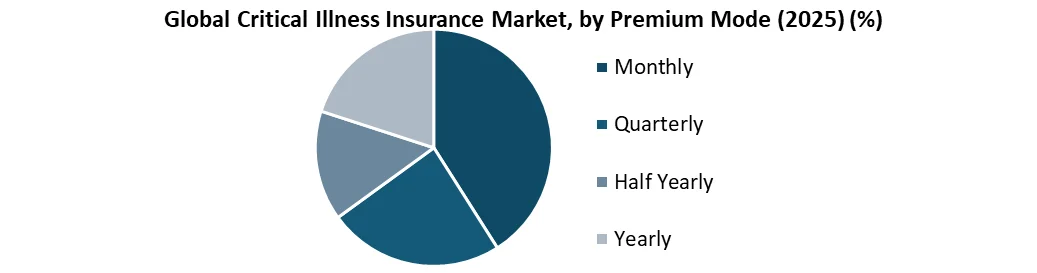
Based on Premium Mode, the Yearly Premium Mode is the most dominant in the Critical Illness Insurance market. Many policyholders prefer annual premium payments as they are often more cost-effective. Insurers commonly offer discounts for yearly payments, making this option attractive. Furthermore, paying premiums annually provides policyholders with the convenience of managing their financial commitments upfront, reducing the hassle of frequent payments. Annual premiums also enable insurers to maintain a consistent cash flow, helping them manage long-term policies. While monthly or quarterly payment plans are available, the yearly premium mode remains the preferred choice due to its financial efficiency and ease of budgeting.
Critical Illness Insurance Market Regional Insights:
North America dominates the global critical illness insurance market, driven by high healthcare costs, established insurance infrastructure, and growing demand for supplementary health coverage. The United States and Canada contribute to regional market growth through employer-sponsored insurance programs, increasing consumer awareness, and the availability of comprehensive critical illness insurance policies. The rising financial burden associated with cancer, cardiovascular diseases, and other life-threatening conditions encourages individuals to seek additional financial protection. Furthermore, established insurance providers, digital insurance platforms, and flexible policy offerings strengthen market adoption across the region.
Europe holds a significant share of the global critical illness insurance market, supported by established insurance providers, growing awareness of financial protection, and increasing demand for supplementary health coverage. Countries such as the United Kingdom, Germany, and France contribute to regional expansion through private insurance products and employer-sponsored benefits. The increasing prevalence of chronic diseases and demand for personalized insurance policies encourage insurers to introduce flexible coverage options. Additionally, digital policy management and simplified claims processing improve customer accessibility and support market growth.
Asia-Pacific represents a significant growth opportunity in the critical illness insurance market, driven by rising healthcare expenditure, expanding middle-class populations, and increasing awareness of financial protection against serious illnesses. China, India, Japan, and Australia contribute to regional demand through expanding insurance distribution networks and growing interest in supplementary health coverage. Increasing disposable incomes, digital insurance adoption, and improvements in healthcare accessibility encourage more consumers to consider critical illness insurance. Furthermore, insurance providers introduce affordable policies and customized coverage options to reach underserved populations, supporting regional market expansion.
South America experiences growing demand in the critical illness insurance market, driven by rising healthcare costs, increasing awareness of financial protection, and the expansion of private health insurance services. Brazil, Argentina, and Chile contribute to regional market growth through the increasing availability of critical illness insurance policies and supplementary health coverage. The growing burden of chronic diseases and demand for financial protection against expensive medical treatments encourage consumers to consider critical illness insurance. Additionally, digital insurance platforms, flexible premium options, and customized coverage plans improve policy accessibility and support market expansion across South America. However, affordability constraints and limited insurance penetration among certain population groups continue to influence market adoption.
The Middle East and Africa present emerging opportunities in the global critical illness insurance market, supported by expanding private healthcare services, increasing awareness of health-related financial risks, and gradual improvements in insurance accessibility. Countries such as the United Arab Emirates, Saudi Arabia, and South Africa contribute to regional demand through private insurance products and employer-sponsored coverage. The expansion of digital insurance services and the introduction of customized policies improve consumer access to critical illness protection. However, differences in insurance penetration, affordability, and consumer awareness influence market development across the region.
Global Critical Illness Insurance Market Competitive Landscape
The global critical illness insurance market features a competitive landscape comprising established insurance companies that focus on product innovation, expanded coverage options, digital distribution, and customer-centric insurance solutions. Key players include Aflac Incorporated, Allianz SE, AXA SA, Prudential plc, MetLife Inc., China Life Insurance Company Limited, Ping An Insurance, and Sun Life Financial Inc. These companies strengthen their market positions by offering coverage for critical illnesses such as cancer, heart attack, stroke, and major organ failure. Their strategies emphasize flexible policy structures, financial protection, and supplementary health insurance solutions to address evolving customer requirements.
The competitive landscape varies across major countries and regions. In the United States and Canada, Aflac, MetLife, and Sun Life focus on supplementary health insurance, employer-sponsored benefits, and financial protection against unexpected medical expenses. In Europe, Allianz, AXA, and Prudential plc strengthen their market presence through life insurance, critical illness protection, and flexible insurance products. In China, China Life Insurance and Ping An Insurance provide life insurance and health protection solutions that address growing demand for financial security. In India, Bajaj Allianz General Insurance and Tata AIG General Insurance offer health insurance products with critical illness coverage options. Across these markets, insurers prioritize digital policy distribution, simplified claims processing, customizable coverage, and improved customer accessibility to strengthen their competitive positions.
Furthermore, product innovation, digital transformation, strategic partnerships, and geographic expansion remain important competitive strategies in the critical illness insurance market. Insurance providers introduce flexible benefit structures, multiple-claim options, and broader illness coverage to meet diverse customer requirements. Digital platforms support customer acquisition and policy management, while partnerships with banks, employers, and insurance distributors expand market reach. Companies also focus on personalized insurance products and streamlined claims procedures to improve customer satisfaction and retention. These strategies enable established insurers and emerging providers to differentiate their offerings, strengthen their market positions, and capture growth opportunities across North America, Europe, Asia-Pacific, and South America.
Global Critical Illness Insurance Market: Key Companies by Region and Country
| REGION |
COUNTRY |
COMPANY
NAME / KEY PLAYER |
North
America |
United
States |
Aflac Incorporated |
| MetLife, Inc. |
| Unum Group |
| The Guardian Life Insurance Company of America |
| Chubb (Accident & Health Insurance) |
| Cigna Health and Life Insurance Company |
| The Hartford |
| Canada |
Sun Life Assurance Company of Canada |
| Manulife Financial Corporation |
| The Canada Life Assurance Company |
Industrial Alliance Insurance and Financial Services
Inc. (iA Financial Group) |
| Chubb Canada (Accident & Health Insurance) |
| Europe |
United
Kingdom |
Aviva plc |
| Legal & General Assurance Society Limited |
| The Royal London Mutual Insurance Society Limited |
| Zurich Assurance Ltd. |
| Ireland |
Zurich Life Assurance plc |
| Spain |
AXA Aurora Vida, S.A. de Seguros y Reaseguros |
Asia
Pacific |
China |
Ping An Life Insurance Company of China, Ltd. |
| Japan |
Nippon Life Insurance Company |
| Hong Kong |
AIA International Limited (AIA Hong Kong) |
| Manulife (International) Limited |
| Singapore |
Prudential Assurance Company Singapore (Pte)
Limited |
| Singapore Life Ltd. (Singlife) |
| HSBC Life (Singapore) Pte. Ltd. |
| AIA Singapore Private Limited |
| The Great Eastern Life Assurance Company Limited |
| Income Insurance Limited |
| Malaysia |
Great Eastern Life Assurance (Malaysia) Berhad |
| AIA General Berhad |
| India |
HDFC Life Insurance Company Limited |
| Axis Max Life Insurance Limited |
| ICICI Prudential Life Insurance Company Limited |
| Tata AIA Life Insurance Company Limited |
| Aditya Birla Sun Life Insurance Company Limited |
| Aditya Birla Health Insurance Company Limited |
| Australia |
TAL Life Limited |
| AIA Australia Limited |
| Zurich Australia Limited |
Middle
East & Africa |
United
Arab Emirates |
American Life Insurance Company (MetLife UAE) |
South
Africa |
Discovery Life Limited |
Momentum Metropolitan Life Limited (Momentum
Life) |
| Liberty Group Limited |
Old Mutual Life Assurance Company (South Africa)
Limited |
| Sanlam Life Insurance Limited |
South
America |
Brazil |
Porto Seguro Vida e Previdência S.A. |
| Bradesco Vida e Previdência S.A. |
Metropolitan Life Seguros e Previdência Privada
S.A. (MetLife Brasil) |
| Prudential do Brasil Seguros de Vida S.A. |
| Colombia |
Seguros de Vida Suramericana S.A. (SURA) |
| Chile |
MetLife Chile Seguros de Vida S.A. |
Global Critical Insurance Market Recent Developments
| Date |
Company |
Development |
Impact |
| January 8, 2026 |
Cigna Healthcare Hong Kong |
Launches VitalGuard Critical Illness
Plan, offering a lump-sum benefit for covered critical illnesses alongside
mental wellness support. |
Strengthens financial protection
offerings by combining critical illness coverage with additional wellness
support. |
| March 11, 2026 |
Prudential Singapore |
Introduces PRUActive Life V, a
customizable whole-life insurance plan with critical illness add-ons covering
up to 182 conditions. |
Expands flexible, long-term critical
illness protection and enables customers to tailor coverage to their needs. |
| March 18, 2026 |
Aviva |
Extends its AI-powered underwriting
summarization tool to individual critical illness applications that require
medical reports. |
Supports more efficient underwriting
processes and helps streamline the assessment of medical information. |
| April 10, 2026 |
Chubb Life Indonesia |
Introduces My Critical Illness
Protection, providing staged payouts for early-stage and advanced-stage
critical illnesses. |
Improves flexibility in financial
support by providing benefits at different stages of a covered illness. |
| April 13, 2026 |
AIA Philippines |
Launches AIA Critical Protect Plus,
offering coverage for multiple major critical illness claims and a range of
additional conditions through optional riders. |
Strengthens protection against
recurring critical illnesses and provides customers with more comprehensive
coverage options. |
| August 10, 2026 |
Allianz Life Malaysia |
Launches HealthCover Prime, featuring
multi-pay and recurrence benefits, along with coverage options for conditions
such as cancer. |
Enhances long-term financial
protection by supporting customers facing recurring illnesses and extended
recovery periods. |
| August 13, 2026 |
Chubb Life Hong Kong |
Introduces the Chubb Care Critical
Illness Series, with flexible payout options and coverage for a range of
minor and major critical illnesses. |
Broadens product choice and supports
differentiated coverage for customers with varying health protection needs. |
| September 24, 2026 |
Assurity |
Launches Quick Issue Critical Illness
Insurance, offering benefits ranging from USD 5,000 to USD 50,000 through a
simplified application process. |
Improves accessibility to
supplementary critical illness protection through simplified eligibility
questions and digital application processing. |
| October 5, 2026 |
Aviva Life Insurance India |
Announces a partnership with Wizz
Financial Group to expand access to life insurance and critical illness
protection through its distribution network. |
Broadens distribution reach and
creates additional channels for customers to access critical illness
insurance products. |
| October 16, 2026 |
Life Insurance Corporation of India (LIC) |
Announces new insurance offerings,
including Health Shield and New Cancer Cover, scheduled to become available
from October 19, 2026. |
Expands the range of health-related
financial protection options and strengthens access to coverage for serious
illnesses and cancer. |
| Critical Illness Insurance Market |
| Report Coverage |
Details |
| Base Year: |
2025 |
Forecast Period: |
2026-2034 |
| Historical Data: |
2020 to 2025 |
Market Size in 2025: |
164.9 USD Bn |
| Forecast Period 2026-2034 CAGR: |
10.73% |
Market Size in 2034: |
412.7 USD Bn |
| Segments Covered: |
by Product Type |
Disease Insurance
Medical Insurance
Income Protection Insurance
Others |
| by Premium Mode |
Monthly
Quarterly
Half Yearly
Yearly |
| by Application |
Cancer
Heart Attack
Stroke
Others |
| by End User |
Individual
Businesses |
Critical Illness Insurance Market, by Region
North America (United States, Canada, Mexico)
Europe (United Kingdom, France, Germany, Italy, Spain, Sweden, Russia, Poland, Belgium, Netherlands, Rest of Europe)
Asia Pacific (China, South Korea, India, Japan, Australia, Indonesia, Malaysia, Philippines, Thailand, Vietnam, Rest of Asia Pacific)
Middle East & Africa (South Africa, GCC, Egypt, Nigeria, Rest of MEA)
South America (Brazil, Argentina, Colombia, Chile, Rest of South America)
Frequently Asked Questions (FAQs) – Global Critical Illness Insurance Market
1. What is the global critical illness insurance market size in 2025?
Ans. global critical illness insurance market is valued at USD 164.9 billion in 2025 and is projected to reach USD 412.7 billion by 2034, growing at a CAGR of 10.73% during the forecast period (2026–2034).
2. What are the key factors driving the growth of the critical illness insurance market?
Ans. The growth of the critical illness insurance market is driven by rising healthcare costs, increasing incidences of cancer and cardiovascular diseases, growing awareness of financial protection, and rising demand for insurance products that cover expenses associated with serious illnesses.
3. Which region dominates the global critical illness insurance market?
Ans. North America dominates the global critical illness insurance market due to high awareness of insurance products, rising healthcare expenditure, established insurance providers, and increasing demand for financial protection against critical illnesses.
4. Who are the key players in the global critical illness insurance market?
Ans. Key players in the global critical illness insurance market include Aflac Incorporated, AIA Group Limited, Allianz SE, AXA Group, Aviva plc, Cigna Group, MetLife, Inc., Prudential plc, Sun Life Financial Inc., and Zurich Insurance Group.
5. What are the major trends in the global critical illness insurance market?
Ans. Major trends include the digitalization of insurance services, AI-enabled underwriting, personalized insurance plans, flexible benefit structures, multi-claim coverage, and the integration of wellness programs into critical illness insurance policies.
6. What are the major challenges facing the critical illness insurance market?
Ans. The major challenges include high insurance premiums, limited awareness in emerging markets, complex policy terms, exclusions for pre-existing conditions, and strict eligibility requirements. These factors can limit insurance adoption among price-sensitive consumers and individuals with existing health conditions.
