Compact E-Scooter Market Size by Product Type, Motor Power, Battery Type and Application

10.25%
CAGR (2026-2032)
45.17 USD Bn.
Market Size
313
Report Pages
145
Market Tables

Overview

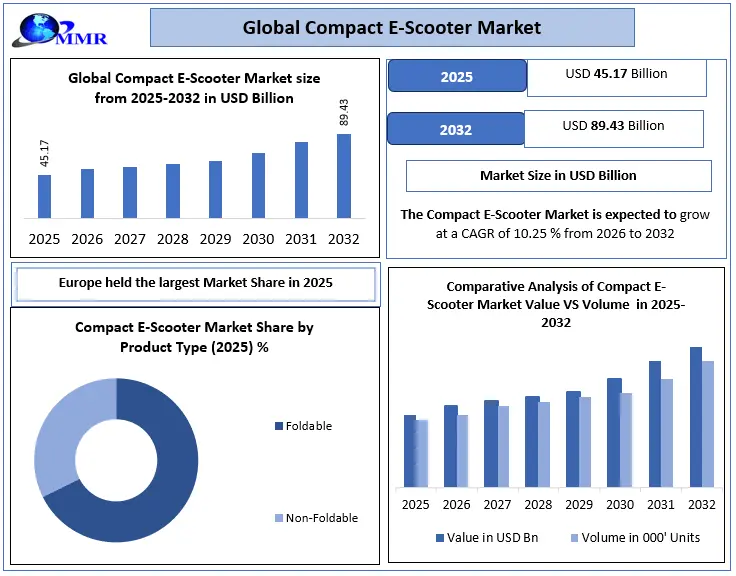
The Global Compact E-Scooter Market was valued at USD 45.17 Billion in 2025 and is projected to reach nearly USD 89.43 Billion by 2032, expanding at a CAGR of 10.25% during the forecast period from 2026 to 2032.

The global Compact E-Scooter Market has experienced significant growth over the 2020–2025 period, driven by rapid urbanisation, increasing traffic congestion, and the growing need for efficient, eco-friendly last-mile transportation solutions. With over 56% of the global population residing in urban areas (UN DESA, 2025), congested city streets and parking shortages have accelerated the adoption of compact e-scooters, particularly in densely populated countries such as India, the United States, Germany, France, and the United Kingdom. In India alone, over 1.2 million electric two-wheelers were registered in FY 2024-25, with compact e-scooters accounting for approximately 37% of these sales. North America saw a surge in shared e-scooter trips, increasing by 35% in 2024, while Europe’s e-scooter fleet grew by 28% during the same period.

Rapid urbanization, rising fuel costs, worsening traffic congestion, and growing environmental awareness are fundamentally reshaping urban mobility preferences across global cities. Consumers are increasingly shifting toward compact, lightweight, and energy-efficient transportation solutions that offer flexibility, affordability, and zero-emission commuting for short-distance travel. Compact e-scooters are rapidly emerging as one of the most preferred last-mile mobility solutions due to their foldable design, low operating costs, smartphone connectivity, and integration with smart-city transportation ecosystems. Against this backdrop, The lightweight, foldable design of compact e-scooters, combined with cost-effective ownership and zero tailpipe emissions, positions them as a preferred choice for urban commuters. These scooters effectively bridge the gap between public transit and final destinations, addressing around 40% of urban trips that are less than 5 km.

Compact E-Scooter Market Key Market Highlights

• The average compact e-scooter trip length ranges from 3 to 4.5 kilometres, primarily serving last-mile connectivity.
• The foldable models segment dominated the largest Compact E-Scooter Market share in 2025, due to their portability and ease of storage, especially among urban commuters.
• Shared micromobility accounted for 60% of total e-scooter trips in urban areas globally, though private ownership is growing, particularly in the Asia-Pacific, with a 12% annual growth rate in 2025.
• Compact e-scooters produce 35-67 g CO2 per km, significantly lower than petrol cars, which emit 200-350 g CO2 per km.
Compact E-Scooter Market Size
To know about the Research Methodology :- Request Free Sample Report

Compact E-Scooter Market Dynamics: Drivers, Penetration, and Opportunities

Increase in Urban Penetration and Demand to Drive the Compact E-Scooter Market Growth

Urbanisation and rising traffic congestion are key drivers behind compact e-scooter adoption and driving the Compact E-Scooter Market growth. Over 69% of car trips in urban areas under 3 miles, compact e-scooters have penetrated city transport networks rapidly. In North America and Europe, shared micromobility rides were to exceed 250 million trips monthly by 2025, reflecting a growing consumer shift from cars to e-scooters.

Rising Urban Congestion and Growing Demand for Sustainable Last-Mile Mobility Solutions to Drive the Compact E-Scooter Market Growth

Increasing urban population density, worsening traffic congestion, and rising fuel prices are significantly accelerating demand for compact electric mobility solutions worldwide. Compact e-scooters are emerging as highly efficient alternatives for short-distance urban travel due to their portability, lower operational costs, reduced parking requirements, and zero tailpipe emissions.

Governments across Europe, North America, and Asia-Pacific are increasingly promoting electric micromobility solutions through subsidies, low-emission urban transportation policies, and smart-city development initiatives aimed at reducing transportation-related carbon emissions. Integration with public transportation systems and shared mobility platforms is further supporting widespread adoption of compact e-scooters globally.

Compact E-Scooter Market Growth Drivers

• Traffic Congestion & Last-Mile Connectivity: The ability to cover short distances quickly and flexibly appeals to urban commuters. For example, in the UK, 58% of car trips are less than 5 miles, making e-scooters ideal alternatives.
• Environmental Concerns: Global governments strive to reduce transportation emissions by 30-40% by 2030, with e-scooters’ zero tailpipe emissions playing a pivotal role.
• Technological Advances: Annual improvements of nearly 7% in lithium-ion battery efficiency and the integration of IoT features such as GPS tracking and anti-theft systems enhance usability and safety.

Compact E-Scooter Market Restraints
Compact E-Scooter Market Restraints

Compact E-Scooter Market Opportunities

• Public Transit Integration: In 2025, Over 65% of e-scooter trips start or end near transit stations in major metropolitan areas, presenting opportunities for multimodal travel solutions.
• Data-Driven Urban Planning: Cities increasingly mandate operator data sharing to optimise e-scooter deployment and ensure harmonious integration into transport networks.

Compact E-Scooter Penetration rate by CountryCompact E-Scooter Market Segment Analysis

By Battery Type: Lithium-Ion batteries dominated the Compact E-Scooter Market share in 2025. Their lightweight design, high capacity, and fast charging offering range of up to 36 km. Lead-Acid batteries, though heavier and less efficient, are the entry-level segment by affordability. Nickel-Metal Hydride batteries accounted for a niche role, especially in hybrid models, with ongoing performance improvements.Compact E-Scooter Market by Battery Type

Compact E-Scooter Market Regional Analysis

Europe dominated the Compact E-Scooter Market in 2025 owing to strong regulatory frameworks supporting electric mobility, increasing investments in sustainable urban transportation infrastructure, and rapid adoption of shared micromobility solutions across Germany, France, Spain, and the United Kingdom. Governments are increasingly implementing low-emission urban transportation policies and expanding dedicated micromobility infrastructure to reduce traffic congestion and transportation-related emissions.

Asia-Pacific is projected to witness the fastest growth during the forecast period due to rapid urbanization, rising disposable income levels, strong government EV subsidy programs, and increasing private ownership of compact electric scooters across China, India, Japan, and Southeast Asia. Expanding battery manufacturing capabilities and cost-efficient production ecosystems are further strengthening regional market growth.

North America continues to represent a significant market supported by rising adoption of shared mobility services, investments in smart-city projects, and increasing focus on reducing urban transportation emissions across the United States and Canada. Strong consumer demand for connected and app-enabled mobility solutions is also accelerating regional market penetration.

Compact E-Scooter Market Competitive Landscape

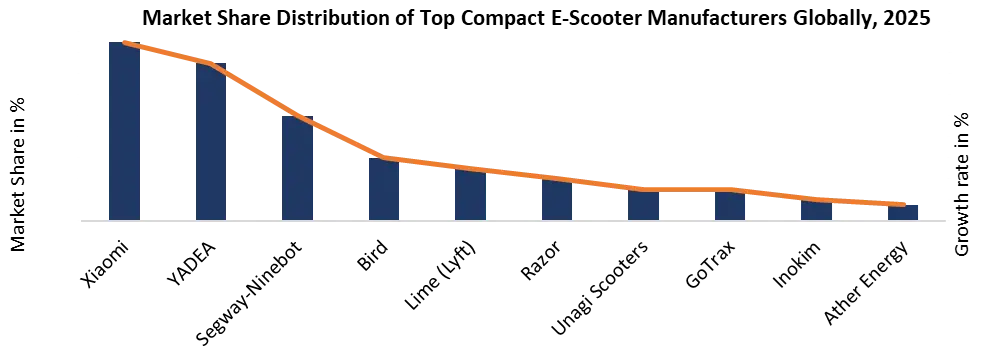
Organised global and regional brands accounted for the majority of market revenue in 2025, while local unorganized manufacturers continue to maintain a strong presence in price-sensitive emerging economies through low-cost product offerings and regional distribution networks.

Leading manufacturers operating in the Compact E-Scooter Market are increasingly focusing on battery efficiency enhancement, lightweight chassis engineering, IoT-enabled fleet management systems, AI-powered safety technologies, and expansion of shared mobility ecosystems to strengthen competitive positioning. Companies are aggressively investing in fast-charging technologies, battery swapping infrastructure, connected mobility applications, and strategic partnerships with urban transportation authorities to accelerate long-term market penetration globally.
Compact E-Scooter manufacturers

Compact E-Scooter Market Scope: Inquire before buying

Compact E-Scooter Market
Report Coverage Details
Base Year: 2025 Forecast Period: 2026-2032
Historical Data: 2020 to 2025 Market Size in 2025: USD 45.17 Bn.
Forecast Period 2026 to 2032 CAGR: 10.25% Market Size in 2032: USD 89.43 Bn.
Segments Covered: by Product Type Foldable
Non-Foldable
by Motor Power > 250W
250-500W
< 500W
by Battery Type Lead-acid Batteries
Lithium-Ion Batteries
Nickel-Metal Hydride Batteries
by Speed / Power Low-Speed (Under ~25 km/h)
High-Speed (Above ~25 km/h)
by Sales Channel Direct Sales
Indirect Sales
 Retailers
 Dealers
 Online
by Application Urban Commuting
Last-Mile Delivery
Recreational Use
Others

Compact E-Scooter Market, by region

North America (United States, Canada and Mexico)
Europe (UK, France, Germany, Italy, Spain, Sweden, Austria and Rest of Europe)
Asia Pacific (China, South Korea, Japan, India, Australia, and Rest of APAC)
South America (Brazil, Argentina, Rest of South America)
Middle East & Africa (South Africa, GCC, and Rest of ME&A)

Compact E-Scooter Key Players

1. Segway-Ninebot
2. Xiaomi Corporation
3. Unagi Scooters
4. Gogoro Inc.
5. NIU Technologies
6. Bird Rides, Inc.
7. Lime (Neutron Holdings, Inc.)
8. Razor USA LLC
9. Inokim
10. Okai Inc.
11. Micro Mobility Systems AG
12. Swagtron
13. Apollo Scooters
14. Glion Dolly
15. Hiboy
16. Gotrax
17. E-TWOW
18. EcoReco / EcoReco Tech
19. Kaabo (Dualtron/Minimotors)
20. Jetson Electric Bikes
21. SoFlow AG
22. Honda Motor Company
23. Yamaha Motor Company
24. Hero Electric Vehicles Pvt. Ltd.
25. Ola Electric
26. Others

Frequently Asked Questions:

1: What is the size of the global Compact E-Scooter Market?
Ans: The Compact E-Scooter Market was valued at USD 45.17 billion in 2025 and is projected to reach USD 89.43 billion by 2032, growing at a CAGR of 10.25% (2026–2032) due to rising urban mobility demand.

2: What are the key trends in the Compact E-Scooter Market?
Ans: Key trends include dominance of foldable e-scooters, 60% share of shared micromobility trips, rapid private ownership growth in Asia-Pacific and rising adoption of IoT-enabled smart e-scooters.

3: Which region leads the Compact E-Scooter Market?
Ans: Europe led the Compact E-Scooter Market in 2025, supported by strong regulations and urban infrastructure, while Asia-Pacific is the fastest-growing region, driven by subsidies and rising private ownership in India and China.

4: What factors are driving the Compact E-Scooter Market growth?
Ans: Growth is driven by traffic congestion, last-mile connectivity needs, government EV incentives, and low carbon emissions (35–67 g CO₂/km) compared to petrol vehicles.

5: Who are the key players in the Compact E-Scooter Market?
Ans: Major players include Segway-Ninebot, Xiaomi, NIU Technologies, Gogoro, Razor, Bird, Lime, Ola Electric, and Hero Electric, collectively holding around 65% of global market value.

Table of Contents

1. Compact E-Scooter Market Introduction 1.1. Study Assumption and Market Definition 1.2. Scope of the Study 1.3. Executive Summary 2. Global Compact E-Scooter Market: Competitive Landscape 2.1. MMR Competition Matrix 2.2. Key Players Benchmarking 2.2.1. Company Name 2.2.2. Headquarter 2.2.3. Product Segment 2.2.4. End-User Segment 2.2.5. Revenue Details in 2024 2.2.6. Market Share (%) 2.2.7. Growth Rate (%) 2.2.8. R and D Investment (%) 2.2.9. Technological Capabilities 2.2.10. Geographical Presence 2.3. Market Structure 2.3.1. Market Leaders 2.3.2. Market Followers 2.3.3. Emerging Players 2.4. Global vs. Regional Players Comparative Analysis 2.4.1. Dominance of Global Compact E-Scooter Manufacturers 2.4.2. Regional and Emerging Players in Key Markets 2.4.3. Differentiation by Product Design, Portability, and Range Efficiency 2.4.4. Pricing Strategy vs. Performance and Urban Mobility Needs 2.4.5. Strategic Positioning by Geography (Asia-Pacific, Europe, North America, Latin America) 2.5. Market Share & Positioning by Segment (2025) 2.6. Mergers and Acquisitions Details 3. Compact E-Scooter Market: Dynamics 3.1. Compact E-Scooter Market Trends 3.2. Compact E-Scooter Market Dynamics 3.2.1. Drivers 3.2.2. Restraints 3.2.3. Opportunities 3.2.4. Challenges 3.3. PORTER’s Five Forces Analysis 3.4. PESTLE Analysis 3.5. Regulatory Landscape by Region 3.6. Key Opinion Leader Analysis for the Global Industry 3.7. Analysis of Government Schemes and Initiatives for Industry 4. Technological Innovations and Advancements in Compact E-Scooters 4.1. Integration of Smart Connectivity, GPS, and IoT Features 4.2. Battery Technology Advances (Solid-State, Fast Charging, Battery Swapping) 4.3. Lightweight Materials and Foldable Chassis Innovations 4.4. Energy-Efficient Motors and Regenerative Braking Systems 4.5. AI-Driven Safety Features and Anti-Theft Systems 4.6. Use of Sustainable and Recyclable Materials 5. Import-Export and Trade Analysis (2025) 5.1. Top Exporting Countries of Compact E-Scooters and Components 5.2. Leading Importing Countries and Regional Trade Flows 5.3. Impact of Tariff Policies and Trade Regulations on Market Dynamics 5.4. Localization Initiatives and Government Incentives for Manufacturing 6. Price Trend Analysis by Region (2020-2025) 6.1. Historical and Current Price Trends by Model Type and Battery Technology 6.2. Regional Price Comparison (China, Europe, North America, India) 6.3. OEM vs. Aftermarket Pricing and Cost Components 6.4. Factors Influencing Price Volatility (Battery Raw Materials, Labor Costs, Policy) 6.5. Price Breakdown: Motor, Battery Pack, Frame, Electronics 7. Consumer Behavior Analysis 7.1. Preferences for Portability, Battery Range, and Affordability 7.2. Growing Demand for Eco-Friendly and Convenient Urban Mobility 7.3. Usage Frequency by Age Group, Income, and Purpose (Commuting, Leisure) 7.4. Impact of Urbanization and Lifestyle Shifts 7.5. Influence of Mobile Apps and Digital Platforms in Purchase Decisions 8. Buyer & End-User Analysis 8.1. End-User Segmentation: Individual Consumers, Corporate Fleets, Rental Operators 8.2. Consumer Preferences on Pricing, Range, and Charging Convenience 8.3. Trends in Fleet Adoption and Leasing Models for Shared Mobility 8.4. Maintenance and Service Preferences: OEM vs. Third-Party Providers 8.5. Digital Sales Channels and Subscription Models 9. Funding, Investment & Innovation Infrastructure 9.1. R&D Spending by Leading Compact E-Scooter Manufacturers 9.2. Venture Capital and Strategic Partnerships in the E-Mobility Sector 9.3. Innovation Clusters and Manufacturing Hubs (China, Europe, India) 9.4. Government Support, Subsidies, and Pilot Urban Mobility Programs 9.5. Collaborations and Public-Private Partnerships Accelerating Electrification 10. Supply Chain Analysis 10.1. Key Components and Raw Materials (Battery Cells, Motors, Controllers, Frames) 10.2. OEMs, Component Suppliers, and Assembly Units 10.3. Distribution Network: Retailers, E-Commerce, and B2B Fleets 10.4. Value Chain Overview – From Component Sourcing to End-User Delivery 10.5. Supporting Services: Charging Infrastructure, Maintenance, Upgrades 11. Compact E-Scooter Market: Global Market Size and Forecast by Segmentation (by Value in USD Billion and Volume in 000’ Units) (2025-2032) 11.1. Compact E-Scooter Market Size and Forecast, By Product Type (2025-2032) 11.1.1. Foldable 11.1.2. Non-Foldable 11.2. Compact E-Scooter Market Size and Forecast, By Motor Power (2025-2032) 11.2.1. > 250W 11.2.2. 250-500W 11.2.3. < 500W 11.3. Compact E-Scooter Market Size and Forecast, By Battery Type (2025-2032) 11.3.1. Lead-acid Batteries 11.3.2. Lithium-Ion Batteries 11.3.3. Nickel-Metal Hydride Batteries 11.4. Compact E-Scooter Market Size and Forecast, By Speed / Power (2025-2032) 11.4.1. Low-Speed (Under ~25 km/h) 11.4.2. High-Speed (Above ~25 km/h) 11.5. Compact E-Scooter Market Size and Forecast, By Sales Channel (2025-2032) 11.5.1. Direct Sales 11.5.2. Indirect Sales 11.5.2.1. Retailers 11.5.2.2. Dealers 11.5.2.3. Online 11.6. Compact E-Scooter Market Size and Forecast, By Speed / Power (2025-2032) 11.6.1. Urban Commuting 11.6.2. Last-Mile Delivery 11.6.3. Recreational Use 11.6.4. Others 11.7. Compact E-Scooter Market Size and Forecast, By Region (2025-2032) 11.7.1. North America 11.7.2. Europe 11.7.3. Asia Pacific 11.7.4. Middle East and Africa 11.7.5. South America 12. North America Compact E-Scooter Market Size and Forecast by Segmentation (by Value in USD Billion and Volume in 000’ Units) (2025-2032) 12.1. North America Compact E-Scooter Market Size and Forecast, By Product Type (2025-2032) 12.1.1. Foldable 12.1.2. Non-Foldable 12.2. North America Compact E-Scooter Market Size and Forecast, By Motor Power (2025-2032) 12.2.1. > 250W 12.2.2. 250-500W 12.2.3. < 500W 12.3. North America Compact E-Scooter Market Size and Forecast, By Battery Type (2025-2032) 12.3.1. Lead-acid Batteries 12.3.2. Lithium-Ion Batteries 12.3.3. Nickel-Metal Hydride Batteries 12.4. North America Compact E-Scooter Market Size and Forecast, By Speed / Power (2025-2032) 12.4.1. Low-Speed (Under ~25 km/h) 12.4.2. High-Speed (Above ~25 km/h) 12.5. North America Compact E-Scooter Market Size and Forecast, By Sales Channel (2025-2032) 12.5.1. Direct Sales 12.5.2. Indirect Sales 12.5.2.1. Retailers 12.5.2.2. Dealers 12.5.2.3. Online 12.6. North America Compact E-Scooter Market Size and Forecast, By Speed / Power (2025-2032) 12.6.1. Urban Commuting 12.6.2. Last-Mile Delivery 12.6.3. Recreational Use 12.6.4. Others 12.7. North America Compact E-Scooter Market Size and Forecast, by Country (2025-2032) 12.7.1. United States 12.7.2. Canada 12.7.3. Mexico 13. Europe Compact E-Scooter Market Size and Forecast by Segmentation (by Value in USD Billion and Volume in 000’ Units) (2025-2032) 13.1. Europe Compact E-Scooter Market Size and Forecast, By Product Type (2025-2032) 13.2. Europe Compact E-Scooter Market Size and Forecast, By Motor Power (2025-2032) 13.3. Europe Compact E-Scooter Market Size and Forecast, By Battery Type (2025-2032) 13.4. Europe Compact E-Scooter Market Size and Forecast, By Speed / Power (2025-2032) 13.5. Europe Compact E-Scooter Market Size and Forecast, By Sales Channel (2025-2032) 13.6. Europe Compact E-Scooter Market Size and Forecast, By Application (2025-2032) 13.7. Europe Compact E-Scooter Market Size and Forecast, by Country (2025-2032) 13.7.1. United Kingdom 13.7.2. France 13.7.3. Germany 13.7.4. Italy 13.7.5. Spain 13.7.6. Sweden 13.7.7. Russia 13.7.8. Rest of Europe 14. Asia Pacific Compact E-Scooter Market Size and Forecast by Segmentation (by Value in USD Billion and Volume in 000’ Units) (2025-2032) 14.1. Asia Pacific Compact E-Scooter Market Size and Forecast, By Product Type (2025-2032) 14.2. Asia Pacific Compact E-Scooter Market Size and Forecast, By Motor Power (2025-2032) 14.3. Asia Pacific Compact E-Scooter Market Size and Forecast, By Battery Type (2025-2032) 14.4. Asia Pacific Compact E-Scooter Market Size and Forecast, By Speed / Power (2025-2032) 14.5. Asia Pacific Compact E-Scooter Market Size and Forecast, By Sales Channel (2025-2032) 14.6. Asia Pacific Compact E-Scooter Market Size and Forecast, By Application (2025-2032) 14.7. Asia Pacific Compact E-Scooter Market Size and Forecast, by Country (2025-2032) 14.7.1. China 14.7.2. S Korea 14.7.3. Japan 14.7.4. India 14.7.5. Australia 14.7.6. Indonesia 14.7.7. Malaysia 14.7.8. Philippines 14.7.9. Thailand 14.7.10. Vietnam 14.7.11. Rest of Asia Pacific 15. Middle East and Africa Compact E-Scooter Market Size and Forecast (by Value in USD Billion and Volume in 000’ Units) (2024-2032 15.1. Middle East and Africa Compact E-Scooter Market Size and Forecast, By Product Type (2025-2032) 15.2. Middle East and Africa Compact E-Scooter Market Size and Forecast, By Motor Power (2025-2032) 15.3. Middle East and Africa Compact E-Scooter Market Size and Forecast, By Battery Type (2025-2032) 15.4. Middle East and Africa Compact E-Scooter Market Size and Forecast, By Speed / Power (2025-2032) 15.5. Middle East and Africa Compact E-Scooter Market Size and Forecast, By Sales Channel (2025-2032) 15.6. Middle East and Africa Compact E-Scooter Market Size and Forecast, By Application (2025-2032) 15.7. Middle East and Africa Compact E-Scooter Market Size and Forecast, by Country (2025-2032) 15.7.1. South Africa 15.7.2. GCC 15.7.3. Egypt 15.7.4. Nigeria 15.7.5. Rest of ME&A 16. South America Compact E-Scooter Market Size and Forecast by Segmentation (by Value in USD Billion and Volume in 000’ Units) (2025-2032) 16.1. South America Compact E-Scooter Market Size and Forecast, By Product Type (2025-2032) 16.2. South America Compact E-Scooter Market Size and Forecast, By Motor Power (2025-2032) 16.3. South America Compact E-Scooter Market Size and Forecast, By Battery Type (2025-2032) 16.4. South America Compact E-Scooter Market Size and Forecast, By Speed / Power (2025-2032) 16.5. South America Compact E-Scooter Market Size and Forecast, By Sales Channel (2025-2032) 16.6. South America Compact E-Scooter Market Size and Forecast, By Application (2025-2032) 16.7. South America Compact E-Scooter Market Size and Forecast, by Country (2025-2032) 16.7.1. Brazil 16.7.2. Argentina 16.7.3. Colombia 16.7.4. Chile 16.7.5. Rest Of South America 17. Company Profile: Key Players 17.1. Segway-Ninebot 17.1.1. Company Overview 17.1.2. Business Portfolio 17.1.3. Financial Overview 17.1.4. SWOT Analysis 17.1.5. Strategic Analysis 17.1.6. Recent Development 17.2. Xiaomi Corporation 17.3. Unagi Scooters 17.4. Gogoro Inc. 17.5. NIU Technologies 17.6. Bird Rides, Inc. 17.7. Lime (Neutron Holdings, Inc.) 17.8. Razor USA LLC 17.9. Inokim 17.10. Okai Inc. 17.11. Micro Mobility Systems AG 17.12. Swagtron 17.13. Apollo Scooters 17.14. Glion Dolly 17.15. Hiboy 17.16. Gotrax 17.17. E-TWOW 17.18. EcoReco / EcoReco Tech 17.19. Kaabo (Dualtron/Minimotors) 17.20. Jetson Electric Bikes 17.21. SoFlow AG 17.22. Honda Motor Company 17.23. Yamaha Motor Company 17.24. Hero Electric Vehicles Pvt. Ltd. 17.25. Ola Electric 17.26. Others 18. Key Findings 19. Analyst Recommendations 20. Compact E-Scooter Market: Research Methodology

Custom Market Research Services

We Will Customise The Research For You, In Case The Report Listed Above Does Not Meet With Your Requirements